Month: June 2022

  • Caribbean Trade and Development News Digest – June 19-25, 2022

    Caribbean Trade and Development News Digest – June 19-25, 2022

    Welcome to our Caribbean Trade and Development News Digest covering the week of June 19-25, 2022! We are pleased to bring you the major trade and development news headlines and analysis from across the Caribbean Region and the world from the past week. We do hope you enjoy this week’s edition!

    THIS WEEK’S HIGHLIGHTS

    This week Commonwealth Heads of Government met for the first time physically in four years in Kigali, Rwanda under the theme “Delivering a Common Future: Connecting, Innovating, Transforming”. They voted, albeit by a narrow margin, in favour of a second term for incumbent Secretary General Baroness Patricia Scotland. The final communique, leaders’ statement and other declarations can be accessed here.

    UNCTAD has released a study on COVID-19 and trade and development, as well as the lessons learnt. Have a read of the report here. An agreement in principle was reached on a modernised Energy Charter Treaty.

    So what’s happening this coming week? Leaders of the Group of 7 (G7) countries are currently meeting in Germany and have so far announced a ban on the importation of Russian gold as part of a tightening of sanctions against Russian aggression in Ukraine. On June 29th, the Trade Facilitation Agreement, the first major multilateral trade agreement agreed by WTO members, celebrates its fifth year anniversary.

    This week I had the pleasure and honour of being a speaker at the Institute of Chartered Accountants of the Caribbean (ICAC) 39th Annual Conference speaking on the topic “COVID-19 and Businesses: Reflections, Impact and Options“. Read my latest blog article based on my presentation here.

    REGIONAL NEWS

    Belize Chamber BCCI President says Trade License Bill in current form is flawed

    LoveFM: The Government of Belize has put its plan for national trade license reform on hold. This came after several sectors of society, including artists and DJs, complained that the proposed legislation was unfair and badly timed. Read more

    China-Guyana, Bilateral Trade Increased To US$710 Million Last Year

    MENAFN: China’s Ambassador to Guyana, Guo Haiyan, said Monday, that bilateral trade between Guyana and China has grown steadily in recent years, increasing to some US $710 million in 2021 compared to US $500 million during the previous years. Read more

    Guyana local agro-processors to engage Antiguan buyers

    Newsroom: Between 40 to 50 small agro-processors are expected to travel to Antigua soon to engage buyers, Vice President of the Guyana Manufacturing and Services Association (GMSA) Ramsay Ali has told the News Room. Read more

    Bajans spent millions on Guyanese products at Agrofest

    Newsroom: There was an overwhelming interest in the locally-made products at the recently concluded agro-fest in Barbados and Head of the Guyana Manufacturing and Services Association (GMSA) Rafeek Khan said that there is now a revitalised interest in improving transportation between the two countries. Read more

    Britain thanks Windrush Caribbean migrants for their contribution to the UK

    Caribbean National Weekly: Britain Wednesday paid tribute to Windrush Caribbean immigrants by unveiling a national monument to celebrate their work in rebuilding the country after World War II. Read more

    UN SG to attend CARICOM Conference

    Prensa Latina: The UN Secretary General, António Guterres, will travel next Friday to Paramaribo, Suriname, to participate in the conference of heads of government of the Caribbean Community (Caricom), they announced the eve. Read more

    Barbados opens CARICOM diplomatic mission in Kenya

    Caribbean National Weekly: Barbados Foreign Affairs and Foreign Trade Minister, Dr. Jerome Walcott, has officially opened the Caribbean Community (CARICOM) diplomatic mission in Nairobi making it the first for the 15-member regional integration movement on the African continent. Read more

    Jamaica Tourism Minister Suggests Single-Visa Regime For CARICOM

    JIS: Tourism Minister, Hon. Edmund Bartlett, says a single-visa regime among CARICOM member countries should be the next critical consideration in rationalising entry protocols in the region. Read more

    Beyond CARICOM, Guyana registers hemispheric support for threats to food security

    Newsroom: Guyana is leading an aggressive food security agenda within the Caribbean Community (CARICOM)- a 15-member bloc of Caribbean states, but amid growing concerns of food shortages, the country has backed similar efforts in the wider Americas. Read more

    Cayman Islands Minister contemplating trade with Costa Rica, Belize and Honduras

    LoopCayman: This scenario could change, however, as the Minister for Agriculture, Jay Ebanks, now has his eyes set on trading with more neighbours in the region, in particular, Honduras, Belize, Costa Rica and possibly Cuba. Read more

    INTERNATIONAL NEWS

    EU, UK win carve-out in Energy Charter Deal

    Euractiv: Investments in new fossil fuel projects will no longer enjoy legal protection on EU and UK territories under a deal reached on Friday (24 June) to reform the 1994 Energy Charter Treaty. Read more

    Commission unveils new approach to trade agreements to promote green and just growth

    European Commission: In its Communication on “The power of trade partnerships: together for green and just economic growth”, the Commission is putting forward how to further strengthen the implementation and enforcement of Trade and Sustainable Development (TSD) chapters of the EU’s trade agreements. Read more

    Food security: EU to step up its support to African, Caribbean and Pacific countries in response to Russia’s invasion of Ukraine

    European Commission: The European Commission adopted today a proposal to mobilise €600 million from the reserves of the European Development Fund to address the current food security crisis aggravated by Russia’s invasion of Ukraine. These funds will support African, Caribbean and Pacific (ACP) countries to cope with the dire situation, through humanitarian assistance (€150 million), sustainable production and resilience of food systems (€350 million) and macro-economic support (€100 million). Read more

    India, European Union resume talks for free trade agreement after over eight years

    The Hindu: India and the European Union (EU) finally restarted the negotiations for the long-pending trade and investment agreement on Friday after a gap of over eight years. Read more

    UK PM announces major trade initiatives to capitalise on Commonwealth Advantage

    Gov.uk: The Prime Minister will announce a raft of new trade and investment initiatives to create jobs, growth and shared prosperity across the Commonwealth. Read more

    UK appoints new trade commissioner to lead UK-Africa trade and investment relationship

    Gov.uk: International Trade Secretary Anne-Marie Trevelyan has appointed John Humphrey as Her Majesty’s Trade Commissioner (HMTC) to Africa. Read more

    Intra-Commonwealth trade to grow to $20 trillion in five years

    The New Times: British Prime Minister Boris Johnson has commended the benefits from existing ties between Commonwealth countries and pointed out that intra-trade within the community is expected to grow by 50% to $19.5 trillion in the next five years. Read more

    Rwanda: SG Launches Digital Trade Hackathon

    AllAfrica: The Commonwealth Digital Trade Hackathon was launched Tuesday, June 21, at the end of the Commonwealth Youth Forum (CYF) in Kigali. Read more

    USTR Tai calls U.S. tariffs on Chinese goods ‘significant’ leverage

    Reuters: U.S. Trade Representative Katherine Tai on Wednesday said that she views tariffs on Chinese goods as “a significant piece of leverage” in the U.S.-China trade relationship and removing them would likely have a limited effect on controlling short-term inflation. Read more

    US Farmers Welcome Indo-Pacific Economic Framework

    Voice of America: Before the 2016 presidential election, Illinois farmer Brian Duncan looked to the Trans-Pacific Partnership (TPP) trade agreement between the United States and Asian countries, to boost demand for his crops, and in particular, prices for the thousands of hogs he raises annually. Read more

    Russia and China are brewing up a challenge to dollar dominance by creating a new reserve currency

    Business Insider: Russia is ready to develop a new global reserve currency alongside China and other BRICS nations, in a potential challenge to the dominance of the US dollar. Read more

    In unstable times, Jacinda Ardern hopes European powers can avert further crises

    Stuff.co.nz: New Zealand Prime Minister Jacinda Ardern will look to lock in a free trade agreement and push Western leaders to reduce the impacts of climate change in the Pacific in a series of meetings across Europe this week. Read more

    STRAIGHT FROM THE WTO

    NEW ON THE CTLD BLOG

    The Caribbean Trade & Development Digest is a weekly trade news digest produced and published by the Caribbean Trade Law & Development Blog. Liked this issue? To read past issues, please visit here. To receive these mailings directly to your inbox, please subscribe to our Blog below:

    ← Back

    Thank you for your response. ✨

  • COVID-19 and MSMEs: Two and a half years on

    COVID-19 and MSMEs: Two and a half years on

    Alicia Nicholls

    Shortly after the World Health Organisation (WHO) declared the novel coronavirus disease (COVID-19) a pandemic in March 2020, I had authored a blog piece about the outbreak’s possible impact on micro, small and medium-sized enterprises (MSMEs). I had also posited some options for MSMEs to help weather the COVID-19 storm. On June 23, I had the honour and pleasure of presenting on the topic “COVID-19 and Business: Reflection, Impact and Options” at the 39th Annual Conference of the Institute of Chartered Accountants of the Caribbean (ICAC). It is in this vein, and in recognition of the upcoming United Nations’ MSME Day on June 27th, that this ‘update’ article reflects on the impact of the COVID-19 pandemic on MSMEs two years on. Specifically, it discusses how businesses have pivoted and proposes some further options for weathering these increasingly turbulent economic headwinds.

    Setting the context

    The first confirmed COVID-19 case in a Caribbean Community (CARICOM) Member State was in Jamaica on March 10, 2020. Since then Caribbean countries, like other countries around the world, have undergone at least four or five waves of infection fueled by the initial virus and subsequently by variants.  As of June 21, 2022, there have been over 750,000 confirmed COVID-19 cases and over 13,400 confirmed deaths in CARICOM Member States according to data collected from the WHO’s COVID-19 Dashboard.

    Since the start of the pandemic, Governments have had to maintain a delicate balance. This involved implementing measures to flatten the COVID-19 curve to reduce infection and hospitalization rates, but also with the knowledge that these measures would dampen economic activity, especially tourism, the bread and butter of most of our regional economies.  At various stages and to varying degrees, governments both regionally and internationally, implemented curfews and stay-at-home orders, lockdowns, mask mandates, travel restrictions and temporary border closures. The most stringent measures were taken particularly in the first wave of the virus when we were still learning about the virus and how to cope with it and prior to the availability of an effective vaccine.

    Governments formulated protocols around social distancing requirements, temporarily banning certain ‘close contact’ activities or placing limits on the numbers of patrons for these activities. In 2020 and 2021 many Caribbean Governments also made the difficult decision to cancel their annual festivals or carnivals, which are major money earners and tourist draws, due to the risk of having such a large number of patrons. Save for some exceptions, most Caribbean countries avoided vaccine mandates and took a more persuasive approach to vaccine uptake.

    These government public health measures, while necessary for managing the epidemiological impact, negatively affected firms. In a very informative Interamerican Development Bank (IDB) study, Acevedo et al (2021) found a positive correlation between social distancing policies and the proportion of firms surveyed reporting a drop in sales. Though noting that this pattern was viewed across countries worldwide, the correlation, they argued, seemed to be stronger for countries in the Caribbean. Similarly, the International Trade Centre (ITC) in an earlier study found that 76% of surveyed firms providing accommodation and food services stated that full or partial lockdowns had strongly affected their business operations (ITC 2020).

    Business Impact  

    Two years into the pandemic, we now have a pretty useful set of data from the World Bank’s Enterprise Survey and its COVID-19 business pulse survey on how firms have been impacted globally. Based on data from 120,000 firms in over 60 countries, the World Bank found that on average, companies’ sales dropped 27% in October 2020-January 2021 from pre-pandemic levels, after plunging 45% in April to September.

    Regionally, using data from the IDB’s “Innovation, Firm Performance and Gender (IFPG)” Survey, Acevedo et al (2021) described as “substantial” the impact of the pandemic on Caribbean firms surveyed. They observed that “more than 90% of Caribbean firms surveyed reported a negative impact and a 33% on average reduction in sales” and that firms in the category of “services and retail” reported the largest decrease in sales and capacity utilization. Similar studies on the business impact of the COVID-19 pandemic have also been conducted in Suriname (Khadan 2020) and Jamaica (Tennant 2021).

    COVID-19 has had a very differentiated impact on businesses, that is, not all businesses were impacted negatively or in the same way. Globally, those businesses in so-called ‘high or close contact’ sectors– such as the tourism, hospitality, entertainment and retail sectors – were among the most impacted, especially due to the tourism shortfall and social distancing requirements (ITC 2020; Bartik et al 2020). Women and youth-led/owned firms appeared to be more significantly affected (ITC 2020). This is not because of their quality of leadership but because of the structural barriers many women and youth-led/owned firms usually face, including greater difficulty in accessing finance.

    An interesting Financial Times article on winners and losers from the pandemic showed that at January 2022 several large companies like Apple, Alphabet and Microsoft had seen significant increases in their market valuations since the start of the crisis. However, other large firms also saw non-negligible reductions. That being said, MSMEs were more significantly impacted than larger firms. In its COVID Business Impact Survey, the ITC found 55% of SMEs indicated that that the pandemic had “strongly affected” their business operations and that one out of four (26%) micro firms risked shutting down permanently within three months, whereas less than one in ten (9%) large firms were in a similar position.

    Many MSMEs at the start of the pandemic lacked functional websites or e-commerce capability or even delivery which meant they were often at a disadvantage to pivot to online shopping and service delivery. Indeed, the COVID-19 pandemic exacerbated some of the issues facing businesses, especially small businesses, such as cashflow difficulties and access to finance. Other impacts included reduced sales or loss of access to local/international markets, while also incurring increased costs, such as the need to purchase personal protective equipment (PPE) and pay for more frequent sanitization of work spaces.

    Many MSMEs were affected and continue to be impacted by supply chain disruptions. Many faced price increases from suppliers and tighter supplier payment terms, as well as longer waiting times for supplies as suppliers prioritized orders from larger purchasers.  Some businesses also faced increased costs of inputs, especially due to global supply chain disruptions and higher commodity prices.  Some businesses faced productivity losses due to staff layoffs, reduced hours and in some cases there were unfortunately business closures.

    How have businesses pivoted?

    Businesses have had to do lots of soul-searching, hunkering down and in many cases, belt-tightening. The fundamentals of sound leadership, teamwork, evidence-based business planning were key, and those which were in the fortunate position to quickly adapt through the use of technology were among those who weathered the best so far.

    Businesses implemented firm-specific COVID-19 protocols informed by national guidelines. They also looked for new clients/markets for their products. JAMPRO (the Jamaican export and investment promotion agency) was able to find new markets for Jamaican mango exporters. In some cases, businesses had to source from newer suppliers either due to supply chain disruptions or because of more favourable payment terms offered by other suppliers.

    Some new businesses sprung up to cater to new areas of demand, such as pickup and delivery. Many retailers and restaurant businesses added online shopping or booking and delivery service, which were particularly useful during the lockdowns and have been continued. Regional rum manufacturers started manufacturing and also donating rubbing alcohol and hand sanitizers when there was a shortage of these products. One of my favourite restaurants no longer gives patrons physical menus. Patrons instead use the QR scanner on their phone to scan the QR code the restaurant provides to access the menu online using the restaurant’s wifi.

    Other business responses included implementing work from home policies and adopting technology to facilitate this remote working. This led to some firms engaging in downsizing their physical space.

    While CARICOM governments lack the fiscal largesse to offer the extensive stimulus packages which larger countries were able to finance, they however provided various forms of support to businesses. These included in some cases special grants,  deferral of taxes and social security contributions, tax debt forgiveness, concessional loans and grants, temporary loan moratoria, ‘compensation’ for lockdowns, and training opportunities. However, businesses in the informal sector did not qualify for many of these support measures as eligibility often required that the applicant should be a registered business or incorporated and be able to show financial statements for a defined period. A key lesson coming out of this is that governments must make it easier for businesses to formalize. Behind every business are people with families to feed and support and where a business fails, that is at least one person who has lost an income and the ability to support herself/himself and family.

    Adapting to the new normal

    The term “new normal” has become ubiquitous in our parlance in recognition that while the worst of the pandemic appears to have passed us, COVID-19 will remain with us for quite some time. With an increase in the vaccinated population and lower infection numbers, most governments have now rolled back or even eliminated completely their Covid restrictions to kickstart economic recovery. However, the COVID-19 impact on the economy has been compounded by the Russia/Ukraine war and the sanctions imposed by the international community in response to Russia’s actions. This has further disrupted global supply chains, and led to spiralling inflation globally, higher commodity prices and product shortages and growing workers’ demands for higher wages to offset the soaring cost of living. The war has prompted the International Monetary Fund (IMF) to slash its global growth forecasts for 2022 and 2023 in its April World Economic Outlook. How can businesses continue to adapt in these increasingly turbulent times?

    First, innovation, as cliché as it sounds, is pivotal for businesses to build competitiveness. This involves prioritising research and development and market research and leveraging technology to improve day-to-day operations and customer experience. Companies worldwide are also relooking working modalities. In the UK, for example, over seventy businesses spanning a variety of industries are participating in a pilot study on a four-day working week with no cut in workers’ pay for the reduced hours.

    Second, many business support programmes appear to be under-used for a variety of reasons, including businesses’ lack of awareness of their existence or perception of their usefulness in some cases. Where possible, businesses should be on the look out for available business support and assistance offered by export promotion agencies and other business support organisations.

    Third, businesses should continue to explore new product offerings to meet new and growing areas of demand. For example, given the growing food security issues intensified by the Russia-Ukraine conflict, there are opportunities, such as, of expanding the availability of wheat flour substitutes, such as breadfruit and sweet potato flour.

    Fourth, businesses should continue to expand their markets. CARICOM businesses have preferential access to several markets thanks to the trade agreements the Community has concluded with Colombia, Costa Rica, the Dominican Republic, the European Union, the United Kingdom and Venezuela. They also have access to the United States and Canadian markets for most goods under unilateral trade preference regimes offered by those governments. Businesses which are not yet exporting and are looking to do so should take advantage of the export support programmes, such as training, workshops and other technical assistance and capacity-building programmes offered by regional export development agency Caribbean Export and national export promotion agencies and business support organisations. Additionally, sourcing locally and regionally where possible, through making use of our trade arrangements with Latin American countries, will help with building supply chain resilience.

    Fifth, cyber-security is one area on which businesses often skimp to their detriment. With more of their operations being conducted through digital means, businesses are now more exposed to hacking, malware and data breaches which, when they occur, result in a very embarrassing and dangerous situation for a business and reduces client confidence and trust.

    Sixth, if there is one thing that COVID-19 has made clear is that MSMEs need to manage risks, ensuring they have updated business continuity plans and appropriate insurance coverage.   

    Seventh, COVID-19 will be with us for some time. We know that business must go on and we must live with COVID-19, but protecting the health of employees and customers must be paramount and never sacrificed for profit.  

    Lastly, while survey fatigue is indeed a real problem, it is imperative that businesses are more open to sharing information with governments as evidence-based policy making can only be successful if there is up-to-date data. Governments cannot offer suitable business support without timely and accurate data on which to base their measures. There is also the need for continued and greater business-academia linkages such as greater internships, mentorship programmes, data-sharing and partnerships to ensure graduates are workforce ready and to assist businesses with research.

    In closing, as I had predicted in my previous article, COVID-19 has been a significant challenge for businesses, both regionally and globally. Not all businesses have been impacted the same way but MSMES have generally been more negatively impacted than larger firms. Businesses have been finding ways to adapt. Those which had the greatest capacity to incorporate technology into their daily operations and to serve customers appeared to be the ones which were better able to manage. Although we appear to be nearing (hopefully) the tail end of the pandemic, we are not yet out of the woods. Moreover, several storm clouds still loom ahead. MSMEs must continue to pivot in order to not only survive but thrive in this ‘new normal’.

    Alicia Nicholls, B.Sc., M.Sc., LL.B is an international trade specialist and founder of the Caribbean Trade Law & Development Blog. These remarks were part of an address at the 39th Annual Institute of Chartered Accountants of the Caribbean (ICAC) Virtual Conference. The author takes this opportunity to thank all frontline healthcare workers for their yeoman’s service and expresses condolences to all persons who have lost a loved one to this virus.

  • Caribbean Trade and Development News Digest – June 12-18, 2022

    Caribbean Trade and Development News Digest – June 12-18, 2022

    Welcome to our Caribbean Trade and Development News Digest covering the week of June 12-18, 2022! A happy Father’s Day to all CTLD Blog readers who are fathers and father figures! We are pleased to bring you the major trade and development news headlines and analysis from across the Caribbean Region and the world from the past week. We do hope you enjoy this week’s edition!

    THIS WEEK’S HIGHLIGHTS

    It has been a pretty nail-biting week in the world of trade. The biggest development, of course, is that the WTO’s Twelfth Ministerial Conference (MC12) after going into overtime was able to reach outcomes on a package of issues, informally dubbed the ‘Geneva Package’. While there was need for much compromise and some other key things have been left for future work, many commentators laud the outcomes, specifically because they give the WTO a shot of much needed success at a time of growing questions about the organisation’s continued relevance and effectiveness.

    The existing e-commerce customs duties moratorium has been extended for two more years, while a TRIPS Waiver was finally agreed but on vaccine production only and for five years. Perhaps most significantly, the WTO has reached an agreement on disciplining fisheries subsidies. Although there have been reservations expressed about the ‘watered down’ nature of the fisheries subsidies agreement, it is only the second multilateral trade agreement concluded in the WTO’s 25-plus year history and has been dubbed, therefore, a needed win for the organisation.

    Earlier this month, the Summit of the Americas 2022 saw the announcement of a US climate climate initiative for the Caribbean. Read Ambassador Ron Sanders’ commentary on the Summit here.

    The Financial Action Task Force (FATF) held its June plenary. Barbados, Cayman Islands, Haiti, Jamaica remain among the countries listed on FATF’s grey list as of June 2022, while Malta has been removed from that list.

    The COVID-19 pandemic and the fall-out from the Russia-Ukraine conflict continue to negatively impact global supply chains, leading to spiralling inflation and rising fuel costs. The Federal Reserve of the US has implemented the biggest interest rate hike since 1994 in an effort to cool the spiralling inflation and prevent a recession.

    Finally, be sure to read this insightful article by guest contributor Lucius S.J. Doxerie examining the prospects of trade for promoting economic growth in Least developed countries here!

    REGIONAL NEWS

    Guyana tops list of Britain’s Caribbean trade partners

    Stabroek: One of the more recent indicators of external perceptions of the state of health of the Guyana economy was reflected in the pronouncement by British High Commissioner to Guyana, Jane Miller, on Thursday July 2 that Guyana has now positioned itself as Britain’s top trade partner in the Caribbean. Read more

    Caribbean and African Development Banks ink deal

    Turks & Caicos Weekly: The Caribbean Development Bank and the African Development Bank have joined forces to promote trade between the regions and will work together on the sustainable development of MSMEs. Read more

    CDB looking at an integrated logistics transportation system for the region

    Barbados Today: The Caribbean Development Bank (CDB) says it is looking at “an integrated logistics transportation system” for the region which would focus on developing various aspects of infrastructure such as ports, roads, farms, storage, warehousing, and standards. Read more

    Promoting sustainable fisheries trade in Eastern Caribbean

    UNCTAD: Eastern Caribbean island nations Grenada, Saint Lucia, and Saint Vincent and the Grenadines have committed to a regional Blue BioTrade action plan to sustainably harvest and trade queen conch. Read more

    Foreign direct investment to Latin America and the Caribbean rebounded by 56% in 2021

    UNCTAD: Foreign direct investment (FDI) in Latin America and the Caribbean has rebounded from the pandemic-induced slump, growing by 56% to $134 billion in 2021, according to UNCTAD’ World Investment Report 2022 published on 9 June. Read more

    FACT SHEET: Vice President Harris Launches the U.S.-Caribbean Partnership to Address the Climate Crisis 2030 (PACC 2030)

    Whitehouse: Vice President Harris announced the U.S.-Caribbean Partnership to Address the Climate Crisis 2030 (PACC 2030). PACC 2030 is the Biden-Harris Administration’s new initiative involving fresh commitments to — and integration of — climate adaptation and resilience and clean energy programs across the Caribbean region. Read more

    CARICOM trying to restore correspondent banking – Belize PM

    Amandala: At the first official press conference held by the Prime Minister since his being elected into office in November 2020, Hon. John Briceño spoke on several foreign affairs issues concerning the country and the region, including correspondent banking. Read more

    Colombia, CARICOM Countries Open Talks to Update Trade Agreement

    Finance Colombia: Colombia and the CARICOM member countries (Caribbean Common Market) reported advances during an initial meeting held seeking to deepen the Partial Scope Agreement, in force since 1995. Read more

    INTERNATIONAL NEWS

    AfCFTA Positive On Intra-African Trade Levels-Survey

    East Africa Business Week: For the third year running, the Pan-African Private Sector Trade and Investment Committee (PAFTRAC) have partnered with African Business magazine for the Africa CEO Trade Survey. Read more

    WTO strikes global trade deals after ‘roller coaster’ talks

    Reuters: The World Trade Organization agreed on the first change to global trading rules in years on Friday as well as a deal to boost the supply of COVID-19 vaccines in a series of pledges that were heavy on compromise. Read more

    Commonwealth leaders set to meet for first time in four years

    Commonwealth: Leaders from 54 countries will gather in Kigali, Rwanda, this week for the 2022 Commonwealth Heads of Government Meeting (CHOGM), the sixth time the event has been hosted by an African country. The week-long summit is expected to attract over 5,000 participants from government, business, and civil society under the theme ‘Delivering a Common Future: Connecting, Innovating, Transforming’. Read more

    NI Protocol: UK reveals plans to ditch parts of EU Brexit deal

    BBC: The UK government has published plans to get rid of parts of the post-Brexit deal it agreed with the EU in 2019.It wants to change the Northern Ireland Protocol to make it easier for some goods to flow from Great Britain to Northern Ireland. Read more

    EU set to take legal action against UK over post-Brexit deal changes

    BBC: The EU is expected to launch legal action against the UK government on Wednesday over its decision to scrap some post-Brexit trade arrangements. Ministers insist current checks on some goods travelling from Great Britain to Northern Ireland must end to avoid harm to the peace process. Read more

    EU refuses to rule out suspending Brexit trade deal

    Euronews: The European Commission won’t rule out suspending the EU-UK trade deal if the UK approves a draft bill that unilaterally overrides parts of the Brexit agreement. Read more

    European Commission backs Ukraine for EU candidate status

    Al Jazeera: Commission gives a fast-tracked opinion on membership of the bloc before a summit of EU leaders on June 23-24. Read more

    EU signs gas deal with Israel and Egypt

    Al Jazeera: The European Union, Israel and Egypt have signed a tripartite natural gas export deal as the bloc seeks to diversify away from Russian energy. Read more

    STRAIGHT FROM THE WTO

    NEW ON THE CTLD BLOG

    The Caribbean Trade & Development Digest is a weekly trade news digest produced and published by the Caribbean Trade Law & Development Blog. Liked this issue? To read past issues, please visit here. To receive these mailings directly to your inbox, please subscribe to our Blog below:

    ← Back

    Thank you for your response. ✨

  • An uphill climb?  International Trade for Boosting Post-COVID-19 Growth in Least Developed Countries

    Lucius S.J. Doxerie – Guest contributor

    Lucius S.J. Doxerie

    The Covid-19 pandemic severely impacted/devasted the economies of countries that have been classified as ‘least developed’ by the international arena. It has prompted me to take a closer look at the ideation of resilience amid global shocks and market failures.

    The aim of this brief article is to examine the role of trade in boosting economic growth of least developed countries (LDCs) such as Haiti, Liberia and Timor-Leste. Special attention will be diverted to the type of preferential treatment received and the trade policies needed to increase the growth prospects in a post-Covid period. We first need to highlight the current situation with regard to trade amongst LDC countries as underscored by the World Trade Organisation (WTO) and will posit possible solutions to facilitate an amelioration of trade.

    According to (WTO 2022:5) “The top ten LDC exporters represented more than 80 per cent of LDC merchandise exports in 2011; this declined to 73 per cent in 2020. LDC exports continue to be concentrated in five major destination markets: China, the European Union, the United States, India and Thailand.”.

    As early as the 1930’s, discussion around the benefits of lessening restrictions to international trade and investment was actively happening among countries. In 1948, an international agreement was established among countries to reduce barriers to trade. After eight rounds of meetings, a General Agreement on Tariffs and Trade (GATT) was formed, and in 1995, the World Trade Ogranisation (WTO) was established. The WTO is an international trade governing body that is tasked with monitoring, enforcing and liberalizing trade amongst countries (Suranovic 2010).

    The key reasons why countries trade is summed up below.

    1. Differences in technology (Ricardian theory of comparative advantage)
    2. Differences in resource endowments (Pure exchange model of trade and Heckscher-Ohlin factor proportions model)
    3. Differences in demand (Monopolistic model)
    4. Existence of economies of scale in production (Increasing returns to scale)
    5. Existence of government policies among countries

    In the reality, trade takes place for many reasons. There is no single model or theory that captures all the reasons. For example, the Ricardian model, which focuses on the differences in technology among countries posits that everyone benefits from trade whereas on the other hand the Heckscher-Ohlin model suggests differences in endowments are the reason for trade and that there will be losers and winners. These traditional trade theories illustrate a myopic justification for trading as countries trade for a myriad of reasons. According to experts like Suranovic, most of these theories of trade are very simplistic in nature and generate unrealistic assumptions.  

    So let’s now discuss, especially in consideration of the quote below:

     “Least developed countries (LDCs) have been recognized by the United Nations since 1971 as the category of the states, which are deemed highly disadvantaged in their development process, for structural, historical and also geographical reasons”(Białowąs and Budzyńska 2022:1).

    As early as 1979, least developed countries have been receiving preferential treatment from advanced economies as part of the Tokyo round of the GATT. These preferences fall under what is coined the generalised system of preferences (GSP). As such, they have enjoyed exclusive schemes geared at entry into the markets of advanced economies by removing barriers such as tariffs and quotas from the early 2000s (Klasen et al. 2016).

    According to the WTO, “the Istanbul Programme of Action for LDCs (IPoA) for the decade 2011 to 2020 identified trade as one of the eight priority areas of actions for the economic growth and sustainable development of least-developed countries”(WTO 2022:3).

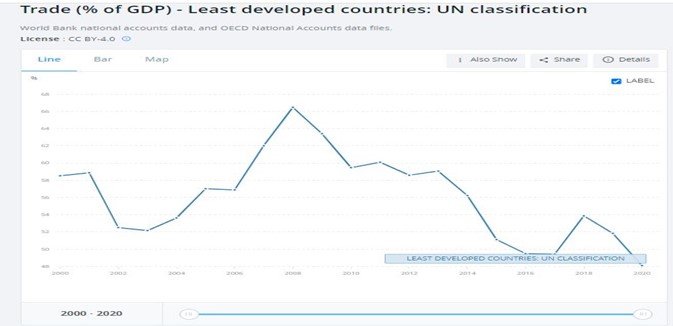
    Trade as a percentage of the Gross domestic Product (GDP) for LDC’s since the year 2000 is reflected below in figure 0.1.

    Source: http://data.worldbank.org

    The graph above illustrates that trade as a percentage of GDP for LDCs rose steadily from as early as 2003 up until the financial crisis in 2008. A downward pattern continued for another eight years until 2016, then there was improvement. However due to the Cocid-19 pandemic a downward movement has been evidenced since.

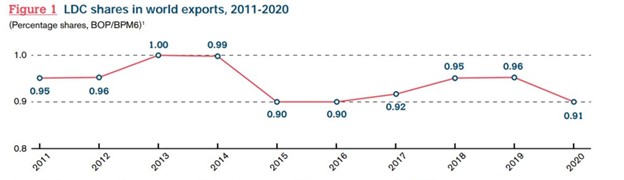
    The graph below illustrates the latest statistics of the LDCs share of world exports.

    Source (WTO 2022)

    We can clearly see that there was steady expansion of exports between 2017-2019. After the pandemic, there was a sharp decline of .04%, falling way below the expected target set by IPoA. (WTO 2022) shows that LDCs have seen declines over the last ten years in merchandise exports in all areas except clothing.  Although LDCs received preferential treatment, not all goods and services exported are covered (Antimiani and Cernat 2021).

    So what does this all mean, and what’s the bottom line?

    There is clear evidence supporting the WTO’s preferential treatment towards increasing  the revenues and economic prosperity of LDCs (Antimiani and Cernat 2021). Notably, there is still room for further easing of  trade barriers especially due to the shocks created by the pandemic. This is further underpinned by larger regional trade blocks emerging amongst developed countries undermining the efforts of the WTO (Palit 2015).  A 2016 paper carried out by (Klasen et al. 2016:5) using econometric techniques highlighted that “only Canada’s, Australia’s and EU’s trade preference systems have a positive and significant impact on LDCs’ exports”. Therefore, the following recommendations are proffered in the interest of economic uptake and growth through trade for LDCs.

    1. Establish regional trade agreements among LDCs to help increase their market share.
    2. Provide concessions for value added goods from LDCs within the global value chain for finished products exported by WTO members
    3. Increase the unilateral agreements enjoyed by LDCs  especially duty and quota free access to world markets on a wider range of products
    4. Increase the production and institutional capacity of LDCs by providing technical support to their industries
    5. Improve the LDC service waiver allowing it to cover more areas within the service industries

    These recommendations will allow LDCs to improve their trade practices, have more standardized procedures, facilate growth of local sectors which, in turn will increase the overall welfare of the economy and the people post covid.

    Note: Multiple WTO reports, textbooks and journals from industry experts were utilized in the writing of this article.

    Lucius S.J. Doxerie is an aspiring economist and co-founder and CEO of Stratagem Paradigms Inc.  He is a Chevening Scholar currently enrolled at the University of Bradford completing a Master of Science in Economics and Finance for Development. 

    REFERENCES

    Antimiani, A. and Cernat, L. (2021) Untapping the full development potential of trade along global supply chains: ‘gvcs for ldcs’ proposal. Journal of world trade 55 (5), 697-714.

    Białowąs, T. and Budzyńska, A. (2022) The Importance of Global Value Chains in Developing Countries’ Agricultural Trade Development. Sustainability 14 (3), 1389.

    Klasen, S., Martínez-Zarzoso, I., Nowak-Lehmann, F. and Bruckner, N. (2016) Trade preferences for least developed countries. Are they effective? Preliminary Econometric Evidence. Policy Review 4.

    Palit, A. (2015) Mega-RTAs and LDCs: Trade is not for the poor. Geoforum 58, 23-26.

    Suranovic, S. (2010) International trade: Theory and policy. The Saylor Foundation.

    WTO (2022) Boosting Trade Opportunities for Least Developed Countries. WTO. https://www.wto.org/english/res_e/publications_e/boottradeopp22_e.htm Accessed 22/03/22.