CARICOM Secretariat | Turkeyen, Greater Georgetown, Guyana | Thursday, 29 January 2026: A senior Caribbean Community (CARICOM) official has positioned deeper regional integration as a strategic response to an increasingly fragmented and uncertain global trade environment, as global rules-based systems weaken and economic nationalism intensifies.
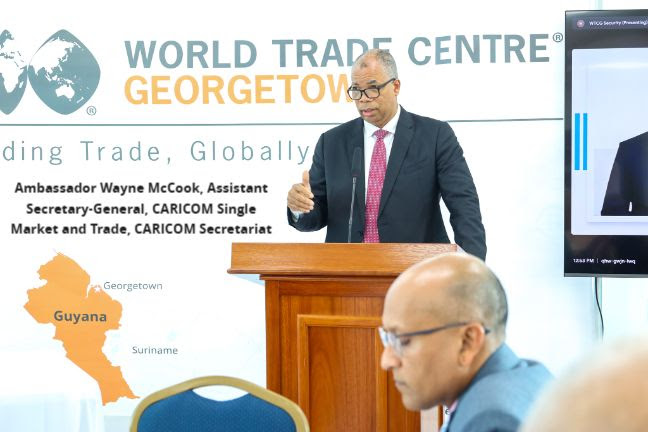
Ambassador Wayne McCook, Assistant Secretary-General, CARICOM Single Market and Trade, was a panelist discussing Prospects for International Trade in 2026 in the Context of the Changing Global Geopolitical and Economic Landscape – Impact on Trade and the Challenges and Opportunities for the Caribbean and Latin America. The discussion was held on Wednesday, 28 January, at the World Trade Centre in Georgetown, Guyana.
Contextualising the Region’s position, Amb. McCook said: “For our Region, the scars of the immediate past are visible. The devastating passage of Hurricane Melissa encapsulated the dual challenge we face: the existential threat of climate change and the inherent economic vulnerabilities of our CARICOM Member States. Simultaneously, we have navigated dramatic shifts in global trade, driven largely by an intensified “America First” trade policy that has significantly impacted our exports, value chains and supply chains through a suite of unprecedented tariff measures.”
Against the background of what he described as “a truly tumultuous 2025” for international and regional trade, Amb. McCook highlighted CARICOM’s “oneness” and its resilience to navigate the “choppy waters” of the 21st century.
Amb. McCook warned that the erosion of multilateral trade norms is no longer theoretical, but already affecting investment, supply chains, and growth prospects worldwide.
According to UN Trade and Development (UNCTAD), global foreign direct investment fell by 11 per cent in 2024, marking a second consecutive year of decline, with further weakness expected in 2026. Global trade growth has slowed dramatically, falling below one per cent in 2025, even as uncertainty and geopolitical rivalry reshape supply chains.
Despite these headwinds, CARICOM’s trade performance has shown resilience. Between 2023 and 2024, CARICOM exports grew by 32 per cent to US$34.7B, with exports to the United States increasing by 86 per cent. However, recent data reveals uneven impacts across Member States.
The Assistant Secretary-General pointed to the recent steps toward full free movement of people by Barbados, Belize, Dominica, and St. Vincent and the Grenadines as tangible progress toward a more integrated Community.
“Fundamentally, CARICOM integration should be seen as a strategic response to a shifting global order,” he emphasised.
Addressing prospects for international trade in 2026, he advanced a multi-pronged strategy focused on strengthening intra-regional trade, strengthening existing relationships while diversifying global partnerships beyond traditional allies, and deepening economic integration. Central to this approach is the CARICOM Industrial Policy and Strategy (CIPS), and the 25×25+5 food security agenda aimed at reducing food import dependence and boosting regional production.
Read his presentation here: https://caricom.org/deeper-caricom-integration-key-to-navigating-fractured-global-trade-order-amb-wayne-mccook/
Blog
-
Deeper CARICOM integration key to navigating fractured global trade order – CARICOM ASG
-
Is CARICOM Complicit in the United States and Trinidad’s Unlawful Partnership?
Rahym R. Augustin-Joseph (Mr.) – Guest contributor

Rahym R. Augustin-Joseph CARICOM countries must always be lauded for their international advocacy at the United Nations General Assembly (UNGA) among other global forums, as the “conscience of the world” as aptly put by Prime Minister Mia Amor Mottley of Barbados, on Geopolitical Issues, Climate Change, Reformation of the International Economic and Political Architecture, AI regulation, Threats to Democracy, Reversal of Modern forms of Imperialism and Neo-colonialism, et cetera.
But they must also be bemoaned for their cognitive dissonance and inertia. Most CARICOM Countries in the recent week, when discussing the recent actions by the United States of America in the destruction of the Venezuelan “drug cartel” vessels in the Caribbean Sea, contrary to International Law and in flagrant disregard for the sovereignty of the Caribbean Region, and consequent permanent stationing in the Caribbean Sea to respond to crime and violence, skilfully omitted the explicit acceptance and endorsement of the above mentioned by our own sister island, Trinidad and Tobago.
It is as if the United States of America on their own, without explicit endorsement determined this security position.
Most countries who discussed the issue only sought to dedicate two lines in their speech to the issue and sought to lay the blame solely at the feet of the United States of America.
It is as if the Caribbean Leaders have forgotten that Imperialism always has benevolent friends, aiders and supporters, who mask their support for imperialism in domestic interests and particularly national security, at the expense of others who are a stone’s throw away. Moreover, they utilise the victimised electorate (whom they have not consulted) and are affected by crime and violence as their justification, for ‘action’ contrary to the rule of law, international diplomacy, peace and established democratic principles.
Obviously, it is impolite, and certainly not diplomatic courtesy for the CARICOM member States to drop our dirty laundry in public, appear fragmented, and bemoan actions of others within the CARICOM grouping at a public forum. This is certainly not the central thesis of this Article.
It is certainly prudent for us to settle our internal diplomatic and political differences (and defend the guardrails of regional integration internally).
But, in the absence of any notable action on the latter, as evidenced through the radio silence of the hierarchy of the Secretariat, Chairman of CARICOM- Hon. Andrew Holness of Jamaica, Institutions of CARICOM et cetera, it raises cause for some concern as to whether the former or the latter is being undertaken.
Should the states have also addressed the issue in a fulsome manner at the UNGA, or should they also be addressing it internally?
However, I am more concerned, with the lack of dialogue, conversation and action internally within the Community to address actions by Trinidad and Tobago that are not in concordance with the objectives, principles, spirit, and positions of the regional grouping as a whole. I interrogate the extent to which CARICOM as an institution can rein in a member who possibly violates the Community principles. And if they are unable to, due to the constrains of functional cooperation, which permits sovereignty of foreign policy, what tools can the regional grouping equip itself with in order to respond to these instances?
Dismissing Some Myths
Now, this is not to suggest nor propose that there is any requirement on any state in CARICOM to sing at the same tone, pace, and volume on every international issue, as the RTC provides not for a ‘unified singular foreign policy’, but ‘coordination on foreign policy’ as noted in Article 6 (h) of the RTC.
So, the Prime Minister is accurate when she suggested that it is her ‘sovereign’ right of her country to articulate their foreign policy position. But, where I disagree is that the unilateral position of Trinidad and Tobago, is certainly at odds with the core pillars of the regional integration movement i.e., foreign policy coordination, as this policy does not contemplate nor advance any type of common ground, deliberative or consultative approach within the region on the resolution to the issue through the utilisation of the American military to supposedly reduce the infiltration of overseas drug cartels which affect Trinidad and Tobago and the wider Caribbean.
Moreover, it is certainly at odds with the long held customary principle within the Region that the Caribbean Sea must always be a zone of peace.
Even as a practical matter, Trinidad actually manages and earns money from the airspace for the Southern Caribbean and is the repository of all flight information for every craft flying in and through the space. As such, their obligations are both essential to our safety and evidence-based posture as a zone of peace.
But the reclaiming of this “lost ideal of a zone of peace” as evidenced by massive murder rates, interregional gang networks and organised crime, as noted by Hon. Kamla Persaud Bissessar from Trinidad and Tobago in her recent UNGA Address, is certainly not going to be achieved through the stationing and utilisation of American Military.
It may see short term results, as evidenced in the ‘neutralisation of supposed threats’ of Venezuela, but the ends may not be successful overtime as this measure is unsustainable, an avenue for retaliatory measures by other countries which can affect the lives and livelihoods of the Caribbean peoples, and a victim of the fleeting geopolitics of the four-year term of the US Presidency. It is also not directly responsive to the research which suggest that a huge percentage of illicit trafficking of firearms and drugs which cause crime and violence originate in the USA, by virtue of their liberal Constitutional gun laws. It is akin to a thief assisting you to look for the stolen goods elsewhere, knowing that they possess it.
But, additionally, it does not deal adequately with the guns and drugs already present within the country, which can be utilised for continuous crime and violence. Nor does it engage in the development and utilisation of technology to track and destroy transnational criminal networks, that do not utilise the ‘sea’ or originate from Venezuela as their route of access to the Caribbean.
But it also does not respond to the local economic and social disenfranchisement among people which fuel crime and violence. Certainly, the USA and Trinidad and Tobago cannot execute ‘all criminals’, in order to respond to crime. As such, other measures must be contemplated and utilised. Those that are in conjunction with the rule of law, international law and other rules-based systems.
It means that overtime the crisis will not dissipate.
Moreover, the literalistic text- which is the cushion upon which these decisions sit does not confines foreign policy in the hands of the individual governors but should always be analysed and assessed in the context of the unspoken conventions and practices from our own individual countries and the CARICOM. As such, the coordination of foreign policy within the Community, is always optimised when countries within CARICOM are singing from the same page of the hymnal, because as I noted in another Op-Ed, history has shown us that “greater results emanate from the Caribbean speaking as one voice within the global political ecosystem, by virtue of their bargaining power as a bloc which eclipses our size constraints. Thus, the utilisation of polar opposition positions within the Caribbean, encourages a colonial ‘divide and conquer’ strategy for developed countries which only elevates their position and agenda, at the expense of the interests of the Caribbean.”
Certainly, one must remember, even at the most basic example, when in December 2011, the government of Trinidad and Tobago was forced to change the venue of the CARICOM-Cuba summit from the Trinidad Hilton Conference Center to the National Academy for the Performing Arts (NAPA). The reason for the change of location offered was that even though the government of Trinidad and Tobago owns the Hilton Hotel plant, the U.S.-owned Hilton Company manages it. Delegates to the conference were all expected to stay at the Hilton Hotel; however, the presence of Cuban president Raul Castro posed a problem for the hotel. This is in contradistinction to other parts of the world where this was tried by the United States and the respective companies and governments protested the actions, on the basis that engaging in the decision of the USA would be enabling discrimination on the grounds of nationality.
Instead, if the interests of the Caribbean were at the forefront of the mindset of these partners or actors- there would be an engagement of CARICOM as a bloc, through a deliberative, consultative and transparent process in order to arrive at a regional agreement on mechanisms and methods to respond to overseas drug cartels infiltrating the Caribbean.
As such, one is only reminded of the many instances of Caribbean disunity propagated by the USA, such as the Ship Riders Agreement in the 1990’s, debates over permitting the US invasion of Grenada, inability to support one candidate in the Commonwealth SG Race of 2022, recognition of Jerusalem as the capital of Israel, Venezuela- USA Debacle under President Trump, among others. What is generally done, is the major powers co-opt CARICOM States to be against each other or pick them off one by one through inducements such as aid, financial and technical aid et cetera.”
One of the best examples of the abovementioned philosophy in practice is not only the statement of Kissinger, that “America has no friends or enemies, just interests”, but instead the remarks by Abrams- who held foreign policy positions during the Raegan and George Bush administrations, when commenting on the Ship Riders Agreement after the objections raised by Jamaica and Barbados noted that: But the anti-colonial mind-set, and the insistence on full independence, that marked the 1960s should be relegated to the past. Development in the world economy, and indeed, international criminal activity, have made full independence tantamount to full vulnerability for the smallest states. Far more valuable would be a relationship with the United States that helped guarantee prosperity, security, and liberty.”
But, even beyond that, she identified the underlying ethos of the United States foreign policy when she noted later on that, “ostensibly the Shipriders Agreement is an integral part of the strategy for restructuring American hegemony within global capitalism, national states and sovereignty.”
But, even beyond the legal and historical examples, there is an unspoken convention in the Caribbean that we will always advance the causes that are based on a core set of pillars that have been denied from our peoples for a long time through enslavement i.e., human rights, democracy, the rule of law, people-centred development, and an advancement of resolving the inherent vulnerabilities of small states in the world.
Dr. the Hon. Kenny D. Anthony, as a former leader within CARICOM words must he remembered when he said that “we [must] see our democracy as the main defence against recolonisation. Without it, we would have no choice but to bow to the dictates of global economic forces, which are neither accountable to our populations nor constrained by popular intervention and choice.”
But this unspoken conventions, which CARICOM must protect, even if it means bemoaning or intervening when one of their members acts at odds with it, is buttressed by the fact that all the “CARICOM countries have committed their countries to the Charter of Civil Society, which is a firm statement of the determination to uphold human rights and the pursuit of good governance. As part of this process, there is also an agreement to establish National Monitoring Committees to ensure compliance to the principles of the Charter.”
As such, the actions of Trinidad and Tobago may be contrary to the non-binding Charter of Civil Society i.e., the permitting and encouraging the destruction of vessels and summary executions of peoples in the Caribbean Sea on the suspicion of drugs and crime without criminal due process and respect for human rights.
This is particularly relevant in circumstances where Prime Minister of Trinidad and Tobago, as Lead for Security in the Quasi Cabinet of CARICOM, has noted in effect at her UNGA Address that, forceful and aggressive action must be taken in order to respond to the evil drug cartels, and because they believe affected nations will always unreservedly resort to morals and ethics and human rights considerations which they blatantly flout and disregard. We will thus fight fire with fire “within the law” because they do not adhere to these values.
This is not only problematic and dangerous language because it defies the domestic, regional and international conventions and laws that Trinidad and Tobago have signed unto.
But the tacking on, almost grudgingly and forgetfully “within the law”, at the end of the statement of fire, is certainly not occurring presently because of the breaches of various conventions and treaties. As a matter of fact, it would be interesting to ascertain what “the law” provides in these instances, and whether there are any legal safeguards for the military intrusion, which are being followed?
But it is dangerous and problematic because it positions war and military interventions as the solution to crime and violence, ignoring the potential innocent death toll and destruction of war as evidenced in history, the length of war without results, and the inability of Trinidad and Tobago to make a definitive statement on the Caribbean Sea and by extension the Caribbean region, without consultation with other CARICOM members. Trinidad and Tobago cannot willingly invite war to the Caribbean, with significant implications for other countries based on geography and a possible spin-off for immigration et cetera, without the buy-in from these respective countries.
But it is also dangerous and problematic because it positions fundamental human rights and international law as being conditional on the actions of criminals, such that if they do not respect human rights, we must not in our response.
But, implicit in this argument is a question of the extent to which this thought, if adopted by every political official, and every citizen, who is also armoured with the power of a military, believed and actualises this, whether you would have any peace, people or prosperity in the respective countries. It is akin to the commencement of a dictatorship where the centre will ultimately determine who and what is worthy of life and death.
This is a slippery slope. The words of Martin Niemoller is thus instructive when he reminded us that “First they came for the socialists, and I did not speak out—because I was not a socialist. Then they came for the trade unionists, and I did not speak out—because I was not a trade unionist. Then they came for the Jews, and I did not speak out—because I was not a Jew. Then they came for me—and there was no one left to speak for me.”
Applied in our context, it would possibly mean, that they came for ‘criminals’, ‘immigrants’ and then, the list goes on.
Permitting the application of human rights, which everyone should be entitled to, by virtue of their humanity to be subject to the whims and fancies of political officials is dangerous as it does not create clear, accessible, verifiable, and equal treatment of individuals. But, implicit in the statement is also a suggestion that by utilising the law to dismantle gangs in its current form will only render countries “in name, but without substance.” It is as if, there are not formulae which shows us that both the rule of law and suppression of gang violence cannot coexist.
It is as if there is an absence of laws and processes which can be utilised to suppress and destroy gangs in the Caribbean and the wider world, without resorting to an eye for an eye mechanisms. As a matter of fact, it only signals that we are no different from them and have lost any ingenuity required for responding.
But, even beyond the bemoaning and identification of the problematic areas of the foreign policy position of the Government, there must be an interrogation and assessment of some of the tools within the arsenal of CARICOM which should be equipped to respond to these stances by a member state.
For example, implicit in the role of the Chairman of CARICOM is the underlying obligation to provide definitive statements and a position of the Heads of the Community on major issues facing the Caribbean Region. Obviously, this position and particular response by the Heads of Government and wider Caribbean, must be provided after a deliberative, engaging and consultative process, among themselves even outside the limitations of the scheduled meetings of Heads of Government. Certainly, any division among the Heads of Government, marked by differing voices or deafening silence undercuts the foreign policy coordination objective of CARICOM. It also permits a repeat of history where developed countries continue to employ a divide and conquer strategy, pitting the heads against each other at the expense of the Caribbean people’s safety and maintenance of our democratic traditions.
With the ubiquitous nature of technology, the Heads of Government and specifically the Chairman, cannot thus argue that the lack of a statement is because of the inability to have a forum to receive a common position on the abovementioned.
Certainly, the late Ramphal is instructive when he noted that “we have become casual, neglectful, indifferent and undisciplined in sustaining and advancing Caribbean integration: that we have failed to ensure that the West Indies is West Indian and are falling into a state of disunity which by now we should have made unnatural. The process will occasion a slow and gradual descent from which a passing wind may offer occasional respite; but, ineluctably, it will produce an ending.”
However, to date, and particularly prior to the UNGA, and even within the UNGA, the Chairman of CARICOM, Hon. Holness has tiptoed and circumvoluted around the particular issue, while still notably ringfencing the action by the USA when he noted that “Jamaica welcomes cooperation with all partners in this fight, including the interdiction of drug trafficking vessels, provided that such operations are carried out with full respect for international law, human rights, and with the coordination and collaboration of the countries of the region. The Caribbean has created regional security mechanisms, but these efforts alone cannot match the scale of the threat. What we need is a unified front with the same urgency, resources, and coordination the world has applied to terrorism. Only then can we turn the Caribbean and indeed the wider region into a true zone of peace.”
As such, since the Prime Minister was assertive enough to identify that he will only support actions that respect international law, human rights and collaboration. I take this to mean that he could not thus support these interventions by the United States and aided by Trinidad and Tobago.
But, he does not say that!
But one can glean that since these actions are in flagrant disregard for international human rights law and other international treaties that both these states and others in the Caribbean have signed, that they would be condemned by the Chairman and other Heads of Government.
Certainly, it is clearly evident that these strikes are at odds with (i) due process of law that the ‘drug dealers’ require wherein they must be charged, arrested and be prosecuted in accordance with the relevant criminal laws as opposed to being executed summarily in the seas, (ii) the rule of law which also suggest that everyone must have a fair trial, and that states must comply with their international obligations, which do not provide for summary execution of suspected drug dealers, such as the UN Convention on Narcotic Drugs, which suggest that under Article 35 that individuals who are believed to be engaging in illicit trafficking of drugs, shall be liable to adequate punishment particularly by imprisonment and other penalties of deprivation of liberty, provision of reporting mechanisms and procedures to ensure that the interdiction of the parties are being done in accordance with international best practices and standards, or that the principle of no one being above the law such that these states cannot be the judge, jury and executioner without due process, et cetera.
Further, for example the United Nations Convention against Illicit Traffic in Narcotic Drugs and Psychotropic Substances, also notes under Article 17, that respective parties must board, search, and take appropriate action if illicit drugs are found on the vessel. It certainly does not contain any provisions which permit the execution of drone strikes on the vessel. Implicit in this convention also is the satisfaction that there are illicit drugs on the vessel, which in accordance with international best practices must be safeguarded for the evidentiary basis for prosecution of the criminals. But this is not occurring as the drone strikes destroy any ‘evidence’ of drugs and fuels constructive cynicism and lack of trust for political officials among peoples who question whether there were any drugs to begin with. Or, whether these drone strikes are only for strategic geopolitical reasons or only done to justify the earlier position of having the US military stationed in the Caribbean Sea.
As I argued in the other piece on this subject, there must be the provision of appropriate safeguards i.e., reporting, ensuring adequate and accurate intelligence is received and communicated to the political officials and the wider Caribbean Community, proper accessible policies and procedures that provide us with some information on the authority to engage in such intervention and the four corners in which it is occurring, and other requisite communication with other geographically closer member states to prevent unforeseen harm and damage. In effect, these safeguards are to ensure that the objective of the mission is met and is also in accordance with International Law, the rules-based order and best practices.
But certainly, there must be the utilisation of the corridors of power to articulate that view or the public platforms in the Commonwealth Caribbean, in a clearer way to permit the citizenry to be aware of the clear position of the Chairman of CARICOM and by extension the CARICOM itself. Moreover, beyond the speeches at the United Nations, the Chair of CARICOM must provide some definitive position and work towards providing and resolving some of the issues that arise from this intervention as I have identified above.
But, what of the purpose of the Bureau established by CARICOM, which is made up of the former, current and future Chairman of CARICOM, as per Article 12 of the RTC.
Albeit its role is textually limited to focusing on the assistance in the implementation of the decisions of CARICOM, in order to cure the malaise of the implementation deficiency disorder, there is an argument to be made that, their role in “providing guidance to the Secretariat on policy issues, or initiating proposals for development and approval by the Ministerial Councils” can be interpreted as an opportunity to ensure interrogating, analysing, and development of solutions to the question of whether the USA should be utilising our seas to intercept alleged Venezuelan drug dealers, without any due process of law and protection of the law.
As a matter of fact, notwithstanding the RTC does not explicitly specify a role for the Bureau in resolution of disputes, the Bureau has provided leadership along with the Secretary General in the past, in for example, seeking cooperation between two member states, Guyana and Suriname, over the disputed Tigri Area.
As such, the bureau’s informal powers can be utilised again to assist in this resolution, and the agency must have the internal conviction and courage to hold members accountable internally for their actions.
But the problem is not only that of the Leadership but inclusive of the Ministerial Councils, such as the Council for Foreign and Community Relations (COFCOR), which is made up of Ministers responsible for Foreign Affairs of Member States, and is responsible for ensuring that there is a coordination and articulation of a clear position on the subject matter. As noted in Article 16, the Council is responsible for establishing “measures to co-ordinate the foreign policies of the Member States of the Community, including proposals for joint representation, and seek to ensure, as far as practicable, the adoption of Community positions on major hemispheric and international issues. Further, “to coordinate, in close consultation with the Member States, Community policy on international issues with the policies of States in the wider Caribbean Region in order to arrive at common positions in relation to Third States, groups of States and relevant inter-governmental organizations.”
As it currently stands the abovementioned has been otiose.
There is also a case to be made for the quietness of Ministerial Councils, such as the Council for National Security and Law Enforcement (CONSLE) which is responsible for “the coordination of the multi-dimensional nature of security and ensuring a safe and stable community.”
More particularly, Article 17(a), provides an impetus to promote the development and implementation of a common regional security strategy to complement the national security strategies in individual member states, and establish and promote measures to eliminate threats to national and regional security, which also include the mobilisation of resources to manage and defuse regional security crises, of which this is certainly included. These among other responsibilities are included in Article 17(a).
But, even as recent as this year where the CARICOM Heads of Government signed in Jamaica, the Montego Bay Declaration for Organised Transnational Crime and Gangs. Yet still, the resolution to the ‘infiltration of drugs from Venezuela to the Caribbean’ is not being enacted through the principles and practical steps that is provided in this Declaration.
It provided that one of the main aims would be to “renew our commitment to strengthening the Region’s response by implementing effective measures to monitor new trends in illicit firearms trafficking, enact robust legislation to include stringent penalties for firearm and gang-related offences, and to strengthen public awareness on the issues relating to the prevention and prosecution of all forms of organised criminal activities.”
But more importantly, it responded in text to one of the burning desires to maintain sovereignty while still responding to these ordeals, through the strengthening of the regional institutional security structures, to include CARICOM Implementation Agency and implementation of programmes such as the Caribbean Basin Security Initiative (CBSI), to effectively enhance collaboration and sharing of information, to disrupt criminal networks, as well as, leverage shared resources to enable law enforcement and support border security efforts.
However, the Chairman and by extension CARICOM, has only paid lip service to this Declaration and have not engaged in the above which can be assistive in responding to the ordeal. Instead, the regional institutional security structures have been ignored and sidelined in favour of military assistance by the United States, with many disastrous trade-offs that has not been debated, distilled, or get consensus, under the aegis of “ensuring that the friends in the Caribbean are safe.”
What should have been pursued is the strengthening of IMPACS, in order to assist in the identification and interception of the illicit trafficking of drugs, in accordance with International Law and other best practices.
And in circumstances where the abovementioned cannot be pursued, the partnering with the US agencies to ensure oversight and that the objectives of the mission are met and the appropriate safeguards are included in the intervention.
For example, is there a regionally produced satellite mapping of the placement and movement of the American Vessels? Are we certain that these vessels are actually ‘striking’ Venezuelan Vessels and peoples carrying illicit drugs and firearms? Have we agreed on some of the rules of engagement that is sensitive to immigrants, women and children, who may be coerced and trafficked along with the drugs? What is the intelligence utilised to determine whether these interceptions do not disastrously affect Caribbean fisherfolk, especially when Vice President of the United States, JD Vance felt the idea of collateral damage of peoples funny, when he noted “I wouldn’t go fishing right now in that area of the world.”
And how do we alleviate and address the fears of ordinary people on the seas and in communities across the region, who may fear that the Indians would not come to their rescue as suggested by the Minister but agonise over the destruction of their communities with retaliatory strikes by any of the respective parties? Certainly, it is not as tranquil as Prime Minister of Trinidad and Tobago suggested that it is only those who are criminal masterminds who should be afraid.
All of these could have been components of a collaborated effort between IMPACS and other agencies. Or even alternatively, a new deal could have encompassed equipping IMPACS with these competencies to address the abovementioned, in accordance with International Law.
However, this willing transferring of sovereignty to the USA, is certainly reflective of what Lamming describes as “the staggering nature of the region to resolve the contradiction of being at once independent and neocolonial, and the struggling of new definitions of itself to abandon the protection of being a frontier created by nature, a logistical basin serving some imperial necessity and struggling to move away from being a regional platform for alien enterprise to the status of being a region for itself, with the sovereign right to define its own reality and order its own priorities.”
The abovementioned concerns are those of ordinary peoples across the Caribbean, which must be addressed by their leadership across the Caribbean, even while they fear local gangs and crime and violence.
But the RTC under Chapter 9: Dispute Settlement, does however also provide some recourse for CARICOM Member States to rein in the actions of the Government of Trinidad and Tobago, which may contravene the objectives of the Community or prejudice the object and purpose of the Treaty, required by Article 187(a).
As such, should any CARICOM country feel compelled to act, they could utilise good offices, mediation, consultations, conciliation, arbitration and adjudication as their modes of dispute settlement as noted by Article 188 of the RTC, cognisant that should any of the methods prove unsuccessful, they can easily resort to another mode to arrive at a resolution.
Under good offices, the member states could easily engage the Secretary General of CARICOM or a third party, as required by Article 191. Should they consider mediation as the better mode, they can also agree on a mediator or request one from the Secretary General who will appoint one from the list within CARICOM as noted in Article 196.
Moreover, a member state can also request consultations, where they assert or allege that the actions taken by the other member state constitutes a breach of obligations arising from or under the provisions of the Treaty. After which, they must comply with all of the procedural requirements for consultations established in the Treaty.
Should the Member States assert that these mechanisms are insufficient, they can also resort to the more formal mechanisms of arbitration or conciliation, which establishes commissions and tribunals for adjudication, and provides for an empanelling a list of arbitrators or conciliators, and permits third party intervention, reports, evidence, expert advice et cetera. Recognising the significance of the issue, member states may be tempted to engage in this mode but must be cognisant of the ability of this mode to potentially fracture the inter-Caribbean dialogue and unity because of its ability to become acrimonious and combative. Notwithstanding the above, some member states have still demonstrated diplomatic maturity and Community comradery, even when they have brought each other before the CCJ to adjudicate on matters arising from the Treaty. This option pursuant to Article 211 of the RTC though is also always available to the member states on this matter, should they be able to conjure an argument of a violation of a treaty provision as opposed to the lofty ideals of ‘objectives’ and ‘principles.’ It not only provides that the CCJ has compulsory and exclusive jurisdiction regarding the interpretation of the Treaty, between member states who are parties to the agreement, but also provides the court with the ability to issue an Advisory Opinion, concerning the interpretation and application of the Treaty should a member state request it.
However, one should be more amenable to one of the earlier modes of dispute settlement at the commencement of this process as opposed to the latter.
CARICOM’s silence in the face of Trinidad and Tobago’s endorsement of U.S. military intervention in the Caribbean Sea exposes a deeper crisis of coherence, conviction, and courage within the regional movement. For decades, our leaders have spoken boldly on the global stage yet hesitated to confront contradictions at home invoking sovereignty when convenient and overlooking its erosion when politically expedient. This selective diplomacy undermines both the credibility and moral authority of the Caribbean voice in international affairs. If CARICOM is to remain the “conscience of the world,” it must also have the courage to be the conscience of itself: defending international law, sovereignty, and the Caribbean Sea as a genuine “zone of peace,” not a theatre for external militarisation disguised as partnership.
The instruments for accountability already exist from the Caribbean Court of Justice to the dispute-settlement provisions of the Revised Treaty of Chaguaramas but they remain dormant without political will. What the moment demands is not procedural caution but principled leadership: the willingness to speak truth to power, even within our own ranks. To remain silent is to invite the gradual erosion of the West Indian spirit that once defined our integration. If the region cannot summon unity in defence of peace, law, and dignity, it risks becoming not a community of nations but a collection of states, sovereign only in name and subdued by convenience.
Rahym Augustin-Joseph is the 2025 Commonwealth Caribbean Rhodes Scholar. He is a recent political science graduate from the UWI Cave Hill Campus and an aspiring attorney-at-law. He can be reached via rahymrjoseph9@ gmail.com and you can read more from him here.
Image credit: Pixabay
-

Trinidad’s Troubling Invitation of War to Caribbean Shores
Rahym R. Augustin-Joseph (Mr.) (Guest contributor)
Early last week, the Prime Minister of Trinidad and Tobago, Hon. Kamla Persad-Bissessar, indicated via Press Release, that, her government unequivocally supported the deployment of American Military assets into the Caribbean Region in order to destroy the terrorist drug cartels.
Interestingly enough, the Prime Minister noted that it was not the government’s intention to engage CARICOM, as the foreign policy of each CARICOM state is within their sovereign domain and must be articulated for and by themselves. After all, one’s foreign policy is indeed based on one’s national interests, values, pragmatism, ideology, et cetera.
Albeit, accurate in theory, but not truly in praxis, particularly when a country is within a regional integration movement and history has shown that greater results emanate from the Caribbean speaking as one voice within the global political ecosystem, by virtue of their bargaining power as a bloc which eclipses our size constraints. In fact, some naysayers will argue that when the foreign policy dictates of a country is not solely influenced internally, it is reflective of a reduction in sovereignty. But sovereignty is also an action which permits the island’s foreign policy to be in sync with other countries.
Thus, the utilisation of polar opposition positions within the Caribbean, encourages a colonial ‘divide and conquer’ strategy for developed countries which only elevates their position and agenda, at the expense of the interests of the Caribbean.
Of course, there has been many instances of Caribbean disunity propagated by the USA, such as the Ship Riders Agreement in the 1990’s, debates over permitting the US invasion of Grenada, inability to support one candidate in the Commonwealth SG Race of 2022, recognition of Jerusalem as the capital of Israel, Venezuela- USA Debacle under President Trump, among others.
What is generally done, is the major powers co-opt CARICOM States to be against each other or pick them off one by one through inducements such as aid, financial and technical aid et cetera. It is for this reason I support the Golding Commission’s Report Recommendation 26 which suggested “a review of the procedures for foreign policy consultation and coordination in order to avoid as far as possible, the types of conflict and embarrassing positions that have emerged from time to time among CARICOM members depriving it of the collective force it is capable of exerting.”
While the Prime Minister is accurate that CARICOM countries, reserve the sovereign authority to articulate their individual foreign policy position, it is a known fact that her unilateral position undermines one of the core pillars of the regional integration movement, i.e., foreign policy coordination, as noted in Article 6 (h) of the RTC which notes in part that one of the Community’s objectives is “enhanced co-ordination of Member states’ foreign and foreign economic policies.” It is where countries within the Caribbean Community, seek to find common ground on our individual national positions on these myriad of hemispheric and international issues of great importance to the Caribbean Community, such as the Venezuela- Guyana Dispute and the infiltration of overseas drug cartels which affect Trinidad and Tobago and the wider Caribbean.
But what is also ironic and confusing about the Prime Minister’s position, is that she, without the concurrence of her CARICOM colleagues endorsed the American deployment in the ‘Caribbean Region’, not only in the waters close to Trinidad and Tobago, but the Caribbean, while quickly denouncing her Government’s intention to engage CARICOM on the subject matter.
But, even beyond this foreign policy vernacular, Trinidad and Tobago should not make decisions under the guise of the sovereign name of Trinidad and Tobago when these decisions have life and death implications for the wider Caribbean Region peoples without consulting CARICOM.
Thus, the invitation of war to the shores of the Caribbean, with wanton disregard for the potential effects on human life, through the permitting of US military operations which can have counter-military responses within the small landmass in the Caribbean region potentially affecting multiple Caribbean countries is a decision that should not be taken as fiat by one Caribbean country.
As one online commentator noted, decisions about war are not akin to putting on the call of duty video game, but requires careful deliberation, analysis, consultation, respect for international law et cetera.
It is as if the Prime Minister, in the absence of the Chair of CARICOM is speaking for the region without their concurrence, while still attempting to confine her foreign policy position to Trinidad and Tobago.
But, the articulation of such position should have been even more circumspect, because under the Quasi-Cabinet of CARICOM, Prime Minister Bissessar is the Lead for Security (Drugs and Illicit Arms). As such, when she speaks and takes definitive positions, both for Trinidad and Tobago and implicitly for the Caribbean, it is as akin to a response from the CARICOM, which makes it even more problematic, questionable and worrying. After all, CARICOM is one of the bastions of Caribbean sovereignty.
As such, if the regional Quasi Cabinet works anything like our domestic cabinet, Prime Minister Bissessar has just articulated a policy position of CARICOM, while admitting ‘boldfacely’ that she would not be consulting with her CARICOM colleagues.
But one would believe though that such a request for the deployment of military assets has already been made to the Government of Trinidad and Tobago, which prompted this press release. But, instead, the Prime Minister indicated that, no requests have ever been made by the American government for their military assets to access Trinidad and Tobago territory for any military action against the Venezuelan regime.
But, still, she offers it, citing that should the Maduro regime launch any attack against the Guyanese people, her government will provide the access if required to defend the people of Guyana against Venezuela.
What is also concerning about this policy position by Bissessar is that at the domestic level, it is a confining and narrowing of liberal democracy to the political elite, such that the people of Trinidad and Tobago have not been given any meaningful opportunity to form any opinion on whether they are supportive of the utilisation of foreign military assets by the USA, to fight drug cartels and/ or, as a launching pad for war against the Venezuela regime, with significant potential for retaliatory measures against Trinidad and Tobago which will affect their peoples.
Certainly, Bissessar has shown that the people of Trinidad and Tobago, at the recent ballot box, engaged in what Jean Jacques Rosseau calls a simultaneous exercise in, and surrender of sovereignty, such that the very moment they made the x, was the same moment they surrendered their sovereignty to her, such that all decisions of national importance are only decided by the political elite. They remain excluded from engaging in the political lives of their society and have surrendering all of their power to their representatives.
Of, course the common retort of her colleagues and supporters would be that ‘the people voted for a promise of the reduction of crime and violence’ and provided the government with the latitude to engage in measures such as this to pursue the outcome.
A typical example of the ‘ends justify the means’ only that in governance the means, more than ‘the ends’ matter. How and why, you do what you do matters in politics.
But this position is also at odds with other positions taken in Trinidad and Tobago, in the past under Dr. Eric Williams, where in response to internal turmoil with the Black Power Movement, the USA entered the territorial waters; in order to quell the uprising and they were not welcomed by the Government.
But the policy position is also bewildering because is the administration providing their support for the ‘stationing of military assets to destroy drug cartels’ which emanate from or do not emanate from Venezuela?
Or is it to provide the Americans with the launching pad for war against Venezuela if they attack Guyana? Or is it both?
Under the latter, such a retaliatory response under collective self-defence as per International Law, can only be invoked where there was indeed an ‘armed attack’, the victim state must have declared itself to be under attack, and must request assistance, and that this assistance should still be necessary and proportionate.
It apparently is both because days later, we then see video footage of American military assets destroying an alleged Venezuelan vessel on the waters which was allegedly carrying drugs. What this confirms is that there seems to possibly be a request by the Americans for deployment, contrary to the Prime Minister’s assertion which was accepted by the Prime Minister. Further, the aim of the deployment is not only to respond to the Venezuelan state against Guyana, but to also respond to drug cartels emanating from the state of Venezuela.
In any instance, both are problematic.
Certainly, the former is because, notwithstanding the realities that Trinidad and Tobago faces, wherein the data suggests that there has been an infiltration of violence because of the Venezuelan political and economic crisis, it also places Bissessar in a diplomatic chokehold and at odds with the regional position which also recognises that the influx of unlicenced firearms are due in part to the second amendment right under the USA constitution, to bear arms.
Such that, guns continue to be rampant in our countries, which allegedly also come from the USA without the necessary support from the USA, to revisit their internal background checks and support stronger border control to reduce the influx of firearms.
As noted, in a recent peer-reviewed journal article published in the European Journal of International Security by Dr Yonique Campbell, Professor Anthony Harriott, Dr Felicia Grey and Dr Damion Blake titled “From the ‘war on drugs’ to the ‘war on guns’: South–South cooperation between Mexico and the Caribbean” diagnoses the burgeoning gun violence epidemic permeating the Caribbean is as a result of the illegal trafficking of guns stemming from the illegal trafficking of guns from the US, given that an “estimated 60–90% of guns used in criminal acts in LAC are trafficked from the United States”. Further, the article also notes that some of the necessary pragmatic solutions include a “ban on the sale of military-grade weapons to civilians” and “punitive measures against legitimate carriers that convey illegal weapons across national borders as well as monitoring and performance reviews.”
As noted in an instructive piece assessing this situation through the lens of realism, in International Relations Theory, by Dr. Emmanuel Quashie, lecturer in International Relations, notes and he is quite accurate that, “the Trump administration should also declare a War on the illegal trafficking of guns from the US that is responsible for the bloody violence ravaging our communities and destroying and slaughter of our people as the Prime Minster of Trinidad and Tobago Kamala Persad-Bissessar stated in which she seems to blame the issue solely on “evil traffickers”.
Sidestepping this reality, repeating of the American narrative shared by Vice President Vance which does not apportion responsibility and culpability for the crime and violence in this region equally, and not factoring the American complicity into the policy and diplomatic response and engagement is certainly antithetical to the reduction of crime and violence.
As a matter of fact, it continues to sidestep and pass the difficult task of reduction of crime and violence to the United States of America, ignoring the internal national efforts that Trinidad and Tobago could engage in to reduce crime and violence.
As no amount of warships parked outside of Trinidad can fix the issues of trust in the institutions, corruption of the police force, court backlogs, income inequality, lack of youth opportunities which provide an environment for crime to fester, broken education system which creates tiers of citizens, broken family and community structures, border control which reduces the influx of illegal firearms, et cetera.
After all, crime emerges as the data has shown, not simply out of the existence of drugs and guns i.e., manifest tools of crime and violence. But there is an economic, social and political explanation, which lies in the government’s inability to adequately provide for the majority of citizens. Thus, government inadequacy, which cannot be replaced with warships in seas of foreign vessels, must be blamed and responded to.
It is a short-term knee jerk reaction to appease the West and to remove culpability on the nation-state’s complicit role in festering crime and violence through inaction in a time when long-term sustainable actions are necessary.
But the decision is also at odds with prevailing data from the US itself, which notes that as per academic and departmental research, that 84% of the cocaine seized in the US comes not from Venezuela, as they are not a cocaine producer, but from Colombia.” In fact, the major cartels that pose a threat to the USA according to the U.S. DEA are the Sinaloa Cartel, and the New Generation Cartel from Mexico. As such, Dr. Quashie argues and he may be accurate that this position has less to do with Trinidad’s benevolence and altruistic foreign policy in advancement of Guyana’s self-determination, or alternatively in reduction of violence in Trinidad and Tobago, but in the destabilisation of the Maduro regime which may result in their view in a return of the Oil market for Trinidad and Tobago, which was obliterated with the Petro-Caribe Initiative.
But, the naivety of the Prime Minister, unless this is exactly what it was meant to be, seems to be unaware that regime change only benefits the USA’s self-interest of reduction of communism, socialism and other ‘isms’ and is a continuation of their entrenched doctrines in the Caribbean.
Her support as a friendly host will not result in any benefits for the peoples of Trinidad and Tobago and the wider Caribbean but only be a lesson in the realist nature of geopolitics and the international political economy of war and conflict as noted by Dr. Emmanuel Quashie.
Haile Sellasie words are thus instructive when he lamented the inaction of the League of Nations, during the League of Nations address when his country was defeated by the Italian army of Mussolini, that “today it is us, but tomorrow it will be you.”
Dr. Quashie is also thus also instructive and accurate when he noted that, “thus, the idea that the US military presence in the Caribbean will result in a reduction in illegal guns, drugs and violent crimes is to have a fanciful and superficial understanding of Us foreign policy. Plain and simple, it’s about Venezuela’s oil, because they hold the largest oil reserves in the world and nothing to do with supposed “drug cartels,” or “narco-terrorists” or even the issue of illegal guns that actually comes from the United States and are the main source of the burgeoning gin violence that is ravaging our Caribbean communities.”
But it is important for citizens to not be distracted by the Prime Minister’s utilisation of the trauma of the victims as an excuse for diplomatic prostitution, as she implicitly suggest that it is an all-or-nothing approach. Such, that, if the USA warships are not stationed in the waters, crime and violence cannot be solved.
Scholar Lowenthal is thus accurate then as he is now, when he said that “it is a deceptively attractive policy because it seemed cheap and simple, but it is a dangerously short signed, since it amounted to putting out the fires while doing nothing to remove the flammable material.”
The actualisation of the position was thus seen in the US illegal strike on a boat that the Trump administration claimed were carrying 11 Venezuelan gang members from the Tren De Aragua cartel that was loaded with drugs bound for the US which resulted in the destruction of the vessel and the killing of the individuals. The Prime Minister’s response praising the military operation “that the US Military should kill them all violently” is an affront to the rule of the law, due process, right to a fair hearing, proportionality, among other human rights safeguards enshrined in domestic Constitutional and international human rights treaties.
Certainly, in Trinidad and Tobago and within the USA, these offences are not meted out with ‘death’ ‘vigilante justice’ or an ‘eye for an eye’. There is no legal penalty for drug trafficking which is summary execution without due process, i.e., being arrested, charged, provided with a trial and permit the prosecution to prove its case beyond a reasonable doubt. In fact, even in circumstances where guilt is proven, or plead by the perpetrators, the penalty is not death by execution as witnessed over the last few days.
As such, why should this be the policy position on the waters by these states, in flagrant disregard for domestic and international law?
Instead, in these countries, which boast and are rated highly their admiration for the ‘rule of law’ officials could have simply conducted maritime interdiction of the drug shipments utilising their intelligence, and the subsequent processing, charging, prosecuting and sentencing of the individuals without attacking the vessel’s occupants.
In some reports, they have noted that in most instances, those transporting the drugs are not big drug traffickers, but rather very young poor people from the region utilised for the enhancement of the drug trade.
But, in typical Caribbean Prime Minister fashion, anyone who interrogates the policy is somehow an enemy of progress, the state, unpatriotic and not a law-abiding citizen, as opposed to embracing critics who question the rationale, nature, safeguards et cetera of the policy position. And hosting forums, conversations among other forms of public engagement meant to address these concerns and invite people into the confidence of the decision making of the political elite.
Patriotism and active citizenship is certainly not clothed in selling Caribbean sovereignty to the highest bidder, but in being self-reflective and interrogating the societal issues and the responses by the political elite.
But the policy position is also problematic because it lacks the necessary details, which can cause citizens to possibly rally and interrogate the position.
It reeks of an unquestioning endorsement of the Ship Riders Agreement, such that the USA can continue to deploy and operate their coast guard outside their territorial waters, to respond to terrorism and other related activities.
So, it is important to ask:
- What of any benefit is the parking of warships in the Caribbean Sea, and how will it actually seek to reduce crime and violence?
- Under what conditions are they present?
- How can any ordinary fisherfolk be certain that with the mechanisms utilised they too would not be randomly killed by military arsenal from the US, as young black men are killed in America, by killing first and finding out they do not possess any weapons after? After all, there have been many cases where some Jamaican fishermen have been subjected to abusive measures by the US Coast Guards who accused them of drug smuggling, burning their boats, stripped searched, and shackled like slaves as noted by Bekiempis in a 2019 article published on the subject.
- For how long will they remain the Caribbean Sea?
- What are the safeguards in place to ensure that they will only pursue their purpose?
- What have the two states and the Caribbean region agree should not be done during this military deployment, such as killing of children, women, among other ‘rules of war’, or is it summary execution of every boat on the seas?
- What if any are the ramifications if the conditions are breached?
- How does the Caribbean people reconcile the history of the West, of utilising our waters and countries as pawns for their own political agenda, at the expense of our small island interests?
- Does the President truly mean his friends in the Caribbean will not be terrorised by Venezuela, or is that there is an ulterior motivation of staving off communism as has been embedded within the US-Caribbean relations?
- Moreover, as one saw with the recent attack, how can one be assured that the intelligence of the USA and Trinidad and Tobago is accurate such that they are indeed attacking drug cartels, and not just immigrants?
- How can we be assured that the execution of the policy is in response to a genuine threat or merely a response to the critics to show that there is a threat?
- When the Prime Minister noted that “all traffickers” should be killed violently, how will they ensure if they engage in summary execution that the individuals killed are traffickers as opposed to the trafficked?
- And, also, what of the diplomatic courtesies of notification and other forms of engagement with neighbouring states when actions will have regional impacts, or is the Prime Minister still of the insular belief that Trinidad’s actions have no impact elsewhere?
- How does the Prime Minister countenance the potential of a return of the US ships and the possible retaliation by Venezuelan authorities on Trinidad and Tobago and potentially the Caribbean region?
- Has the Prime Minister engaged in any analysis of the international law surrounding the abovementioned and satisfied herself that it is being followed, or is there just a disregard for law and order?
- How does this alter the Caribbean philosophical position of being a zone of peace?
Naturally, the Caribbean people could remember the pretence of the USA, when they claimed they were ‘saving medical students in Grenada’, only to realise that it was an attempt to destabilise and destroy the Revolutionary Government led by Maurice Bishop. Or one only has to remember the USA’s interventions in Dominican Republic, Guyana, among others to maintain their hegemonic status and stave off potential communism in their backyard, i.e., the Caribbean.
But, even today with the onslaught of attacks on Grenada’s ability to retain Cuban medical professionals, under the false pretence of solving human trafficking, only to further isolate Cuba’s medical internationalism, is another apt example of the USA utilising their big stick for their own foreign policy outcomes.
History can repeat itself, only if we are not conscious enough to know it and take corrective action. And even if it does not repeat itself, certainly this is a rhyme.
But, in all of these instances, it is important for the defenders of Caribbean freedom and sovereignty to be conscious of how embedded within the US foreign policy has been the Monroe Doctrine, Big Stick Policy, Platt Amendment, among others which advance the USA first interest, and an assumption of an innate hegemonic status in the Western hemisphere.
Such that, any political squabbles in another state would be interpreted as a hostile act against the USA, that they must respond to. Further, that the region continues to be their backyard, such that any action that is taken, must be in consonant with their underlying interests.
It is in contradistinction to the Barbados foreign policy position, which other CARICOM leaders have supported, and seem to adopt at their own, at Independence by Prime Minister Errol Barrow, when he said that “we should be friends of all, and satellites of none.”
But this position by the Prime Minister of Trinidad and Tobago is also a satellite position because in the latter, it advocates pre-emptively responding to war, as opposed to advocating for the Caribbean sea to continue to be a zone of peace.
Prime Minister Bissessar could have taken the opportunity instead to play a leading role in the Caribbean Region to enhance dialogue over preparation for war. As done in the previous Arnos Vale Accord, Venezuela and Guyanese parties were brought together for dialogue with the ultimate goal of peace. More particularly, the Summit resulted as you know in a Joint Declaration of Argyle for Dialogue and Peace between Guyana agreeing to: “.. directly or indirectly not threatening or using force against one another in any circumstances, including those consequential to any existing controversies between the two States.” This, of course, is in keeping with international law, particularly the customary rule of Article 2(4) of UN Charter, which “prohibits the threat or use of force and calls on all Members to respect the sovereignty, territorial integrity and political independence of other States.”They also agreed “that any controversies between the two States will be resolved in accordance with international law, including the Geneva Agreement dated February 17, 1966.
And that the talks have not completely yielded peace, does not provide an impetus for the preparation and support of war.
Or are we so satisfied with being the choir singers of the West that we believe that the more we support the West interest and imperatives, we will be included in the ‘America First’ policy, especially with the endorsement of President Trump, that we are his friends and he will protect us.
The words of Prime Minister Mia Amor Mottley of Barbados in one of her first UNGA Speeches in 2019 are instructive and should be followed by other Caribbean leaders when she noted, “The time for dialogue, the time for talk, my friends can never be over in a world that wants peace and prosperity. We do not take sides, but what we know is that you cannot propel war over dialogue.”
Eternal vigilance is truly the price of liberty! Let us advocate that peace and good sense prevails!
Rahym Augustin-Joseph is the 2025 Commonwealth Caribbean Rhodes Scholar. He is a recent political science graduate from the UWI Cave Hill Campus and an aspiring attorney-at-law. He can be reached via rahymrjoseph9@ gmail.com and you can read more from him here.
Photo credit: WordPress AI-generated image
-

From Extractivism to Impact: What I learnt in Zambia
Alicia Nicholls
What good is research if it never reaches the people it is meant to assist? That question echoed in my brain as I boarded the plane from Zambia to South Africa, the first stop on my way back home to Barbados. In the preceding several days, I had been in Lusaka, the capital of the beautiful landlocked African country of Zambia, a country known for its copper exports and being home most notably to the iconic Victoria Falls on its border with Zimbabwe. I had joined fellows from across the Global South for an in-person convening under an inaugural OXFAM Fellowship Programme in which I have been participating for the past few months.
I was deeply grateful for the chance to finally meet the mentors and scholars whose names and faces, until then, I had only seen on a screen during our monthly Zoom meetings. Drawn from across the Global South, we came together in beautiful Zambia not just as bright-eyed early career academics, but as thinkers committed to reshaping the conversations around justice, equity, and the global order.
As a PhD candidate and early-career scholar, I found the experience both inspiring and intellectually-stimulating. Sitting in workshops where our mentors spoke about the role of public intellectuals, I could not help but think of the giants whose work shaped my own worldview—Angela Davis, Cheikh Anta Diop, Walter Rodney, and so many others who never shied away from challenging power in their own scholarship. To be honest, the imposter syndrome was real at times, but so too was the motivation: the reminder that, in my own way, I too could contribute to carrying that torch forward in my research on trade and global financial governance issues.
Over the four days, we engaged in a series of workshops and practical sessions designed to equip us with the tools to move our work beyond the pages of academic journals and to bring it to the communities and struggles that inspired it in the first place. One of the most defining moments for me was an evening dialogue with Zambian community leaders organized by the Fight Inequality Alliance at an Arts Centre which too had its own inspiring origin story. The message from the leaders, a mix of young people and experienced ‘aunties’, was sobering. Too often, academia feels “extractive.” Researchers arrive, collect data from communities, and disappear, leaving behind little of value for the very people whose lived experiences inspired the research. The published research is buried in journals which are often inaccessible behind pay walls.
This struck a chord with me. In academia, our ‘street cred’ comes from publications, particularly in high-impact journals. While important, these are publications that few people outside of academic and policy circles will ever read. Unless that research is then translated into accessible forms such as policy briefs, blog posts, short videos or documentaries, it remains out of reach for the communities who could benefit most. Yet, the incentive structure for promotions and other accolades in academia rarely rewards accessibility or impact of our research. If we are to move from extractive research to impactful scholarship, we must push for an incentive system in our universities that values on-the-ground outcomes as much as journal citations.
As I watched Lusaka disappear beneath the clouds, I reflected deeply on my own journey. Fourteen years ago, fresh out of my Master’s in Trade Policy and about to pursue my Bachelor of Laws, I launched my blog Caribbean Trade Law and Development. My goal was simple. It was to make otherwise esoteric trade issues accessible to everyday readers and to give me a platform through which I could, unfiltered by others, share my thoughts on burning trade issues. Did it give me visibility? Most definitely. Did it help my career as an academic? No, not really. Blog posts do not count toward promotions. Indeed, as I transitioned from the private sector into academia, I had to prioritize traditional academic publishing to “get ahead”, much to the neglect of my blog. Yet, Zambia reminded me that scholarship has a greater purpose when it is accessible. Only then can it move from being extractive to transformative.
I am grateful to OXFAM and to convenor, the Zambian economist, Prof. Grieve Chelwa, for creating this space of reflection, learning, and growth in Lusaka. This fellowship is already reshaping how I think about my role as a scholar, and I look forward with anticipation to what lies ahead.
Alicia D. Nicholls, B.Sc., M.Sc., LL.B. is an international trade specialist and the founder of the Caribbean Trade Law and Development Blog.
Image by Muhammad Syafrani from Pixabay
-
Boosting island economies’ trade through education
Alicia D. Nicholls
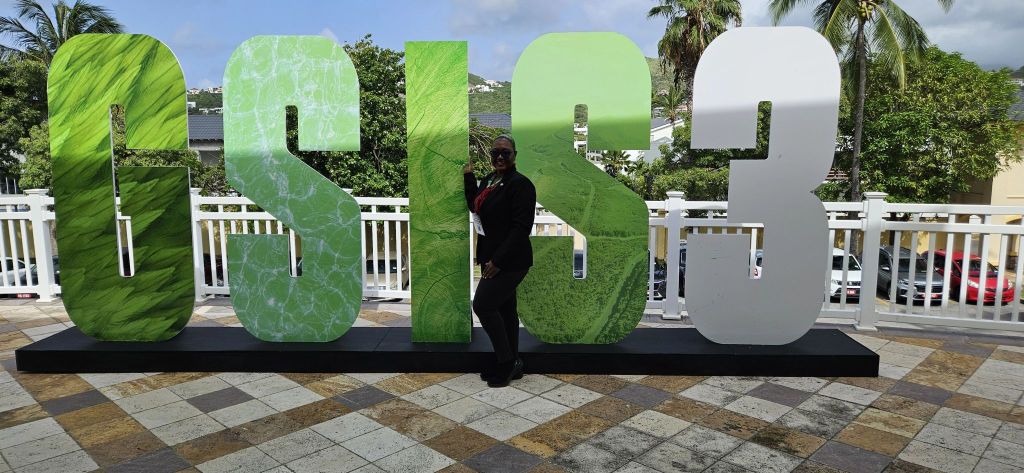
From May 27-29, 2025, I had the honour of participating in the Main Summit of the Global Sustainable Islands Summit (GSIS) in my capacity as an academic. Organised by Island Innovation, this third edition of the GSIS was co-hosted with the Government of the Federation of St. Kitts & Nevis. The event welcomed over 200 delegates, mainly from island states and territories from across the Caribbean and world, some coming as far away as the Marshall Islands and Tuvalu!
In this article, I expand on some of the key points I raised as a speaker on the Day 2 panel “Identifying Opportunities to strengthen relationships between global island states”. I focussed on the critical role of education not just as a social good, but an economic asset indispensable for boosting trade both from and between island economies. To this end, I offer at least three interconnected ways in which education can contribute to boosting island economies’ trade: building human resource capacity generally, enhancing trade capacity and serving as a tradeable service.
Building Human Resource Capacity
For many small island economies, their most valuable resource is their human resource endowment. Poor in natural resources, countries like Barbados and Mauritius for example have since their political independence in the 1960s invested significantly in providing universal access to education, a key component of the development success these two countries have enjoyed.
Investments in education not onlyfoment well-being, but also cultivate a well-educated population capable of advancing national development and adapting to global shifts. A well-skilled and educated workforce is vital not just for the local private sector which relies on a robust domestic talent pool, but also as a draw for foreign investors interested in finding the talent they need locally.
As trade becomes increasingly digitised and technology-driven, the education systems of island economies and territories must evolve to nurture citizens who are not just literate and numerate in the traditional sense, but are technologically literate. An educational system responsive to these trends can drive the high-value growth that Caribbean island economies aim to pursue.
Enhancing trade capacity
Education not only contributes to trade competitiveness by building a country’s human resource generally, but also by building its capacity to trade and engage in trade policy making, more specifically.
The University of the West Indies’ Shridath Ramphal Centre’s Masters in International Trade Policy (MITP) programme, now approaching its 23rd cohort, has played a significant and often understated role in developing a cadre of highly skilled trade professionals across the Caribbean region and even beyond these shores. Many of the MITP alumni sit in the highest echelons of governments (including within the cabinet of Barbados), international organisations, donor agencies, business support organisations and private sector firms. Indeed, on the panel on which I spoke at the GSIS 2025, three of the panelists (myself including) were MITP alumnae, and all women.
Understanding trade rules and standards and conducting market intelligence are fundamental for Caribbean businesses to convert the market access they have on paper through the trade agreements and other trading arrangements Caribbean countries have into market presence. Expanding education in areas like sustainability standards, logistics and compliance will ensure the region can fully harness the benefits of trade and regional integration as it seeks to consolidate the CARICOM Single Market and Economy (CSME).
Education as a tradeable service
Education is itself a tradeable service, and one in which Caribbean island economies already participate across the four modes of supply of service defined by the World Trade Organisation (WTO)’s General Agreement on Trade in Servicess (GATS).
Under Mode 1 (Cross-border supply), Caribbean educational institutions increasingly offer online courses, some of which are taken by students abroad, effectively exporting education services. Under Mode 2 (consumption abroad), students from across the Caribbean travel between islands for tertiary education, while foreign students also come to attend offshore medical universities. Under Mode 3 (commercial presence), foreign universities, especially medical schools like Ross University and St. Georges University, have established physical campuses, resulting in a commercial presence/foreign direct investment. Under Mode 4 (temporary movement of natural persons), Caribbean professionals deliver lectures or courses physically on other campuses or other countries, thereby providing educational services physically in another country on a temporary basis.
With certain countries tightening access to their universities for international students, this presents an opportunity for Caribbean universities to strengthen their value proposition not only to serve local students who might have intended to go overseas, but to attract more international students from the Global South and the Global North.
Despite the allure of Global North universities because of their prestigious names and globally recognised faculty, Caribbean universities like The University of the West Indies, already have several advantages: a history of contributing to Caribbean development and well-recognised faculty in many areas, programmes which are tailored to small states’ and developing realities and promoting solutions grounded in our realities, cognisant of our regional history and development concerns, and a well-established track record of research in many areas like climate change, regional integration, development economics and cultural studies. Let us not forget that we are the region which has produced many thought leaders, including one of the world’s foremost development economists – Sir W. Arthur Lewis!
In other words, Caribbean students’ options are not limited to Global North universities and we need a paradigm shift in the thinking that only Global North universities provide good quality education. Many universities here in the Caribbean have educated persons who are excelling at the highest levels in their field, including current and former statesmen, while there are many global South countries which offer scholarships yearly to our nationals to study at their universities. By supporting each others’ universities we would also be contributing to boosting south-south trade in educational services!
Toward Knowledge Economies
To maximise the role of education in trade, it must be embedded within a broader knowledge economy ecosystem. During the summit, I was particularly intrigued by the research shared by colleagues from ODI Resilient and Sustainable Islands Initiative (RESI) on how SIDS can build robust knowledge economies. Their findings underscore the importance of prioritising innovation and the role of education in this. Building these ecosystems requires stronger linkages between universities, governments and industry, greater investment in research, intellectual property rights protection and support for entrepreneurship and start-ups.
Ultimately, the role of education is not merely to promote trade per se. It is to ensure that the trade in which we engage is inclusive and sustainable and redounds to the benefit of our societies. Although it was not identified as one of the 7 pillars of St Kitts & Nevis’ Sustainable Island State Agenda (SISA), education will be key to achieving this road map set out by that government in its commendable quest to become the world’s first sustainable island state.
Final thoughts
If island economies are to boost their trade and promote a future grounded in sustainable growth, inclusion and transformation, education must be a strategic pillar and not an after thought. I am grateful to Island Innovation and the Government of St. Kitts & Nevis for hosting a very engaging and forward-looking summit and for the opportunity afforded to me to contribute to these conversations.
Alicia D. Nicholls, B.Sc., M.Sc., LL.B. is an international trade specialist and the founder of the Caribbean Trade Law and Development Blog.
-

Re-invigorating CARICOM–Canada Trade in a Shifting Global Order
Alicia Nicholls
On May 5, 2025 I had the opportunity and pleasure of being a panelist on the Canada Caribbean Institute (CCI)’s webinar entitled “Canada-CARICOM Relations in the Trump Era”. In this blog post, I share and expand on some of the reflections I made at this session around the theme of reinvigorating CARICOM-Canada trade in this current global dispensation.
While the US remains an important partner for Caribbean Community (CARICOM) countries, it is well understood in international trade and development circles that overreliance on any single market or partner increases exposure to geopolitical, economic and other shocks emanating in that partner. For the small island developing states (SIDS) of CARICOM whose economies are already highly open and vulnerable, diversifying trade and economic relationships is not a luxury, but a necessity. Diversification entails not only expanding south-south ties with Africa, China, and Latin America, as CARICOM countries have increasingly been doing, but also strengthening partnerships with long-standing allies like Canada. In this storm of uncertainty, Canada stands out as a stable and values-aligned safe harbour—a reality reinforced by the presence of a sizable Caribbean diaspora in Canada and a not insignificant Canadian diaspora presence here in the Caribbean, serving as bridges between us.
The foundations of the Canada-CARICOM trading relationship stretch back to the colonial era when trade between the British West Indies and British North America (now Canada) involved an exchange of sugar, molasses, and rum for Canadian fish, lumber, and flour. That historical trade has evolved in structure and content, but the essence of mutual respect and cooperation remains. Today, our trade is anchored by the Canada Caribbean Trade Agreement (CARIBCAN)—a non-reciprocal preferential trade arrangement established in 1986 under which Canada grants unilateral duty-free access to eligible goods from Commonwealth Caribbean countries and territories. This covers most CARICOM countries’ exports to Canada, excluding goods in Harmonised System (HS) chapters 50-65 (mainly textile products) and goods subject to most favoured nation (MFN) tariffs of over 35%.
CARIBCAN beneficiary countries or territories are Anguilla, Antigua & Barbuda, Bahamas, Barbados, Belize, Bermuda, The BVI, the Cayman Islands, Dominica, Grenada, Guyana, Jamaica, Montserrat, St. Kitts & Nevis, St Lucia, St. Vincent & the Grenadines, Trinidad & Tobago and the Turks and Caicos Islands. Notably, CARICOM member States Suriname and Haiti are not CARIBCAN beneficiaries.
The arrangement is unilateral which means that beneficiary countries and territories are not required to reciprocate by lowering duties on Canadian imports, reflecting the agreement’s original development-oriented rationale: to enhance the region’s export capacity, promote economic development, and stimulate regional integration. The arrangement is subject to a World Trade Organisation (WTO) waiver, which was most recently extended in 2023 for another ten year period (until 2033).
Despite this favourable arrangement, CARICOM’s trade performance with Canada has seen signs of stagnation. According to data gleaned from ITC’s Market Access Map, bilateral trade between CARICOM and Canada was valued at just US $1.2 billion in 2024. This is relatively modest when compared to CARICOM’s trade volumes with other partners. Notably, CARICOM enjoyed a trade surplus with Canada until 2019, but that dynamic has since reversed and Canada now enjoys a surplus with the region. CARICOM countries’ margin of preference in the Canadian market has declined as Canada has concluded agreements with other partners and its tariffs have lowered. Moreover, utilization rates of CARIBCAN preferences vary significantly across countries, with some utilising the preferences for significant shares of their exports and others failing to capitalize on the access afforded. CARICOM’s share of Canadian imports has declined, from 0.17% in 2014 to just 0.09% in 2024. Conversely, Canada’s share of CARICOM’s imports also dropped from 2.5% in 2014 to 1.5% in 2024.
Digging deeper into the data reveals more about what is being traded and where opportunities lie. CARICOM’s leading exports to Canada include gold, aluminum, methanol, rum and spirits, root crops and seafood. On the flip side, Canada exports oil, wheat, iron ores, medicines, and meats to the Caribbean. According to ITC’s Export Potential Map, there remains significant unrealized export potential—estimated at around $1.4 billion. Gold alone, in its unwrought, non-monetary form, represents a good portion of this untapped potential. There may also be scope to expand exports of products like Caribbean rum, especially as Canadian consumers seek alternatives to U.S. products, including spirits and other alcoholic beverages.
On the services side, tourism, commercial services and transportation services form the bedrock of the Canada–CARICOM relationship. Canadian banks have a long history in the region and for Barbados, Canadian firms are the major players in its global business sector. Travel remains one of the most vital service links, with Canada emerging as the region’s second-largest source market in 2024, sending 3.3 million visitors—a 4% increase from 2023, although still below pre-pandemic figures. With Canadians traveling less frequently to the US due to geopolitical tensions between these two countries, there is real potential for the Caribbean to capture more of this outbound market through targeted marketing, improved airlift, and creative offerings such as multi-destination packages. The education link is also noteworthy. Many CARICOM nationals study at Canadian institutions, bolstering ties through Mode 2 (consumption abroad) services trade.
In addition to bilateral trade and services, Canada and CARICOM share values that manifest in their joint positions on the multilateral stage on issues like climate action, support for the Sustainable Development Goals (SDGs), and championing on-going and badly needed reform of the rules-based multilateral trading system. As global multilateralism comes under increasing strain, these alignments become even more critical.
Some concrete recommendations
The 2023 Canada–CARICOM Strategic Partnership, launched at the Ottawa Summit, marked an important milestone. This framework creates a permanent mechanism for structured dialogue and coordination—a platform we must now leverage more ambitiously. There are several immediate and medium-term actions worth considering.
First, we need to better understand and address the reasons behind the low utilization of CARIBCAN by firms in beneficiary countries and territories and ensure evidence-based interventions to remedy this. This might involve empirical research in partnership with institutions like the University of the West Indies. Technical assistance to help exporters meet rules of origin, the simplification of customs procedures, and the creation of digital trade platforms or business missions could strengthen small and medium-sized enterprise (SME) readiness. As most CARICOM countries’ exports (except those exempted from the baseline tariff) now face additional 10% tariffs in the US market where they might have entered either duty-free or reduced rates of duty under the Caribbean Basin Initative (CBI) programmes, some CARICOM exporters will be seeking alternative markets for their products and Canada’s market of 40 million people and where most CARICOM goods can enter duty-free under CARIBCAN, beckons.
Second, the question of whether CARIBCAN should be modernized or replaced with a reciprocal but development-sensitive agreement must be considered seriously before it is up for renewal of the waiver in 2033. While negotiations for a reciprocal trade agreement began in 2007, they eventually stalled due to divergent priorities. Today’s changed global landscape may offer a window to revisit the idea, possibly with a WTO-compatible trade and development agreement better tailored to CARICOM and Canada’s current needs.
Third, Canada and CARICOM could benefit from updating their bilateral investment treaties (BITs) to reflect contemporary standards. Most are older generation BITs which prioritise investor protection over promoting and facilitating investment for sustainable development. In the absence of the negotiation of an FTA with a comprehensive investment chapter, Canada and CARICOM countries with which it has BITs should consider renegotiating their BITs and integrating development-friendly provisions, environmental safeguards, and mechanisms that encourage responsible investment.
Fourth, greater attention should be paid to emerging sectors like digital trade, creative industries, fintech, scientific research and development, and digital health. These are areas where Canadian and Caribbean firms can collaborate meaningfully, and where mutual capacity-building could lead to innovation and job creation. I am always reminded of and inspired by the story of Barbadian-born scientist, Dr. Juliet Daniel, who is doing significant cancer research in Canada. This shows that the possibilities do indeed exist, especially given the strong ties between many Canadian universities and The UWI here in the Caribbean.
Fifth, Canadian tourism is on a growth trend towards its pre-pandemic levels but could be boosted not just through more aggressive marketing in Canada, but through product innovation and better coordination across the region. Multi-destination tourism packages, for instance, could offer Canadians a richer Caribbean experience while distributing tourism benefits more evenly within CARICOM.
Finally, the new Canada–CARICOM Strategic Partnership should also be used as a platform for closer multilateral coordination, including on WTO reform to strengthen the rules-based multilateral trading system. Although the Liberal Party in Canada won the elections in the just concluded election, there is a new Prime Minister and it remains to be seen to what extent he will continue some of the work of his predecessor.
In all of this, the Caribbean diaspora in Canada and the Canadian community in the Caribbean serve as vital bridges that can drive trade, investment, cultural exchange, and policy dialogue, and are important players and allies as we seek to strengthen this relationship.
In a world increasingly shaped by geopolitical unpredictability and economic volatility, deepening our economic relationship with Canada is not simply a reactive response. It is a logical and strategic one. Canada is already a valued partner with shared values, historical ties and a demonstrated commitment to inclusive and sustainable development. But the current level of trade and investment does not yet reflect the true potential of this relationship. There is considerable scope for deeper growth.
Let me thank the Canada Caribbean Institute for the great work it is doing on fomenting this relationship, including its advancement of thinking on forging deeper Canada-Caribbean ties in the backdrop of Trump 2.0, as well as some of the concrete policy recommendations it has highlighted in a recent blog post. In these headwinds of global uncertainty, we should view Canada as not just a buffer in times of crisis, but as a cornerstone in our efforts to build a more resilient, prosperous, and sustainable CARICOM. Strengthening this partnership is more than a policy option—it is a strategic imperative.
Alicia Nicholls, B.Sc., M.Sc., LL.B. is an international trade and development specialist with over 15 years experience and is the founder of the Caribbean Trade Law and Development Blog.
-
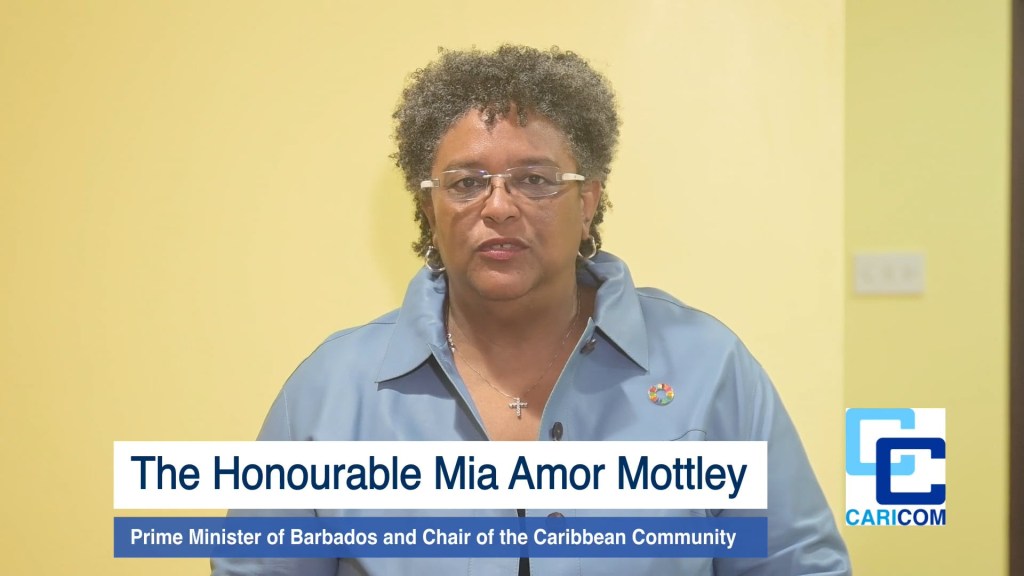
Statement from Chair of CARICOM, Hon. Mia Amor Mottley on Impact of the Global Crises on the Caribbean
(CARICOM Secretariat, Turkeyen, Greater Georgetown, Guyana – Friday, 4 April 2025) –
The transcript of the Statement from the Honourable Mia Amor Mottley, Chair of the Caribbean Community (CARICOM) on the impact of the global crises on the Caribbean.
I speak to all our Caribbean brothers and sisters today, not as the Prime Minister of Barbados, but in my capacity as Chair of the Caribbean Community.
Our world is in crisis. I will not sugarcoat it. These are among the most challenging of times for our region since the majority of our members gained their independence. Indeed, it is the most difficult period our world has faced since the end of World War II, 80 years ago. Our planet faces a climate catastrophe that worsens every year. We have a cost-of-living crisis that has been bedevilling us since the disruption of supply chains, when the COVID-19 Pandemic triggered the shutdown of the majority of countries.
Misinformation, disinformation and manipulation are relevant. The mental health crisis is causing hopelessness among many of our young people, and regrettably, crime and fear are on the rise. We’re fighting wars in the Holy Land, in Europe and in Africa. Countries are distrustful of countries and neighbours are distrustful of neighbours. The international order, the international system, my friends, is in great danger of collapse, and now we are on the precipice of a global trade war.
Our Caribbean economies are largely reliant on imports. Just go to the supermarket or visit the mall or the hardware shop or the electronic store, and you will see that most of the things there are not produced in this Region. Many of those commodities are either purchased directly from the United States of America or passed through the United States of America on their way to the Caribbean region. That, my friends, is a legacy of our colonial dependence. Together with colleague Heads of State and Heads of Government, we have been working to diversify ourselves away from this dependence.
We’ve already started to reap some successes, especially in the field of agriculture, for example, but we still have a long way to go. As we do this work, we have to be mindful that those recent announcements that have been made in the last few days will impact us very directly as a Region and as a Caribbean people.
We are working and will continue to work to become more self-sufficient, but I want every Caribbean man and every Caribbean woman to hear me. This trade war and the possibility of a US $1 million to $1.5 million levy on all Chinese made ships entering US harbours will mean higher prices for all of us at the corner shop, higher prices at the supermarket, higher prices at the electronic store, higher prices for us at the shop, higher prices for us at the restaurant, higher prices for us at the current dealership and beyond.
A lot of Caribbean people will think that these things that you are seeing on television news or reading about are far away and “They don’t impact on me.” A lot of people think “I’m just a farmer”, “I’m just a schoolteacher”, or “I’m just a mechanic.” They say, “I live in Saint Lucy in Barbados”, or “I live in Portmore in Jamaica”, or Kingstown in St Vincent, or Arima in Trinidad or Basseterre in St Kitts & Nevis, or San Ignacio in Belize.
“These problems are far away from me, and they don’t impact me.” That is what you will hear them say. But the reality, my friends, is that if you buy food, if you buy electronics, if you buy clothes, it will impact you. It will impact each of us.
My brothers and sisters, our Caribbean economies are not very large. So, we are, and have always been, at the whims of global prices. If Europe and China and the U.S. and Canada and Mexico are all putting tariffs on each other, that is going to disrupt supply chains, that is going to raise the cost of producing everything, from the food you eat, to the clothes on your back, to the phone in your pocket, to the car you drive down the road, to the spare parts that you need for critical infrastructure. That means higher prices for all of us to pay, and sadly, yes, this will impact all of us, regardless of what any of our Caribbean governments will do.
We could lower our tariffs to zero in CARICOM, and it will not make a lick of difference, because our economies are small and vulnerable. This crisis, my friends, will impact not only goods, but it may also have a large spillover effect on tourism. We suggest that the region takes steps to sustain the tourism industry as likely worsening conditions and many of our source markets will have negative impacts on people’s ability to travel. We call on our regional private sector and the tourism sector to come together and to work with governments to collaborate for an immediate tourism strategy to ensure that we maintain market share numbers as a region.
My friends, I pray that I’m wrong, and I’m praying that cooler heads prevail across the world, and leaders come together in a new sense of cooperation, to look after the poor and the vulnerable people of this world, and to leave space for the middle classes to chart their lives, to allow businesses to be able to get on with what they do and to trade.
But truly, I do not have confidence that this will happen.
So, what must we do?
First, we must re-engage urgently, directly, and at the highest possible level with our friends in the United States of America. There is an obvious truth which has to be confronted by both sides. That truth is that these small and microstates of the Caribbean do not, in any way or in any sector, enjoy a greater degree of financial benefit in the balance of trade than does the United States. In fact, it is because of our small size, our great vulnerability, our limited manufacturing capacity, our inability to distort trade in any way, that successive United States administrations, included, and most recently, the Reagan administration in the early 1980s went to great lengths to assist us in promoting our abilities to sell in the United States under the Caribbean Basin Initiative. We will see how these tariffs will impact on that. That spirit of cooperation largely enabled security, social stability and economic growth on America’s third border in the Caribbean, or as we have agreed as recently in our meeting with Secretary of State Rubio, what is now our collective neighbourhood.
Secondly, we must not fight among each other for political gain. Because my dear brothers and sisters, as the old adage goes “United, we stand and divided, we fall.”
Thirdly, we must redouble our efforts to invest in Caribbean agricultural production and light manufacturing. The 25 by 2025 initiative, ably led by President Ali, seems too modest a target now, given all that we are confronting. We must grow our own and produce our own as much as possible. We can all make the decision to buy healthy foods at the market instead of processed foods at the supermarket.
Fourthly, we must build our ties with Africa, Central and Latin America, and renew those ties with some of our older partners around the world, in the United Kingdom and Europe, and in Canada. We must not rely solely on one or two markets. We need to be able to sell our Caribbean goods to a wider, more stable global market.
My brothers and sisters, in every global political and economic crisis, there is always an opportunity. If we come together, put any divisions aside, support our small businesses and small producers, we will come out of this stronger.
To our hoteliers, our supermarkets and our people, my message is the same. Buy local and buy regional. I repeat, buy local and buy regional. The products are better, fresher and more competitive in many instances. If we work together and strengthen our own, we can ride through this crisis. We may have to confront issues of logistics and movement of goods, but we can do that too.
To the United States, I say this simply. We are not your enemy. We are your friends. So many people in the Caribbean region have brothers and sisters, aunties, uncles, grandmothers, grandfathers, sons and daughters, God children living up in Miami or Queens or Brooklyn or New Jersey, Connecticut, Virginia, wherever. We welcome your people to our shores and give them the holidays, and for many of them, the experiences of a lifetime.
I say simply to President Trump; our economies are not doing your economy any harm in any way. They are too small to have any negative or distorted impact on your country. So, I ask you to consider your decades-long friendship between your country and ours. And look to the Caribbean, recognizing that the family ties, yes, are strong. Let us talk, I hope, and let us work together to keep prices down for all of our people.
My brothers and sisters, there’s trouble in our Caribbean waters, but the responsibility each and every day for much of what we do and what much of what we grow must be ours, if we take care of each other, if we support each other, if we uplift each other, and if we tap into the strength and innovation of our common Caribbean spirit, we will see this through.
Our forefathers faced tribulations far worse than we will ever do and yes, they came through it.
My friends, my brothers and sisters, we can make it.
We shall make it.
God bless our Caribbean civilization.
Thank you.
-

US ‘Liberation Day’ Tariffs: What impact for the Caribbean?
Alicia Nicholls
On April 2, 2025, United States (US) President, Donald J. Trump, announced additional ad valorem tariffs of 10% on goods imports from all countries, including Caribbean Community (CARICOM) countries, under his new ‘Reciprocal Tariff Policy’. In addition, some countries like Guyana, which have a merchandise trade surplus with the US, will face even steeper additional tariffs. This article discusses these ‘Liberation Day’ developments and what they might mean for CARICOM countries.
The Reciprocal Tariff Policy
Earlier this year, on January 20, 2025, President Trump signed a presidential memorandum outlining the broad contours of his America First Trade Policy 2.0, initiating an investigation into the root causes of the country’s “large and persistent” merchandise trade deficit. This was followed by a second executive order, the Presidential Memorandum on Reciprocal Trade and Tariffs issued on February 13, 2025, which ordered a review of non-reciprocal trade practices and their contribution to the U.S. trade imbalance. On April 1, 2025, the President received the results of these investigations.
The executive order of April 2, 2025 entitled “Regulating Imports with a Reciprocal Tariff to Rectify Trade Practices that contribute to large and persistent annual US goods trade deficits” introduces the so-called Reciprocal Tariff Policy as a response to the national emergency supposedly caused by foreign trade and economic practices.
Using presidential authority pursuant to the International Emergency Economic Powers Act of 1977 (IEEPA), this policy applies an additional ad valorem duty starting at 10% on imports from all of the US’ trading partners, effective April 5, 2025 at 12:01 am (EDT). For countries in Annex I, these tariffs will increase to the country-specific rates outlined in that annex effective April 9, 2025 (EDT). For Guyana, the only Caribbean Community (CARICOM) country on Annex I, its goods exports to the US will be hit with additional ad valorem tariffs of 38%.
These tariffs are to remain in place indefinitely, until the President determines that the conditions warranting them have been “satisfied, resolved, or mitigated”. Additionally, the President has the authority to increase the tariffs if the countries retaliate. A narrow range of goods listed in Annex II of the Memorandum is exempt from the ad valorem tariffs.
These new ‘reciprocal’ tariffs aim to address what the Trump Administration perceives as chronic non-reciprocity in the US’ trade relationships, hampering U.S. manufacturers’ ability to compete in foreign markets and thereby threatening American jobs, manufacturing capacity, and competitiveness. However, the methodology used to determine these tariffs has faced criticism. If it is to be a so-called ‘reciprocal’ tariff, the initial thinking by many of us in the trade policy community was that the US would match the tariffs charged by these countries on US imports. Rather, according to financial journalist James Surowiecki in a post on X and later confirmed by economists and the administration, the formula for calculating the additional tariffs appears to involve simply dividing a country’s trade balance with the U.S. by the value of its exports to the US multiplied by ½ to arrive at the tariff rate. This has led to some of the poorest countries in the world being hit with disproportionately high tariffs based on this dubious formula. Moreover, tariffs have even been imposed on small uninhabited territories like the Heard and McDonald Islands, reiterating doubts about the logic behind the policy and on the more humorous side, giving rise to a raft of penguin memes on social media.
Possible implications for Caribbean economies and firms
However, this is no laughing matter as all goods exported from CARICOM countries to the U.S. will now face the additional 10% tariff, except for Guyana which faces a country-specific 38% tariff. This makes the costs of Caribbean products more expensive in the US, although there is the argument that they will also be competing with goods from other countries which might be subjected to even higher country-specific rates.
The US has a large trade surplus with the region on a whole, and with most Caribbean countries, with the exceptions of the commodity-exporting countries of Guyana and Trinidad & Tobago. Indeed, the US remains a key market for several important Caribbean exports, including energy products like oil, ammonia and methanol, as well as rum, textiles and other manufactured and agricultural products. Since the 1980s most CARICOM countries’ goods exports to the US are eligible to enter duty-free due to the Caribbean Basin Initiative and its constituent Acts. This is not a negotiated trade agreement, but a unilateral preferences programme which has enjoyed bipartisan US support because it benefits US manufacturing as the biennial US International Trade Commission (USITC) reports on the operation of the CBERA have consistently shown.
In her latest article, noted Caribbean economist Dr. Kari Grenade outlined a variety of ways in which these developments could impact Caribbean economies, including inflation as since the Caribbean imports a significant volume of US goods, including essential foodstuffs, this could lead to rising prices on our supermarket shelves. Analysis by Tax Foundation shows that the Trump tariffs amount to an average tax increase of more than $2,100 US per US household in 2025. What does this mean for the Caribbean diaspora in the US? What does this mean for Americans’ travel to the region if US consumers will be paying more for everyday goods and will have less disposable income ? What does this mean for those countries in the Caribbean which depend on the US as a major tourism source market?
What next? Firm and regional responses
The tariffs have not yet come into effect, and it is likely that they could be halted at the last minute given the backlash and stock market volatility the announcement has caused. Nonetheless, it is imperative for firms and Caribbean countries to plan for them. For Caribbean exporters which rely on the CBI concessions, this may necessitate rethinking export strategies, possibly by shifting to non-trade market entry strategies to maintain access to the U.S. market, or by diversifying into new export destinations. For those Caribbean companies which rely on inputs imported from the US, they could face higher costs as US manufacturers pass on their increased costs to intermediate and end consumers. This means they will have to continue to diversify their sourcing. Some firms are already doing this.
Retaliation is not a feasible option for CARICOM countries as we import much of what we consume from the US and already have high tariffs on imported goods. Where feasible, Caribbean countries could lower their applied rates on imported goods to help offset some of the pain consumers would feel. Our other main options are diplomatic, preferably as a grouping. Caribbean governments have been engaging in diplomatic outreach to urge the US to reconsider the policy or at least provide carve-outs for small countries. In a recent article, Antigua & Barbuda’s highly respected Ambassador to the US, Sir Ronald Sanders, has called on the US to revisit these tariffs as they are against the spirit of the CBI and US-Caribbean relations, have human and economic costs and also imperil US strategic interests. Indeed, this policy will make the price of US goods more expensive and further incentivise importers in the region to source more regionally or internationally. Moreover, many Caribbean nationals have customarily gone to the US, especially cities like Miami and New York, to vacation and shop, contributing to the economies of those cities. Caribbean nationals will increasingly go to cheaper destinations like Panama.
The ‘America First Trade Policy 2.0’ reinforces the need for us in CARICOM to accelerate efforts to expand our intra-regional trade and continue our trade diversification efforts. This is nothing novel and it is something we have long recognised. I listened to the speech of EU Commission President, Ursula von der Leyen earlier this week and found it noteworthy that the EU, a market of some 450 million people and with the economic heft to implement meaningful retaliatory measures also saw the salience of deeper integration and economic diversification to helping build its resilience and navigate this period of uncertainty. If deeper integration and diversification are important for the EU, they are doubly vital for us in CARICOM. After all, it is not just these tariffs we must contend with, but also the mooted fees to be placed on vessels which are Chinese made or are part of fleets which have a large number of Chinese-made vessels, which could impact many Caribbean countries.
A broader concern is the pall this beggar thy neighbour trade policy by US as the world’s largest economy casts over the rules-based multilateral trading system and the World Trade Organisation (WTO) which it was critical in establishing. While the multilateral trading rules are far from perfect, they have provided a predictable and rules-based framework where, inter alia, countries agreed to bind their tariffs for tariff lines at specific levels, which ensures some predictability for exporters. However, what the Trump administration is doing is contrary to the spirit of the multilateral trading system and will set off a global trade war as major economic powers react with their own retaliatory measures. As history shows, this will possibly have deleterious implications for the global economy, and just a mere five years after the world was hit by the worst pandemic in 100 years. This latest move heralds a more unpredictable, uncertain, unstable and unilateral era in global trade relations, one in which strategic diplomacy, regional cooperation and diversification will be key for CARICOM countries to navigate.
Alicia Nicholls, B.Sc., M.Sc., LL.B. is an international trade specialist and the founder of the Caribbean Trade Law and Development Blog: www.caribbeantradelaw.com.
-
US Tariff Wars: What possible impact for the Caribbean?
Alicia Nicholls
What a time to be an international trade analyst! That was my first thought after reading the latest memorandum dated February 1, 2025, announcing sweeping tariffs on America’s three biggest trading partners—Canada, Mexico, and China. Well-known for using tariffs as a tool for geopolitical ends, President Donald J. Trump is justifying these latest measures as part of a national emergency he declared against illegal immigration and drug trafficking under the International Emergency Economic Powers Act (IEEPA). This Act, signed in 1977, allows the President broad powers to regulate commerce after declaring a national emergency.
These aggressive trade moves, the latest in Trump’s America First Trade Policy 2.0, are in fulfillment of promises he made on the campaign trail and expand on his first-term tariffs on China (which President Biden largely maintained). In his first term he had also announced 25% tariffs on steel imports and 10% on aluminum imports from the European Union (EU), Canada and Mexico. Canada and Mexico are not just the US’ largest trading partners, but are its treaty partners under the U.S.-Mexico-Canada Agreement (USMCA), the agreement that replaced the North America Free Trade Agreement (NAFTA) during Trump’s first term and which is due for review in July 2026 under its review clause.
What do these new tariffs involve?
Yesterday, President Trump announced a 25% additional tariff on imports from Canada and Mexico and a 10% additional tariff on imports from China, and has also vowed to increase these tariffs should these countries retaliate.
This move will of course hurt those countries, affecting manufacturers and also jobs. But Trade 101 is that tariffs also mainly hurt consumers in the country imposing them – the US in this case! Billions of dollars in trade occurs among USMCA countries each year, with tightly interwoven supply chains, especially in the automobile, agriculture, textiles and other industries. Indeed, U.S. goods and services trade with USMCA totaled an estimated $1.8 trillion in 2022, according to the Office of the US Trade Representative (USTR). This means that many of the goods on American shelves come from these countries or were made with inputs sourced from these countries. Therefore, American manufacturers will pay higher costs for raw materials and intermediate goods sourced from these countries and higher business costs which they will likely pass on to consumers. The end result is that American shoppers and businesses will pay higher prices for everyday goods, an ironic state of affairs given that reducing these costs was said to be one of the reasons the American public voted for President Trump.
For their part, both Canada and Mexico have announced retaliatory measures of their own yesterday. Outgoing Canadian Prime Minister, Justin Trudeau, announced in a press conference last evening a 25% tariff on 155 billion (Canadian dollars) of US goods, while Mexican President Claudia Sheinbaum indicated that Mexico will be implementing retaliatory measures as well.
Trump has also again threatened to hit the EU with tariffs, and Colombia following a row over Colombia’s insistence that its deportees be returned with dignity. Trade wars among the world’s major powers threaten global economic stability, as the International Monetary Fund (IMF) warned in October last year, even before Donald Trump was re-elected but in the amidst of tariff threats he made on the campaign trail.
They’ll Hit Caribbean Consumers too
Caribbean manufacturers, which depend on US inputs, will likely face higher prices and business costs, while we end consumers might spend more for American-made food, cars, electronics and the like. However, there are ways in which we could seek to combat this to the best that we can. Caribbean manufacturers should, to the extent possible, continue to explore alternative suppliers to mitigate against these possible price hikes. This state of affairs also makes the case for more intra-Caribbean sourcing. After all, instead of sourcing so much of our fresh fruit from Florida, we could be sourcing these from within the region more.
Final Thoughts
Trump’s tariffs may be aimed at Canada, Mexico, and China, but the ripple effects will be felt far beyond in the possible form of higher prices and business costs, supply chain disruptions and economic uncertainty. Our jobs as trade analysts have never been more important as we help the Caribbean businesses and governments we advise to stay informed, and ready to adapt in an increasingly unpredictable global trade landscape.
Alicia Nicholls, B.Sc., M.Sc., LL.B. is an international trade specialist and the founder of the Caribbean Trade Law Blog. Learn more about her work at http://www.caribbeantradelaw.com.
-

Denial and Banning of Dancehall and Trinibad Artists across CARICOM : Compatible or Incompatible with Regional Integration Law
Rahym R. Augustin-Joseph (Mr.) (Guest contributor)

Overtime, there has been a discernible increase in the denial of entry or even banning of certain dancehall and Trinibad artists, who were scheduled to perform in Caribbean countries in 2024 such as K-Mann 6IXX in Antigua and Barbuda and DJ Punz in St. Kitts and Nevis.
Earlier, in 2022, Skeng was denied future permits for any show he was scheduled to have in Guyana, after the Baderation event he had, was disrupted by gunfire and bottles turned missiles. In response, the Guyanese Government therefore noted that they would no longer issue permits to skeng or other artists whose lyrics included violence and public disorder to perform in Guyana. In 2024 however, it appears that this position was reversed as Skeng performed in Guyana.
But these refusals and banning of artists from other Caribbean countries is not a new phenomenon, as in 2014 Jamaican artiste Tommy Lee Sparta, or Cabral Douglas was denied entry into Dominica, where he was supposed to perform, but it raised concerns for public safety. In 2010, Vybz Kartel was issued a performance ban in Saint Lucia and Barbados, citing his lewd lyrics and raunchy performances, and in 2009, Bounty Killer was also denied entry into Trinidad and Tobago, allegedly without reasons, while Vybz Kartel his reputed rival was allowed to enter and perform. There are many more examples of the denial of entry and banning of artists in the Caribbean.
On the one hand, a wide cross section of the Caribbean peoples listen and engage with the music of these artists, and see it is a citadel of modern Caribbean culture. However, political leaders and technocrats have noted that these artists and their music are in the main, vulgar, misogynistic, crude, and have a major influence in the increased crime and violence in our society. It is their view that this music is contributing towards the increase in gang recruitment and violence, as people continue to be influenced by the lyrical component and call to action elicited by this music. Young people are therefore not seeing this music for its ‘creative expression’ but instead seeing this music for its literal meaning.
One only has to listen to the words uttered by Dr. Mohamed Irfaan Ali of Guyana, when he noted during the 46th Regular Meeting of the Conference of the Heads of Government of CARICOM. He urged leaders to prevent the proliferation of violent music in their respective nations. “We do not need lyrics that promote violence in this region, We have the ability to promote positive lyrics that inspire people to think, act, and behave positively. As leaders, we must take this matter seriously and ensure that the region’s lyrics reflect the positivity embodied by Bob Marley and encourage positive living and change.”
This debate however is to be had at another time, and within our respective countries, wherein one can examine properly whether the music which portrays violence has been having an effect on the perpetrators of violence within the Caribbean, such that if it is reduced, curtailed or banned across various mediums, that it would reduce violence significantly. This is a task for researchers across the region, which political leaders must take their cues from if they are to sustain such an argument.
But, beyond just the consumption of the music by nationals in the respective Caribbean countries, it is also being packaged and sold through concerts and other mediums across the Caribbean. As such, the banning and denial of entry of the artists has effects on trade in services, and also possibly implicates regional integration law of which will be discussed briefly here.
So, how is the banning and denial of entry of artists to ply their trade within the Caribbean a regional integration law problem?
As you may be aware, every CARICOM national has an automatic right of entry and stay within another CARICOM country for a maximum of 6 months pursuant to the 2007 Conference Decision of the CARICOM Heads of Government, Article 45 of the Revised Treaty of Chaguaramas, and the seminal case of Shanique Myrie v. The State of Barbados. This automatic right must also be hassle free, or without harassment or the imposition of impediments. Beyond just the mere right of entry, cases such as Tamika Gilbert v. The State of Barbados also notes that the right extends to being able to move freely within the particular country without any harassment and impediments.
In restricting such right however, the offending state can only do so on two strict and narrowly applied grounds i.e., if the individual is an undesirable or a charge on public funds. Under the first prong, the offending state must show that the individual presents a genuine, present and sufficiently serious threat to national security and safety, public morals, and national health of the member state affecting one of the fundamental interests of the society. So, individuals who actually pose or can reasonably be expected to pose such a threat. It is interesting however, that the cases from the European Court of Justice also suggest that one cannot refuse an individual of another state to one’s territory by reason of or of the threat of conduct which when attributable to their own nationals, do not give rise to repressive measures or other genuine and effective measures intended to combat such conduct. One must show essentially that their own nationals who engage in the behaviour which is refused are prosecuted regularly or otherwise subjected to some legal action. This begs the question of whether the states which have denied entry and banned artists altogether, have similarly banned local artists which share similar lyrical content in their songs?
In the latter, one must show that the individual does not have sufficient funds, such that they will become a charge on public funds, wherein they do not have sufficient monies for the duration of their visit, lack possession of online cash and card among other considerations. Further, when refusing an individual, there are certain procedural elements that the offending country must satisfy, which include inter alia, that they must (I) inform the individual in writing why they are being refused entry, (II) state the reasons why they are refused entry (III) provide them with the right to challenge such decision, through an effective appeal or review procedure with adequate safeguards to protect the rights of the persons denied entry and (IV) allow them the opportunity to consult with an attorney or their consular official of their country.
The probing questions is therefore whether reasons have been given to these artists justifying their performance ban, how long are these measures in effect and is there is a review mechanism for these artists to allow them to appeal against the performance ban and what do these review mechanisms look like. These are according to Dr. Waite, “serious legal and policy questions that have implications for our regional integration movement, cultural exchange, vibrancy of socio-political commentary and our community rights. In order to answer them, a probing review is necessary, not a knee-jerk emotional and moral response.”
However, the right which the refused artists will be captured under is the Article 46 right, which is where community nationals who are skilled nationals are able to travel freely across the region to ply their skills upon attainment and presentation of their CARICOM Skills Certificate. As such, the artists or musicians should be able to travel to any CARICOM state, hassle- free, without any impediments or harassment for a period of 6 months.
Should the abovementioned artists have their CSME Certificate, which is attained by artists after they provide, (I) copies of their portfolio work which include pictures, videos, news, reports, examples of their work, (II) letters from their previous employers which state the period of employment and a job description- which is a bit problematic of a criteria, recognising the entrepreneurial nature of most of our artists and their engagement in the gig economy, (III) letters of reference from previous individuals attesting to work previously and (IV) five invoices dated within the last six months. However, the artists can only enjoy such right of freedom of movement with the acquisition of the CSME Certificate which would validate their status as a skilled national. As such, on a prima facie level, the banning of artists and the denial of entry into certain countries within the Caribbean already has affected and infringed on their community rights as a CARICOM citizen, wherein they can receive redress before the Caribbean Court of Justice in its original jurisdiction.
Of course, any state, which has banned the artists who had upcoming and scheduled performances and shows in their respective countries if challenged would argue that these artists can be classified as ‘undesirables.’ As such they would argue that these artists represent a genuine, present and sufficiently serious threat to their national security, safety, and public morals, and they affect one of the fundamental interests of society. Their argument would possibly be that these artists by virtue of their lyrical component of their music could or have elicited violence in their respective countries, especially with increasing crime and violence statistics and as such is a threat to the national security. Further, they may argue that the lyrics of the artists may also be against public morals, particularly violent music which encourage gun violence. Recognising that there has been no cases within the region which have touched and concerned the exceptions, with regards to the nexus of violence and national security and public morals, one has to look towards the European Court of Justice jurisprudence, which the CCJ would look to.
Within the ECJ, Catherine Barnard in her text, The Substantive Law of the European Union, Four Freedoms has noted that, the court grants member states a certain latitude and margin of discretion to determine what constitutes national security or public security in light of the national circumstances. It would therefore vary from one member state to another as noted in Van Duyn v. Home Office [1974]. Moreover, the courts provide the relevant national authorities an area of discretion within the limits imposed by the treaty, particularly as it does not provide a uniform set of values related to conduct which may be considered contrary to the national security interests of a country. However, the court still maintains its overarching view that there must be a genuine and sufficiently serious threat affecting the fundamental interests of the society.
However, the court has noted in Shanique Myrie, which is a slight departure from the abovementioned, when they noted that public policy cannot be used as a justification for derogation from the fundamental principle of freedom of movement and hassle-free travel of community nationals wholly or unilaterally be determined by each member state without being subject to control by the major community organs, in particular the conference and ultimately by the court as the guardian of the RTC.
The unfortunate or fortunate thing about the law and the decision by the court is that it forces a ‘culture of justification’ as coined by the South African public law scholar Etienne Mureinik, albeit post-law and decision making, wherein our officials must justify their decisions utilising evidence, logical reasoning as the court does not provide a carte blanche to the decision maker, which is critical for policy making and decision making. While members of the public may see it as being heavy handed, Article 211 of the RTC, provides the CCJ with this exclusive and compulsory jurisdiction to interpret and apply the RTC.
As such, questions which have been posed by Dr. Neto Waite, on this subject are instructive and worthy of repetition here, when he asked whether it is right to argue that salacious lyrics undermine public morality and national security, is it true that lyrics about violence and rebellion against government harm public order? Has it ever posed a serious and sufficient risk and if so what does such intelligence tell us? Is the performance ban the best mechanism to deal with it, is it not too draconian and shouldn’t adult concertgoers be left to decide for themselves what sort of lyrics they wish to enjoy? In addressing whether the concern is minors being exposed to such music, he also argues correctly, whether it would be more appropriate for the government In consultation with civil society, implement a parental rating system for concerts based on the lineup of artists which can protect minors and respect the agency of adults to determine what types of music they want to listen to.
However, from the reports in the media, it appears that save and except for Tommy Lee Sparta or Cabral Douglas, of which the CCJ has ruled on, the artists are not being denied entry after they have attempted to enter the respective countries. Instead, they are being banned from before. This does not mean they are not captured under the abovementioned. It just means that existing domestic Immigration legislation is being utilised to preclude entry which has been addressed in Maurice Tomlinson v. The State of Belize and Trinidad and Tobago. The court has therefore noted however that the mere existence of incompatible legislation, which suggests that there are categories of individuals who may not be eligible to enter the respective country, without it being harmonised with community law is not ipso facto, incompatible. Instead, the court will assess the state practice of the particular state to decide whether the legislation is incompatible with regional integration law.
Therefore, this denial and banning of dancehall and trinibad artists would be assessed on a country-by-country basis in order to assess whether the individual country has a history of banning of dancehall and trinibad artists, which would be determinative of the legislation and state practice being incompatible. As such, countries such as Guyana, St. Kitts and Nevis among others may be found inconsistent, and the artists can make a claim even prior to entering that they will be denied entry, because of the legislation and also the application of the legislation with the banning of the artists. The artists would therefore have a claim before the CCJ in its OJ.
However, CARICOM countries should take heed of the warning of the CCJ, who noted in Maurice Tomlinson, “that the court does not condone the indefinite retention on the statute book of a national law which in appearance seems to conflict with obligations under Community Law, and member states must ensure that national laws, subsidiary legislation and administrative practices are transparent in their support of the free movement of all CARICOM nationals and there should be harmonisation of the legislation with Community Law. If there is any permanent or indefinite discord between administrative practices and the literal reading of the legislation, then the rule of law requires clarity and certainty especially for nationals of other Member states who are to be guided by such legislation and practice.”
Another right of the Artists, which may be affected is the right to not be discriminated on the grounds of nationality, as per Article 7 of the RTC. Essentially, in refusing entry to the artist, the offending state cannot discriminate on the artist solely on the basis of their nationality. Essentially, the artists must therefore show that similar individuals i.e., individuals who sing music similar to them have not been denied entry and that these individuals have no separate distinction other than their nationality. The unfortunate hurdle that they will face however is the high and unreasonable evidentry burden, as noted in Shanique Myrie v. Barbados, where the court noted that to show discrimination one has to show that there is statistical data which shows discrimination against the particular nationality that the individual artist has come from. It does not allow discrimination to be seen on a case-by-case basis, with the evidence being solely attributed from the particular case.
The last right however which may affect the artist is the right to provision of services under Article 36 of the RTC, which is connected to the right to freedom of movement as noted in Shanique Myrie v. Barbados. Cabral Douglas v. The State of Dominica notes that an individual can be a service provider, if they satisfy condition precedent in Article 36 which is that (I) it must be within an approved activity in an approved sector, which music and performances are, (II) It must be supplied cross-border, which is satisfied as the artists are moving from one country to another. This would be different from Cabral Douglas, which has been critiqued, where the court held that he could not show that he was providing services because he was from Dominica attempting to provide services in Dominica and therefore the cross-border element was not satisfied. Thirdly, the element of temporary nature will be satisfied as they are travelling for a concert or some other performances which would be temporary. Finally, there must be renumeration as they are going to benefit from the payment by the patrons among other forms of income arising from the concert.
Recognising the above, it would be advisable that these artists troubleshoot their cases in the OJ of the CCJ in order for the court to provide a definitive ruling on this matter, to guide or instruct states as to how to treat with these artists as a collective, ensuring state decisions are compatible with community law, as individual states believe they may be affecting their public morals, national security among other fundamental interests of the society.
This is particularly opportune as there are further promises to increase freedom of movement in the region. The region cannot continue to address these matters in isolation and also ignore the trade and possible incompatibility implications of the individual countries with the RTC.
Rahym Augustin-Joseph is the 2025 Commonwealth Caribbean Rhodes Scholar. He is a recent political science graduate from the UWI Cave Hill Campus and an aspiring attorney-at-law. He can be reached via rahymrjoseph9@ gmail.com and you can read more from him here.
Photo credit: WordPress AI-generated image
-

Trade Year in Review 2024: Top 5 Trade Developments
Alicia Nicholls
As 2024 draws to a close and we prepare to welcome 2025 in another week or so, it is time yet again to reflect on the defining trade policy developments that shaped these past twelve months. This year unfolded against a backdrop of persistent geopolitical tensions, an escalating climate crisis, and economic uncertainty. Yet, amidst these challenges, we also witnessed a resurgence in global trade growth, some landmark trade agreements, and other notable developments, including right here in the Caribbean.
Here are my picks for the top five trade stories that left their mark in 2024.
1. Global Trade Hits Record High Amid Uncertain Outlook
According to UN Trade and Development (UNCTAD) in its latest Global Trade Update, global trade will surge to an unprecedented $33 trillion in 2024, surpassing its 2022 record, and growing by 3.3% over 2023 levels. This impressive growth was driven by a robust 7% expansion in services trade, offsetting the more modest 2% growth in merchandise trade, which remains below its 2022 peak. However, the growth pattern was uneven, with developed regions taking the lead in the third quarter.
While UNCTAD predicts a positive start to 2025, it notes that potential escalation in trade wars, geopolitical instability, and the increasing adoption of industrial policies by major economies add layers of uncertainty.
The World Trade Organization’s (WTO) latest G20 Trade Measures report highlights a notable uptick in trade restrictions and the proliferation of climate-focused support measures by G20 countries, underscoring the complex relationship between protectionism and sustainability.
2. Barbados Hosts Inaugural Global Supply Chain Forum
In May, Barbados made history by co-hosting the first-ever Global Supply Chain Forum with UNCTAD. This groundbreaking event convened global leaders, experts, and stakeholders to tackle the critical issues of sustainable and resilient transport and logistics in Small Island Developing States (SIDS).
The Forum culminated in the adoption of the Barbados Ministerial Declaration, a pivotal contribution to the Fourth International Conference on SIDS (SIDS 4) held in Antigua & Barbuda shortly thereafter. As an attendee of both events, I would like to once again extend kudos to the organisers on two very well organised events which exemplified the Caribbean region’s role in contributing to global discussion and action on key trade and development issues.
3. WTO Director-General Ngozi Okonjo-Iweala Secures Second Term
In November, World Trade Organization (WTO) Director-General Dr. Ngozi Okonjo-Iweala was appointed by the General Council via consensus to a second four-year term starting September 1, 2025. Her leadership comes at a critical juncture, with the WTO navigating legacy reforms and heightened trade tensions. Dr. Okonjo-Iweala’s four-year vision encompasses a WTO that delivers results, modernises to remain relevant, and capitalises on emerging trade opportunities. Her agenda includes finalising agreements on the outstanding agenda of the fisheries subsidies agreement (Fish 2) and Investment Facilitation for Development and preparing for the 14th Ministerial Conference (MC14) in Cameroon in 2026.
4. Landmark Trade Agreements and Ongoing Negotiations
This year saw several landmark trade agreements. The European Union and four Mercosur countries (Argentina, Brazil, Paraguay, and Uruguay) finalized a historic deal after 25 years of negotiations. This agreement promises to deepen economic cooperation and includes provisions addressing deforestation concerns, a contentious point during talks.
In November, Costa Rica, Iceland, New Zealand, and Switzerland signed the Agreement on Climate Change, Trade, and Sustainability, setting a precedent for integrating climate and sustainability goals into trade agreements. Meanwhile, the African Continental Free Trade Area (AfCFTA) launched its operationalization phase with five key instruments adopted, marking a significant leap for intra-African trade.
Closer to home, Trinidad & Tobago and Curaçao advanced negotiations on a partial scope agreement, expected to conclude in 2025.
5. Donald Trump’s Re-election and Its Trade Implications
Campaigning on promises of reshoring manufacturing and imposing hefty tariffs, incoming US President Donald Trump’s second term is poised to once again reshape U.S. trade dynamics. He has already threatened more tariffs on China, as well as tariffs on its US-Mexico-Canada (USMCA) free trade agreement partners: Canada and Mexico. Increased US tariffs on imports from its major trading partners, and retaliatory tariffs by these trading partners could signal potential disruption to the global trade landscape.
Trade analysts are bracing for ripple effects, including retaliatory measures and a potential pivot toward greater unilateralism. The implications for the multilateral trading system and global economic stability will undoubtedly be profound, making this a development to watch in the coming months.
Looking Ahead
At the CTLD Blog, we remain committed to delivering insights on the evolving trade landscape. As we bid farewell to 2024, I extend my heartfelt gratitude for your readership and engagement throughout the year. Here’s wishing you and your families a joyful holiday season and a prosperous 2025. Stay tuned as we continue to unpack the stories shaping global trade in 2025!
Alicia Nicholls, B.Sc., M.Sc., LL.B. is an international trade and development specialist and the founder of the Caribbean Trade Law and Development Blog: www.caribbeantradelaw.com.
-

Barbados’ Debt-for-Climate Resilience Swap: A Blueprint for Sustainable Development
Ainsley Brown (Guest contributor)
Barbados has once again positioned itself as a global trailblazer, completing what it calls the world’s first debt-for-climate resilience swap, a groundbreaking financial arrangement that frees up USD$165 million for critical investments in water infrastructure, food security, and environmental protection. This bold move not only addresses urgent climate adaptation needs but also underscores Barbados’ commitment to sustainable development and ESG (Environment, Social, and Governance) principles.
This initiative is a watershed moment for small island developing states (SIDS) and other climate-vulnerable nations facing the triple crises of high debt, climate change, and biodiversity loss. But what does this deal mean in the broader context of global sustainability, and can it serve as a template for other countries grappling with similar challenges?
What Is a Debt-for-Climate Resilience Swap?
In essence, a debt-for-climate resilience swap involves a country negotiating with its creditors to restructure or reduce its sovereign debt in exchange for commitments to invest in climate resilience or biodiversity conservation. In Barbados’ case, the funds will be channeled into:
- Water infrastructure projects: Including the construction of a new South Coast Water Reclamation and Reuse Facility to more than double water availability by 2050.
- Environmental protection: Investments in mangrove conservation and water restoration.
- Agricultural resilience: Enhancing food security amidst rising climate pressures.
This model allows governments to reallocate resources from debt servicing to vital climate adaptation measures. For creditors, it’s an opportunity to support global public goods like biodiversity conservation while safeguarding their financial interests.
Why Debt Swaps Matter for SIDS and Climate-Vulnerable Countries
Barbados’ Prime Minister Mia Mottley aptly describes this transaction as a model for other vulnerable states. Small island nations like Barbados are the “canaries in the coal mine” of climate change, grappling with rising sea levels, more frequent hurricanes, and dwindling freshwater resources.
Water Scarcity in Barbados
Barbados is one of the most water-scarce nations in the world. Climate change exacerbates this scarcity, threatening not just daily life but also economic activities like agriculture. The New South Coast Water Facility, financed through the swap, aims to alleviate these challenges by increasing water availability and reducing pollution in the Caribbean.
The Debt Crisis
Debt burdens severely limit the ability of developing nations to invest in climate resilience. According to the UN Conference on Trade and Development (UNCTAD), global sovereign debt reached a staggering USD$92 trillion in 2022. More than 50 of the poorest countries are on the brink of default, with some spending more on interest payments than on health or education.
Barbados’ debt restructuring initiative is part of a broader effort to reduce its debt-to-GDP ratio from 105% to 60% by 2036.
Global Examples and Lessons Learned
Barbados is not alone in leveraging debt swaps to address climate challenges:
- Belize: A 2021 debt-for-nature deal reduced its debt by 12% of GDP and unlocked USD$180 million in long-term conservation funding, helping protect the Western Hemisphere’s longest coral reef.
- Ecuador: Converted USD$1.6 billion of debt into USD$12 million annually for Galápagos Islands conservation, under the world’s largest debt-for-nature deal.
- Seychelles: Pioneered marine debt-for-nature swaps, safeguarding its ocean territory while alleviating fiscal pressures.
These examples illustrate how debt swaps can provide fiscal relief, protect biodiversity, and attract new actors and financing mechanisms into the climate action space.
The Bridgetown Initiative: Reimagining Global Finance
Barbados’ efforts are closely tied to the Bridgetown Initiative, a global movement led by Prime Minister Mottley to reform the international financial architecture. Key proposals include:
- Redefining loan terms: Preventing nations from spiraling into debt crises after climate disasters.
- Mobilizing USD$1 trillion for climate resilience: Through development banks and discounted lending for vulnerable countries.
- Establishing a global reconstruction mechanism: Backed by private-sector investment to fund post-disaster recovery.
The initiative recognizes that the current financial system, designed in a post-World War II era, is ill-equipped to address today’s challenges, including systemic inequality and climate change.
Challenges and Limitations of Debt Swaps
Despite their promise, debt-for-nature and debt-for-climate swaps are not panaceas. Critics highlight several challenges, which include:
- Limited scale: While impactful, the financial relief from debt swaps is often small relative to the scale of global adaptation needs, estimated at USD$359 billion annually by the United Nations.
- Complexity: These transactions require extensive negotiations, partnerships, and upfront financing, which can deter broader adoption.
- Dependency on grants and private investment: Debt swaps cannot replace the need for concessional financing, grants, or private sector participation.
A recent IMF report underscores that while debt swaps are valuable, they must complement—not replace—comprehensive debt restructuring and other financial tools.
A Blueprint for the Future?
Barbados’ leadership sets an example of how innovative finance can align debt management with sustainable development goals. The country’s latest debt swap, bolstered by guarantees from institutions like the European Investment Bank and Inter-American Development Bank, illustrates the power of partnerships. This approach also offers co-benefits, such as potential credit rating upgrades, as seen in Belize, which can lower borrowing costs and unlock further investment opportunities. For countries in the Global South, debt swaps could:
- Enhance fiscal space: Freeing up resources for health, education, and climate action.
- Attract international support: By demonstrating strong commitments to ESG principles.
- Foster resilience: By addressing both immediate adaptation needs and long-term sustainability.
Conclusion
Barbados’ debt-for-climate resilience swap is not just a financial transaction; it’s a bold declaration that climate action and fiscal responsibility can—and must—go hand in hand. As more countries explore similar arrangements, the potential for scaling up global climate finance becomes evident. However, achieving transformative change requires systemic reform, including:
- Expanding access to concessional financing for vulnerable nations.
- Enhancing the efficiency and scope of global financial institutions.
- Prioritizing sustainable development in creditor-debtor negotiations.
Barbados has provided a roadmap for others to follow. The question is no longer whether debt swaps are feasible but how quickly and effectively they can be scaled to meet the global challenges of our time. As Prime Minister Mottley aptly said, this is not just about Barbados—it’s about creating a future where “people and the planet” take precedence over profit and debt burdens. Let this serve as a call to action for governments, financial institutions, and global citizens to rally behind innovative solutions for a more sustainable world.
By pioneering this debt-for-climate resilience swap, Barbados has turned an economic challenge into an opportunity for leadership. The world would do well to take notice—and to act.
Ainsley Brown is a global expert in economic development and special economic zones, passionate about aligning finance with climate action to create resilient futures.
-
What Trump 2.0 Could Mean for the Caribbean Region
Rahym R. Augustin-Joseph (Mr.) (Guest Contributor)
Rahym R. Augustin-Joseph On November 5th the Caribbean watched with bated breath, the outcome of the US Elections, knowing that the results of the global superpower, would have significant and decisive implications for the future of the Caribbean, because of America’s tremendous influence and leadership in global multilateralism. Of course, the common refrain is that ‘if America coughs, the Caribbean catches the cold.’
Notwithstanding, both the candidates lacking any particular and comprehensive plans for our region particularly in the trafficking of illegal firearms which is causing havoc in our streets, the Caribbean watched with a keen eye.
But, as it was clear that Donald Trump had won the US Presidency, for the second time, Caribbean leaders such as Prime Minister Mia Mottley, Andrew Holness, Philip J. Pierre, Philip Davis and others, posted their congratulations, in signs of diplomacy, most noting that their countries remain committed to strengthening the close and enduring friendship and partnership with the US. The diplomatic niceties however could not obfuscate the questions they have, and the Caribbean people have about what it would mean for us and the stability or instability of the global international order.
As such, what will Trump 2.0 mean for the Caribbean?
Climate Change
While we don’t know for certain what policies the Trump administration will pursue internally on climate change in light of increased climate-related disasters across the US, and the fact that the Inflation Reduction Act has continued to pour over $390 billion into EVs, and other climate resilient technologies, which have created millions of jobs and other benefits to Republican affiliated states. These may all disappear if he repeals sections of the Act. However, If this has impacts during the midterm elections, he may not be as keen to repeal.
But his global actions will have disastrous impacts for the Caribbean, particularly since he has promised to withdraw the US again from the Paris Agreement, and possibly to withdraw from the United Nations Framework Convention on Climate Change (UNFCCC), which is the multilateral framework for the reduction of carbon dioxide (CO2) in the world, and which also provides financial and technical assistance for developing countries like the Caribbean to mitigate climate change through a shift to renewable energy, and to adapt to its impacts and respond to the loss and damage it creates.
When these are coupled with his denial of the existence of climate change as a ‘hoax’, and his intention to ‘drill baby bill’ and ‘frack, frack, frack’, like never before, increasing the fossil fuel stock of the US, which some have suggested would not only roll back the gains by President Joe Biden, but contribute an estimated 4 billion tons of additional CO2 emissions by 2030 and 25 billion tons by 2050, then these increases would significantly increase the vulnerability of the Caribbean to extreme weather events, more ferocious hurricanes, devastating droughts and floods, and deadly heatwaves, which can continue to plummet our GDPs, increase poverty, destroy infrastructure and roll back any gains made in our climate recovery processes.
As we know, our Caribbean countries are low-lying and heavily exposed to rising sea levels, which erodes coastlines, and displaces populations and industries. Any withdrawal from the Paris Agreement, which is meant to reduce greenhouse gases (GHGs), will increase the emissions of these gases, thereby exacerbating the climate crisis and affecting our ability to protect lives and livelihoods. Of course, it is a no brainer that with warmer ocean temperatures that increase the intensity and ferocity of our hurricanes, the US exit will increase the levels of financial and technical support needed to bolster the climate recovery effort. Such an exit is even more egregious when you add the fact that the US, together with the other developed countries, are the ones that have created this existential climate crisis. The Caribbean may unfortunately be in for some hotter months, longer droughts and more devastating floods.
What is needed now is not an increase in GHGs, which fuels the extreme weather patterns, which Trump promises, but a radical decarbonization of the US and other global economies. Caribbean leaders should therefore be prepared to dialogue with the President on these critical issues, but also to engage other European counterparts to step up and not bend over backwards to try and mould the climate regime around the vagaries of the US political currents.
These countries, together with China, must now play leading roles in reducing the climate crisis. This is not to suggest however that when the US exits, the climate movement is ‘trumped’, but it is only morally appropriate that due to their overwhelming historical and current contributions to global GHGs, that the US contribute towards reducing the effects on developing countries. Additionally, they must meet their financial obligation, not just to the USD 100 billion per annum that was promised from 2020 by developed countries, but to a higher New Collective Quantified Goal (NCQG) on Climate Finance, which was one of the UNFCCC’s Twenty-Ninth Conference of the Parties (COP 29) outcomes held in Baku, Azerbaijan. It is one thing to withdraw from the Paris Agreement, like Trump did during his first presidency, but it is another thing entirely to commit to increasing greenhouse gas emissions by expanding oil and gas exploration, given the severe impacts that Caribbean and other SIDS are already experiencing from the climate crisis.
Immigration
Trump’s immigration policy, according to him would see the largest domestic deportation operation in human history of millions of illegal immigrants.
For the Caribbean, and Haiti in particular, this is troubling, because Trump’s inward-looking policies will devastatingly affect all who flee from war, climate crises, strife, political upheavals and the collapse of their states in search for a better life or the American dream, which has sustained the economic prosperity of America. This use of excessive force against already vulnerable and marginalised populations is testament of Trump’s disregard for human dignity and rights.
Of course, it is easy for us to sit in comfort and say that ‘they should enter legally now or that they should return to their countries.’ That is a privileged position as our countries are not facing the life-threatening issues that Haiti and others do, requiring individuals to flee, as a condition of survival. Who feels it knows it!
But have we for one moment, considered that it is also a global responsibility to ensure integration of displaced peoples, in tandem with our humanitarian and civil rights requirements, particularly in circumstances where the US has also contributed towards this destabilisation and has an opportunity to cure these wrongs? At least in Haiti’s case for certain. But, Trump may only compound the problem, making the work of the Expert Group more difficult, if he refuses to assist, but also if he increases his Haitian animus. Remember his eating the animals’ comments, and how they were poisoning the blood of America, ignoring the diversity of America.
What is even more certain is that Trump may not provide support for the improvement of the Haitian state, such that migration is an option, and not a necessity.
It will also now become almost impossible to gain a legal path to citizenship, as even those who have become citizens by marrying an American citizen or their child is a ‘dreamer’ are at risk of deportation, thereby further decreasing their quality of lives causing migration issues for the Caribbean.
The implications for the Caribbean are a general sentiment of fear of migration and lack of belonging as they search for a better life, and a concomitant fear by those who voted for ‘closed borders’ of all who are not of the blood of America i.e., also Caribbean peoples. But, more directly, if there are Caribbean peoples who are ‘illegal immigrants’, working and providing remittances to their families back home, one can potentially see a massive reduction in the country’s remittances income, which contribute towards healthcare, education among other areas. The reduction will exacerbate poverty, which has wider economic impacts for the Caribbean economy. Further, there may be deeper fiscal and political strains on other Caribbean countries which would not be able to handle this sudden migration flows.
Already, there are reports in mainstream media which suggests that certain Caribbean countries such as the Commonwealth of Bahamas, Turks and Caicos and Grenada have all denied the Trump’s transition teams proposals to deport migrants to these third countries, recognising the inability and difficulty to deport them to their home states. These countries have probably already made an analysis of the political, fiscal and ‘security’ constraints of this proposal and determined that their country is unable to handle this influx. But, even without a determination by these Caribbean leaders, there are international human rights considerations which should have been assessed prior to such requests being made. But this request and its attendant failure necessitates a rethinking of this policy position to deal with the immigration issues in a manner which is respectful to international human rights norms and laws, which ensures human dignity and protection.
One would have to continue to follow these developments to see the extent to which this American off-shoot of the ‘British Rwandan scheme’ which met its demise in the courts and with the election of Sir Keir Stramer would extend to other parts of the world. It would be interesting to see where next will President Elect Trump turn to house the ‘deportees’ and what the American people who have voted for such immigration policies believe of the early indications of this policy failure?
But, these issues of immigration should never be divorced from the underlying race relations, which as a region whose population is predominantly black should still be of concern to the Caribbean, particularly as President Trump in his last term was apathetic in his condemnation of these incidents which sparked the BLM and is ignorant and tone-deaf to institutionalised racism in the United States.
The Caribbean region as a whole through their political leaders need to engage the President on the abovementioned.
Foreign Aid
In Trump 2.0, particularly with his isolationist ‘America First’ philosophy, there may be less pushback to aid cuts as there were in Trump 1.0, and it could mean that key developmental programmes and agencies within the Caribbean could receive less funding, particularly in areas that are not favourable to the Trump administration. It means that the Caribbean should now utilise the opportunity to continue forging new relationships with new nations, as opposed to confining itself to looking North.
Trade
As Trump seeks to reduce the US trade deficit, ensuring manufacturing jobs stay within the US, and ensure a baseline global tariff for imports, it has the potential to affect Caribbean exports to the US, making it more difficult through stricter trade regulations. Should there also be a modification of the Caribbean Basin Initiative (CBI), which provides certain duty-free access to the US market, in favour of US production, it could also reduce the competitive advantage of Caribbean goods in US markets. But, recognising the large trade deficit with the US, the Caribbean poses no real threat to US jobs, and its beneficial nature to US industry might prove helpful to its continuation.
Global Peace and Solidarity
In global peace and solidarity, the wide cross section of people in the Caribbean, in addition to Caribbean leaders have echoed their Pro-Palestine support as noted through protests and online commentary, that there should be a two-state solution in which the two peoples can coexist. However, both the Biden-Harris Administration and now President Trump, has declared their unwavering support for Israel and their Prime Minister Netanyahu. They have suggested that Israel has a right to defend itself under International Law, but ignored that, while true, the acts of retaliation must not go beyond proportional self-defence where the actions must be defensive rather than punitive. In this case, these actions have gone beyond. As such, a Trump presidency would see the continued support of Netanyahu, which is at odds with the position of the Caribbean in the main. The implications therefore is that Caribbean countries must dialogue with the US and other countries, in order to echo an approach of Middle East peace. Of course, one does not have to explain the approach which will be taken to the Caribbean’s friend, Cuba with the continued embargo.
In the end, Caribbean leaders and people should never see the election of Donald Trump as far removed from impacting the Caribbean region but heed the words of David Rudder, the Trinibagonian Calypsonian, when he said that “they’re trying to pass all laws to spoil our beauty, but in the end we shall prevail. We must take a side or be lost in the rubble, in a divided world that don’t need islands no more. Are we doomed forever to be at somebody’s mercy, little keys can open up mighty doors. Rally!”
Rahym Augustin-Joseph is the 2025 Commonwealth Caribbean Rhodes Scholar. He is a recent political science graduate from the UWI Cave Hill Campus and an aspiring attorney-at-law. He can be reached via rahymrjoseph9@ gmail.com.
-
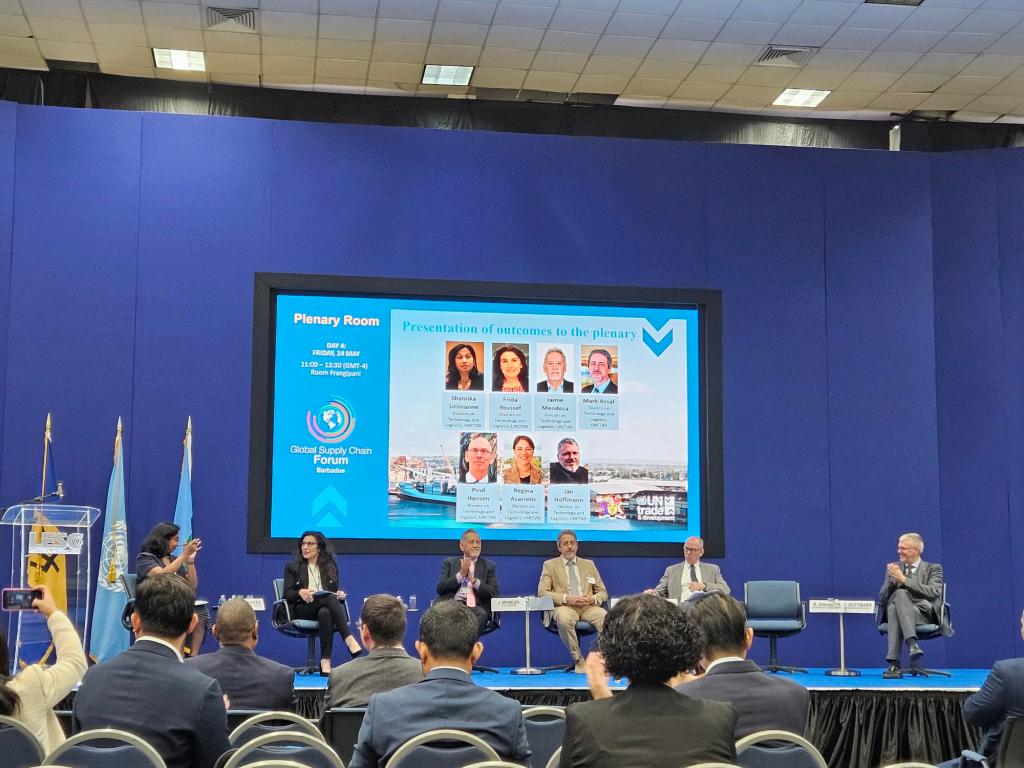
GSCF Day 4 – Gender Equality Plenary and Closing Ceremony
Alicia Nicholls
Ladies and gentlemen, it is a wrap! The curtains have come down on the inaugural Global Supply Chain Forum, jointly hosted by UN Trade and Development (UNCTAD) and the Government of Barbados here in beautiful Barbados, May 21-24. Barbados is no stranger to hosting high-level conferences. But it gives me such pride as a Barbadian to see my country not just propose but host this important forum. Some 1,200 persons reportedly attended the Forum, of which 900 attended in person!
Today’s proceedings commenced with the final plenary which touched on the important theme of gender equality in global supply chains. A key takeaway from the International Labour Organisation (ILO)’s Director General Gilbert Houngbo’s introductory remarks on the panel was that while women now make up a large part of this sector, they still only occupy a small percentage of the higher-level jobs and continue to face several challenges, including poor working conditions, discrimination on the basis of gender and sexual harassment/violence. It was also enlightening to hear from each of the outstanding women on the panel, including the UN Trade and Development SG Rebeca Grynspan, on their own trailblazing journeys and some of the ways their respective organisations are seeking to support and increase women’s participation in this sector.

The closing ceremony featured reflections on the week’s events, key takeaways and some next steps for 2026 in Saudi Arabia. The Forum’s main outcome, the SIDS Ministerial Declaration, was signed by the ministers present and will be one of the inputs into the SIDS 4 conference taking place next week in Antigua.
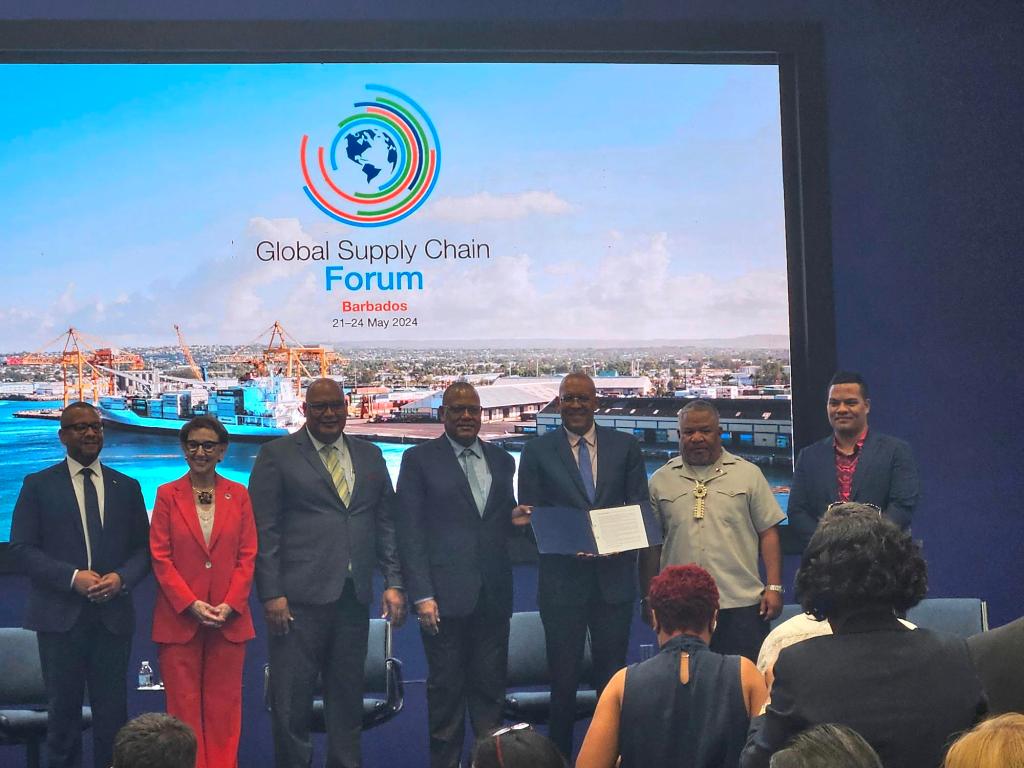
The Forum was a resounding success! Heartfelt kudos to all involved, including Carlos Wharton, Ambassador Matthew Wilson and their teams and all other members of Team Barbados, as well as the UNCTAD team, including Jan Hoffmann and Pamela Ugaz!
I will be heading to Antigua for SIDS4. Follow us for our updates there!
-

GSCF Days 2 & 3: Sustainability Issues, the Youth and Port Tour
Alicia Nicholls
Sustainability issues, including issues around climate change and greening supply chains, dominated the discussions on Days 2 & 3 of the historic and inaugural Global Supply Chain Forum (GSCF) taking place here in Barbados, May 21-24! The parallel sessions touched on diverse topics, all with a sustainability underpinning, and included leveraging pooled procurement, Electronic Single Windows, National Trade Facilitation Committees, food (in)security, climate change, decarbonisation of ports, building resilient supply chains, energy transition of fishing fleets, trade in services for economic diversification, regional connectivity, among others. The sessions allowed for discussing not just challenges, but the sharing of best practices from around the world.
I also wish to make special mention of the panel on Day 3 on Regional Connectivity and the frank discussion which ensued on the challenges and opportunities for improving regional air and sea connectivity and intra-regional trade.
Given the sustainability thrust, it is therefore fitting that the youth voice was also featured over these past two days. Notably, there was a side event forum hosted by the UWI and UN Trade and Development with SG Rebeca Grynspan at the main campus of The UWI Cave Hill on Day 2. There was also a special panel co-organised by The UWI and UN Trade and Development on Day 3 on youth involvement in global supply chains.
A highlight for me was the port tour this morning (Day 3) at the Bridgetown Port where we as delegates on the tour got to see first hand some of the work being done to expand the Bridgetown Port’s capacity and efficiency. This includes for example the new berth 6 under construction and a marina which will feature a small supermarket which is also currently under construction, new cranes being ordered, among other things.

Stay tuned for Day 4 updates, the final day of the forum!
Did you miss our updates from Day 1? Check them out here!
-
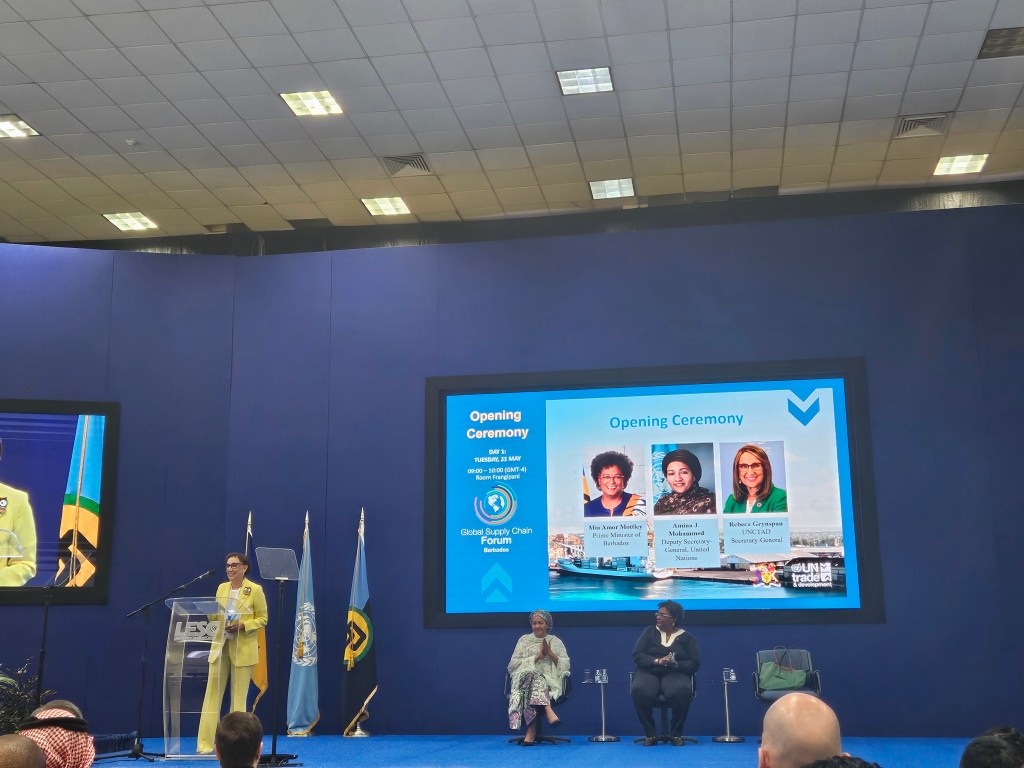
GSCF Day 1: SIDS Ministerial Declaration on Transportation Launched and Location of next GSCF Announced!
Alicia Nicholls
The inaugural Global Supply Chain Forum (GSCF), jointly organised by UN Trade and Development (UNCTAD) and the Government of Barbados, kicked off yesterday at the Lloyd Erskine Sandiford Centre in Barbados with an opening ceremony and several high-level panels, including a High-Level SIDS Ministerial Dialogue. The forum’s theme is “Transport and Logistics Challenges and Opportunities Relevant to Small Island Developing States (SIDS)”.
One of the key highlights of Day 1 was the official launch of the Ministerial Statement for Enhancing Transport and Logistics in SIDS. This document is not only a key outcome of the GSCF but a major input into the upcoming 4th UN International conference on Small Island Developing States (SIDS4) taking place in Antigua next week.
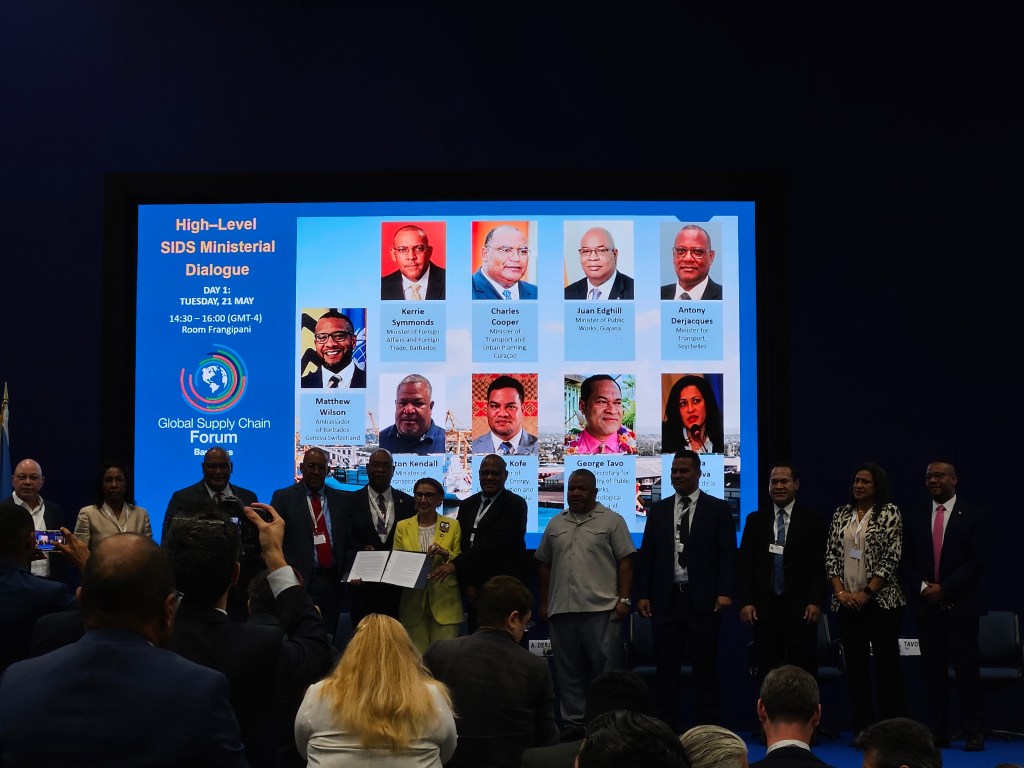
The second major highlight was that Secretary General of UN Trade and Development (UNCTAD) announced that the Kingdom of Saudi Arabia will host the next GSCF.
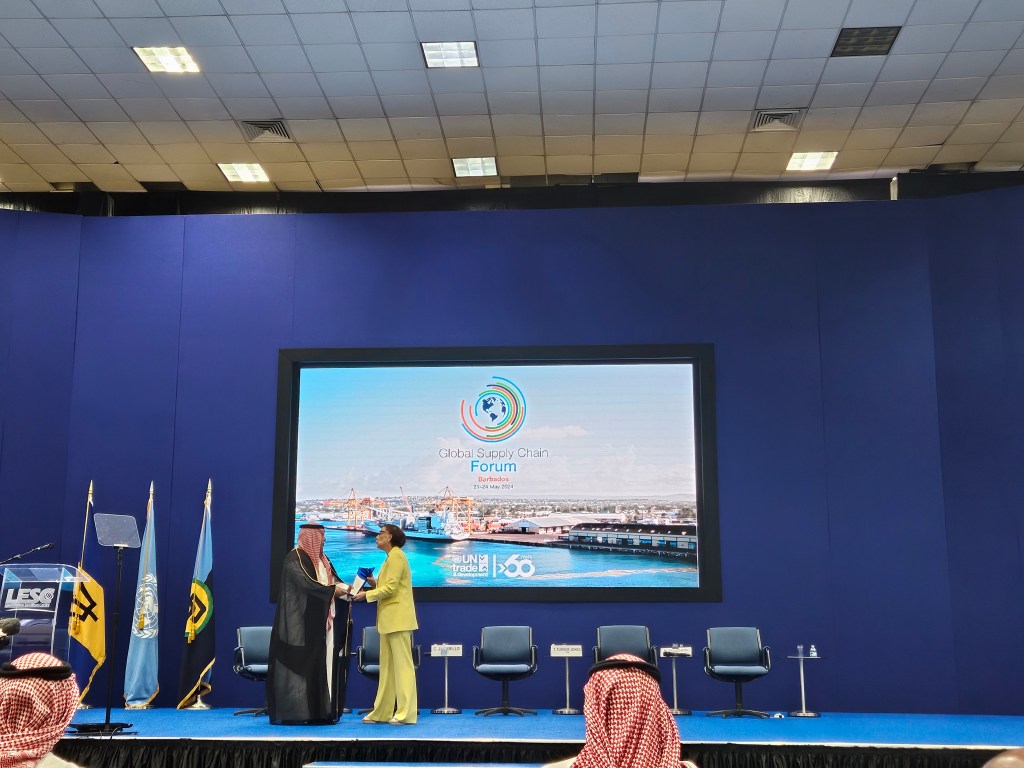
Stay tuned for updates from Day 2!
-

Caribbean Hosting Global Supply Chain Forum & SIDS4 Summit
Alicia Nicholls
While cricket fans are glued to the upcoming International Cricket Council (ICC) Men’s T-20 World Cup, policy nerds like me have our sights set elsewhere. Over these next two weeks, the Caribbean will host two high-level international conferences gathering together delegates from across the world to discuss issues which are germane to Small Island Developing States (SIDS). In this piece, I discuss briefly what these two upcoming conferences and their themes mean for SIDS.
Global Supply Chain Forum
This week, May 21-24, the Government of Barbados will co-host with UN Trade & Development (formerly UNCTAD) the historic Global Supply Chain Forum. Its delegates from drawn from all over the world and include Heads of Government and other high-level political officials, experts, academics, practitioners and other stakeholders. Its high-level panels will encompass discussions on transport, logistics and trade facilitation for sustainable development.
Issues around logistics and supply chains occupy significant importance for SIDS which due to their high dependence on international trade. Their small size, geographic isolation and climate-vulnerability also generate particular logistics and transportation challenges. As such, these panels will discuss, inter alia, practicable solutions for helping these countries better integrate into global supply chains, and to improve the sustainability, efficiency and resilience of their transportation and logistics networks.
Among the anticipated outcomes will be the adoption of the Barbados Ministerial Declaration on Sustainable and Resilient Transport and Logistics in SIDS which will be presented at the upcoming Fourth International Conference on Small Island Developing States (SIDS 4) conference.
SIDS4 Conference
From May 27-30, Antigua & Barbuda will host the UN Fourth International Conference on SIDS (SIDS4) under the theme “Charting the Course Toward Resilient Prosperity”. In addition to the conference, there will be a number of side events, including the SIDS Global Business Network Forum 2024 immediately preceding the conference.
In 1992, SIDS were declared a special case for environment and development at the UN Conference on Environment and Development. Barbados hosted the first Global SIDS conference in 1994. Subsequent SIDS conferences were held in Mauritius (2005) and Samoa (2014). As with each of these decennial conferences, the main outcome document will be a new Programme of Action for SIDS for the next ten years.
Topics on the agenda include climate change, biodiversity loss, ocean conservation, disaster risk reduction, access to finance, debt sustainability, and the overall sustainable development of SIDS, according to the host government of Antigua & Barbuda. As such, yet again, the Caribbean will play a pivotal role in shaping the SIDS agenda for the next decade.
Why it matters
The Caribbean’s role in hosting these conferences brings both practical benefits in terms of tourism arrivals and spend, and international recognition. It places the region at the heart of global discussions and decision-making on issues crucial to SIDS, giving us a hand in crafting our fate. With the UN SDG deadline just six years away and climate challenges intensifying, these discussions are even more urgent now than ever.
Exciting times await us! We at Caribbean Trade Law & Development will be in attendance at both and look forward to bringing you, our readers, updates from these two important events.
Alicia Nicholls, B.Sc., M.Sc., LL.B. is an international trade consultant and founder of the Caribbean Trade Law & Development Blog www.caribbeantradelaw.com.
-
An evaluation of the Exporting mode of entry of Carib Brewery into the Cuban market
Mala Samaroo and Natasha Gomes-George

The aim of this research report is to evaluate the Trinidad company – Carib Brewery’s – exporting mode of entry into the Cuban market which commenced in January 2019. This research is significant because it will supply readers with a thorough examination of the exportation mode that was negotiated and utilized by Trinidad and Tobago’s Carib Brewery. Also this research will spotlight as well the possible benefits and challenges that Trinidad and Tobago’s Carib Brewery successfully managed to eliminate during the two year intense negotiations (2016 – 2018) with Cuban authorities prior to the company’s entry into the Cuban market in December 2018, after Carib Brewery officially appointed UCSA Freixent S. A. as its agent for the Cuban market. As such, the purpose of this research report will result in a better understanding of the exporting mode of entry as well as the benefits and challenges upon entering into the Cuban market.
In Section I of the research report, general data of the organization has been gathered. Data is gathered through primary and secondary sources also. Section II of the research report, the information is gathered through the PESTLE analysis to help determine the factors that are at stake in the Cuban market. Objective of the research report is to conduct a thorough analysis that will relate the various marketing and distribution strategies of Carib Brewery into this particular market. As a result, the research report draws attention to the fact that Cubans favour Carib Brewery beverages particular Carib lager beer which comprised 45% of the market. Pricing strategy proved to be the most successful marketing and distribution strategy in the Cuban market as Carib Brewery will undoubtedly gain a competitive edge by offering their product at low affordable prices. Regarding the political factor of the PESTLE analysis, it is suggested that Carib Brewery pays special attention to tax prices as they fluctuate on a regular basis.
Also, economically speaking, the cost of labour and raw materials tend to increase regularly, therefore this factor needs to be evaluated. More importantly, Carib Brewery utilizes recycling procedures pertaining to old bottles in order to conserve the environment. This environmental factor has proven to be an effective one thus far and can be in the Cuban market as well. In the end it is recommended that Carib Brewery export Carib products to Cuba specifically the Carib lager beer. Also, in order to boost sales, culture-specific marketing plans should be followed alongside pricing strategies. The economy pricing method should be followed as low prices can be offered; also making a name in the Cuban market is important. Lastly, it is recommended that Carib Brewery utilize the Segmentation, Targeting & Positioning (STP) Strategy as the right products will reach the correct customer.The full paper may be accessed here.
The paper was authored by Mala Samaroo and edited by Natasha Gomes-George, an International Trade Development Specialist.
-
WTO Thirteenth Ministerial Conference: What’s at stake?
Alicia Nicholls
All eyes of the trade policy world will be on the United Arab Emirates’ glistening capital city, Abu Dhabi, for the World Trade Organization (WTO)’s Thirteenth Ministerial Conference (MC 13) taking place February 27-29, 2024. Under the chairmanship of His Excellency Dr Thani bin Ahmed Al Zeyoudi, UAE’s Minister of State for Foreign Trade, WTO members’ trade ministers and other delegates will discuss several key priority areas in hopes of securing a substantive package of outcomes which reinvigorates some confidence and strength to the WTO and the rules-based multilateral trading system which it oversees. This article takes a broad look at some of the major issues being discussed.
Unlike other major multilateral organisations, the WTO is run by its members. Its highest decision-making body, the Ministerial Conference, comprises all of its members and meets every two years. The main exception to this was the four-year lag between the Buenos Aires Ministerial (2017) and Geneva Ministerial (2022) due largely to the COVID-19 pandemic.
Similar to the run-up towards the last ministerial (MC 12), pressure exists for achieving concrete outcomes from this Ministerial Conference. Public commentary leading up to the ministerial has ranged the gamut from optimistic to pessimistic, especially since some issues like the TRIPS Waiver extension and agriculture appear far from reaching consensus. Significant discussions and preparatory work by delegations leading up to MC13 seek to ensure, however, that the pessimists are proven wrong. Indeed, ever-optimistic, the WTO’s formidable Director-General, Dr. Ngozi Okonjo Iweala is quoted as stating ““You know it’s always very difficult and seems like it’s not going to work…But we never say never. We are going to get it done.”
Two new accessions
On the bright side, the WTO will see two new accessions – Comoros and Timor Leste, the first since 2016 and which will bring its membership from 164 currently to 166. Both Comoros and Timor Leste are least developed countries (LDCs) and small island developing States (SIDS), emblematic of the importance small States in particular attach to the rules-based multilateral trading system despite its flaws. Some twenty-two other countries or separate customs territories are presently in the accession process. This lends credence to the argument that despite its shortcomings, countries still see WTO membership as desirable.
Fisheries Subsidies Agreement
Securing the entry into force of the Fisheries Subsidies Agreement, which was adopted at MC12 in 2022, is one priority area, as well as the second round of negotiations under that Agreement. The Agreement establishes binding multilateral rules seeking to discipline harmful fisheries subsidies which have been detrimental to the world’s fish stocks. The Agreement requires two-thirds of the WTO’s membership to deposit instruments of acceptance. Barbados, Dominica and Haiti recently deposited their instruments of acceptance this month. Indeed, Barbados’ Ambassador Matthew Wilson shared a video entitled “The Barbadian Matriarchy of Fishing” to highlight the importance of supporting small-scale and artisanal fishing in Barbados.
E-commerce moratorium extension
In place since 1998, the long-standing agreement among Members against imposing customs duties on electronic transmissions is due to expire unless Members agree once again to extend it. This e-commerce moratorium has been controversial as some countries argue that it has been critical for a smooth environment for digital trade. However, some developing countries are concerned about foregone customs revenue.
Trade and development
Development-related issues are also key on the agenda, particularly how to operationalize the development flexibilities – Special and Differential Treatment – within the WTO’s agreements. In December 2023, WTO members agreed on a draft decision to be submitted to trade ministers for approval at MC13 on further integration of small economies into the world trading system. Additionally, in January 2024, the Plastics Pollution Dialogue, comprising 76 WTO Members, reached agreement on a ministerial statement to be issued at MC13.
Incorporation of JSI outcomes into WTO rulebook
Since the stalemate of the Doha Development Agenda, some WTO members have turned to joint statement initiative discussions as a way to advance rule-making in the WTO in the areas of e-commerce, MSMEs, investment facilitation for development and domestic regulation in services trade. The JSI discussions have been criticized by some members, most prominently India and South Africa, as ‘illegal’ and lacking a formal mandate for the discussions. As such, the recently concluded Investment Facilitation for Development (IFD) Agreement’s incorporation as a plurilateral agreement under Annex 4 of the Marrakesh Agreement remains fraught. It would require consensus, including support from non-parties to the Agreement and from countries which oppose the JSI process. Six CARICOM Member States (Antigua & Barbuda, Barbados, Belize, Dominica, Grenada, Suriname) participated in the IFD Agreement negotiations and are among the 118 WTO members which support the Agreement.
WTO Reform
WTO reform has been an important agenda item, but the Doha Development Agenda stalemate and the Appellate Body crisis have reiterated the need to reform the institution’s dispute settlement function. A draft text on dispute settlement reform has elicited much discussion but there appears so far to be no way forward for the resumption of a two-tier system.
Lots at stake
Interestingly, the WTO’s MC13 will be taking place at the same time as the 46th Regular Heads of Government Meeting in Georgetown, Guyana, opening on Sunday, February 25. However, it is expected that at least some of CARICOM’s trade ministers will be at MC13, especially given the nature of the issues being discussed.
In conclusion, there is a lot riding on MC13. MC13 cannot be divorced from the economic and political context in which it is occurring. For example, the fact that this is a ‘mega-election’ year with elections due in major countries, such as the US and India, for example, mean that there is added pressure on delegations to ensure that MC13 outcomes deliver for their own citizens and are politically palatable for their electorate. It is hoped that whatever the outcomes, they help to strengthen, revitalise and restore some confidence to an institution which, though not perfect, is indispensable for global trade and the wider global economy.
Alicia Nicholls is an international trade consultant and founder of the Caribbean Trade Law & Development Blog www.caribbeantradelaw.com.
-

AI as an enabler and solution to financial crime: What I learnt from the Fintech Islands Conference 2024!
Alicia Nicholls
In an ever more interconnected world, financial criminals are finding endlessly ingenuous and sophisticated methods of perpetuating crimes and laundering the proceeds of their criminal activity. Artificial intelligence (AI), which broadly refers to the simulation of human intelligence by machines, can be both an enabler of, but also an invaluable tool for fighting financial crime. It is, therefore, imperative for businesses to both understand the risks emanating from AI, but also the ways in which this transformative technology could help them protect themselves and their customers from financial fraudsters. I gleaned these insights from a fireside chat with finance expert, Eduardo Sanchez, Special Vice President and Head of Cyber & Intelligence (Latin America and the Caribbean) at Mastercard which I moderated during the recently held 2nd Fintech Islands Conference in Barbados on January 24-26, 2024.
AI is already integrated in our daily lives
To an increasing extent, AI is integrated into our daily routines to help improve our productivity and make our very busy lives much easier. Many of us professionals now use virtual assistants like Amazon’s Alexa, Apple’s Siri and Google Assistant to do mundane tasks, freeing up our time to do other things. Businesses are using AI-powered chatbots and virtual assistants to provide customer assistance in a more efficient manner, and increasingly using AI-powered algorithms to analyse vast amounts of data to observe customer behaviour and predict market trends to assist in their business planning, research and innovation. On a wider scale, AI is having a non-negligible impact in fields such as ecommerce logistics, banking and finance, telemedicine, and preventive healthcare, to name a few. In a Blog post dated January 14, 2024, IMF Chief Kristalina Georgieva called for a ‘careful balance of policies’ to ensure a positive net effect of AI on the global economy, noting that 40% of the global job market could be ‘exposed’ to the effects of AI. Indeed, there are also real ethical, privacy and other considerations emanating from the misuse of this technology by bad actors. These must be addressed if AI is to have a truly transformative impact.
AI and financial crime
AI can be used to imitate human sounds and images for the purpose of scamming and bribery. In March 2023, the United States (US) Federal Trade Commission (FTC) published a consumer alert warning of the use of AI tools to clone loved ones’ voices in order to scam money from their relatives, but also the use of AI-powered chatbots to perpetuate romance scams. Moreover, the release of fake AI-generated sexually explicit nude images of pop singer Taylor Swift on X (formerly known as Twitter) has generated condemnation from the White House and also prompted a bipartisan effort in the US congress to tackle this issue.
Since machine learning algorithms can be trained to simulate human behavior, they can enable fraudsters to send out highly personalized and realistic phishing emails to unwitting persons. Take for example the spam emails we often receive purporting to be from financial institutions asking us to ‘verify’ our account data. Fraudsters can harness AI’s powerful analytical abilities to find multiple username and password combinations to hack into websites and accounts and also more quickly and efficiently analyse the sensitive customer data emanating from breaches in order to steal their identities and perpetuate scams. Moreover, AI algorithms could be used by money launderers to evade traditional systems of detecting suspicious transactions.
AI as a solution
While the above is quite scary, the good news is that AI is increasingly a powerful tool to fight financial crime. Regtech is becoming an important asset for financial institutions to help them assess risks, streamline and automate reporting and documentation procedures, thereby lowering their compliance costs.
Mr. Sanchez pointed to the way that AI-driven algorithms are used by businesses like Mastercard, the world’s second largest payments platform. AI is used increasingly by businesses in fraud prevention to monitor historical patterns in a customer’s transaction behaviour and therefore raise a red flag if there is a deviation from this, triggering an alert for further investigation to determine whether fraudulent activity is indeed occurring.
Another key take-way from my chat with Mr. Sanchez was that businesses need to consider both the risks but also the benefits AI could play in their cybersecurity efforts. Doing so not only ensures they are a step ahead of criminals, but also protects their reputations and their customers. This is important as many of us could name at least one prominent business or entity we know which has suffered a major data breach and the angst we customers felt at the potential of our sensitive data being used by the perpetrators for nefarious purposes. In an April 2023 blog piece, Barbadian-born internationally renowned cybersecurity expert Niel Harper called for the “responsible and ethical use of AI” and offered practical advice to businesses which are incorporating AI into their activities on how they could do so responsibly and ethically.
Fintech Islands as a space for Fintech thought leadership
Since its first iteration in 2022, the Fintech Islands Conference is fast becoming one of the ‘must-attend’ conferences in the Caribbean region for persons with an interest in fintech, allowing for a rich exchange of insights and ideas among industry gurus, regulators and policy makers from across the Caribbean and the world. I was grateful for the opportunity afforded to academics and trade policy specialists like myself who have an interest in regulatory issues to participate in these three days of interesting panels on a diversity of topics. My session on Day 1 with Mr. Sanchez of Mastercard was one of several in the AI track, but there were tracks on banking revolution, climate fintech, digital assets and web 3.0, payments innovation, modernising central banking, open finance, future of commerce and wealth building.
This second successful staging of the Fintech Islands Conference is an important step in solidifying Barbados’ reputation as a space for world-class thought leadership and discussion of cutting-edge trends in this rapidly developing field. And why not enjoy some famous Barbadian rum, beaches, sunshine and hospitality while you are at it? I wish to extend heartfelt kudos to the conference’s visionary organisers for another informative, interesting and engaging conference and I look forward to the next edition!
Photo credit: Matt Hamilton. Eduardo Sanchez (left), Alicia Nicholls (right)
Alicia D. Nicholls is an international trade specialist and founder of the Caribbean Trade Law & Development Blog. She has a keen interest in foreign investment law and policy and global financial regulatory issues. Read more of her work at http://www.caribbeantradelaw.com.
-

2023 Trade Year in Review and Year Ahead 2024
Alicia Nicholls
Happy New Year to all readers! As is customary at this time of the year, we trade policy analysts like to reflect on the trade year that passed and the year ahead. Global trade trends are important for us to follow in the Caribbean given our countries’ high dependence on cross-border trade for much of what we consume. In this article, I reflect on the trade year that passed, discussing some of the major trends globally and in the Caribbean region and looking forward to 2024.
Trade Year in Review
Slowing global trade growth but services trade resilient
In its just released Global Economic Prospects 2024 report, the World Bank described global trade growth in 2023 as “the slowest outside global recessions in the past 50 years”. That is in sync with the predictions of the World Trade Organization (WTO) in its Global Trade Outlook Update (October 2023) and United Nations Conference for Trade and Development (UNCTAD) in the December release of its Global Trade Update. In its report, UNCTAD had predicted a 5% decline in global trade in goods by nearly US$2 trillion in 2023, including an underperformance in developing countries’ exports and a sharp decrease in South-South trade. Major factors cited by UNCTAD for this decline included reduced demand in developed countries, underperformance in East Asian countries and volatility in commodities’ prices. On the bright side, services trade growth remained positive and resilient in 2023, which UNCTAD estimates to have grown by $500 billion, a 7% increase over 2022’s levels.
Rising protectionism and geopolitical tensions
The US-China ‘trade war’ in semi-conductors has continued. Moreover, the 30th WTO Trade Monitoring Report on G20 trade measures issued in December showed that over the review period, G20 economies introduced more trade-restrictive than trade-facilitating measures on goods. However, the value of traded merchandise covered by trade facilitating measures remained greater than that covered by trade restrictive measures. The Russia-Ukraine war has had an impact on the volatility of commodities prices with food security implications. However, according to a WTO blog article by its chief economist Ralph Ossa published in February 2023, the Russia-Ukraine war’s impact on trade has been less than initially feared.
On-going global supply chain disruptions
Global supply chains, which still have not fully recovered from the COVID-19 pandemic disruptions and have been impacted by the Russia-Ukraine conflict, have been further disrupted by maritime traffic hiccups in two of the world’s busiest trade routes: the Panama Canal and the Suez Canal. First, historically low water levels in the Panama Canal due to the worst El Niño event in recent history have reduced the number of ships which could transit through the canal daily, which caused backlogs. Second, shipping carriers have started to avoid the Red Sea, which provides access to the Suez Canal, due to Houthi attacks on shipping vessels. Delays or cancellations from ships having to divert to longer routes increase transit times and fuel costs for the carriers. Indeed, Vincent Le Clerc, CEO of global shipping giant Maersk, reportedly stated in a Financial Times interview that this “could potentially have quite significant consequences on global growth”. Increased shipping costs could lead to higher prices ultimately for consumers and delays could mean a longer wait for many of our favourite items on the shelves.
IFD agreement concluded
In the trade policy world, WTO Members participating in the Joint Statement Initiative on Investment Facilitation for Development (IFD) structured discussions announced their conclusion of an agreement text. These negotiations, in which over 110 WTO members are participating, aims to facilitate investment for the purposes of development. Whether that agreement will be adopted as a multilateral agreement or as a plurilateral agreement remains to be decided and is expected to be an agenda item at MC 13.
Successor to Cotonou Agreement finally signed
The successor agreement to the Cotonou Agreement, the Samoa Partnership was finally signed by some countries, although not without controversy. This is not a trade agreement but is an overarching agreement which sets the legal framework for cooperation between the European Union (EU) and the countries of the Organization of African Caribbean and Pacific States (OACPS) for the next twenty years. As readers may already know, trade between CARIFORUM countries and the EU is covered under the CARIFORUM-EU Economic Partnership Agreement (EPA). Provisional application of the Samoa Partnership Agreement began on January 1, 2024.
Regional issues
CARICOM Member States are reportedly working towards full free movement of persons by the end of 2024. CARICOM countries also continued their push for deeper African economic engagement and the 2nd Africa-Caribbean Trade and Investment Forum (ACTIF) was held in Guyana.
Looking ahead for 2024
Economic uncertainty
The buzzword for 2024 is ‘uncertainty’, which has been the prevailing sentiment since 2020. We are still no doubt in a ‘polycrisis’ moment as major international organisations show in their forecasts for 2024. In its previously mentioned report, the World Bank has predicted a further slowing in global growth this year to just 2.4%, “amid the lagged and ongoing effects of tight monetary policy, restrictive financial conditions, and feeble global trade and investment”. It called this the slowest half decade of GDP growth in 30 years. The World Bank noted as downside risks to its outlook the escalation of the Israel-Palestine conflict and the attendant disruptions to commodity markets, persistent inflation, slower growth and deflation in China, trade fragmentation, elevated sovereign debt levels and climate-related disasters. While trade is expected to pick up in 2024, the World Bank warned that this will be “only half the average in the decade before the pandemic”, and UNCTAD described its outlook for 2024 as “pessimistic”.
WTO’s 13th Ministerial Conference
As usual, there is a lot on this year’s trade calendar for us trade nerds to look forward to. All trade policy analysts’ eyes will be on Abu Dhabi, United Arab Emirates which will host the WTO’s upcoming Thirteenth Ministerial Conference (MC 13) from February 26-29. The WTO is also likely to welcome its two newest members, Comoros and Timor Leste, both least developed countries (LDCs). As the WTO’s Director General Dr. Ngozi Okonjo-Iweala eloquently stated in the press release welcoming Timor Leste’s finalization of its accession package, “[w]elcoming two members at MC13 will send a strong message to the international community on the relevance and attractiveness of this organization”.
Mega-election year and implications for countries’ trade policies
Dubbed a ‘mega-election’ year in the media, 2024 will see “more than 2 billion voters in 50 countries go to the polls” in 2024, according to the Center for American Progress. The electoral outcomes in these elections could set the tone for global economic and trade policy. For example, whoever eventually occupies 1600 Pennsylvania Avenue will shape the US’ trade policy for the next four years, including its approach to hemispheric economic cooperation and whether it supports the WTO-headed rules-based multilateral trading system.
Climate crisis and trade nexus
In January this year, scientists from the European Union’s Copernicus Climate Change Service (C3S) confirmed that 2023 was by far the warmest year on record since record keeping began in 1850. This is something which we in the Caribbean certainly felt during August-November when daily temperatures were unbearably hot. Of course, with a worsening climate crisis, issues of resilience and sustainability are increasingly important in trade conversations. There is greater emphasis now not just on the impact of climate change on trade and vice versa, but how trade policy could support countries’ climate mitigation and adaptation efforts. Indeed, the WTO’s Public Forum 2023 with its theme of “It is time for action” focused on green trade. Moreover, the United Nations Framework Convention on Climate Change’s 28th Conference of the Parties (UNFCCC COP 28) held its first ‘Trade Day’, the first time that an entire day has been devoted to trade at a COP summit. COP 29 will take place in November 11-22 in Azerbaijan.
Meetings within the region
The Caribbean region will play host to at least two important international trade and development-related meetings over the next twelve months. First, from May 21-24, UNCTAD and the Government of Barbados will host the first Global Supply Chain Forum in Barbados. Second, Antigua & Barbuda will host the 4th International Conference on Small Island Developing States from May 27-30. The West Indies and the USA will co-host the International Cricket Council’s Men’s T-20 World Cup 2024 which promises to bring a influx of tourists. It is an opportunity for the Caribbean region to showcase not just its signature hospitality, but its goods and non-tourism services to the world.
Nearshoring and friendshoring trends
The global supply chain disruptions caused by the COVID-19 pandemic exposed the vulnerabilities of long supply chains, leading to an acceleration of reshoring and nearshoring over the past few years. Friendshoring – companies setting up in or sourcing more from countries which are political and economic allies of their home government – has also gained momentum due to geopolitical tensions such as the US-China trade war. Mexico has been a major beneficiary of these trends, eclipsing China to become the US’ largest trading partner in 2023. Several countries in the Caribbean region, particularly Jamaica, have sought to capitalise on these trends, leveraging their geographical location, infrastructure and talent pool as key selling points for US companies seeking to shorten their supply chains by sourcing regionally or to set up operations closer to home.
Intra-regional travel and trade
The year started with news that the Governments of Barbados, Guyana and Trinidad & Tobago have agreed to establish an intra-regional ferry service. This is a welcomed development as the twin issues of poor intra-regional connectivity and the high costs of intra-regional travel have long plagued intra-regional tourism and trade, undermining the spirit of regional integration as envisioned by the CARICOM project.
Final thoughts
2023 was a mixed bag and 2024 holds much uncertainty due to the multiple crises being faced. However, there are some bright spots as I mentioned. It will be up to our trade officials and the private sector – the people who actually trade – to continue to explore how we can turn some of these lemons into lemonade, that is, by turning challenges into opportunities for regional trade and development. With this, I wish all readers a happy new year. As usual, I look forward to following these and other trade developments with you.
Alicia Nicholls, B.Sc., M.Sc., LL.B. is an international trade specialist and founder of the Caribbean Trade Law and Development Blog.
-

CARICOM and Canada launch a Strategic Partnership
The Caribbean Community (CARICOM) and Canada have launched a strategic partnership. Building on many years of political and economic ties between Canada and the Caribbean region, this new partnership is an outcome of their recently concluded Canada-CARICOM Summit. The Summit’s theme was “Strategic Partners for a Resilient Future” and was held in Ottawa, Canada, October 17-19, 2023.
Please see below from the CARICOM Secretariat:
- INTRODUCTION
Bound by an unwavering friendship, Canada and the Caribbean Community (CARICOM) seek to formalize their vibrant and multi-faceted partnership, as natural hemispheric partners, with strong and lasting foundations built on deep people-to-people, historical and cultural ties, and mutual respect. Among the first to recognize the independence of CARICOM Member States, Canada remains steadfast in its trusted relationship with CARICOM over the years. This relationship, forged in the birth of new Caribbean nations, has evolved into an enduring strategic partnership amongst equals, based on a shared commitment to democracy, the rule of law, respect for human rights and the rules-based international order, and which aims to advance common foreign policy, trade, security, and development priorities.
As global actors, Canada and CARICOM join forces to navigate evolving geopolitical events, including our most recent engagement in the triple crises of COVID-19, climate change, and food and energy insecurity. Together we commit to joint action on shared priorities such as climate resilience; building inclusive and sustainable economies; enhancing multilateral cooperation; and bolstering bilateral and regional security, including working together to help restore the security and stability of Haiti for the benefit of its people. We are also committed to working together to promote gender and racial equality and inclusion in the hemisphere, and to strengthening our already deep people-to-people ties. We are committed to achieving the sustainable development goals (SDGs) and building strong, resilient and inclusive societies and economies.
Marking the occasion of our first Summit to be held in Canada, we launch the Canada-CARICOM Strategic Partnership, to embed our close collaboration and cooperation on mutually agreed sectors.
- OBJECTIVES
The Canada-CARICOM Strategic Partnership:
- Serves as a permanent joint mechanism for regular dialogue, as well as for ad hoc consultations on issues of mutual interest, with responsibility for preparation, follow-up and implementation of joint actions, decisions and agreements between Canada and CARICOM.
- Fosters the existing relationship between Canada and CARICOM through regular leader, ministerial and senior official level meetings to advance time-bound and agreed-upon roadmaps for action.
- STRUCTURE AND COORDINATION
3a.General Coordination and Management
Global Affairs Canada and the CARICOM Secretariat will co-lead the general coordination and management of the Strategic Partnership. Collaborative partnerships can be forged between competent institutions in Canada and relevant regional organizations in CARICOM in order to drive dialogue and implement initiatives.
3b. Structure and Frequency of MeetingsThe Canada-CARICOM Strategic Partnership is comprised of regular leader-level engagement to set overarching priorities and interests to advance and further deepen the partnership in addition to concurrent formal and ad hoc fora:
- Canada-CARICOM Foreign Ministers’ Group (CCFMG): meet annually to advance overarching priorities through substantive discussions on issues impacting the Caribbean region and the hemisphere, emerging trends and solutions to common challenges. Based on the agenda and discussions during the CCFMG, Ministers will set annual priorities for officials to guide the implementation of a Canada-CARICOM evergreen Roadmap for action. Foreign Ministers will report to Leaders through a joint letter from Canada’s Foreign Minister and the Council for Foreign and Community Relations (COFCOR) pro-tempore Chair of CARICOM describing engagement, progress to date and joint action to advance the Strategic Partnership.
- Canada-CARICOM Ministerial Meetings: ad-hoc ministerial-level meetings to advance specific thematic priorities, including on Trade, Development, Finance, Health, Environment, and Defence, etc.
- Canada-CARICOM Senior Officials’ Dialogue: the annual CCFMG meeting is preceded by the Senior Officials’ Dialogue, which serves as a preparatory meeting for Foreign Ministers’ substantive discussions on topline issues, and reviews progress and implementation of the Canada-CARICOM Roadmap.
- Canada-CARICOM Expert Dialogues: ad-hoc expert dialogues between relevant Canadian and CARICOM Institutions could be established to advance thematic priorities and actions listed in the Canada-CARICOM Roadmap, including bilateral, regional and multilateral initiatives. Expert groups would meet before and after major international summits, including – but not limited to – UNGA, the OAS, WHO, the Commonwealth, the G7 and the G20, to deepen coordinated action on multilateral priorities of democracy, human rights, and the rules based international order and amplify advocacy for hemispheric challenges. Expert groups would report on concrete progress at the annual Senior Officials’ Dialogue, to ensure effective and sustainable progress is being made on thematic lines of activity.
- Capacity Building and Technical Assistance: to deepen institutional linkages through training, knowledge exchange, capacity building and technical assistance initiatives, including considering secondments as a form of exchange program, where a CARICOM official is embedded in a federal organisation and vice-versa in the Secretariat or within a CARICOM Member State’s organisation.
- Special ad-hoc meetings: could be held at the request of Canada or CARICOM.
- LAUNCH OF THE CANADA-CARICOM STRATEGIC PARTNERSHIP
Pursuant to the Co-Chairs’ Statement of the Second Meeting of the Canada-CARICOM Foreign Ministers’ Group, the Canada-CARICOM Strategic Partnership is hereby launched by Leaders at the Canada-CARICOM Summit in Ottawa, 18 October 2023.
-
CARICOM-US Trade and Investment Council to meet in Georgetown, Guyana
CARICOM-U.S. Trade and Investment Council to meet in Georgetown (CARICOM Secretariat, Turkeyen, Greater Georgetown, Guyana – Wednesday, 11 October 2023): The trade and investment relationship between the Caribbean Community (CARICOM) and the United States of America (USA) will come under review on Friday, 13 October when representatives of the two sides meet in Georgetown, Guyana.
Agricultural sustainability, food and nutrition security, matters pertaining to the Caribbean Basin Initiative, trade in services, trade facilitation and good regulatory practices, are on the packed agenda of the Ninth Meeting of the CARICOM-United States Trade and Investment Council, at the CARICOM Secretariat headquarters.
The two sides are expected to review the Caribbean Basin Initiative (CBI), the U.S. trade preference programmes for the Region and explore ways in which to enhance the trade and investment relationship between the United States and CARICOM.
As CARICOM accelerates efforts to achieve the goal of 25 percent reduction in food imports by the year 2025, the discussion on agricultural sustainability and food and nutrition security would highlight the use of biotechnology and other tools to promote climate resilience in agriculture, and CARICOM’s 25 by 2025 initiative.
On trade facilitation, officials are expected to discuss avenues for streamlined procedures to facilitate exports and the participation of micro, small and medium enterprises (MSMEs) in international trade.
CARICOM and U.S. representatives would also examine ways to enhance engagement under the Trade and Investment Framework Agreement (TIFA). This agreement rationalizes CARICOM and Unites States’ desire to promote long-term development, expansion, and diversification of trade in products and services.
The Meeting will be co-chaired by HE Felix Gregoire, Ambassador of Dominica to CARICOM and the OECS, on behalf of CARICOM and by Ambassador Jayme White, Deputy US Trade Representative on behalf of the US. -
BRICS Summit 2023: Expanded Development Options for the Global South
By Tracia Leacock, PhD – Guest contributor

The 15th BRICS Summit was convened from Tuesday, August 22 to Thursday, August 24, 2023, in Johannesburg, South Africa. The BRICS acronym represents the fact that the current grouping comprises the five nations of Brazil, Russia, India, China, and South Africa, among the world’s largest and fastest growing emerging markets and developing countries, across continents. BRICS aims to serve as a platform for the voices and interests of the Global South.
As of 2022, the current five BRICS nations accounted for approximately 25 percent of global GDP (but 31.5 percent in terms of purchasing power parity (PPP), already surpassing the G7’s 30 percent), nearly 20 percent of global trade, 42 percent of the entire global population, and 26 percent of the world’s landmass. Intra-BRICS trade in 2022 topped $762 billion.
All five BRICS nations were represented at the leaders’ discussions by their heads of state (Russia’s President, Vladimir Putin, attended via videoconference, with Foreign Minister Sergey Lavrov leading the in-person delegation).
This year’s gathering garnered the most media attention of any BRICS summit and was the most heavily attended. South Africa’s President, Cyril Ramaphosa, invited the leaders of all 54 African states, as well as of 15 other Global South nations, in addition to representatives of major international organisations and regional groupings, including the United Nations and the G77+China (which presently includes 134 developing nations, and was represented by Cuba’s President, Miguel Díaz-Canel Bermúdez).
During this highly anticipated BRICS summit, member states deliberated on various global affairs issues. Some salient points are as follows[1]:
Clarification about what BRICS represents
BRICS leaders emphasised that, contrary to rumours in some pre-summit news coverage, the group is not aiming to challenge the West.
Brazil’s President Lula da Silva said, “We do not want to be a counterpoint to the G7, G20 or the United States.” “We just want to organise ourselves.” India’s Prime Minister Narendra Modi called on BRICS to be “the voice of the Global South.” Chinese President Xi Jinping also rejected “bloc confrontation,” insisting that “hegemonism is not in China’s DNA,” and called on BRICS to build a more just and equitable international order.
Reform of global financial institutions
“…We require a fundamental reform of the global financial institutions so that they can be more agile and responsive to the challenges facing developing economies…,” Ramaphosa told the summit’s Business Forum on Tuesday, August 22.[2] He lauded the achievements made by the New Development Bank (NDB). Known as the BRICS bank, NDB was established by the group in 2015 as an alternative to traditional Multilateral Development Banks (MDBs) such as the IMF and the World Bank.
In an August 22 interview with Financial Times (FT), Dilma Rousseff, former President of Brazil, and now President of the Shanghai-based NDB, stated that the bank, which already makes loans in China’s renminbi (yuan) currency, would also lend in the national currencies of other BRICS states: Brazilian real, Indian rupee, and South African rand.[3]
Per FT:
Rousseff said lending in local currency would allow borrowers in member countries to avoid exchange rate risk and variations in US interest rates. “Local currencies are not alternatives to the dollar,” she said. “They’re alternatives to a system. So far the system has been unipolar…it’s going to be substituted by a more multipolar system.”
The Brics bank has also tried to distinguish itself from the World Bank and IMF by not setting lists of political conditions on loans. “We repudiate any kind of conditionality,” Rousseff said. “Often a loan is given upon the condition that certain policies are carried out. We don’t do that. We respect the policies of each country.”[4]
NDB aims to issue 30 percent of its loans in local currencies by 2026, and 40 percent of funding is allocated to climate change mitigation and adaptation, including energy transition.
Global governance reform
In his plenary address, Ramaphosa said: “The world is changing. New economic, political, social and technological realities call for greater cooperation between nations. These realities call for a fundamental reform of the institutions of global governance so that they may be more representative and better able to respond to the challenges that confront humanity.”
Point 7 of the summit’s final communiqué also calls for “a comprehensive reform of the UN, including its Security Council, with a view to making it more democratic, representative, effective and efficient, and to increase the representation of developing countries.…”
Point 8 supports “the open, transparent, fair, predictable, inclusive, equitable, non-discriminatory and rules-based multilateral trading system with the World Trade Organisation (WTO) at its core, with special and differential treatment (S&DT) for developing countries, including Least Developed Countries.”
Sustainable development goals (SDGs) and climate mitigation
UNCTAD Secretary General, Rebeca Grynspan, in an interview with Xinhua news service ahead of the BRICS summit, called for a more inclusive multilateral system, naming China’s Belt and Road Initiative (BRI) as an example for cooperation on sustainable development.
“We need the voice of the South in revitalizing the sustainable development goals as the only real commitment for solidarity and collective action at the global level,” said Grynspan. “All the BRICS countries are also in the G20. We want to make multilateralism more vibrant, more inclusive, and to help build a more multilateral world even in a moment of more multipolarity.” “It’s important to have another platform that represents the perspective of the developing world and the need for development and more opportunities.”[5]
South African President Ramaphosa said that “…BRICS nations need to advance the interests of the global south and call for industrialised countries to honour their commitments to support climate actions by developing economic progress….”
Options for global trade currencies and payment settlement systems
At a BRICS summit plenary session Putin said, “…we see a need in increasing the role of our states in the international monetary and financial system, the development of interbank cooperation, the expansion of the use of national currencies and the deepening of cooperation between tax, customs, and antimonopoly authorities.”
Pointing out that “Global economic recovery relies on predictable global payment systems and the smooth operation of banking, supply chains, trade, tourism and financial flows,” Ramaphosa also added that BRICS “will continue discussions on practical measures to facilitate trade and investment flows through the increased use of local currencies.”
At present, BRICS members China and Brazil conduct their $170 billion of trade in their national currencies. China and Russia also settle 80 percent of their $190 billion trade in renminbi (yuan) and ruble using China’s CIPS and Russia’s SPFS payments settlement systems. Other nations settling part of their trade in yuan include Bolivia and Argentina, which recently also used yuan for an IMF loan payment. India offers rupee accounts with a growing number of trade partners, including Guyana.
Additionally, each of the current five BRICS nations is piloting or trialling its own Central Bank Digital Currency (CBDC), a concept invented and pioneered on the Caribbean island of Barbados.
Anil Sooklal, South Africa’s BRICS Sherpa said, “What we are talking about is creating more financial inclusion in terms of global financial transactions, global financial trade and how we conduct our payment.”
The group indicated that complex discussions about a common trade currency are ongoing and would be explored at next year’s summit. Currency deliberations were led by Standard Bank Group CEO Sim Tshabalala, who indicated that the BRICS Business Forum gave noteworthy consideration to Afreximbank’s Pan-African Payment and Settlement System (PAPSS) for cross-border payments within Africa.[6]
Reuters also reported that “South Africa’s finance minister said on Thursday that the BRICS grouping would not be looking to replace international payment systems including SWIFT, but rather consider creating one that would strengthen trade in local currencies.”[7]
Such a BRICS platform would hold potential for “networking the networks,” i.e., serving as an umbrella mechanism interconnecting geographically dispersed “satellite” national, regional, and coalitional payment systems.
Expansion of BRICS grouping to incorporate more Global South nations
In 2022 BRICS announced that it would consider accepting new members, and in the lead-up to this year’s summit, over 40 nations expressed interest in joining, with 22 nations submitting formal applications and another 20 making informal enquiries.
At the end of the summit, current BRICS members announced that they have invited six nations, Argentina, Egypt, Ethiopia, Iran, Saudi Arabia, and the United Arab Emirates (UAE), to become full members of BRICS effective January 1, 2024.
By including three OPEC nations (Saudi Arabia, UAE, and Iran), BRICS membership will now count six of the world’s top 10 oil producing nations (with almost 50 percent of both global oil production and reserves), and at least four of the world’s top 10 gas producing nations (in total, seven of the top 20) in its fold. By including Argentina, the group now has three of the top five lithium producing countries (Brazil and China being the other two). Recently, Iran also has discovered vast lithium deposits, potentially the world’s second largest reserves. In addition, BRICS includes four of the top five agricultural producing countries (now seven of the top 20). This expanded BRICS group includes seven of the G20 nations, thereby solidifying the input of the Global South.[8]
South Africa’s Minister of Finance, Enoch Godongwana, has indicated that this is just the first phase of admission of new members. BRICS leaders already have embarked on a second round of discussions, seeking consensus on additional member nations.[9] More countries are still in the queue to join BRICS, with Algeria, Bangladesh, Bolivia, Cuba, Indonesia, Kazakhstan, Kuwait, Thailand, Venezuela, and Vietnam among them. By next year’s summit, BRICS also aims to develop further guidelines for accepting prospective partner countries.
Fortification and diversification of global supply chains
In point 33 of the BRICS Summit 2023 final communiqué, the members state: “We encourage further cooperation among BRICS countries to enhance the interconnectivity of supply chains and payment systems to promote trade and investment flows.”
A cursory glance at a map of the globe will suffice to demonstrate the impact of this new phase of BRICS member expansion on stabilising global supply chains and securing key maritime and overland trade routes. The following graphic from an article by Marcus Lu (and Bhabna Banerjee) is useful[10]:

Russia–Ukraine conflict
Addressing the open plenary session of the summit, Ramaphosa said, “BRICS has proven itself to be a credible entity that stands in solidarity and seeks to promote a more equitable global system. We thank you also for the efforts that are being made by a number of BRICS countries to bring about a peaceful end to the conflict between Ukraine and Russia…. We agree that… these types of conflicts are best brought to an end by negotiations…BRICS members will continue to be supportive of the various efforts to bring this conflict to an end through dialogue, mediation and negotiation.”
Tracia Leacock, Ph.D. is an Independent Research and Content Consultant, with a keen interest in international relations. She may be contacted via Linkedin here.
[1] The full joint statement for BRICS Summit 2023 is accessible at member states’ government websites. PDF link at South Africa presidency website, “XV BRICS Summit Johannesburg II Declaration,” August 23, 2023, https://www.thepresidency.gov.za/content/xv-brics-summit-johannesburg-ii-declaration-24-august-2023
[2] In point 10 of the BRICS Summit 2023 final communiqué, the members state: “We call for reform of the Bretton Woods institutions, including for a greater role for emerging markets and developing countries, including in leadership positions in the Bretton Woods institutions, that reflect the role of EMDCs in the world economy.”
[3] NDB lending in Russian ruble was suspended with the onset of the Russia–Ukraine conflict.
[4] Michael Stott, Financial Times (FT), August 22, 2023, “Brics bank strives to reduce reliance on the dollar,” https://www.ft.com/content/1c5c6890-3698-4f5d-8290-91441573338a
[5] Martina Fuchs, Xinhua, August 22, 2023, “Interview: UNCTAD chief urges ‘inclusive multilateral system’ ahead of BRICS summit,” https://english.news.cn/20230822/f8ed708a1c074b2b8f7f2d71bbd96f0a/c.html
[6] Siphelele Dludla, DFA, August 23, 2023, “BRICS nations reach stalemate on potential common reserve currency,” https://www.dfa.co.za/opinion-and-features/brics-nations-reach-stalemate-on-potential-common-reserve-currency-2e19b006-2340-41a0-ac5a-05256b8befea/
[7] Reuters, August 24, 2023, “BRICS payment system would not replace SWIFT—S. Africa finance minister,” https://www.reuters.com/world/africa/brics-payment-system-would-not-replace-swift-safrica-finance-minister-2023-08-24/
[8] See Marcus Lu (and Bhabna Banerjee), Visual Capitalist, August 24, 2023, “Visualizing the BRICS expansion in 4 charts,” https://www.visualcapitalist.com/visualizing-the-brics-expansion-in-4-charts/, for a detailed overview of the impact of the BRICS expansion.
[9] Nokukhanya Mntambo, Eyewitness News (EWN), August 26, 2023, “Algeria likely to be among second batch of countries to join BRICS—Godongwana,” https://ewn.co.za/2023/08/26/algeria-likely-to-be-among-second-batch-of-countries-to-join-brics-godongwana
[10] Marcus Lu (and Bhabna Banerjee), Visual Capitalist, August 24, 2023, “Visualizing the BRICS expansion in 4 charts,” https://www.visualcapitalist.com/visualizing-the-brics-expansion-in-4-charts/
-
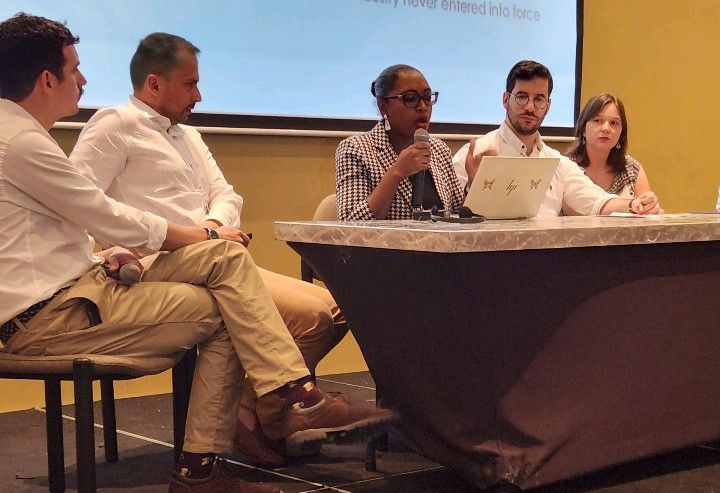
Latin America and Caribbean Tax Summit in Cartagena: A Caribbean Perspective
Alicia Nicholls
On July 27-28, 2023, sixteen countries from Latin America and the Caribbean (LAC) participated in a historic LAC Ministerial Summit for a more “Inclusive, Sustainable and Equitable Global Tax Order” held in Cartagena, Colombia. It was jointly hosted by the Governments of Colombia, Brazil and Chile and was the first occasion on which finance ministers and other officials of these countries have met to discuss tax issues as a regional grouping at this high-level. As an academic, I had the fortune of participating in the civil society meetings held in Panama City (Panama) and Cartagena de Indias (Colombia) in the lead up to the Summit, respectively. In this article, I share my initial reflections on this initiative for greater LAC cooperation on national and international tax matters.
Background
Countries of the global South, including LAC countries, are predominantly rule-takers in the global financial system. In recognition of the need for LAC countries to come together to fight for a more equitable and inclusive global tax order, Jose Antonio Ocampo, Colombia’s then Minister of Finance and Public Credit, announced in January 2023 the Colombia government’s intention to host this high-level summit. Colombia’s efforts were later supported by the Governments of Brazil and Chile, and the UN Economic Commission for Latin America and the Caribbean (UN ECLAC). An invitation to participate in the summit was extended to all LAC countries, while African and other G24 leaders were invited as observers.
Hosting this meeting in the port city of Cartagena de Indias, Colombia’s fifth largest city, was symbolic for at least three main reasons. First, the city bears the nickname ‘La Heroica’ as on November 11, 1811, it was the first Colombian territory and the second in the whole of Latin American to declare independence from the Spanish Empire. Second, in 1815, the city also valiantly resisted Spanish forces for 105 days in what is known as the Siege of Cartagena. Third, it is also one of the most ‘Caribbean-esque’ of Colombia’s major cities and with a large noticeable Afro-Colombian population. As both a Barbadian and Caribbean national, there were many aspects of Cartagena that felt familiar in terms of the warmth and friendliness of the people, the colorful buildings and the food, in particular. Now in 2023, this beautiful city was the setting for what is hoped to be the dawn of an era of south-south cooperation among LAC countries on tax matters.
Summit Outcomes
First, the summit outcome included a joint declaration signed by the delegates from the 16 participating countries establishing the Regional Platform for Tax Cooperation for Latin America and the Caribbean. This proposed platform would promote dialogue and knowledge exchange to develop national and global tax policies that help the region to more adequately confront the mounting crises faced.
Second, it was also agreed that Colombia would hold the Pro Tempore Presidency of this Regional Platform for the next twelve months and that ECLAC will be the technical secretariat of the platform. Third, the Pro Tempore Presidency is tasked with creating an Annual Work Plan, with ECLAC support, and prioritizing the most pressing themes regarding an inclusive, equitable and sustainable taxation agenda within a period of 6 months.
A positive aspect of this LAC initiative is that development is a central component of this effort, acknowledging that countries’ tax policy must support, advance and not undermine their development imperatives and that international tax initiatives must do likewise. Many LAC countries do not feel that the current OECD-led tax discussions, including the BEPs two-pillar solution, will redound to their benefit and have argued that a unified LAC voice is needed to ensure global tax rule-making takes into account the region’s interests and not simply those of the world’s richest countries.
Civil society had a critical role to play in the discussions, and the effort has received tremendous support from civil society groups and think tanks globally as well as from the United Nations. As such, there was explicit mention of the link between tax and gender and women’s empowerment, the environment, education and public health, for example. To this end, there was a strong argument made that the growing shift in LAC countries towards largely regressive taxes was anti-developmental as they shifted the tax burden away from the wealthy towards the most vulnerable segments of society.
Limited Caribbean Participation
The initiative appears to be a good faith attempt to build a LAC coalition not only for regional coordination on tax issues but one that would also help to strengthen the region’s impact on global tax policy making, recognizing that the global South remains on the periphery of global financial rule-making. However, attendance at the summit was quite muted as only 16 countries of the 33 countries which are CELAC members attended. Moreover, despite being hailed as a ‘LAC’ summit, only two Caribbean countries (Haiti and Dominican Republic) participated in the Summit. None of the English-speaking Caribbean governments participated in the Summit although representatives of civil society groups from some Caribbean countries were present at the civil society meetings in Panama City and Cartagena. It is not publicly known why this is the case as the Summit has barely received any media coverage in the English-speaking Caribbean nor is it clear whether it was discussed at the CARICOM Heads of Governments meeting in early July. However, I can speculate on a few possible reasons for the lack of any widespread Caribbean appetite so far for the initiative.
One reason could be that tax is an area of policy-making which countries guard closely. The right to tax has always been linked to the exercise of a State’s sovereignty. As small open economies with limited natural resources in most cases, many Caribbean countries have developed international business and financial sectors as a diversification strategy to grow their economies and provide for their people. Among other things, they use their favourable tax rates and offer sophisticated corporate tools and tax incentives as central planks of their investment attraction strategies to promote sustainable economic growth and to create jobs for their workers. Their ability to do this is being increasingly circumscribed by the need to meet global regulatory demands and they might see this still nebulous LAC platform as yet another fetter on their sovereign right to set their own tax policies for their development purposes.
Second, there might be some discomfort among Caribbean governments with creating a new platform for tax issues outside of an existing and familiar architecture like the Community of Latin American and Caribbean States (CELAC). On that front, it is curious why CELAC was not the chosen venue for this discussion.
Third, it is unclear to what extent this new platform takes into account existing sub-regional cooperation mechanisms. CARICOM countries usually approach foreign policy matters as a bloc as the Revised Treaty of Chaguaramas calls for coordination of foreign policy. Moreover, CARICOM countries discuss tax and other finance matters in their Council for Finance and Planning (COFAP). Another fear among Caribbean countries could be that their voice in this regional space might still be drowned out by more powerful LAC countries. This fear is not unfounded. While there is much to be gained from greater LAC cooperation and there are, of course, similarities, there are also important differences which any proposed LAC-wide regional cooperation must take into account. These differences include size, economic structure, social structure and tax structure. Among Latin American countries, only Panama could really be considered an international financial centre (IFC), while IFCs are more predominant in Caribbean countries.
Additionally, many Caribbean countries face accusations of being tax havens, including by some Latin American countries despite the fact that Caribbean countries are often among the first adopters of global tax initiatives despite their capacity constraints. Therefore, while blacklisting for tax and AML/CFT/PF issues is not a major issue for Latin American countries, for Caribbean countries it is. It is for this very reason that Caribbean representatives present at both the Panama and Cartagena civil society meetings were insistent that the final civil society outcome document handed over to the Ministers at the Summit needed to include some reference to this issue. Indeed, recommendation nine of the final civil society document calls for decolonialization of the global tax order and specifically condemns biased blacklisting which unfairly targets Caribbean countries while ignoring large countries of the Global North where most of the tax evasion occurs.
I am sure many persons reading this article are probably hearing about this summit for the first time. Indeed, the Summit received very little media coverage in the anglophone Caribbean, compared to the press coverage in well-known newspapers like Colombia’s El Espectador. This is just a symptom of a longstanding problem facing us in the LAC region, that is, that in many ways, we in LAC often know more about what is happening in the countries of the Global North than what is happening in our own sub-region or neighbouring regions.
A major reason for this is, of course, the language barrier. Even though technologies such as simultaneous interpretation during meetings, Google translate and the like may mitigate these barriers somewhat, they do not replace the utility of learning another language, learning about the culture in order to foster understanding and meaningful exchange. In many ways, and despite existing (mainly partial scope) trade agreements between CARICOM and some Latin American countries, and increased airlift, there is still much we need to learn about each other. As someone who speaks several languages including Spanish, I know that it is only when we truly get to know each other that we can build that trust needed to turn the LAC as a cohesive negotiating bloc on these issues on a global scale.
Concluding Thoughts
I am thankful to the organisers, Latindadd and Public Services International (PSI) and to the rest of the Caribbean contingent who attended, for the opportunity to have participated in these meetings not just for the opportunity to have presented a Caribbean perspective on the discussions as an academic, but to build links with some truly amazing people in LAC who are working on these and other global economic issues.
In theory, south-south cooperation among LAC countries on tax justice matters could be mutually beneficial. After all, in much the same way that G7 and G20 countries use their collective might to set the rules of global finance, LAC countries could leverage their collective voices to press for a fairer global financial system which takes into account their development imperatives. It could provide opportunities for sharing best practices and providing technical assistance on these matters.
It is commendable that this initiative is seeking to incorporate a Caribbean voice as many Caribbean countries often feel that LAC discussions usually are limited to the experiences of Latin American countries without acknowledging Caribbean realities which in some cases could be quite different. LAC cooperation must bear in mind the region’s heterogeneity and as such, Caribbean issues should be given the same weight as issues affecting other LAC countries.
Additionally, this cooperation should seek to use already existing regional cooperation structures such as CELAC and also respect and bear in mind that CARICOM already has its own processes for functional cooperation on this issue. In other words, any LAC cooperation should complement not seek to replace CARICOM’s own structures. It is also time for LAC countries to leverage their collective voices to support the African Group proposal for a UN Tax Convention and for the UN to be the official forum for the development of global tax rules as opposed to the status quo where the OECD, a club for the world’s wealthiest countries, has sought to arrogate on to itself this power. If done on the basis of mutual respect and communication, south-south cooperation among LAC countries, including possibly on tax justice issues, could be beneficial to Caribbean countries but this is something which Caribbean countries would need to carefully consider.
Alicia D. Nicholls, B.Sc., M.Sc., LL.B is an international trade specialist and founder of the Caribbeantradelaw.com Blog. She attended and participated in the civil society meetings in Panama and Cartagena as an academic and thanks the organizers for the opportunity.
-

Caribbean Trade and Development News Digest – June 25-July 1, 2023
Welcome to our Caribbean Trade and Development News Digest covering the week of June 25-July 1, 2023! We are pleased to bring you the major trade and development news headlines and analysis from across the Caribbean Region and the world from the past week. We do hope you enjoy this week’s edition!
THIS WEEK’S HIGHLIGHTS!
Happy 50th anniversary CARICOM! Coming up this week, July 4, 2023, marks the 50th anniversary of the signing of the Treaty of Chaguaramas (later revised) forming the then Caribbean Community and Common Market (CARICOM). The 50th anniversary and celebrations around this will be among the agenda items at the CARICOM Heads of Government 45th regular meeting in Trinidad & Tobago this week. It will include the official launch of the 50th celebrations. You can also see the CARICOM calendar of events here.
On June 27, UNCTAD released the fifth edition of its annual SDG Pulse, tracking progress towards achieving the United Nations Sustainable Development Goals (SDGs) by 2030. According to UNCTAD, “the data shows that the COVID-19 pandemic, the war in Ukraine and the climate crises are having a devastating effect on progress towards the SDGs.” Read the report here.
New on the Blog and what have I been up to?
CARICOM at 50: Trade for Regional Sustainable Development: As CARICOM approaches 50 years in existence, I share my reflections on using trade as an engine for sustainable regional development here.
I had the pleasure of moderating a CIC/CCI webinar on “Optimising the Canada-Caribbean trading relationship” and also the panel at the Barbados Coalition of Services Industries Business Breakfast Forum.
I also contributed an article on why Barbados is a logical choice for African business in the Caribbean to Invest Barbados’ Barbados International Business and Finance Magazine 2023.
Finally, I was pleased to be ome of the panelists on a special edition of
Looking towards this week, we look forward to following the 45th Heads of Government Regular Meeting!
REGIONAL NEWS
Guyana looking to Caricom markets for fish exports
Jamaica Observer: Guyana says it is looking towards Barbados, Trinidad and Tobago and the Eastern Caribbean to help deal with a glut in the local fish market resulting in fisherfolk here unable to meet their expenses. Read more
Work permit fee waivers for Caricom nationals in effect, gov’t confirms
Antigua Observer: Concerns are being raised that some Caricom and Dominican Republic nationals are still being asked to pay for work permits despite a recently implemented government waiver. Read more
Dominican PM preparing for tenure as Chairman of CARICOM
RJR: Dominican Prime Minister Roosevelt Skerrit says the upcoming six months will be critical for the regional integration grouping as he prepares for his tenure as chairman, which begins July 1. Read more
Incoming CARICOM chairman says next six months will be critical
Jamaica Gleaner: Prime Minister Roosevelt Skerrit says he is looking forward to his tenure as chairman of the 15-member Caribbean Community (CARICOM) grouping from July 1, predicting that the upcoming six months will be a “critical” one for the regional integration grouping. Read more
INTERNATIONAL NEWS
China ratifies WTO deal on fisheries subsidies
Reuters: Top fishing nation China has formally accepted an agreement to cut state subsidies for the fisheries sector struck by members of the World Trade Organization (WTO) last year, the trade watchdog said on Tuesday. Read more
WTO warns of global GDP loss through decoupling and fragmentation
ANN: WTO Director-general Ngozi Okonjo-Iweala said that decoupling into two trading blocks would cost the world a 5 per cent loss in global GDP. Read more
WTO director-general: ‘Re-globalization’ to include those left behind
CGTN: Refuting the hype surrounding “de-globalization” and “de-risking,” World Trade Organization Director-General Ngozi Okonjo-Iweala wants everyone to adopt the idea of “re-globalization.” Read more
EU-Mercosur trade deal threatens Indigenous lands, activist says
Reuters: A planned free trade deal between the European Union and South American bloc Mercosur risks increasing demand for farm produce from Brazil at the expense of Indigenous people’s land and rights, a leading activist said on Thursday. Read more
EU ambassador regrets lack of ‘substantial progress’ on trade talks with Beijing
France24: The European Union’s ambassador to China expressed regret on Sunday over the lack of “substantial progress” with Beijing on trade talks, as EU countries seek to reduce their economic dependence on the Asian giant. Read more
Paris Summit: Commonwealth and OIF stress need for Vulnerability Index
Commonwealth: The Commonwealth Secretariat and the Organisation Internationale de la Francophonie (OIF) joined forces this week to convene a high-level side event during the Paris Summit for a New Global Financial Pact on June 22. The side event focused on the measures required to: ‘Take account of multidimensional vulnerability in the allocation of new development funding’. Read more
Commonwealth Secretary-General to attend CARICOM Heads of Government Meeting in Trinidad and Tobago
Commonwealth: Commonwealth Secretary-General, the Rt Hon Patricia Scotland KC, will attend the Conference of the Heads of Government of the Caribbean Community (CARICOM) in Port-of-Spain from 3 to 5 July 2023 as a special guest. Read more
STRAIGHT FROM THE WTO!
NEW ON THE CTLD BLOG
The Caribbean Trade & Development Digest is a weekly trade news digest produced and published by the Caribbean Trade Law & Development Blog. Liked this issue? To read past issues, please visit here. To receive these mailings directly to your inbox, please subscribe to our Blog below:
-

CARICOM at 50: Some Reflections on Trade for Sustainable Regional Development
Alicia Nicholls
This week I had the opportunity to moderate two panels which on the surface dealt with different topics, but in fact, had a central underlying theme. That theme, I argue, is that of how Caribbean Community (CARICOM) member States could better use trade and their trading relationships to meet their sustainable development imperatives. Read any of the speeches of our Caribbean statesmen or the writings of Caribbean scholarly giants over the years and you will see that the trade and development problematique has occupied the regional development discourse for decades. The topic bears continued significance as CARICOM celebrates its fiftieth year in existence. In this short article, I offer some cursory reflections on trade as an engine for sustainable development as we celebrate this important CARICOM milestone amidst a panoply of trade and development challenges facing not only our region but the global community.
CARICOM Heads meet this week (July 3-5) in Trinidad & Tobago for the 45th CARICOM Heads of Government meeting. Formed in 1973 and now comprising 15 member States and 5 Associate Members, CARICOM is a regional inter-governmental organization and regional integration movement built on four pillars. One of those four pillars is economic integration. While trade fits under this pillar, in reality, trade also touches and concerns the three other pillars: human and social development, foreign policy coordination, and security which was added later. Trade is not an end in itself. It is really to be an engine for promoting human and social development through creating meaningful jobs and opportunities for entrepreneurship and knowledge transfer, for example. Under foreign policy coordination, commercial diplomacy is becoming an essential part of the foreign policy imperative of countries, including CARICOM Small Island Developing States (SIDS). Finally, trade in illicit goods such as narcotics, illegal firearms and endangered species are among the most pressing security issues facing the Caribbean region. In essence, trade impacts and is impacted by all four pillars underpinning CARICOM. Indeed, trade, even more so now, cannot be viewed in a silo given its increasing intersection with development issues, such as human rights, the environment, climate change and public health.
Two key issues with which CARICOM continues to grapple as it celebrates its 50th year in existence is first, how can CARICOM promote greater intra-regional trade for sustainable development. Second, how can it meaningfully expand its trade with both traditional and non-traditional external trading partners in a mutually beneficial and sustainable manner?
The CARICOM Single Market and Economy (CSME) envisions the creation of a single economic space. By removing barriers to the flow of each other’s goods, services, skilled nationals and allowing the right of CARICOM nationals to establish businesses in each other’s markets, it is expected that there would be greater intra-regional trade and investment, tourism and the like. However, despite the importance of the CARICOM market for some countries like Barbados, intra-regional trade as a percentage of CARICOM’s total trade with the world remains low and has declined over time due to many factors, including, but not limited to, remaining barriers which still impinge on the ability to export in a frictionless manner, as well as high costs of transport and other logistical challenges. Intra-regional transportation, including travel for business and leisure, remains a bug-bear due to high airfares and taxes, and let us face it, it is even more frustrating now in the post-COVID era due to the LIAT fiasco. The introduction of intra-regional flights by UK-carrier Virgin Atlantic is an encouraging development and I truly hope that at least in the short term this could be a partial solution to this vexing problem.
Turning to extra-regional trade, most CARICOM countries, with the notable exception of Trinidad & Tobago which enjoys a trade surplus, are net-importing countries, that is to say, their imports exceed their exports. The region’s exports have in general been underperforming and remain highly concentrated in only a narrow range of goods and services despite attempts at diversification. Guyana has discovered oil and is developing a booming oil/gas industry but has to ensure it does not fall victim to ‘Dutch Disease’. Much of this declining competitiveness is due to high costs of production in the region, lack of economies of scale, loss of preferences and preference erosion in its main export markets which has led to declining competitiveness of Caribbean countries’ exports vis-à-vis exports of other countries.
CARICOM presently has free trade agreements with the European Union, the United Kingdom, the Dominican Republic and Costa Rica. It has partial scope agreements with Colombia, Cuba and Venezuela. Not many publicly available studies exist analysing CARICOM’s trade performance under these agreements. However, a 2015 study by McClean and Khadan on the performance of CARICOM’s extra-regional agreements show the private sector’s limited utilization of the preferences under CARICOM’s trade agreements and arrangements. This is despite the many sensitization workshops, export promotion programmes and other great assistance offered by regional business support organisations (BSOs). Perhaps a more recent study is needed to see if this is still the case.
Usually where more contemporary reports exist in the public sphere, such as the latest Ex Post Evaluation of the CARIFORUM-EU EPA, these are usually reports done by our trading partners and not our region itself. For instance, the latest biennial CBERA Report published by the Office of the US Trade Representative (USTR) in 2022 showed a marked increase in the percentage of some CBI-beneficiary countries’ imports into the US under the various components of the CBI programme. By contrast, only some 4% of Caribbean imports into Canada are under CARIBCAN preferences according to StatCan data.
I do not purport to have a magic wand to solve either of these issues and neither am I implying that these issues are easy to address or that they are not being actively worked on by the hard-working staff of the CARICOM secretariat, the BSOs and the various trade ministries across the region. Indeed, having spent two weeks in Geneva in May-June this year as part of an annual study tour offered by the UWI Shridath Ramphal Centre for students of the Masters in International Trade Policy (MITP) programme, I was able to see firsthand the hard work of our missions there, often with limited staff and resources. Perhaps it is time for CARICOM to more seriously consider having joint missions, similar to the OECS in key capitals, and pool their scarce financial and human resources. Additionally, there are clear initiatives underfoot, supported by commercial diplomacy, at expanding trade with non-traditional partners in China, Africa, Latin America and the Middle East, for example and deepening ties with the Caribbean diaspora, especially in the US, UK/Europe and Canada. Barbados’ recent opening of embassies in Ghana, Kenya and a consulate in Rwanda are examples of this outreach to non-traditional markets. Promoting digital transformation of regional economies is also another issue actively being worked on at both the regional and national levels, including how digitalization could improve the ease of doing business across the region, the role of digital technologies in building competitiveness, inter alia.
What I am offering in this article are some of my personal reflections as a trade specialist who firmly believes, like most other regional figures, that expanding intra-regional trade and diversifying CARICOM’s trading relationships are necessary in helping the region meet not just the 17 sustainable development goals (SDGs) under the United Nations (UN) 2030 Agenda for Sustainable Development but its wider development imperatives. Chief among these imperatives are reducing poverty and creating meaningful jobs for our populations (especially the youth), building resilience in an increasingly polycrisis world to climate change and other natural disasters and other shocks, and combatting the challenges of non-communicable diseases (NCDs) which are severe threats to the region’s prosperity.
With regard to extra-regional trade performance, CARICOM desperately needs to review its current trade agreements and evaluate their sustainable development impact. This means improving the data available on trade under these agreements. Have these agreements really contributed to job creation or expanded investment? This evaluation process is likely on-going but there is very little information publicly shared about the status or findings from such analyses. The point about evaluation of our trade agreements was certainly underscored in one of the panels I moderated at the CIC/CCI “Optimising the Canada-Caribbean Trade Relationship” webinar on June 29 with a key takeaway being the need to consider whether the current trade cooperation framework between Canada and the Caribbean was fit for the purpose of twenty-first century trade and development realities, where sustainability issues are increasingly recognized as being intersected with trade.
This evaluation process must include CARICOM member States’ network of international investment agreements (IIAs), particularly the older bilateral investment treaties (BITs), which, due to their broad and vague investor protection provisions, are unfit for the purpose of attracting investment for sustainable development. As I argued in a recent policy brief published by the UWI’s Shridath Ramphal Centre, such outdated IIAs could open up the region to legal exposure from foreign investor claims as the region seeks to step up its climate action.
I also think that there is still too much disconnect between CARICOM and the ordinary citizen, despite the excellent CARICOM youth ambassadors programme, the increasing public awareness campaigns, greater social media presence by the CARICOM Secretariat and to some extent, greater mainstreaming of teaching about CARICOM in schools. I think in many ways CARICOM does not do enough to tout its successes and how its work is beneficial to the ordinary CARICOM citizen. This could be focused on a lot more in its public awareness campaigns. Additionally, one of the things I would love to see is a CARICOM Young Professionals Programme, similar to what exists in other organisations, as well as greater opportunities for secondary school and university students to intern within CARICOM institutions.
CARICOM has released a 50th Anniversary celebrations calendar of activities. As many countries in the region will be observing a one-off public holiday in celebration of CARICOM’s 50th anniversary, it would be good if regional airlines would consider the feasibility of offering specials on inter-island routes in celebration of this important milestone. Doing such would be a win-win as it would not only make it cheaper for persons wishing travel to other CARICOM islands for these celebrations or on vacation, but also help to foster intra-regional tourism and people-to-people connection, key ingredients for promoting a common Community spirit and connection.
As trade and public health law expert Nicole Foster sagely opined in her presentation at the Public Health Law forum held June 30, it is imperative for ministries of trade and ministries of health, as well as other ministries to talk to each other to ensure policy coherence. This includes greater data sharing among ministries to ensure trade policy is being made based on actual empirical evidence and that trade policies support and do not undermine public health objectives. This latter point about empirical evidence also came up in a Barbados Coalition of Services Industries (BCSI) Breakfast Forum I moderated earlier this week. Data is key to effective trade policy making for development. As such, it is important for the private sector to recognize the need to respond to surveys in a timely and accurate manner and share data not only so governments have an accurate picture of economic activity, but also what challenges and barriers businesses face both in doing business domestically and when exporting. Governments themselves also need to improve access to data, including sharing data with the academic community whose research could be beneficial to both governments and the private sector. There needs to be deeper cooperation among government, business and academia if CARICOM is truly to prosper.
I conclude by imploring that CARICOM’s celebration of its fiftieth year of existence is an achievement. We, as lifelong ‘students’ of international politics know that CARICOM is just one (albeit an important one) chapter in a much longer history of regional integration. There have been failures and disappointments, but there have also been many triumphs. Certainly, let us use this occasion of CARICOM’s fiftieth anniversary as an opportunity for deserved celebration. But it should also be a moment for considered reflection of the lessons to be learnt from the past half a century of CARICOM’s existence and the lengthier history of the regional integration process, including the Caribbean Free Trade Association (CARIFTA) and the West Indies Federation that preceded it. Let us reflect on how we can use our trade policy to operationalize the Bridgetown Declaration on NCDs and Mental Health, for example, or how we can work more cohesively as a region to push for the creation of a more equitable international financial architecture as envisioned by the Bridgetown Initiative which has been endorsed by the Community. Let us use the lessons learnt from the past 50 years and beyond to craft a CARICOM trade policy that is truly fit for our contemporary development realities and meaningfully promotes both intra-regional and extra-regional trade for sustainable development, especially for the youth who are to inherit and continue this regional integration movement. Happy 50th Anniversary, CARICOM!
Alicia Nicholls, B.Sc., M.Sc., LL.B. is an international trade and development consultant and founder of the Caribbean Trade Law & Development Blog www.caribbeantradelaw.com.
-
Caribbean Trade and Development News Digest – June 18-24, 2023
Welcome to our Caribbean Trade and Development News Digest covering the week of June 18-24, 2023! We are pleased to bring you the major trade and development news headlines and analysis from across the Caribbean Region and the world from the past week. We do hope you enjoy this week’s edition!
THIS WEEK’S HIGHLIGHTS!
There’s been much to follow during this past week so please forgive us if we missed some stuff! Chief of course was the Paris Summit for a New Financial Pact which took place this week in Paris from June 22-23 and where Barbados’ Prime Minister, the Honourable Mia Mottley was one of the leading voices calling for transformation of the global financial architecture to facilitate developing countries’ equitable access to climate finance. The Chair’s summary of the discussions may be accessed here. The proposed roadmap coming out of the discussions may be viewed here.
In the UK, there were events on National Windrush Day 2023 (June 22nd) in celebration of the 75th anniversary of the arrival of the MV Empire Windrush to the UK on June 22, 1948 carrying Caribbean migrants (then colonies of the UK) who were encouraged to migrate to the then Mother Country to help the latter’s rebuilding in the immediate aftermath of World War II.
Canada-CARICOM Foreign Ministers’ Group Meeting – Canadian Foreign Affairs Minister Mélanie Joly and several CARICOM foreign affairs ministers and diplomats met on the sidelines of the Organization of American States (OAS) General Assembly in Washington. The communique from this meeting may be accessed here.
The Caribbean Development Bank held its 53rd annual meetings of the Board of Governors June 12-23, 2023 in St. Lucia under the theme Marshalling Finance for Development: Access to Adequate, Affordable Financing. The Africa Export-Import Bank (Afri-Exim Bank) respectively also held its 30th annual meetings this past week June 18-21.
The Financial Action Taskforce (FATF) held its June plenary meetings June 21-23, this week. Among Caribbean countries, Barbados, Cayman Islands, Haiti, Jamaica remain among the countries on the FATF list of jurisdictions under increased monitoring as of June 23, 2023 (aka FATF greylist). Read the other plenary outcomes here.
New on the Blog
This week on June 29, 2023 at 10:00 am – 1:00 pm (EST) I will be one of the panel moderators at the “Optimising the Caribbean-Canada Trade Relationship“. Register for this event via Eventbrite here.
I will also be the moderator at the Barbados Coalition of Services Industries (BCSI) Business Breakfast Forum on June 28, 2023.
REGIONAL NEWS
Canada and CARICOM pledge to strengthen existing relationship
CMC News: Canada and the Caribbean Community (CARICOM) countries have reaffirmed the “enduring value of the deep and dynamic partnership” strengthening their commitment to sustainability, resilience, climate action, access to finance, regional security, and shared values. Read more
Chinese Premier holds talks with Barbados PM
China Daily: Chinese Premier Li Qiang held talks with Prime Minister of Barbados Mia Amor Mottley, who is on an official visit to China, on Sunday in Beijing. Read more
Caricom says Guyana’s honey woes are not being ignored
Jamaica Observer: The Caribbean Community (Caricom) has sought to assure the producers of honey in Guyana that their concerns about the exportation of their product are not being ignored. Read more
Rum producers seek CARICOM’s help to expand to new markets
Loop News: Regional rum producers have called on CARICOM to facilitate their expansion into new non-traditional markets for premium rum exports. The call was issued during a meeting in Georgetown, Guyana on Wednesday with senior CARICOM officials. Read more
CARICOM deliberating on how ‘local content’ can be supported
News room guyana: The Caribbean Community (CARICOM) is exploring how local content provisions, be it laws or policies, can be supported within the region in keeping with the Revised Treaty of Chaguaramas. Read more
Barbados PM wants closer ties between African Union, CARICOM
Barbados Today: Prime Minister Mia Mottley is calling for closer ties between the African Union and the Caribbean Community (CARICOM) in order to tackle a number of challenges that continue to plague both regions. Read more
Trade Board looking to identify and resolve Jamaica’s export issues
RJR: The Trade Board says it is looking to identify and resolve issues surrounding exports from Jamaica. Read more
Trade Board Limited to Establish ‘Export Academy’
JIS: The Trade Board Limited (TBL) has announced that plans are in place to establish an ‘Export Academy’ to help bolster Jamaica’s export capacity. The platform will be a free online service provided by the Government through the entity. Read more
Caribcan arrangement WTO Waiver extended to 2033
Newsday: Canada has got approval from the World Trade Organisation (WTO) to extend the Caribbean-Canada trade agreement (Caribcan) until December 31, 2033. Read more
INTERNATIONAL NEWS
Global trade growth returns but outlook for 2023 is poor
UNCTAD: Following two consecutive quarters of decline, global trade in goods and services rebounded between January and March 2023. But prospects for the rest of the year are bleak. Read more
Brazilian president calls for alternative to dollar in global trade
CGTN: Brazilian President Luiz Inacio Lula da Silva has called for efforts to find an alternative currency to the U.S. dollar, to end the greenback’s dominance in global trade. Read more
Brazil says it cannot agree to EU’s proposal for Mercosur trade deal
Reuters: Brazilian President Luiz Inacio Lula da Silva on Friday said the European Union’s latest proposal for a trade deal with South American bloc Mercosur made reaching an agreement impossible as it included a “threat” to Brazil. Read more
Kenya-EU trade deal: Why the East African Community was left out
BBC: Kenya’s President William Ruto hailed his country’s “remarkable partnership” with the European Union (EU) as the two sides inked a 25-year trade deal, but it has raised questions about East African unity. Read more
STRAIGHT FROM THE WTO!
NEW ON THE CTLD BLOG
The Caribbean Trade & Development Digest is a weekly trade news digest produced and published by the Caribbean Trade Law & Development Blog. Liked this issue? To read past issues, please visit here. To receive these mailings directly to your inbox, please subscribe to our Blog below:
-

CIC/CCI EVENT on Optimising the Canada-CARICOM Trade Relationship – June 29, 2023
Join the Canada International Council Latin America and Caribbean Study Group and the Canada Caribbean Institute for our “Optimizing the Canada CARICOM trade relationship” webinar on Thursday, June 29, 2023 at 10:00 am -1:00 pm (Eastern Standard Time).
The panels will feature Canadian and Caribbean exporters and investors outlining their experiences and lessons in the respective markets, the main trade promotion and facilitation agencies from the two sides and a discussion of the current “government to government” trade arrangements and whether these are appropriate going forward.
DISCUSSION PROGRAM
Views from the Exporting Community
TBC
Trade, Investment and Development Programs
Dr. Damie Sinanan, Caribbean Export Development Agency
Jake Thomas, Trade Commissioners Service, Global Affairs Canada
Steven Tipman, Trade Facilitation Office, Canada
David Weber, Caribbean Development Program, Global Affairs Canada
Role of Trade Agreements
Dr. Chantal Ononaiwu, CARICOM Secretariat
Robert Ready, CIC and CCI Board (Global Affairs Canada ret’d)
MODERATORS
Alicia Nicholls, International Trade and Development Consultant
Dav-Ernan Kowlessar, Executive Chairman, DYKON Developments
Robert Ready, CIC and CCI Board (Global Affairs Canada ret’d)
The moderators of this event will produce a short summary of proceedings to share with attendees and others following the event.
REGISTRATION FOR EVENT
Register for the Event via Eventbrite here: https://www.eventbrite.ca/e/optimizing-the-canada-caricom-trade-relationship-tickets-623355632477
Note that several days before the event all registrants will receive an email with the actual Zoom link. We look forward to you joining us!
-

CARICOM to meet to review its CET and Rules of Origin
CARICOM TO MEET TO REVIEW ITS COMMON EXTERNAL TARIFF (CET) AND ITS RULES OF ORIGIN(CARICOM Secretariat, Turkeyen, Greater Georgetown, Guyana – Tuesday, 20 June 2023): The Caribbean Community (CARICOM) is reviewing its trade instruments to make them fit for purpose to facilitate increased trade, agricultural expansion and industrial development beyond 2023. The Community’s main trade instruments are the Common External Tariff (CET) and the Rules of Origin.
Member States and other Regional stakeholders will engage in deliberations in the Seventh Meeting of the Sectoral Working Group to Review the CET and in the Ninth Meeting to Review the Rules of Origin. The Working Groups will meet respectively on 22 and 23 June 2023.
The Working Group on the CET will give further in-depth consideration to the principles underlying the categories and levels of the CET as well as the rates to be applied. The Working Group on the Rules of Origin will seek to finalise several aspects of the working text of the Rules of Origin regime.
The following was a press release from the CARICOM Secretariat. -
Caribbean Trade and Development News Digest – June 11-17, 2023
Welcome to our Caribbean Trade and Development News Digest covering the week of June 11-17, 2023! We are pleased to bring you the major trade and development news headlines and analysis from across the Caribbean Region and the world from the past week. We do hope you enjoy this week’s edition!
What’s new on the blog?

My Interview with Barbados’ Honorary Consul Ms Rhoda Green: A couple weeks ago, I had the honour and pleasure of interviewing Barbados’ Honorary Consul to South Carolina and President and Founder of the Barbados and the Carolinas Legacy Foundation, Ms. Rhoda Green.
We spoke about her work, what drives her passion and how the shared history between Barbados and the Carolinas could help propel deeper trade links.
Listen to the audio of the full interview here.
THIS WEEK’S HIGHLIGHTS!
Barbados hosted the SIDS Ministerial Conference on NCDs and Mental Health on June 14-16 in conjunction with the World Health Organization (WHO) and the Pan-American Health Organization (PAHO). It follows on from the SIDS High-Level technical meeting on NCDs and mental health held in January 2023. A major outcome of the conference was the launch of the 2023 Bridgetown Declaration on NCDs and Mental Health which may be accessed here.
Some other important meetings occurred over the past few weeks. The US-Caribbean Leaders meeting occurred in Nassau, Bahamas on June 8, 2023. You can read about the new initiatives announced by US Vice President Kamala Harris here. The Commonwealth Trade Ministers met June 5-6, 2023. Read the outcome statement from that meeting here.
REGIONAL NEWS
Afreximbank to open regional headquarters in Barbados
St Vincent Times: The African Export-Import Bank (Afreximbank) will establish its regional headquarters (office) for the Caribbean and the Americas in Barbados next month, Prime Minister Mia Mottley stated on Tuesday. Read more
Barbados to host first global supply chain forum in May 2024
UNCTAD: The high-level forum will focus on ways to make supply chains more efficient, resilient and sustainable. Read moreBelize formally accepts the Agreement on Fisheries Subsidies
WTO: Belize deposited its instrument of acceptance for the Agreement on Fisheries Subsidies on 16 June, making it the first Central American WTO member and first WTO member of the Caribbean Community (CARICOM) to do so. Read more
Trinidad and Tobago gets approval to suspend tariffs on almond milk, batteries
Newsday: Trinidad and Tobago has received approval on its proposed suspension of common external tariff (CET) on almond milk and lithium ion batteries, which are used in renewable energy systems. Read more
Barbados to end importation of trans fats
Nation News: Barbados’ Minister of Health and Wellness, Senator The Most Honourable Dr Jerome Walcott confirmed the island was on course to end the importation of foods with trans fats by December 2024. Read more
Grenada looking to the African continent to boost tourism
Loop News: Grenada is looking to the African continent as a new source market for the tourism industry. Lennox Andrews, Minister of Tourism, told Loop News that there is an emerging middle class on the continent that they will be targeting. Read more
St. Kitts and Nevis PM to assume chairmanship of OECS
Radio Jamaica News: St. Kitts and Nevis Prime Minister Dr. Terrance Drew will assume chairmanship of the Organization of Eastern Caribbean States (OECS) when the grouping holds its 73rd meeting in St. Kitts and Nevis on Sunday. Read more
Guyana can produce barley for Caribbean, North American markets – President
Newsroom: As Guyana invests in technology to improve food production to satisfy local and regional demands, the country’s President Dr. Irfaan Ali said on Tuesday that the country is capable of producing enough barley for export. Read more
Italian Ambassador to the Dominican Republic assures bilateral trade between the two countries has doubled
Dominican Today: According to the Italian ambassador to the Dominican Republic, Stefano Queirolo Palmas, trade between Italy and the Dominican Republic has experienced steady growth in the past two years, with a remarkable 231% increase since the signing of the Economic Partnership Agreement (EPA) in 2008. Read more
INTERNATIONAL NEWS
Study finds slowdown in exports from Latin America and Caribbean
Jamaica Gleaner: A new study by the Inter-American Development Bank has found that the value of exported goods from Latin America and the Caribbean grew at an estimated rate of 2.9 per cent year-on-year in the first quarter of 2023, after increasing by 16.4 per cent last year. Read more
Presidents of Argentina, European Commission call for ‘win-win’ Mercosur trade deal
Buenos Aires Times: Stopping in Buenos Aires during a trip through Latin America, European Commission head Ursula von der Leyen pushes for EU-Mercosur deal before the year is out; President Alberto Fernández expresses optimism while calling for the “removal of the obstacles” making for inequality. Read more
China pushes for Asia-Pacific trade agreement membership, promises to ‘actively attract’ foreign investment
South China Morning Post: Chinese vice-minister for commerce says Beijing ‘willing to and capable of’ joining CPTPP, known for its strict requirements. Read more
Experts discuss trade, supply chain challenges at AHIF
Trade Arabia: Leaders across the hospitality sector discussed trade restrictions, transport infrastructure, currency fluctuations and supply chain breakages at the recent African Hospitality Investment Forum (AHIF) 2023 in Nairobi, Kenya. Read moreSão Tomé and Príncipe Accedes to the Establishment Agreement for Afreximbank’s Fund for Export Development in Africa (FEDA)
Zawya: The Fund for Export Development in Africa (FEDA), the development impact-focused subsidiary of the African Export-Import Bank (Afreximbank), has announced that Democratic Republic of São Tomé and Príncipe has become the latest country to sign the FEDA Establishment Agreement. Read more
UK Businesses Call for Plan to undo Brexit damage
Yahoo: The UK has “run out of road” when it comes to trade agreements after securing deals with over 90 countries and needs a new approach as deals with the US and China are not on the horizon, according to the Resolution Foundation. Read more
Post-Brexit trade deal means ‘inevitable’ business costs, says EU
Euractiv: EU and UK businesses will face ‘inevitable’ extra costs while the post-Brexit trade deal remains in place, European Commission Vice-President Maroš Šefčovič warned on Monday (12 June), playing down the prospect of a major overhaul of the agreement. Read more
STRAIGHT FROM THE WTO!
NEW ON THE CTLD BLOG
The Caribbean Trade & Development Digest is a weekly trade news digest produced and published by the Caribbean Trade Law & Development Blog. Liked this issue? To read past issues, please visit here. To receive these mailings directly to your inbox, please subscribe to our Blog below:
-

Interview with Honorary Consul Rhoda Green – Barbados and the Carolinas Connection
Alicia Nicholls
A couple weeks ago I had the honour and pleasure of interviewing Barbados’ Honorary Consul to the US State of South Carolina and President of the Barbados and the Carolinas Legacy Foundation, Ms. Rhoda Green. I had met Ms. Rhoda during a trade mission in which I had participated in April 2023 organised by Invest Barbados and the Barbados Consulate in Miami. She had kindly consented to sitting with me for an interview.
During the nearly hour-long interview we touch on what drives her passion for raising awareness of the historical relationship between Barbados and the Carolinas, her foundation’s work, her role as Honorary Consul and finally how this historical relationship could be leveraged for expanding trade between Barbados and the US State of South Carolina.
If you have any interest in the Barbados and the Carolinas relationship, please check out the website of the Barbados and the Carolinas Legacy Foundation which is a rich source of information: www.barbadoscarolinas.org.
The audio of the full interview may be accessed by clicking below:
Video Credits:
Music: Song “Caribbean Calypso” by Dominic Ashworth and Derek Nash
Photo of Ms Rhoda: Barbados and the Carolinas Legacy Foundation
-

Youth: The Untapped Resource We Need to Save the Planet
Johnny Calliste
Climate change is one of the most alarming global threats of our time, and its effects are being felt by people of all ages, young and old. For a significant segment of our population, though, climate change has become a particularly pressing issue; for the youth, the future of their planet is in jeopardy, and their outlook on the world is quickly shifting to reflect that.
Climate change is already having numerous impacts on the lives of youth worldwide. Young people are witnessing and actively experiencing its effects first-hand, whether through extreme weather events like floods, droughts, freak storms, wildfires or increased air and water pollution. These alterations make accessing various activities, from leisure to livelihoods, more challenging. Youth are then met with reduced opportunities for meaningful growth and engagement in a world increasingly shaped by the unpredictability of extreme weather events. Moreover, the emotional distress experienced by youngsters when contemplating the effects of climate change on their future is alarming.
Over the past few decades, the Caribbean region has experienced a significant shift in weather patterns, resulting in an increased frequency of extreme weather events such as hurricanes, floods, and droughts. This has significantly impacted the region, with effects seen from Jamaica in the north to the South American area. From 2019 to 2022, the Caribbean experienced severe storms that caused immense damage and loss of life. Hurricane Dorian hit the Bahamas in 2019, leaving behind a trail of destruction with at least 70 people dead and over $3 billion in damages. In November 2020, Hurricanes Eta and Iota struck the Northern Caribbean and Central America, leaving over 200 people dead and forcing thousands to flee their homes. In 2021, a series of hurricanes hit the Caribbean island of Dominica. The first hurricane to land was Hurricane Grace in late August, causing significant damage to the island’s infrastructure and leaving thousands without power. A few weeks later, Hurricane Ida unleashed even more devastation on the battered island. Many more countries in the region have faced a similar fate of the rise in freak storms. Higher temperatures and increased precipitation have also caused the spread and increased presence of invasive species, including the Sargassum seaweed.
Sargassum seaweed is a brown alga belonging to the Sargasso family. It is commonly found in the pelagic regions of the ocean and is known for forming large floating masses, referred to as the Sargasso Sea. Seaweed is essential in marine ecosystems as it provides shelter and food for sea animals such as turtles, crabs, and fish. Despite its significance, sargassum seaweed growth can become invasive if not properly managed and controlled, as excessive growth can pose risks to human health and disrupt aquatic ecosystems. Sargassum seaweed began attracting international attention when it washed up on Caribbean islands in the summer of 2011. This trend, commonly called the ‘sargassum bloom’, has continued every year since then in varying amounts.
The seaweed contains chemicals, such as ammonia and hydrogen sulphide, which harm human health. For example, they can cause rashes and other skin irritations in contact with the skin. At the same time, inhaling sargassum-associated air pollutants often leads to respiratory tract irritation, asthma attacks, and other related illnesses. In addition, the seaweed serves as a breeding ground for mosquitoes, which is particularly of concern for those living in coastal regions, as the insects are vectors of severe illnesses such as malaria, Zika and dengue fever. As such, the physical health of youth living in affected areas is often compromised due to the presence of sargassum seaweed.
Not only do the massive accumulations of seaweed create an unsightly landscape and block access to beaches, but they also considerably harm economies dependent on the tourism industry and the sale of seafood. Excessive persistent sargassum seaweed not only has a direct economic cost due to the expenses incurred in its removal and disposal, but it also has an indirect economic cost in that it drastically reduces local tourism, leading to a decrease in revenue for beach-associated businesses and a subsequent decrease in job opportunities for youth living in the area.
As the effects of climate change worsen, the implications can be seen in new generations through the increased burden of mental health issues and psychological distress. Youth are particularly vulnerable to the psychological impacts of global warming, especially when the livelihood of their parents, communities, and themselves faces the threat of becoming socioeconomically vulnerable.
Today, youth are more conscious and aware of their environment than ever and are part of a significant and inspiring movement sweeping the world. Climate change’s economic, environmental, and political implications are becoming increasingly apparent, and young people are responding with innovative, inspiring initiatives. Their critical involvement is essential to tackle the climate crisis, especially considering their broad outreach and ability to spur change quickly. For example, in Grenada, groups such as the Caribbean Youth Environment Network-Grenada (G-YEN) and Leo Clubs of Grenada, Rotaract Club and various School groups have been engaged in activities and public awareness campaigns that have proven practical ways to draw attention to environmental causes and bring about change.
To further support these efforts, international organisations such as the Global Youth Environment Assembly (GYEA-UN), convened by the UN Environment Programme and Global Youth Climate Action Fund (GYCAF), provide small grants and finance that support the youth’s role in this fight. In addition, they spread awareness, inspire and encourage child to act, and connect youth organisations and activists worldwide. On the international scale, young people use social media platforms such as Tik Tok, Instagram, and Facebook to organise initiatives such as global climate strikes and participate in online petitions and discussions.
The youth are proving that their innovative solutions can tackle and resolve some of the most complex climate challenges. Despite the daunting task of halting global warming, these young people are bringing the fight to the politicians, corporations, and communities, exhibiting impressive determination and creativity.
Encouraging youth participation in local initiatives such as community clean-ups, smart agriculture & composting programs, and renewable energy projects helps young people see the impact they can have on the environment. Additionally, donor-funded agencies can further empower youth initiatives by providing more grant funding opportunities and funding pools to support their efforts, especially at the community level. It must be noted that while many funding streams are available to support climate resilience projects, youth are often unable to mobilise these resources since they lack the skills and competence necessary to create winning proposals to secure funding. Therefore, capacity building and training in resource mobilisation strategies can form an integral part of the support given to youth climate advocates and groups.
Providing funding to support youth-driven innovative climate-smart small businesses and cooperatives is an excellent strategy for allowing creative young entrepreneurs to contribute to promoting climate resilience while earning sustainable income and providing employment opportunities. In the Caribbean, one such business example is the attractive option for sustainable business ventures that the Sargassum seaweed offers. It can be used in various industries, such as agriculture, cosmetics, and animal food production. Sargassum seaweed is rich in vitamins, minerals, and antioxidants, making it ideal for fertilising and processing into fertilisers and animal feed supplements. Businesses supported through a grant or concessionary business loans are bound to enjoy high yields given the low competition in this field of speciality. With its numerous benefits and growing concern surrounding consumer sustainability, start-ups utilising sargassum seaweed have great potential to succeed in the marketplace.
All in all, the Caribbean must recognise and appreciate what the youth are doing and support their journey in every way possible if we are to have any chance at solving the critical issue of climate change and essentially saving the planet.
Johnny J. Calliste, MSC, CMC, Dip (M&E) is a Grenadian with a master’s degree in International Business from the Arthur Lok Jack GBS-University of the West Indies, St. Augustine. He also holds post-graduate certifications in Youth Development, Monitoring and Evaluation, Project Risk & Cycle Management, and Human Resource Management. He is preparing for doctoral studies/research in Developmental Economics and Public Policy Management. Johnny works in the Global Development sector with an international organisation and is a climate change and youth development aficionado. As part of his studies, he will conduct considerable research to understand climate change’s socioeconomic and psychological impact on Small Island Developing States. Please feel free to contact him via LinkedIn.
-
EVENT: Optimising the Canada-CARICOM Trade Relationship – Thursday, June 29
The CIC National Capital Branch Latin America and Caribbean Study Group, and the Canada Caribbean Institute invite you to a virtual discussion on
Optimizing the Canada-CARICOM trade relationship
Thursday, June 29, 2023, 10 am to 1 pm
Canada and CARICOM are working to define a forward-looking bilateral cooperation agenda. While trade has been an important part of the relationship for many years, recent trade and investment flows have seen a decline. Can enhanced trade relationships contribute to the forward bilateral cooperation agenda? And if so, how can this best be achieved?
The Canada International Council Latin America and Caribbean Study Group and the Canada Caribbean Institute are pleased to host a panel on Optimizing the Canada CARICOM trade relationship. The panel will feature several exporters and investors outlining their experiences and lessons in the market. The main trade promotion and facilitation agencies from the two sides will set out their programs and experiences in seeking to expand bilateral trade. Finally, the panel will feature a discussion of the current “government to government” trade arrangements and whether these are appropriate going forward.
The moderators of this event will produce a short summary of proceedings to share with attendees and others following the event.
REGISTRATION FOR EVENT
The registration link is the following: Optimizing the Canada-CARICOM Trade Relationship Tickets, Thu, Jun 29, 2023 at 10:00 AM | Eventbrite
Note that several days before the event all registrants will receive an email with the actual Zoom link.
-
Caribbean Trade and Development News Digest – April 30-May 6, 2023
Welcome to our Caribbean Trade and Development News Digest covering the week of April 30-May 6, 2023! We are pleased to bring you the major trade and development news headlines and analysis from across the Caribbean Region and the world from the past week. We do hope you enjoy this week’s edition!
What’s new on the blog?
Strictly Facts Podcast Episode 57: I had the pleasure of being a guest on the Strictly Facts podcast where I spoke with Alexandria about the history of trade in the Caribbean and some contemporary Caribbean trade issues. Have a listen to the episode here!
My participation in the Barbados trade mission to Charleston. In April I was part of a trade delegation led by Invest Barbados and the Consulate of Barbados in Miami to Charleston, South Carolina. See the piece I wrote sharing my thoughts on Barbados-South Carolina trade following my participation in this trade mission! Read here.
THIS WEEK’S HIGHLIGHTS!
The six OECS WTO members had their fourth trade policy review this week. Read more here.
REGIONAL NEWS
Grenada resumes mango exports to US after lifting of 20 year ban
St Vincent TImes: The USDA’s Animal and Plant Health Inspection Service (APHIS) lifted an almost 20-year restriction on Grenada’s mango exports to the US. Read more
New Region 1 ferry to assist with export of fresh produce to Caricom states
News Source Guyana: The new ferry that will be plying the Georgetown to Region One route will also be used to ferry fresh produce and goods to Trinidad and Tobago and other Caribbean islands, the Government has announced. Read more
China/ Guyana trade in goods skyrockets to US$1.8B
Guyana Times: Trade between Guyana and China has been steadily increasing over the past few years and at the end of 2022, bilateral trade in goods skyrocketed to US$1.88 billion (or GY $397.5 billion). Read more
Over US1.9 billion in export earnings, STATIN
Jamaica Observer: Jamaica generated export earnings of just over US$1.9 billion, between January and December 2022. Read more
Bridgetown Initiative 2.0 Highlights Six Key Action Areas
MENAFM: The United Nations secretary-general and the prime minister of Barbados joined forces under the Bridgetown Initiative to address the immediate needs of countries facing debt distress and liquidity challenges, proposing a large-scale SDG Stimulus package to invest in the Sustainable Development Goals (SDGs), while stressing the need for reform of the international financial architecture. Read more
Commonwealth and Caricom Secretariat running entrepreneurial skills scheme for 300 Caribbean youths
The Commonwealth: Entrepreneurial young people in the Caribbean are encouraged to apply for a six-month scheme offering bespoke business training and mentorship. Read more
Cuba reaffirms unconditional relations with Caricom
Jamaica Observer: Cuba on Wednesday reaffirmed its “unconditional and selfless friendship” with the Caribbean Community (Caricom), describing the regional integration grouping as a “vital exceptional institution”. Read more
Call for founding fathers of Caricom to receive region’s highest award
Jamaica Observer: The chairman of the Dr Eric Williams Memorial Committee, Reginald Vidale, is calling for the founding fathers of the regional integration movement, Caribbean Community (Caricom), to be given the region’s highest award posthumously as it celebrates the 50th anniversary of the Treaty of Chaguaramas. Read more
INTERNATIONAL NEWS
AfCFTA: We need business support to succeed
African Business: At the first AfCFTA Business Forum in Cape Town, the secretary-general said that the initiative can only succeed if it finds new ways to include the private sector. Read more
Africa’s trade too low: AfCFTA chief
Zimbabwe Independent: Wamkele Mene, the man who heads a new trade bloc that is working to build seamless trade networks for Africa’s economies, said last week the region’s contribution to global trade and gross domestic product (GDP) was too low. Read more
At 435%: Intra-African Trade Tariff Too High – Okonjo-Iweala
Leadership: Director general, World Trade Organization (WTO), Ngozi Okonjo-Iweala, has said that the Intra African trade tariff is too high at 435 per cent and is detrimental to trade activities as well as the implementation of the African Continental Free Trade Area (AfCFTA). Read more
AfCFTA: Effective implementation and reforms to boost growth – IMF report
Africa News: successful African free trade area implementation could unlock major benefits for Africa in terms of income, jobs among other things, a report by IMF staff said. Read more
Afreximbank launches US$3 billion Country Programme with the Government of Kenya
AfriEximBank: The three-year Country Programme of up to US$3 billion will support viable trade and trade-related investments in Kenya in both the private and public sectors. The financing package will be implemented using several instruments, including loans, guarantee facilities, trade services, investment banking and advisory services. Read more
Sustainable trade, emerging tech to top next transatlantic summit’s agenda
Euractiv: The European Union and the US will strive to align on green tech, emerging technologies, and export control measures in a high-level meeting due later this month. The European Commission and the US administration are meeting on 30-31 May in Sweden for the fourth summit of the Trade and Technology Council (TTC), a platform for transatlantic alignment. Read more
Australia’s exports to China hit record high as relations thaw
CNN Business: Australia’s exports to China hit a record high in March, as Chinese buyers snapped up Australian commodities from coal to iron ore amid a thaw in bilateral relations. Read more
US trade deficit narrows sharply in March as exports rise
Reuters: The U.S. trade deficit narrowed sharply in March as exports increased, which could position trade to continue contributing to economic growth in the second quarter. Read more
Google, Amazon Lobbyists Helped US Shape New Indo-Pacific Trade Framework
FinancialPost: US trade officials have solicited the advice of lobbyists for Amazon.com Inc., Alphabet Inc.’s Google and other major technology companies to help craft the new Indo-Pacific trade framework. Read more
US trade officials concerned about China’s ‘economic coercion’ ahead of Apec trade meeting
SCMP: Christopher Wilson, assistant US Trade Representative, says US has ‘ongoing concerns about the misuse and manipulation of intellectual property’. Read more
33 Democrats urge ban on investor-state dispute provisions in all US trade deals
Reuters: Democratic U.S. lawmakers on Wednesday urged the U.S. Trade Representative and State Department to eliminate investor-state dispute settlement provisions from current and future trade deals and to intervene on behalf of Honduras against a U.S. company’s nearly $11 billion claim against the country. Read more
B.C. MP seeks ban on old-growth log exports by 2030
Northshore News: The motion, submitted by Liberal MP Patrick Weiler this week, aims to end old-growth logging on federal lands and halt the export of ancient logs and related products. Read more
India might lose its global rice market rank
Livemint: New Delhi: India’s rice exports are expected to decline in this financial year as the impact of export curbs starts showing. This may cause India to lose its position in the global trade market, exporters said. Read more
STRAIGHT FROM THE WTO!
NEW ON THE CTLD BLOG
The Caribbean Trade & Development Digest is a weekly trade news digest produced and published by the Caribbean Trade Law & Development Blog. Liked this issue? To read past issues, please visit here. To receive these mailings directly to your inbox, please subscribe to our Blog below:
-
OECS WTO members underwent 4th WTO Trade Policy Review this week
Alicia Nicholls
On May 3-5, 2023, the World Trade Organisation (WTO) completed its fourth review of the trade policies and practices of the six Organisation of Eastern Caribbean States (OECS) WTO members. These are Antigua and Barbuda, Dominica, Grenada, Saint Kitts and Nevis, Saint Lucia and Saint Vincent and the Grenadines. The OECS delegation was led by the Honourable Everly Paul Chet Greene, Minister of Foreign Affairs and Trade of Antigua and Barbuda, and Chair of the OECS Council of Ministers of Trade. The discussant was Her Excellency Ambassador Nadia Theodore, Permanent Representative of Canada to the WTO.
WTO members, meeting as the Trade Policy Review Body, reviewed the WTO Secretariat’s Report and the reports from the Governments of those six countries. During the meeting, WTO members had the opportunity to seek clarity from the OECS delegation on various issues relating to their trade policies and practices. The Chairperson’s concluding remarks stated that 24 delegations had taken the floor over the two-day meeting and 169 advance written questions from 12 delegations had been submitted for the review.
According to the chairperson’s concluding remarks, the OECS members were applauded for “the constructive role that the OECS-WTO Members play in the multilateral trading system” despite their small size. They also received praise for their open trade and investment regimes and strong support of environmental action. However, major concerns raised surrounded implementation of commitments under WTO agreements and the backlog in compliance with their WTO notifications. It was pointed out in the Secretariat report that this was likely because of capacity constraints and the fall-out from the COVID-19 pandemic.
The OECS is a regional intergovernmental organisation and subregional integration movement in the Caribbean region which was formed in 1981 with the signing of the Treaty of Basseterre, subsequently revised. All OECS members are members of the Caribbean Community (CARICOM). Besides the six members mentioned (all six are sovereign States), it also includes a non-sovereign full member, Montserrat. These full members are part of the Eastern Caribbean Currency Union (ECCU) and therefore share a common currency, the Eastern Caribbean dollar. Its associate members are non-sovereigns: British Virgin Islands, Anguilla, Martinique and Guadeloupe.
The TPR reports are made publicly available and are a rich source of information for trade analysts and potential investors of a country’s trade policies and its general trading and macroeconomic environment. The TPRB chairperson’s concluding remarks are released shortly after. The minutes of the meeting, as well as members questions, are also released about six weeks after the conclusion of the review.
You can read the report and other documents here.
Alicia Nicholls, B.Sc., M.Sc, LL.B. is an international trade specialist and founder of the Caribbean Trade Law and Development blog http://www.caribbeantradelaw.com.
-

Barbados and South Carolina: Building on Shared History to Expand Trade
This week I had the pleasure of joining, in a personal and unofficial capacity, a Barbados business delegation organised by Invest Barbados and the Barbados Consulate to Miami to the beautiful city of Charleston in the southern United States (US) state of South Carolina. For many years I have heard of the rich history between Barbados and the Carolinas. History tells us that it was in the 17th century that British planters from Barbados and their enslaved Africans established a “colony of a colony” in the Carolinas, the area now roughly North and South Carolina. A vibrant underground trade existed between the colonies of Barbados and the Carolinas during the colonial era but current Barbados-South Carolina trade is quite small.
This three-day trade mission afforded me the opportunity not just to learn much more about this history, but more germane to my profession, consider how these historical ties could be leveraged to expand on the currently miniscule trading relationship between Barbados and the ‘Palmetto State’. In this article, I share my initial reflections coming out of this visit.
Sweet Home Carolina?
One of the first things which struck me upon arrival to Charleston, the State’s largest city, was the warmth of the people I met. Like my visit to Charlotte, North Carolina a couple years ago, this visit felt almost like coming back home. Charleston is a coastal city of roughly 150,000 people but feels, in many ways, like a small town. Its colourful architecture, tree-lined streets and southern charm were immediately alluring to me.
The Barbados-South Carolina connection has its historical genesis in the evils of colonialism and the blood, sweat and tears of our enslaved ancestors. However, because of that unfortunate historical connection, there is much about Charleston that feels familiar to a Barbadian. People would pass you on the street and say good morning, which is something I am used to in Barbados but not in the US! While trying to get from the airport to my hotel, a complete stranger kindly offered me his phone to call my hotel and made sure I was covered with transportation before he left. That kind gesture took me pleasantly by surprise but I later learnt this was all part of the Charlestonian way. Besides the warmth of the people, many of the customs, the architecture and the food reminded me of home, as well as the uncanny similarity between the Gullah language and our Bajan dialect.
But what does all of this have to do with trade? All business, including international trade, is built on relationships. One of the key benefits of participating in trade missions is the ability for businesses to establish relationships with officials and potential business partners, gather preliminary on the ground market intelligence and learn a bit about the culture, business climate and opportunities in the potential target market.
This mission was just one of several efforts over the years at expanding people-to-people and business links between Barbados and South Carolina. Charleston and Speightstown, which share a historical relationship, have been twin cities since the 1990s. Significant credit behind many of these Barbados-Carolinas initiatives goes to Barbados’ Honorary Consul to South Carolina and CEO/Founder of the Barbados and the Carolinas Legacy Foundation, Miss Rhoda Green, a Barbadian based in the US. ‘Miss Rhoda’, as she is affectionately called, has been a tour de force in educating Barbadians and Carolinians about the Barbados-Carolinas connection and her bubbly spirit and passion are instantly charming. She had also written the foreword to the canonical book “The Barbados-Carolina Connection” by Warren Alleyne and Henry Fraser, which is definitely recommended reading for anyone interested in this historical relationship.
In October 2022, Charleston’s Mayor John Tecklenburg, himself a businessman, led a large business delegation to Barbados. In his address on the first day of the current delegation, Mayor Tecklenburg emphasized the importance of the Barbados-Carolinas connection and noted his hope that these business delegations would be an ongoing exchange. Indeed, a South Carolinian business delegation will be coming back to Barbados in October of this year. Similarly, Barbados’ Consul General to Miami, Rudy Grant, which also has responsibility for eleven US states (South Carolina included), reiterated the importance of commercial diplomacy to helping expand Barbados-South Carolina trade ties.
Much of Barbados’ trade with the US is concentrated with the US State of Florida. Two-way merchandise trade between Barbados and South Carolina is very small and concentrated in only a narrow range of goods. South Carolina enjoys a trade surplus with Barbados. Similarly, South Carolina mainly trades with North America and Asia. Barbados does not rank within its top markets. Addressing us in front of the soon-to-be-opened International African American Museum, South Carolina State Senator Marlon Kimpson, who was recently appointed to President Joe Biden’s Trade Advisory Council, remarked on this limited trading relationship and stated his willingness to work with Barbados on expanding it.
Areas of Opportunity
One of the things that became clearer to me coming out of this mission was that there are many areas of opportunity for expanding and diversifying our trade with South Carolina. One area is tourism, particularly niche areas like heritage, culinary, genealogical, medicinal, educational tourism, among others. There is much for a Barbadian tourist to see in Charleston. On the first day, Miss Rhoda provided us a stirring tour of the Charleston Landing’s museum showcasing the Barbados-Carolinas history. This is also definitely an attraction many Barbadians will likely enjoy. Certainly, I did! On the second day, the delegation was graciously provided with a sneak preview of the International African American Museum by its dynamic and insightful President and CEO Dr. Tonya Matthews. The museum is built on the site of a former slave port, a fact driven home by the hunched sculptures representing our enslaved ancestors awaiting their fate. The exhibits offer a raw and powerful look into the lived realities of the African-American experience from historical times to the present-day. The histories narrated share not just the travails and triumphs of those of black descent in America but also weave in the stories of persons from Latin America and the Caribbean, again reiterating that shared history between us.
Additionally, there is much opportunity for collaborative research, business and investment in the areas of renewable energy and the blue and economy between Barbados and South Carolina. Of interest is that the Sea Turtle Care Center at the South Carolina Aquarium, another must-see attraction, is the largest turtle hospital on the US eastern seaboard. Its CEO Mr. Kevin Mills shared that South Carolina is dealing with some of the same issues we have in Barbados regarding turtle conservation, such as turtles and their hatchlings being injured by manmade hazards. Like all cities, Charleston has its share of problems as does Barbados. But like Barbados is in the Caribbean, Charleston is one of the most attractive markets for business in the US. The city also has one of the lowest unemployment rates in the US. With South Carolina’s ‘low country’ being vulnerable to the effects of climate change, the state is not unfamiliar with the imperative to pivot after a major disaster. Hurricane Hugo in 1989 had caused significant devastation and has made resilience a key consideration for them, similar to Barbados.
Charleston’s proximity to Miami makes getting to the city relatively easy for both business and leisure travel for Barbadians. Moreover, most Barbadian goods exports to the US benefit from duty free treatment in the US under the Caribbean Basin Initiative, a one-way trade preferences scheme implemented by the US Government since the 1980s.
In turn, the Barbados delegation, comprising mainly delegates from Invest Barbados, the National Cultural Foundation (NCF), the Barbados Tourism Marketing Inc (BTMI) and the Barbados Chamber of Commerce and Industry (BCCI) and private individuals, did a fabulous job of selling Barbados as a place for work, play and investment. The team highlighted not just the shared connection, but Barbados’ political and economic stability, openness to investment, stable business climate, and its network of trade, tax and investment agreements. Invest Barbados also shared its Blue Book of investment projects for interested investors.
The response and enthusiasm from the South Carolinian business community and their interest in learning about trading and investment opportunities with Barbados reiterated to me that there is much to be gained from this relationship. The South Carolinian businesses represented included manufacturing, renewable energy, higher education, real estate, financial services and logistics, among others. The budding relationship between the Barbados Chamber of Commerce and Industry (BCCI) and the Charleston Metro Chamber, both the oldest chambers in their respective markets, also bodes well for members of both chambers.
I wish to thank Invest Barbados for the opportunity to join this delegation. I also thank my fellow delegates for a wonderful time of both work and play. I also wish to thank the people of Charleston for their impeccable hospitality, including the Barbados-Carolinas Legacy Foundation. I look forward to seeing this Barbados-Carolinas trade connection grow and flourish. May the levels of trade between us one day be as rich as the history we share!
Alicia Nicholls, B.Sc., M.Sc., LL.B. is an international trade consultant and founder of the Caribbean Trade Law and Development Blog: Caribbeantradelaw.com. She was part of the Barbados delegation to Charleston, South Carolina in a personal and unofficial capacity.
Correction: The number of States for which the Barbados Miami consulate has responsibility has been corrected to eleven.
-
Caribbean Trade and Development News Digest – April 16-22, 2023
Welcome to our Caribbean Trade and Development News Digest covering the week of April 16-22, 2023! We are pleased to bring you the major trade and development news headlines and analysis from across the Caribbean Region and the world from the past week. We do hope you enjoy this week’s edition!
What’s new on the blog? This week’s blog piece differs a bit from our usual trade-related content but focuses on a topic which is very much en vogue at the moment in the region, that is, diaspora voting. Should the Caribbean diaspora vote in national elections back home? My co-author Kevon Edey of KevzPolitics and I discuss this. Have a read here!
THIS WEEK’S HIGHLIGHTS!
Foreign ministers from CARICOM and India met this week for the 4th CARICOM-India Ministerial Meeting. The remarks from Jamaica Foreign Minister Kamina Johnson Smith may be read here. Caribbean Export held its 2nd Annual Results Report this week. The report may be accessed here.
Foreign ministers from The OECS Business Council (OBC) and the Caricom Private Sector Organization (CPSO) have entered into a new cooperation agreement in the form of a Memorandum of Understanding (MOU). See more here: http://prez.ly/nPwc.
REGIONAL NEWS
CARICOM to further deepen relations with India
Jamaica Gleaner: Incoming chair of the Caribbean Community (Caricom) Council on Foreign and Community Relations, Senator Kamina Johnson Smith says she remains confident that Friday’s discussions between India and Caricom officials “will be fruitful and reflect the spirit of cooperation that defines Caricom-India relations”. Read more
uS$2 billion fuel bill stokes record trade deficit
Jamaica Observer: The Statistical Institute of Jamaica (Statin) in its latest release on the country’s external trade position show total imports reached US$7.1 billion over the 11 months, January to November 2022, up 31 per cent. The value of exports rose as well, going up 23 per cent to US$1.6 billion, as fuel shipped to other countries was valued twice as much as the year before. Read more
INTERNATIONAL NEWS
How implementation committees are moving the African free trade area from talks to action
WEF: A fully implemented African Continental Free Trade Area would transform economies, raise African gross domestic product by 9% and reduce poverty by 50 million. It could also be a catalyst for further changes and attract investment from within Africa and beyond. Read more
AfCFTA: Remove visas, reduce customs process to ease logistics
East African: The umbrella bodies of the African Continental Free Trade Area (AfCFTA) private sector have called for the removal of visas and reduction of custom processes to ease movement of goods within the African continent. Read more
Germany backs EU-Indonesia trade pact to curb China reliance
AP: German Chancellor Olaf Scholz said Sunday that he will press for a trade agreement between the European Union and Indonesia as part of his country’s efforts to reduce its reliance on China for crucial raw materials. Read more
UK Trade Minister in US to sign fourth trade pact with a US state
UK.gov: Nigel Huddleston is in Washington to deepen UK-US trade ties and secure two wins that will boost jobs, investment and exports across the Atlantic. Read moreUS-led Pacific Framework might see results this year: USTR
Nikkei: Talks to hammer out the Indo-Pacific Economic Framework for Prosperity (IPEF) are making “very good progress,” and could see tangible results as early as this year, U.S. Trade Representative Katherine Tai said Thursday. Read more
STRAIGHT FROM THE WTO!
NEW ON THE CTLD BLOG
The Caribbean Trade & Development Digest is a weekly trade news digest produced and published by the Caribbean Trade Law & Development Blog. Liked this issue? To read past issues, please visit here. To receive these mailings directly to your inbox, please subscribe to our Blog below:
-

Should non-resident Caribbean citizens vote in national elections?
Alicia Nicholls and Kevon Edey
Should the Caribbean diaspora, or rather non-resident Caribbean citizens, be entitled to vote in national elections back home? This thorny issue has arisen again, including in a recent Kevz Politics Twitter poll, as Caribbean countries seek to make greater diaspora engagement a key plank of their post-COVID-19 development strategies. In Barbados, the issue also owes its contemporaneity to the on-going post-republic constitutional reform discussions in which the diaspora has also been engaged. We aim to contribute to this important development debate by discussing some of the issues to be considered as Caribbean countries navigate this question.
The Caribbean’s diaspora
The Caribbean’s diaspora is often hailed as one of its greatest untapped resources. A 2013 World Bank study estimated a one-to-one ratio on average of the Caribbean diaspora to residents. As the saying goes, there is a Caribbean person wherever you go in the world, but the main Caribbean diaspora hubs are concentrated in the United States of America, the United Kingdom, Canada and continental Europe.
Caribbean countries’ efforts to deepen links with their diaspora communities predate the COVID-19 pandemic and over 85% of the respondents of the cited World Bank study already were giving back in some way to the region. However, the current polycrisis international economy forces Caribbean countries to think creatively about how the diaspora could more actively contribute to a sustainable and inclusive recovery and to the region’s achievement of the sustainable development goals (SDGs) by 2030. Whereas initiatives to increase the diaspora’s economic involvement in their homeland’s economies are largely uncontroversial, diaspora political engagement has been less so.
Diaspora Voting: Some Considerations
Diaspora voting, sometimes called ‘external’ or ‘emigrant voting’, refers to the participation of the diaspora community in the electoral process in their country of origin. A growing number of countries, both developed and developing, permit voting by their non-resident, overseas nationals. The US allows its citizens to vote, regardless of location, once they are registered to vote. In the UK, one can register as an overseas voter once he or she is a citizen and was registered to vote in the UK within the last 15 years.
Internationally, various diaspora voting modalities exist, such as voting in-person at a diplomatic mission, via postal ballot or even by proxy. Some countries restrict the types of elections in which overseas nationals could vote, often limiting the right to vote to general and not municipal elections. France reserves 11 diaspora constituencies out of the 577 seats in total in the national assembly and also has diaspora representation in its Senate. Some other countries allow overseas voters to vote in the constituency in which they were registered prior to leaving.
In Commonwealth Caribbean countries, the right to be registered to vote is generally based on being a citizen of that country but with the requirement that the person be resident in the constituency in which they wish to vote for a defined minimum period of time, depending on national law. Under the Barbados Representation of the People Act, that period of time is three months, with some exceptions. Similarly, Barbados electoral law allows Commonwealth citizens to be eligible to vote if they have lived here for at least three years immediately before the qualifying date. As Barbados undergoes the constitutional reform process, one question to be considered is whether the right to vote should be enshrined for those in the diaspora, even if non-resident in Barbados. It was recently reported in the local news media that diaspora voting was one of the recommendations made by some members of the diaspora during on-going stakeholder consultations held by the Constitution Reform Commission. Indeed, it was reported that commissioners had also consulted the Barbados diaspora in three UK cities.
It reiterated yet again the desire by some in the Barbadian and Caribbean diaspora who are not currently eligible to do so to be able to vote in national elections. The diaspora already votes to some extent. There is the practice of persons flying in to meet residency requirements in advance of an election or to cast their ballot if they are still on the voters’ list. However, the issue relates to whether the persons eligible to vote in the diaspora should be expanded. Proponents of diaspora voting posit, inter alia, that if the diaspora is being asked to invest and contribute even more to national development, they should have a greater say in national issues and the democratic process. However, the results of a recent Kevz Politics online opinion poll conducted in April found that 65% – or two-thirds of 2,100 respondents within the Caribbean Twitter community disagreed with the notion of facilitating conventional diaspora voting. While this poll is not scientific, it does seem to be reflective of a general ill-ease among many with the concept of allowing diaspora voting in the future.
While voters in the Kevz Politics poll were merely given the response options of yes, no or not sure, the quote retweets indicated at least three major and legitimate concerns persons harbour over such voting. The first is that persons in the diaspora do not have to live with the direct consequences of their vote. Second, there is the fear that the diaspora vote could disproportionately tilt the results of the election given the size of the diaspora community and the marginal nature of many constituencies in regional elections. A third concern is the extent to which those in the diaspora could make an informed choice at the ballot box if they are not living in their homeland. These are all concerns worthy of discussion and should be given careful and fulsome consideration as part of this on-going discourse.
On the first concern, non-resident citizens are obviously not as directly impacted by home Government policies as residents. However, those who spend part of the year in their homeland, own property, pay taxes, invest, own bank accounts, send remittances to family members, for example, are in fact, to varying extents, impacted by policies implemented by governments back home. The diaspora community might also be more inclined to invest and otherwise contribute to their homeland theoretically if they have some say in the democratic process.
The second concern highlights the fear that the democratic will of the people could be negated by the diaspora vote skewing the election. Given the small size of Caribbean national populations, ranging from less than 50,000 in St. Kitts & Nevis to 2,800,000 in Jamaica, this is a legitimate concern that must be addressed, especially in those countries with Citizenship by Investment programmes. With an increasing number of Caribbean countries seeing an increase in voter apathy, a trend which has intensified since the pandemic, a higher-than-average turnout among the non-resident population in an election with depressed resident population turnout could be highly consequential. In some past Caribbean elections, it has been alleged that diasporic participation was bolstered by key societal stakeholder assistance, making it easier for persons abroad to come back home to vote. While not all members of the diaspora would wish to exercise their right to vote in their country of origin, there should be some qualification criteria to determine eligibility. Qualification criteria should be based on careful research and consultation as such policy should be balanced – adequately considering concerns raised by citizens domestically and abroad.
The third relates to whether the diaspora community comprises adequately informed potential voters. Perhaps to some, many persons in the diaspora – particularly those who left many moons ago – may have political viewpoints which may not exactly align with the current realities of their homeland. Conversely, there are just as many in the diaspora community, especially those of the first generation, who maintain an active interest in the domestic affairs of their home countries. These dynamics can also be seen domestically where citizens may have varying degrees of engagement in the current affairs of the day. Nevertheless, this reason, by itself, should not preclude the diaspora from being eligible to vote.
Evidence-based decision-making needed
In conclusion, we hope that this issue will not be swept under the rug but will be given full ventilation. Debate should be focused not merely on knee-jerk reactions, but informed and considered discussion of the pros and cons. As the world becomes more interconnected, the concept of active citizenship continues to be redefined, whether the Caribbean likes it or not. If Caribbean countries agree that the diaspora should be enfranchised, there is need to fulsomely discuss the eligibility criteria, how this voting could be facilitated and how it could be most effectively managed to ensure that those at home are not de facto disenfranchised. Many factors, including the potential administrative challenges, must be considered to reduce the likelihood of voter fraud. If Caribbean countries decide to expand diaspora voting, we suggest looking at extant diaspora voting models in other countries and determining whether any provide useful best practices which could inform our own solutions tailored to our unique circumstances. An education and sensitization campaign around diaspora voting will be necessary not just for the diaspora but those living at home. By no means do we suggest that this is an easy issue. Elections have consequences – if we are serious about a sustainable and inclusive model of development that includes greater cooperation with the diaspora, it is one we must tackle head-on sooner rather than later.
Alicia Nicholls, B.Sc., M.Sc., LL.B. is an international trade consultant and founder of CaribbeanTradeLaw.com. Kevon Edey, B.Sc., M.Sc. is a political communications analyst and founder and director of KevzPolitics.
-
Caribbean Trade and Development News Digest – April 9-15, 2023
Welcome to our Caribbean Trade and Development News Digest covering the week of April 9-15, 22, 2023! We are pleased to bring you the major trade and development news headlines and analysis from across the Caribbean Region and the world from the past week. We do hope you enjoy this week’s edition!
THIS WEEK’S HIGHLIGHTS
There was much news for us to follow this week! The IMF and World Bank held their annual spring meetings. The ‘CARICOM at 50’ symposium was held in celebration of CARICOM’s 50th anniversary and a Youth Symposium was also organised. The CARICOM SG’s key note address at the symposium may be accessed here. Have a read below of some of this week’s other highlights.
What’s new on the blog? Check out our latest article authored by friend of the blog and frequent guest contributor Javier Spencer on whether citizenship by investment programme could assist with funding loss and damage. Have a read here!
REGIONAL NEWS
Belize PM defends decision taken against Jamaicans and Haitians
Jamaica Observer: Belize Prime Minister John Briceño has again defended his government’s decision to impose visa and other restrictions on Jamaican and Haitian nationals after Opposition Leader Shyne Barrow denounced the move. Read more
‘Visa requirement for Jamaicans and Haitians violates CARICOM treaty,” says Opposition Leader Shyne Barrow
Breaking Belize News: Leader of the Opposition Shyne Barrow says the visa requirement for Jamaicans and Haitians violates CARICOM Treaty. Read more.
Caribbean must reorient trade routes to push Guyana-led food plan
News Room Guyana: There is much focus on the Guyana-led food plan of expanding food production in the Caribbean while cutting out expensive imports. And Finance Minister of St. Vincent and the Grenadines, Camillo Gonsalves believes that improved trade routes must be developed within the Caribbean to boost intra-regional trade. Read more
Guyana leads CARICOM countries in economic growth for 2023
Jamaica Gleaner: GUYANA IS expected to record the highest growth among Caribbean Community (CARICOM) countries this year, while Haiti will record under one per cent growth in 2023, according to the latest World Economic Outlook, released by the International Monetary Fund (IMF) yesterday. Read more
Trade barriers no longer serve Caribbean countries & hinder food security – says Regional Academic
News Room Guyana: Caribbean countries hope to slash the US$6 billion annual food import bill by 25 per cent by 2025 but these efforts are being hindered by longstanding trade barriers that do not serve Caribbean Community (CARICOM) countries well. Read more
Agri-Food Strategy Being Implemented in CARICOM
JIS: An agri-food strategy is being implemented within the Caribbean Community (CARICOM). This is to enhance production and trade of regional agricultural products, enable greater access to a supply of nutritious foods, and reduce reliance on the importation of extra-regional foods. Read more
INTERNATIONAL NEWS
NI Brexit: Decline in bulk freight moving through ports in 2022
BBC: The amount of freight moving through Northern Ireland’s ports fell by more than 5% to 27.5m tonnes in 2022, official figures suggest. Read more
WTO Director-General: Trade is resilient, but slowing
CNN: WTO Director-General Ngozi Okonjo-Iweala speaks about the risk of slowing trade at the IMF-World Bank meetings. Read more
Turkey seeks to enhance trade ties with Africa
Africanews: Increasing trade between Turkey and Africa to 4.5 billion dollars is the objective set by the Global Forum for Intersectoral Cooperation. The initiative also aims to increase the notoriety of Turkish SMEs on the continent. Its approach is innovative. Read more
Ukraine and Canada agree on updated trade agreement
Yahoo News: Ukraine and Canada have announced the completion of negotiations on an updated Free Trade Agreement between the two countries; this document will replace the existing agreement that has been in effect since 2017. Read more
Commonwealth finance ministers call for systemic reform of global financial architecture
Barbadostoday: Finance ministers from various Commonwealth countries have called for a systemic reform of the global financial architecture to enhance access to development financing for vulnerable countries. Read more
STRAIGHT FROM THE WTO!
NEW ON THE CTLD BLOG
The Caribbean Trade & Development Digest is a weekly trade news digest produced and published by the Caribbean Trade Law & Development Blog. Liked this issue? To read past issues, please visit here. To receive these mailings directly to your inbox, please subscribe to our Blog below:
-
Could citizenship by investment be a homegrown solution to address loss and damage?
Javier Spencer, Guest contributor

Javier Spencer “We have lost everything” is the harrowing cry you would hear from someone in the aftermath of a climate disaster. And ‘everything’ in this context is not a hyperbole but a stark reality. For instance, the paradise islands of Barbuda (part of Antigua & Barbuda) and Dominica were hit by catastrophic hurricanes in September 2017. The hard blow experienced by both islands resulted in permanent infrastructural damages, economic losses, and losses of lives and livelihoods. The onset of these disasters has been coming at an increased frequency with incomparable strength. Citizens of Caribbean Small Island Developing States (SIDS) have no choice but to toil forward in fear – not knowing when or how strong the next hit will be.
After the catastrophe has departed, it leaves a dismal recovery for these Caribbean SIDS. These countries are characterized by small size, high debt burdens, and limited physical resources that make it particularly challenging to address the adverse impact of climate change disasters. This is what we call “loss and damage”. The consequences of climate change fast outpace the ability to adapt, coupled with the lack of resources to exploit in the face of a climate disaster. Out of curiosity, could Citizenship By Investment Programmes (CBI) in the Caribbean be one way to raise urgent finance to address loss and damage? This article considers whether these programmes could be one way to raise quick cash to address loss and damage.
The binary view of loss and damage shows one side as economic losses and the other as non-economic, but both categories are often woven tightly together. On the one hand, economic loss and damage emanates from productive sectors being negatively affected by climate change. In contrast, non-economic loss and damage, on the other hand, is simply the unreckonable human casualties – that is, the loss of life, the human displacement, and even the proliferation of physical and mental illnesses.
The writing on the wall is that Caribbean SIDS lack the requisite resources to build resilience and to merely implement adaptation and mitigation strategies equivalent to the extent of the resulting damage. Owing to this, developing countries, particularly SIDS, have for thirty years vociferously implored developed countries to agree to establish a multilateral fund that would assist them in tackling loss and damage.
The key tenets of the multilateral fund, however, are ‘new’ and ‘additional’. This means that the funding arrangement should be separate and distinct from existing global financial structures marred by eligibility criteria checkboxes that would exclude most SIDS – the most climate vulnerable – from accessing these funds. Furthermore, a specific, fit-for-purpose multilateral funding arrangement that is governed under the oversight of the United Nations Framework Convention on Climate Change (UNFCCC) would guarantee access for vulnerable countries, establish legitimacy and enhance transparency.
The logic is solid and cohesive. Yet, the road to a consensus to establish the fund was daunting and met with resistance from developed countries. Nevertheless, history was made by the sound of the gavel at COP27 in Sharm el-Sheikh, Egypt. Parties finally agreed to establish a long-awaited loss and damage fund for assisting developing countries that are particularly vulnerable to the adverse effects of climate change. This would compensate the most climate-vulnerable countries, which have contributed inconsequentially to the climate crisis.
Now that there is an agreement, what’s next? The next hurdle is negotiating the operationalisation of the fund – what are the sources of finance? What will the fund look like? How will it be administered? And more importantly, how soon will beneficiaries be able to access the fund? With these looming questions and details to iron out, operationalising the fund could be lengthy. But time is a luxury that SIDS cannot afford.
As cynical as this question may be, what if the fund takes another 30 years to operationalise? Some reports have indicated that the cost of weather-related events in 2021 is estimated at US $329 billion globally. In the context of Caribbean SIDS, out-of-the-box fundraising might have to be employed to fill the void and supplement a fund.
Citizenship by Investment (CBI) Programmes have met favour with some Governments in the Caribbean in generating quick revenue outside of traditional revenue streams to repay debts, invest in development projects, and fund other initiatives. CBI Programmes grant investors citizenship for significant investment contributions to the economy. These programmes currently exist in Saint Kitts and Nevis, Dominica, Grenada, Saint Lucia, and Antigua and Barbuda.
So far, these programmes are proving to be one way to generate foreign investment quickly. For instance, between 2016 to 2021, reports have shown that the CBI programme generated an annual average for Saint Lucia, XCD $ 30 million; Grenada, XCD $ 3 million; and Antigua Barbuda, XCD $ 33 million.
Looking at the dollars and cents at the surface shows that CBI programmes could be a veritable income generator. Zooming in, with specific reference to the one in Antigua and Barbuda, the investment options for investors are the National Development Fund (NDF), Real Estate, Business Investment, and the University of the West Indies (UWI) Fund.
In spite of the dollars and cents, these programmes have received negative global press – bringing into question governance, accountability and transparency. Ironically, the same carbon-emitting developed countries are the ones scrutinising CBI programmes in Caribbean SIDS. The increased scrutiny has certainly impacted these countries through blacklisting, tax haven labelling, and visa restriction for passport holders from these countries.
Very soon, we could see a rapid decline or even a sudden halt in CBI programmes. But while they are still alive, now is the time to consider adding a new investment stream: Climate Resilience Fund. This new revenue stream would be exclusively used to address loss and damage. Establishing this would require the integration of relevant local and authorised environmental agencies and a robust transparency and accountability framework that governs these programmes. This article should not be misconstrued to replace the multilateral loss and damage fund but rather a speedy self-fundraising mechanism to supplement the fund. Is this feasible?
Javier Spencer is an International Trade & Development professional with keen interests and specialization in Global Business, Communications and Diplomacy. You are free to reach out to Javier via email at javier@javierspencer.com or on LinkedIn.
-
Book: A Renaissance in New Thinking for Caribbean Prosperity in the 21st Century
We’re pleased to share a new book authored by Perry Douglas on Caribbean development titled “Applied intelligence – A Renaissance in New Thinking for Caribbean Prosperity in the 21st Century.”
You can find it on Amazon here.
-
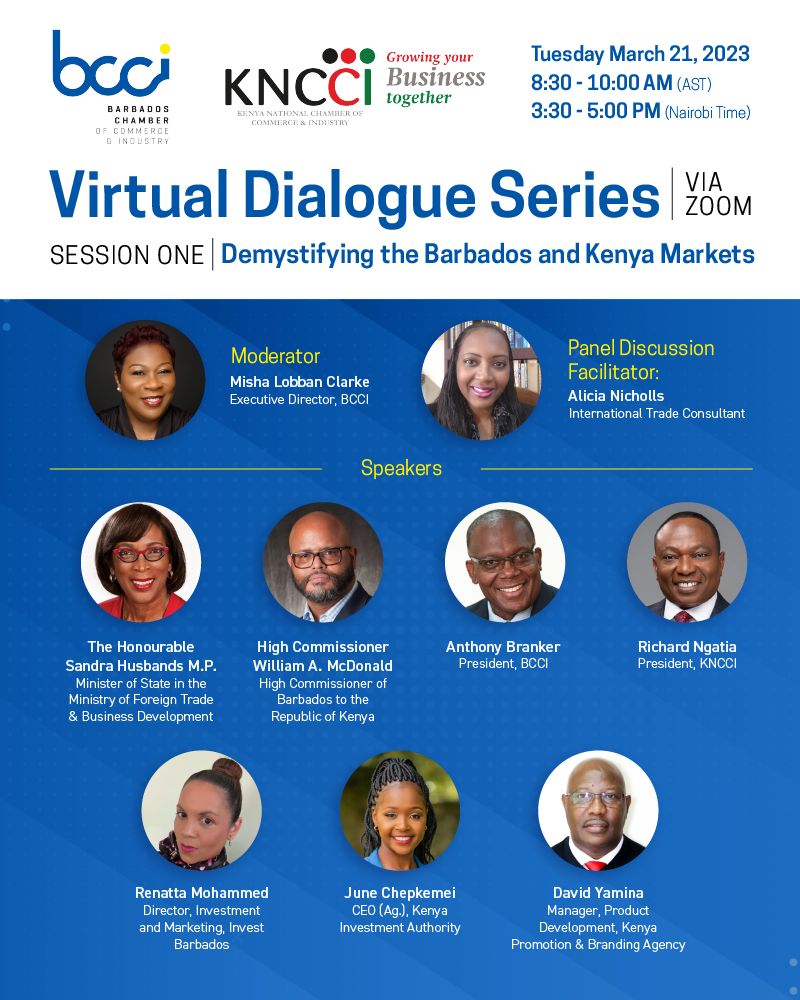
BCCI/KNCCI Virtual Dialogue Series 1: Demystifying the Barbadian and Kenyan Markets
I am pleased to be facilitating this upcoming panel at the first session of the Barbados Chamber of Commerce and Industry (BCCI) and Kenya National Chamber of Commerce and Industry (KNCCI) Virtual Dialogue Series carded for Tuesday, March 21st at 8:30-10:00 am (Atlantic Standard Time).
This first session will be on Demystifying the Barbados and Kenya markets and features an all-star panel. If you’re an exporter, investor, businessperson, or are just generally interested in Africa-Caribbean trade, please register here:
https://lnkd.in/eefaiPQxSee the flyer for further details!
-

Revised Treaty of Chaguaramas to be amended to regulate M&A activity in CSME
Photo credit: CARICOM Secretariat
Alicia Nicholls
Competition policy within the CARICOM Single Market and Economy (CSME), particularly the need for merger control regulation, was one of the major items discussed at the recently held Forty-Fourth Regular Meeting of the Conference of Heads of Government of the Caribbean Community (CARICOM) in the Bahamas last week (February 15-17, 2023).
The lengthy communique issued from the meeting revealed a packed agenda. Of interest to this author, of course, were the components dealing with continuing the consolidation of the CARICOM Single Market and Economy (CSME), especially because July this year will mark the regional grouping’s fiftieth anniversary.
Heads agreed that the Revised Treaty of Chaguaramas (RTC) would be amended to provide for the regulation of mergers and acquisitions in the CSME. This would be done on the basis of an approved Community Policy. They agreed that Member States should complete their internal consultations and approval processes on the Draft Policy on Mergers and Acquisitions in the CSME in time for the Council for Trade and Economic Development (COTED) to consider and approve the Policy in April 2023.
The CARICOM Competition Regime, as elaborated in Chapter 8 of the RTC, presently has three objectives (1) the promotion and maintenance of competition and enhancement of economic efficiency in production, trade and commerce, (2) the prohibition of anti-competitive business conduct which prevents, restricts or distorts competition or which constitutes the abuse of a dominant position in the market; and (3) the promotion of consumer welfare and protection of consumer interests. The Suriname-based CARICOM Competition Commission, along with the national commissions, is therefore a key institution for the functioning of a competitive CSME which is not harmed by anti-competitive conduct by businesses. However, currently, the CARICOM Competition Regime only regulates cross-border anti-competitive business conduct and the abuse of a dominant position. It does not deal with merger control regulation, which is the third aspect of competition policy. The Heads were also updated on the progress towards creating a dual role for the CARICOM Competition Commission (CCC) at the national and regional levels.
Asides from competition policy, the subject of progress towards completing the Draft Policy on a Regional Capital Market was also discussed. The Heads “called upon the Council for Finance and Planning (COFAP) and the Legal Affairs Committee to take the necessary action to ensure that the infrastructure for the regional capital market is largely in place within eighteen (18) months”.
They also supported COFAP’s decision to amend the Intra-CARICOM Double Taxation Agreement (ICDTA), through a Protocol on Treaty Shopping and Exchange of Information. Other topics discussed included advancing the CARICOM Agri-food systems agenda, the 50th anniversary celebrations, Afri-Exim Bank, the Bridgetown Initiative, Climate Change and Climate Finance, among others.
The full communique may be accessed here.
Alicia Nicholls, B.Sc., M.Sc., LL.B. is an international trade and development consultant and the founder of the Caribbean Trade Law and Development Blog http://www.caribbeantradelaw.com.
-
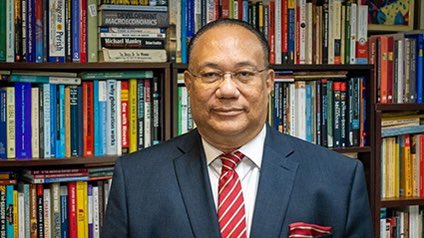
Rest in peace Ambassador Richard Bernal – Pillar of the Caribbean Trade & Development Community
Photo credit: The University of the West Indies
Alicia Nicholls
It is with profound sadness that my first blog post for the year 2023 is to express my condolences on the sudden passing of a pillar of the Caribbean trade and development community and a reader of this Blog, the late Ambassador Prof. Richard Bernal. To say that the Caribbean region has lost yet another a giant is an understatement. For me, it still has not completely sunk in.
Prof. Bernal’s incomparable achievements and contributions, both as an academic and practitioner in the trade and development economics arenas, are lengthy and will be rightfully ventillated in other spaces. Many who follow trade developments would undoubtedly best remember him for his role as a diplomat and trade negotiator, the director general of the then Caribbean Regional Negotiating Machinery (CRNM) and the lead negotiator of the CARIFORUM-European Union Economic Partnership Agreement. This was CARIFORUM countries’ first trade agreement with a developed country. Prof. Bernal’s book “Globalisation, Trade and Economic Development: The CARIFORUM-EU Economic Partnership Agreement” is compulsory 101 reading for an understanding of the EPA, the background behind its negotiation and the wider Caribbean economic development problematique. But there is much more to Prof. Bernal’s work than this. Others will no doubt write profusely on the many facets of his accomplished career and life as an economist, diplomat, educator, academic, negotiator over the next few days as we mourn his loss.
Prof Bernal was both an avid reader and writer. His writings were a quilt of measured, well-researched ideas woven expertly and drawn from his groundings in economics, trade, political economy, development policy and international affairs. At the heart of it all was a central trend, how can the Caribbean escape its current growth and development conundrum? His scholarship has undoubtedly informed, enthused and shaped my interests as a trade policy specialist from the time I was a fresh-faced student doing my Masters in International Trade Policy at The UWI Shridath Ramphal Centre for International Trade Policy & Services well over a decade ago. Even as recently as a few days ago I quoted Prof. Bernal in a journal article I am authoring. I continue to be inspired by and aspire towards his level of academic output. I was even happier when on one of his trips to Barbados, he kindly obliged my humble request to autograph my personal copies of two of his several books. I am an avid follower of his work and own copies of all his books.
While I did not know Prof. Bernal as well as others, I consider myself honoured to have made his acquaintance and privileged to have eventually met him in person. I have also enjoyed serving with him and many other regional luminaries as fellows in the Caribbean Policy Consortium. I deeply cherish the nuggets of wisdom and encouragement he shared with me in our correspondences.
His brilliant mind has physically left us. I however take some comfort in the fact that his voluminous publications list spanning books, journal articles, popular pieces and endless interviews, podcasts and webinars remain a rich repository of knowledge for future generations of trade and development practitioners, diplomats, specialists, scholars and students. These works contain his well-researched thinking and musings on key themes pervading the Caribbean development challenge – how do we achieve sustainable economic growth? How can trade assist this? How can we expand US-Caribbean relations for development? How can we make the growing Chinese-Caribbean relationship a mutually beneficial one? How has the Caribbean helped to shape international affairs even as small States?
I do hope that in recognition of his stellar contribution to the region’s corpus of research and literature on trade, international affairs and development issues, there will be some special library or unit established at The UWI where all his works could be accessed in a central place and/or a lecture series on the topics he held dear to his heart or a scholarship fund for students studying these issues established in his honour. I take this opportunity to express my deepest condolences to the late Ambassador Bernal’s family.
Walk good, Ambassador.
Alicia Nicholls, B.Sc., M.Sc., LL.B. is an international trade and development consultant and the founder of the Caribbean Trade Law and Development Blog http://www.caribbeantradelaw.com.
-
Caribbean Trade and Development News Digest – October 15-22, 2022
Welcome to our Caribbean Trade and Development News Digest covering the week of October 15-22, 2022! We are pleased to bring you the major trade and development news headlines and analysis from across the Caribbean Region and the world from the past week. We do hope you enjoy this week’s edition!
THIS WEEK’S HIGHLIGHTS
This week (October 17-21) was World Trade and Environment week at the WTO. Throughout the week there were 17 interesting sessions on various aspects of the trade and environment nexus organised by WTO member governments, the WTO Secretariat and NGOs. Read more here.
Coming up this week, Barbados has its fourth trade policy review at the WTO October 25 and 26. Read more here!
REGIONAL NEWS
BVI Premier keen on pushing agro-trade in OECS
BVINews: Premier Dr Natalio Wheatley has expressed that the BVI should strengthen its ties with its partners in the Organisation of Eastern Caribbean States (OECS) by participating in agricultural trade, among other things. Read more
WTO team currently in Dominica to conduct review
Dominica News Online: A team from the World Trade Organization (WTO) is currently in Dominica to conduct a trade policy review. Read more
OECS heads of governments commit to more functional participation in the bloc
Antigua Observer: A number of heads of states pledged their commitment to improving the work of the Organisation of Eastern Caribbean States (OECS) when they met this week for the 72nd meeting of the OECS Authority. Read more
Jamaica and UAE sign double taxation agreement
CNW: The governments of Jamaica and the United Arab Emirates (UAE) have signed an agreement to avoid double taxation and the prevention of fiscal evasion with respect to taxes on income. Read more
Jamaica poised to help certify Guyana’s food exports to US
Demerara Waves: A Jamaican accreditation agency, which operates to United States Food and Drugs Administration (USFDA) standards, is offering to certify Guyana’s laboratories for food exports to that North American country, officials said late Thursday. Read more
Jamaica Regulations to import and export medical ganja gazetted
The Gleaner: Jamaica has strengthened its position as a major player in the medical ganja industry by formalising arrangements for the import, export, transit and trans-shipment of the herb to other countries that are also signatories to international drug conventions. Read more
Six-month export revenues total US$801 million
The Gleaner: Revenues from total exports amounted to US$801 million during the first half of 2022, between January and June, representing an increase of 2.3 per cent relative to the comparable 2021 period. Read more
Latin America and Caribbean countries look towards India for trade diversification, experts urge dialogue
Financial Express: “India-LAC trade nearly doubled over the past decade, reaching $42.5 billion in 2021 and there are over 160 Indian companies present in LAC with investments exceeding $30 billion, said Karin Costa Vazquez, Executive Director of the Center for African, Latin American and Caribbean Studies. Read more
Agency coming to help Barbadian businesses get money to export
Barbados Today: The Government of Barbados is working toward establishing an agency that will give manufacturing businesses easier access to financing to expand their operations. Read more
Guyana, Grenada talk enhanced partnership
Newsroom: Foreign Secretary of Guyana Robert M. Persaud recently met with Minister for Foreign Affairs, Trade and Export Development of Grenada Joseph Andall to discuss enhanced bilateral cooperation between Guyana and Grenada in several areas. Read more
Cuba calls U.S. trade embargo a ‘hurricane’ that never ends
Reuters: Cuba on Wednesday said the decades-old U.S. trade embargo has been causing record financial losses and untold human suffering in recent months, at a time when Cuba was also battling the effects of the COVID-19 pandemic and Hurricane Ian. Read more
INTERNATIONAL NEWS
ECLAC predicts economic growth will decelerate in LAC next year
Jamaica Observer: The United Nations Economic Commission for Latin America and the Caribbean (ECLAC) is predicting that economic growth will decelerate in Latin America and the Caribbean next year. Read more
Rival trade bloc would lead to huge global GDP loss, says WTO boss
Nikkei: Geopolitical tensions and the COVID-19 pandemic have prompted some governments to veer toward protectionism, but building more diverse supply chains would better serve the cause of global resilience, the chief of the World Trade Organization said in an interview. Read more
Free trade agreement will boost intra-Africa deals, say 90pc CEOs
Business Daily Africa: Nine in 10 African chief executives have confidence the actualisation and adoption of the free trade agreement will boost intra-African trade, a new survey shows. Read more
Trade war tariffs have collapsed US imports of Chinese IT hardware and consumer electronics
SCMP: Four years into the trade war, China has lost significant US market share in IT hardware and consumer electronics to Mexico and Taiwan, though its exports of low-end semiconductors have not yet been fully replaced, a new study has found. Read more
Failure to renew key trade measure is hitting US manufacturers hard
The Hill: As American manufacturers face mounting economic headwinds, an expired U.S. trade measure is inflicting unnecessary damage on our manufacturing sector which plays a critical role in strengthening our nation’s health and national security and historically paves the way in any economic recovery. Read more
U.S.-India Trade Policy Forum set for November 8, modest outcomes likely
The Hindu: The U.S.-India Trade Policy Forum (TPF) has been scheduled for November 8 in Washington DC, The Hindu has confirmed. U.S. trade officials are arriving in New Delhi next week to finalise issues for discussion , an Indian government official told The Hindu. Read more
Three months into the Black Sea Grain Initiative: What’s been achieved — and why it’s important
UN: Today marks three months since the signing of the Black Sea Grain Initiative – an agreement between Russia and Ukraine brokered by the United Nations and Türkiye to resume vital food exports from Ukrainian ports to the rest of the world amid the ongoing war there. Read more
Dhaka to seek WTO’s net food importer status
TBS News: The government has decided to apply to the World Trade Organization (WTO) for the status of a net food-importing developing country (NFIDC), which, commerce ministry officials say, will allow Bangladesh to provide subsidies on agricultural and food exports even after its LDC graduation. Read more
STRAIGHT FROM THE WTO
NEW ON THE CTLD BLOG
The Caribbean Trade & Development Digest is a weekly trade news digest produced and published by the Caribbean Trade Law & Development Blog. Liked this issue? To read past issues, please visit here. To receive these mailings directly to your inbox, please subscribe to our Blog below:
-

Barbados’ trade policies up for WTO review next week
Alicia Nicholls
On October 25 and 27, 2022 Barbados will undergo its fourth trade policy review at the World Trade Organization (WTO). Trade Policy Reviews are part of the WTO’s trade policy review mechanism whereby all WTO members’ trade policies and practices are periodically reviewed. A country’s share in world trade is the determining factor for the frequency of its reviews. Barbados’ three previous trade policy reviews were in 2002, 2008 and 2014. These reviews are a critical part of the WTO’s transparency function.
WTO members, meeting as the Trade Policy Review Body on October 25 and 27, will review two documents: the WTO Secretariat’s Report and the report from the Government of Barbados. During the meeting, Members will have the opportunity to raise questions and seek clarity from the Barbados delegation on various issues relating to the country’s trade policies and practices. The rules of procedure for the TPRB can be accessed here.
The TPR reports are made publicly available and are a rich source of information for trade analysts and potential investors of a country’s trade policies and its general trading and macroeconomic environment. The TPRB chairperson’s concluding remarks are released shortly after. The minutes of the meeting, as well as members questions, are also released about six weeks after the conclusion of the review.
With regard to other CARICOM Member States up for review this year, Guyana had its most recent trade policy review in March and the Dominican Republic’s latest will be in December.
Alicia Nicholls, B.Sc., M.Sc, LL.B. is an international trade specialist and founder of the Caribbean Trade Law and Development blog http://www.caribbeantradelaw.com.
-
Caribbean Trade and Development News Digest – October 9-14, 2022
Welcome to our Caribbean Trade and Development News Digest covering the week of October 9-14, 2022! We are pleased to bring you the major trade and development news headlines and analysis from across the Caribbean Region and the world from the past week. We do hope you enjoy this week’s edition!
THIS WEEK’S HIGHLIGHTS
The Annual Meetings of the International Monetary Fund (IMF) and the World Bank took place this past week (October 10-16, 2022) with both Washington-based entities warning that the world economy could be in recession in 2023. Among the many things highlighted in UNCTAD’s recently released Trade and Development Report 2022 is that “with 60% of low-income countries and 30% of emerging market economies in or near debt distress, the possibility of a global debt crisis is high”. Barbados took the opportunity to present the Bridgetown Initiative on the reform of the global financial architecture which can be accessed here.
What are we watching this week? The situation in Haiti has taken a turn for the worse. CARICOM countries participated in an important United Nations (UN) Security Council Meeting to address the situation in sister CARICOM member State Haiti where it is estimated by that organisation that 4.7 million Haitians face acute hunger. This Blog extends its heartfelt support for the people of Haiti. This week the FATF’s October Plenary takes place and we will also be watching this.
What have I been up to these past few weeks? It’s been a while so I have lots to share! I was pleased to have moderated a session in September at the inaugural Africa-Caribbean Trade and Investment Forum (ACTIF) and also a session with Canadian fintech company Paystone’s CEO Tarique Al-Ansari at the inaugural Fintech Islands Conference held in Barbados, October 5-7, 2022. My latest piece for IFC Review on Barbados’ Regulatory Resilience in the Face of COVID-19 was recently published. Feel free to also check out my latest piece on what the volatility of the UK pound might mean for Caribbean tourism and trade here.
REGIONAL NEWS
Guyana World Trade Center aims to build bridges between local small businesses, foreign partners
Stabroek: Chairman of Demerara Distillers Ltd., Komal Samaroo, says that “connecting Guyanese businesses with potential partners around the world” and accessing relevant information to support market access for local products ought to be the highest priority for business owners here. Read more
Guyana signs air agreement with China
CWN Weekly: The Government of Guyana has signed an air service agreement with the People’s Republic of China. Read more
Guyana opens tender for its first oil refinery
Economic Times: Guyana has called for proposals to design, finance and build its first oil refinery. Read more
Belize’s SIB reports 13.5% GDP growth, tripling of rum production
Amandala: The Statistical Institute of Belize reported that for the second quarter of 2022, the economy grew by 13.5%, due to increases in beverage production, fruit deliveries, and electricity generation. Read more
Suriname eyeing economic citizenship
Caribbean Life: Suriname, considered as one or the more developed nations in CARICOM, dropped a political bombshell in the past week, indicating that it is considering joining its neighbors in the Organization of Eastern Caribbean States (OECS) in running a passport for money and citizenship scheme. Read more
Gopee-Scoon: Businesses booming in Trinidad and Tobago
Newsday: Exports are at record levels, the country’s figures are great, and exciting new businesses abound in TT, effused Trade Minister Paula Gopee-Scoon, in her budget contribution on Tuesday in the House of Representatives. Read more
INTERNATIONAL NEWS
WTO anticipates sharp slowdown in world trade growth in 2023
UN: Trade growth is expected to lose momentum in the second half of this year and remain subdued in 2023, as the global economy sustains multiple shocks, such as ripple effects from the war in Ukraine, the latest forecast from the World Trade Organization (WTO) has revealed. Read more
Trade and Sustainability Discussions at WTO Approaching Next Milestone
IISD: On October 4 and 5, the 74 members currently co-sponsoring the Trade and Environmental Sustainability Structured Discussions (TESSD) at the World Trade Organization (WTO) met to further their work and discuss preparations for a high-level stocktaking event in December. Read more
How Countries Should Respond to the Strong Dollar
IMFBlog: Policy responses to currency depreciation pressures should focus on the drivers of the exchange-rate moves and signs of market disruptions. Read more
Policymakers Need Steady Hand as Storm Clouds Gather Over Global Economy
IMFBlog: One-third of the world economy will likely contract this year or next amid shrinking real incomes and rising prices. Read more
UK government unveils bill for digitisation of trade documents through blockchain
Financial Express: According to Cointelegraph, MP Michelle Donelan and UK Department of Digital, Culture, Media and Sport stated that the Electronic Trade Documents Bill had been introduced to the Parliament. Read more
UK Government asked to reconsider on trade agreements
UK Parliament: The Environment Food and Rural Affairs (EFRA) Committee has asked the new government to re-consider a “disappointing” response to its report on the impact of the Australian free trade agreement (FTA) on the UK food and agriculture sector. Read more
GOP Members Call for U.S.-UK Free Trade Agreement in Letter to Newly Appointed UK Trade Secretary Kemi Badenoch
US House: Ways and Means Republican Leader Rep. Kevin Brady (R-TX) and Republican Leader of the Ways and Means Subcommittee on Trade, Rep. Adrian Smith (R-NE), joined by all Ways & Means Republicans, today sent a letter to UK Secretary for International Trade Kemi Badenoch conveying this message. Read more
No consensus yet on China joining regional trade pact – Singapore PM
Reuters: Singapore’s Prime Minister Lee Hsien Loong said on Tuesday there is no consensus yet for China to join a trans-Pacific trade pact, although Singapore believed it would be possible for Beijing to meet the trade bloc’s conditions. Read more
Taiwan, U.S. hope to come up with ‘early harvest’ list on trade deal by year-end
FocusTaiwan: Taiwan hopes to reach consensus with the United States to come up with an “early harvest list” on a bilateral trade deal before the end of this year, the nation’s deputy trade negotiator told lawmakers on Monday. Read more
STRAIGHT FROM THE WTO
NEW ON THE CTLD BLOG
The Caribbean Trade & Development Digest is a weekly trade news digest produced and published by the Caribbean Trade Law & Development Blog. Liked this issue? To read past issues, please visit here. To receive these mailings directly to your inbox, please subscribe to our Blog below:
-

Barbados’ regulatory resilience in the face of COVID-19
In my latest piece for IFC Review I write about how financial regulators in Barbados adapted to the Covid-19 challenge. It is based on a book chapter I have forthcoming. Read the article here!
-
Fintech Islands: Catalysing the Caribbean Fintech Industry
Alicia Nicholls
A few months ago, I authored an article for IFC Review positing that Barbados possessed many of the main ingredients necessary to become a global fintech hub of the future as part of its post-COVID-19 economic diversification strategy. Since I penned that article, the need for Caribbean small island developing States to diversify their economies has never been greater. Happily, an upcoming private sector-led event called Fintech Islands is taking a critical step towards strategically positioning Barbados, and the Caribbean by extension, as a key player in the burgeoning global fintech space.
To appreciate the importance of this event, context is key. After three long years, the COVID-19 pandemic appears to be approaching its tail-end. However, as the International Monetary Fund (IMF) outlined in its July 2022 World Economic Outlook Update, several shocks have hit an already pandemic-weakened global economy and made the outlook for the rest of 2022 “gloomy and more uncertain”. Moreover, tourism, the lifeblood of most Caribbean economies, faces the headwinds of a recessionary UK economy battling high inflation and a depreciating pound. These developments could adversely impact both winter arrivals and expenditure from one of the region’s major tourism source markets.
Building resilience to help combat these headwinds requires diversification into higher value-added sectors offering opportunities for earning greater foreign exchange, generating meaningful and high-quality jobs and improving overall welfare for Caribbean citizens. Barbados’ quest to position itself as a global fintech hub forms part of such a strategy.
Governments cannot by themselves create a fintech hub. What all of the world’s most successful fintech hubs boast is an ecosystem encompassing policy makers, regulatory authorities, firms, entrepreneurs and financial service providers. In this vein, three enterprising diaspora-based Barbadians – Allison Hunte, Peter Stoute-King and Curt Persaud – formulated the vision of hosting a world-class fintech event in the Caribbean drawing influential speakers and attendees from across the world. Their team was rounded out by senior advisors William ‘Billy’ Griffith and Andrew Morris. They further partnered with an A-list of partners to put together what promises to be a truly revolutionary event in the Caribbean fintech space to be held on October 5-7, 2022.
Fintech Islands will be the first high calibre global fintech event to be held in Barbados. The mélange of over 100 distinguished speakers provides fertile ground for the world’s most prescient fintech minds to exchange their ideas, experiences and expertise and proffer solutions on how fintech could address some of the development challenges of our times – financial exclusion, poverty, climate change, gender inequality and the like.
Named among Times’ 100 Most Influential people of 2022, Prime Minister of Barbados, the Hon. Mia Amor Mottley, will be a special guest and deliver welcome remarks at this inaugural event. While testifying before the United States (US) House of Representatives’ Financial Services Committee this September, Prime Minister Mottley had made an impassioned plea about the ways in which the de-risking practices by large US banks were harming small States’ ability to engage in cross-border trade and their investment attraction. She had highlighted, for example, the plight of the unbanked and what the lack of access to banking services has meant for these persons at the micro level. It is increasingly recognized, through global examples like Kenya’s M-Pesa for example, the ways in which fintech could provide solutions to tackle financial exclusion and to promote philanthropy and financing for development.
To be sure, though Barbados cannot become a fintech hub overnight, the many rich and insightful discussions over the next few days could be catalytic for the Caribbean fintech industry for the following reasons.
First, as policy makers and regulators will be among the esteemed speakers and attendees, there surely will be the opportunity to learn from other countries and share best practices.
Second, the event, through its diverse panels, will bring attendees up to speed on all the exciting things happening in the region’s fintech space, promoting fintech innovation and adoption and showcasing the region as an attractive place for fintech start-ups and investment. Indeed, some of the sessions feature fintech entrepreneurs who have decided to base their operations here in the Caribbean and who will be sharing their experiences and reasons for investing in the region.
Third, the event affords young fintech entrepreneurs, content creators, industry analysts and those with a general interest in the field a space to meet, network and learn from thought leaders in this landscape.
Fourth, the event will demonstrate that Barbados and the Caribbean can be a choice location for hosting a world-class fintech event. Similar to Money20/20, CoinDesk Consensus, and the Singapore FinTech Festival, a successful Fintech Islands here in Barbados could potentially prove to be a ‘must-attend’ event on the calendars of the fintech landscape’s who’s who in the near future.Learn more about Fintech Islands here.
Alicia Nicholls, B.Sc., M.Sc., LL.B. is an international trade consultant and founder of the Caribbean Trade Law Blog: http://www.caribbeantradelaw.com. -
CARICOM Releases Statement on Military Build-Up in Caribbean Sea
Alicia D. Nicholls
Days after two Trinidadian nationals were believed to have been among the victims in one of the latest extrajudicial killings by US military forces in the Caribbean Sea off the coast of Venezuela, the Caribbean Community (CARICOM) has released a carefully worded statement condemning the build-up of military assets in the Caribbean Sea.
While not specifically mentioning the killings, the statement reiterated, inter alia, support for the “safety and livelihoods of the people of the region”. It should also be noted that the statement was released on behalf of all CARICOM Heads of Government, except Trinidad & Tobago which has “reserved its position”.
The full statement taken from the CARICOM website can be viewed here:
“Heads of Government of the Caribbean Community (CARICOM) met and discussed various issues on the regional agenda including the increased security build up in the Caribbean and the potential impacts on Member States. Save in respect of Trinidad and Tobago who reserved its position, Heads agreed on the following:
They reaffirmed the principle of maintaining the Caribbean Region as a Zone of Peace and the importance of dialogue and engagement towards the peaceful resolution of disputes and conflict. CARICOM remains willing to assist towards that objective.
CARICOM Heads of Government reiterated their continued commitment to fighting narcotrafficking and the illegal trade in small arms and light weapons which adversely affect the Region. They underscored that efforts to overcome these challenges should be through ongoing international cooperation and within international law.
They reaffirmed unequivocal support for the sovereignty and territorial integrity of countries in the Region and the safety and livelihoods of the people of the Region.”
Source: https://caricom.org/statement-from-the-caribbean-community-security-build-up-in-the-region/

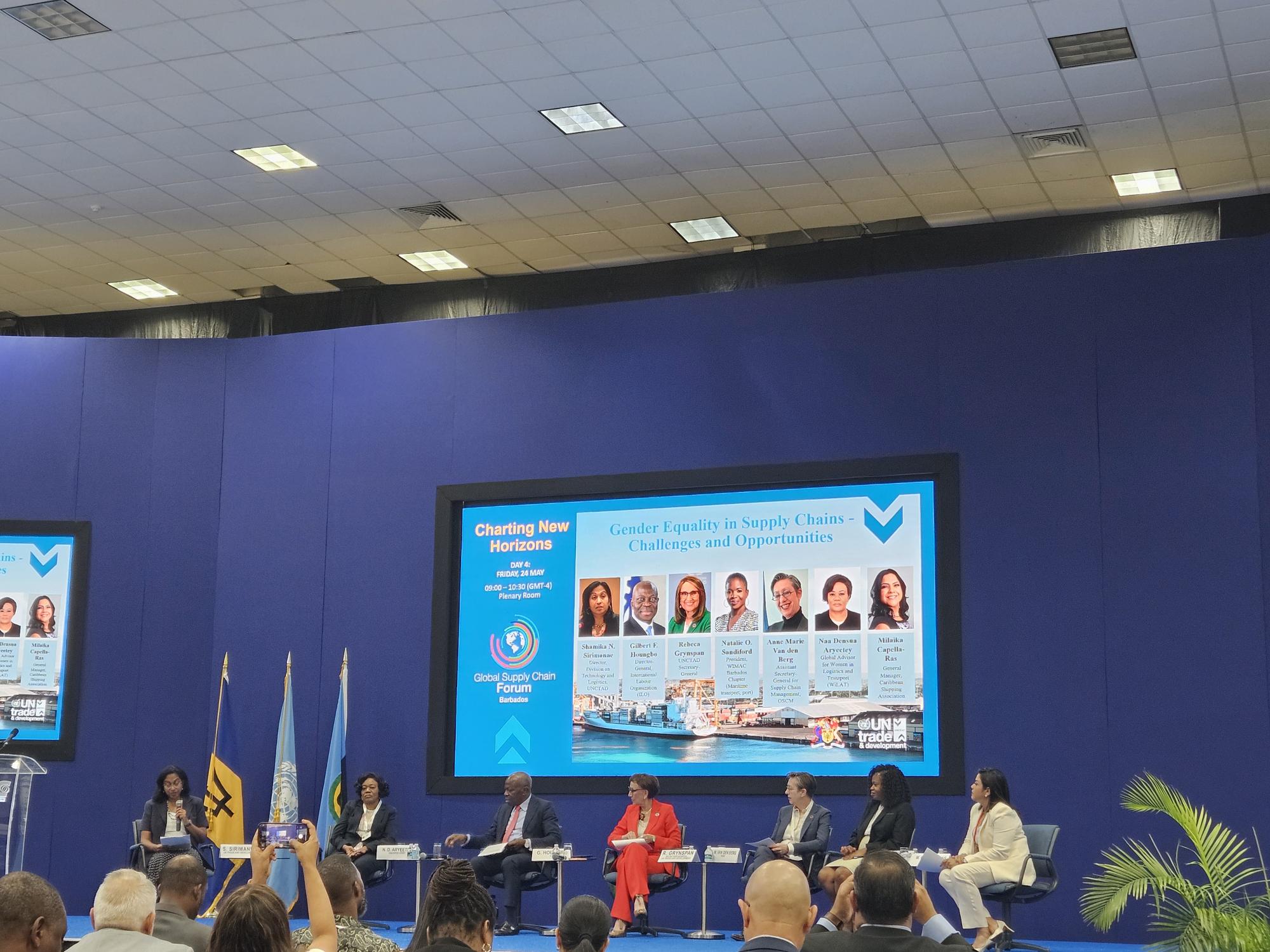




 Caribbean Trade Law and Development
You must be logged in to post a comment.