On Tuesday, July 7th, I am happy to be participating as a panelist in this free Webinar hosted by The University of the West Indies Open Campus’ Business Development Unit and Global Executive Trade! See flyer and below for further details.
“The panel will examine the role of global trade, supply chains and the “new economy” to support Caribbean private sector success in the post Covid19 environment. This will be done by exploring legal policy, technological infrastructure, energy uses, and supply chain management as levers to success and greater opportunity for firms involved in commercial trade, or wanting to do business in and with the Region. It will consider the risks associated with global trade and the role the private sector holds in pooling all resources to boost the Region’s competitiveness during these tumultuous times and in the future.”
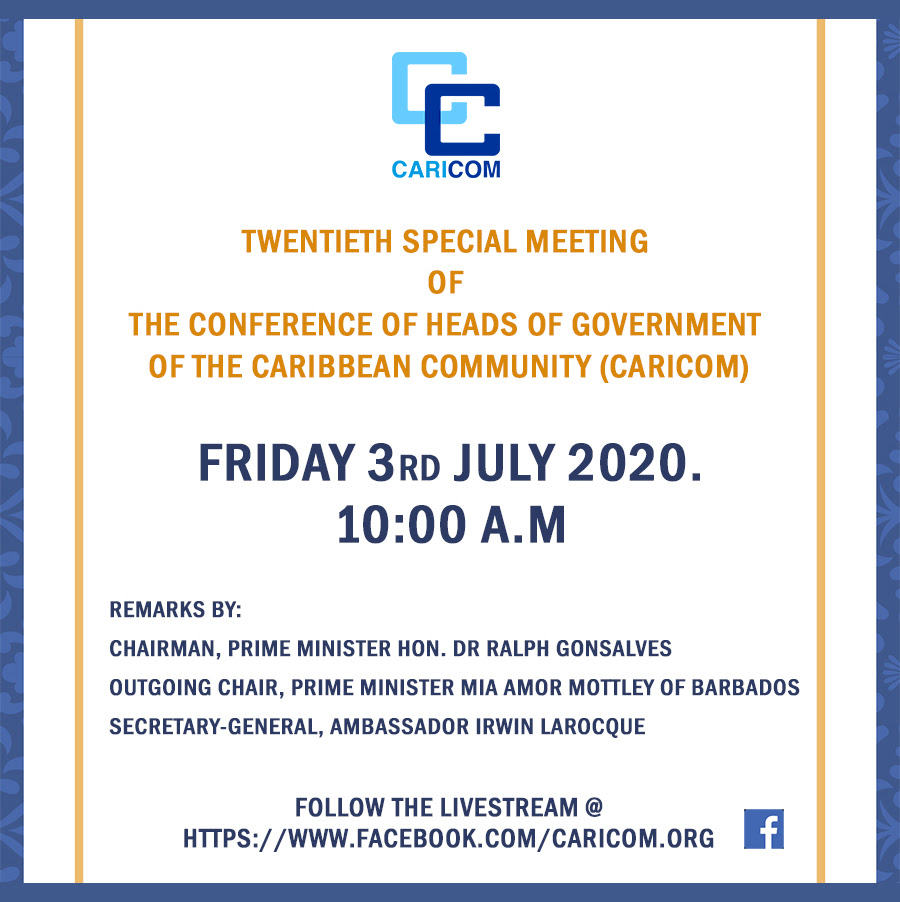
(CARICOM Secretariat, Turkeyen, Greater Georgetown, Guyana) Caribbean Community (CARICOM) Heads of Government will hold a special conference on Friday, July 3, which will see Barbados Prime Minister Mia Amor Mottley handing over the six-month CARICOM Chairmanship to Prime Minister Dr. Ralph Gonsalves of St. Vincent and the Grenadines.
This Twentieth Special Meeting of CARICOM Heads will be held via video conference beginning at 10:00 a.m. Eastern Caribbean time.
The handing over segment of the meeting will be Live-streamed on the CARICOM Secretariat’s Face Book page – https://www.facebook.com/caricom.org
Remarks will be delivered by CARICOM Secretary-General Ambassador Irwin LaRocque, and Prime Ministers Mottley and Gonsalves.
The Caribbean Community has 15 Member States – Antigua and Barbuda, The Bahamas, Barbados, Belize, Dominica, Guyana, Grenada, Haiti, Jamaica, Montserrat, St. Kitts and Nevis, Saint Lucia, St. Vincent and the Grenadines, Suriname and Trinidad and Tobago, and five Associate Members – Anguilla, Bermuda, British Virgin Islands, Cayman Islands, and the Turks and Caicos Islands.
The preceding was a press release from the CARICOM Secretariat.
Welcome to the Caribbean Trade & Development News Digest for the week of June 21-27, 2020! We are happy to bring you the major trade and development headlines and analysis from across the Caribbean Region and the world from the past week.
THIS WEEK’S HIGHLIGHTS
The number of nominees for next World Trade Organization (WTO) Director-General continues to increase. This week, South Korea nominated its trade minister, Ms Yoo Myung-hee.
The candidates have been making their case to the public on their vision for the WTO which is currently in crisis. For example, Nigerian candidate Ngozi Okonjo-Iweala penned an op-ed on reviving the WTO here. Egyptian candidate, Hamid Mamdouh, participated in a WITA Webinar to discuss his candidacy and vision for the WTO which you can watch here.
Yesterday, June 27 was UN Micro, Small and Medium-sized Enterprise (MSME) Day. Read some of our previous posts on MSMEs and the COVID-19 crisis here:
On a final editorial note, this publication announces its solidarity with the movements currently taking place across the US and the world for racial equality and justice #blacklivesmatter.
REGIONAL NEWS
CARICOM’s stake in the WTO Director-General Race
Barbados Today: Incumbent World Trade Organization (WTO) Director-General (DG) Mr Roberto Azevedo’s recent announcement of his resignation a full year before concluding his second term of office took the world by surprise and presents another plot twist among the mounting challenges confronting the guardian of the multilateral trading system. Read more
DR has opportunity to attract investment due to COVID-19
Dominican Today: The Dominican Republic has the opportunity to attract foreign investment from multinationals that will seek to have their factories close to the United States due to the COVID-19 pandemic. This was stated by Ana Arias Urones, Senior Specialist of the Trade and Investment Division of the Inter-American Development Bank (IDB), who stressed that in the next six months the country will have the opportunity to take advantage of post-covid-19 recovery scenarios to position itself as a foreign investment destination. Read more
C’bean among countries unfairly targeted by US senators over Cuba
Jamaica Observer: Three US senators — who have done little to advance the interests of the Caribbean and with whom requests for meetings by many Caribbean ambassadors are usually shunted to their staff — are now proposing US Government punishment for Caribbean countries that request assistance from Cuba for medical personnel. Read more
EU seeking to improve on its financing conditions
Barbados Advocate: The European Union has a vision to provide grants and loans together in a financing package so that it can improve the financing conditions that it offers its partner countries. Ambassador Daniela Tramacere, Head of the EU Delegation to Barbados, the Eastern Caribbean States, the OECS and CARICOM/CARIFORUM noted the above as she spoke recently during the launch of the Barbados Water Supply Infrastructure Rehabilitation Project by the Barbados Water Authority. Read more
Operations Of 20 Entities To Be Digitised Under Single Window Initiative
JIS: The operations of approximately 20 State entities that facilitate imports and exports are earmarked for digitisation under the Jamaica Single Window for Trade (JSWIFT) initiative, which is being implemented by the Jamaica Customs Agency (JCA). Jamaica. Read more
US$12.5 billion limestone potential
Jamaica Observer: As the country seeks to expand its investment opportunities, stronger calls are being made for investors and exporters to take advantage of the emerging benefits in the value-added limestone industry. Read more
Shaw denies companies leaving Ja due to cannabis regulation lag
Jamaica Observer: MINISTER of Industry, Commerce, Agriculture and Fisheries Audley Shaw has denied claims that cannabis companies are leaving Jamaica as a result of the country’s failure to implement import/export regulations. Read more
Region Cannot Return To Pre-COVID-19 Era – Bartlett
Jamaica Gleaner: Jamaica’s Tourism Minister, Edmund Bartlett, says for the first quarter of this year, international tourism has recorded 67 million fewer arrivals and a loss of US$80 billion in exports. Read more
Tian Qi | Enhancing China-Caribbean Cooperation In Building Belt And Road
Jamaica Gleaner: On June 18, the high-level videoconference on Belt and Road international cooperation was held in Beijing under the theme ‘Belt and Road International Cooperation: Combating COVID-19 with Solidarity’. Read more
INTERNATIONAL NEWS
Ottawa Group Recommends Actions on COVID-19, Signals Continued Interest in WTO Reform
IISD: The Ottawa Group, comprised of 13 World Trade Organization (WTO) members, has released a statement outlining six action areas to focus on in light of COVID-19. Formed in the wake of the Ottawa Ministerial on WTO Reform, held 24-25 October 2018, the Group seeks to address specific challenges that are putting the multilateral trading system under stress. Read more
Liam Fox and Peter Mandelson compete to be next world trade chief
The Sunday Times: Ministers are considering whether to nominate Liam Fox, the former international trade secretary, as Britain’s candidate to become the next head of the World Trade Organisation (WTO). Read more
Kenya-U.S. Trade Talks to Start Next Month, President Kenyatta Says
AllAfrica: President Uhuru Kenyatta has said the much-anticipated trade talks between Kenya and the United States of America will start on 7th July 2020. Read more
RCEP members to keep aiming for deal this year, with hopes India will rejoin
The Japan Times: Ministers from 15 Asia-Pacific countries negotiating a sprawling free trade agreement agreed Tuesday to continue aiming for a deal by the end of the year, while keeping the door open for India to return to the talks. Read more
U.S. Still Committed to Digital Tax Talks, OECD Tax Chief Says
Bloomberg: The U.S. is still actively participating in OECD negotiations on global digital tax rules, the organization’s top tax official said Wednesday. Read more
USTR Lighthizer and US trade policy: Right goals, wrong strategy
VoxEU: Joshua Meltzer argues that the Trump administration has failed to provide a coherent vision for maintaining and expanding US competitiveness in the 21st century, including through its trade policy. Read more
China ‘interested’ in Trans-Pacific trade deal but keen to gauge Japan’s ‘attitude’ ahead of potential talks, ex-minister says
South China Morning Post: China is keen to first understand Japan’s “attitude” before beginning formal negotiations to join the Comprehensive Progressive Trans-Pacific Partnership Agreement, according to former commerce minister Chen Deming. Read more
COVID-19, trade war take toll on trans-Pacific volumes through April
JOC: Total container volume carried by the top 15 lines in the US trade with Asia fell 7.2 percent through the first four months of the year, but a recent spike in imports from Asia and a cut in blank sailings this summer should stem declines going forward. Read more
Trump threat to ‘decouple’ U.S. and China hits trade, investment reality
Reuters: Conflicting talk from Trump administration officials about “decoupling” the U.S. economy from China is running into a challenging reality: Chinese imports of U.S. goods are rising, investment by American companies into China continues, and markets are wary of separating the world’s biggest economies. Read more
The Diplomat: In the midst of COVID-19, an unlikely trade agreement breaks through. Read more
ECOWAS endorse Okonjo-Iweala as DG of the World Trade Organization
Nairametrics: The West African Regional political and economic block, the Economic Community of West African States (ECOWAS), has announced the backing of the candidature of Nigeria’s former Finance Minister, Ngozi Okonjo Iweala, as the Director-General of World Trade Organization (WTO). Read more
The WTO’s Fall from Grace: Disputes About Dispute Settlement
McGill International Review: The future of the World Trade Organization (WTO) has come under recent scrutiny, with its Director General (DG), Roberto Azevêdo, announcing plans to resign one year early. Yet the demise of the WTO has been a long-standing issue, particularly linked to the lack of support shown for the organization by one of the world’s largest economies, the United States. Read more
Support for Brexit is collapsing as poll finds big majority of British people want to be in the EU
Business Insider: A newly released survey found just 35% of British people supporting Brexit, with 57% wanting to rejoin the European Union. Read more
Brexit: Angela Merkel says Britain must ‘live with the consequences’ of Boris Johnson’s decision to ditch close alignment with EU
The Independent: Angela Merkel has said that Britain will have to “live with the consequences” of Boris Johnson’s decision to ditch Theresa May’s plans for close alignment with the European Union after Brexit. Read more
The Caribbean Trade & Development Digest is a weekly trade news digest produced and published by the Caribbean Trade Law & Development Blog. Liked this issue? To read past issues, please visit here. To receive these mailings directly to your inbox, please subscribe to our Blog below:
Welcome to the Caribbean Trade & Development News Digest for the week of June 14-20, 2020! And a Happy Father’s Day to all readers who are fathers, fathers-to-be or father figures! We are happy to bring you the major trade and development headlines and analysis from across the Caribbean Region and the world from the past week.
THIS WEEK’S HIGHLIGHTS
Global foreign direct investment (FDI) flows are forecast to decrease by up to 40% in 2020, from their 2019 value of $1.54 trillion, according to UNCTAD’s World Investment Report 2020 released this week. The report also shows that reshoring, diversification and regionalization will drive restructuring of global value chains in the coming years.
US Trade Representative (USTR) Robert Lighthizertestified before the US House of Representatives’ Ways and Means Committee and the US Senate Finance Committee about the Trump Administration’s trade policy, including on hot button issues such as the US-China trade deal, the USMCA, and the administration’s plans for a ‘reset’ of tariffs at the WTO.
Moldova became the fourth WTO Member to officially nominate a candidate for the post of WTO Director-General to succeed incumbent DG Roberto Azevedo who this May announced his decision to step down a year early.
After three months of shutdown and in some cases border closures due to the COVID-19 pandemic, most Caribbean countries are slowly reopening their air and sea borders to commercial traffic in an effort to kickstart their economies. However, with infection rates continuing to surge in several US states, including Florida, a major gateway to the Caribbean, one questions whether it might be too soon to resume air traffic from the US considering that Jamaica recorded 14 new cases for the first time in weeks, all of which were imported from US flights.
Guest Contribution: This week’s guestcontributor Deah James examines the impact of COVID-19 on Micro, Small and Medium-Sized enterprises, including in the Caribbean nation of St. Vincent & the Grenadines. Have a read of her insightful piece here!
On a final editorial note, this publication announces its solidarity with the movements currently taking place across the US and the world for racial equality and justice #blacklivesmatter.
REGIONAL NEWS
Johnson: Missed WTO targets not the focusfor the Bahamas
EyeWitness News: The Minnis administration had set June 2020 as a the target for World Trade Organization (WTO), a process which the country undertook two decades ago. Johnson spoke to the initiative during his contribution to the budget debate yesterday. Read more
Bahamas Govt Not Hostage To WTO ‘Target Dates
Bahamas Tribune: The government will not be held hostage to any deadlines or timelines for completing The Bahamas’ accession to full World Trade Organisation (WTO) membership, a Cabinet minister said yesterday. Read more
JMEA Reports Success In Local And Export Markets
JIS: The Jamaica Manufacturers and Exporters’ Association (JMEA) is reporting that members are having success on the local and export market since the COVID-9 outbreak in March. Read more
JAMPRO woos logistics investors
JIS: President of Jamaica Promotions Corporation (JAMPRO), Diane Edwards, is wooing overseas investment in Jamaica’s logistic services, noting that the country’s location, within reach of 800 million customers, makes it ideal to offer cutting-edge services to the global market. Read more
TTMA launches 5-year strategic plan
Newsday: The focus of the TT Manufacturers’ Association’s (TTMA) manufacturing export strategy 2025 is to increase exports through private sector initiatives over the next five years. TTMA President Franka Costelloe said the aim for 2020 is to restabilise the export market share and sales for the non-energy sector. Read more
Guyana will attract more investment if border controversy is settled
South Florida Caribbean News: The Guyana/Venezuela Border controversy needs to be resolved soonest so that Guyana can further exploit the resources of its maritime space and landmass which is being claimed by Venezuela. Read more
Rice exports up by 13% – GRDB
Stabroek: The Guyana Rice Development Board (GRDB) has reported a 13% hike in rice exports between January and May this year when compared to the same period last year. Read more
EU AML/CFT Listing of Countries Among the Priority Issues of OACPS-EU Post Cotonou Negotiations
Bahamas Information Services: A series of virtual negotiation meetings held between the Organisation of African, Caribbean and Pacific States (OACPS) and the European Union (EU) more specifically the European Commission during the week of 8 through 12 June 2020 featured prominently the unilateral action of the EU and its publication of a listing of High-Level Third Risk Countries due to strategic deficiencies in their anti-money laundering and counter financing of terrorism regimes. Read more
How OECS nations managed to get rid of Coronavirus
WIC: Coronavirus and the lockdowns across the globe are considered the only way to control the contamination of the virus. All the major economies are either under 24-hour lockdowns or observing partial curfews. While lockdowns and curfews are considered to be the one and only way to break the chain of the virus, but some nations have shown otherwise. Read more
INTERNATIONAL NEWS
European Commission kicks off major EU trade policy review
European Commission: Today, the European Commission launched a major review of the European Union’s trade policy, including a public consultation seeking input from the European Parliament, Member States, stakeholders and civil society. The Commission’s objective is to build a consensus around a fresh medium-term direction for EU trade policy, responding to a variety of new global challenges and taking into account the lessons learned from the coronavirus crisis. Read more
US-EU trade war feared after Washington quits digital tax talks
Al Jazeera: The EU could press ahead with plans for digital tax on giants like Google, Facebook and Amazon. Read more
5 ways to advance digital trade in the post-COVID world
World Economic Forum: Globalization is under threat. Even before the pandemic, globalization was already struggling due to years of stagnation in trade growth and uncertainties at the World Trade Organization (WTO) due to US-China trade tensions. COVID-19 was another blow to the system. And the early departure of the WTO Director-General doesn’t help. Yet, international trade is critical to economic recovery. This is especially true for digital trade. Read more
US looks at digital economy tradedeal with Australia
Financial Review: The Trump administration is looking at a groundbreaking digital economy trade deal with Australia that would supercharge the 21st century’s main growth engine while bolstering co-operation to compete with China’s more insular system. Read more
Why ‘digital taxes’ are the new trade war flashpoint
Daily Herald: The U.S. decision to withdraw from international efforts to harmonize global tax rules for digital companies risks triggering a new trade war. The move came after the U.S. and a group of nations failed to agree on the best way to tax revenue from digital companies such as Facebook and Alphabet’s Google. Read more
Brexit: UK plans to keep post-transition trade with EU flowing
BBC: Last week, the government announced that relaxed controls will apply for goods coming into the UK from the EU for a period of six months. These will apply whether the UK and the EU conclude a free trade agreement before the end of the year or not. Read more
97% Bangladeshi products get duty freeaccess in China
Anadolu: 5,161 more products to get the treatment effective from July 1, while there is huge trade deficit between two countries. Read more
India rejects market economy tag for China
Livemint: India on Monday rejected China’s demand to grant it market economy status, amid the ongoing face-off between the two armies along the Line of Actual Control (LAC). New Delhi will continue to treat its neighbour as a non-market economy, which allows it to impose steep anti-dumping duties on imports from China. Read more
US Mulling Over Restoring India’s Status Under GSP
Outlook India: The top trade official from Donald Trump Administration said the US is currently in a big trade negotiations with India. Read more
A Roundup of Recent Perspectives On the Proposed USA-Kenya Free Trade Agreement
Patrick Anam: By now the news and debates around the proposed US- Kenya FTA is in the offing have gained notoriety and has been reported widely in various media both in the US and in Africa. Read more
New trade deal between US and Kenya will be a win for Africa, says Uhuru
The Standard: President Uhuru Kenyatta has sought to dispel fear that the ongoing trade talks between Kenya and the United States will undermine the African Continental Free Trade Agreement (AfCFTA). Read more
Add Logs to a Growing List of Canada-China Trade Problems
Financial Post: Canadian officials are investigating after China said it discovered pests in shipments of hardwood and softwood. The move comes three weeks after a judge ruled that extradition proceedings may continue against Huawei’s chief financial officer Meng Wanzhou and is raising concerns the pest issue may be politically-motivated. Read more
New NAFTA takes effect next month. U.S. is already threatening legal challenges
CBC: Trump’s trade rep says Canada, Mexico could face cases after deal enters force July 1. Read more
Trump Administration to push for a reset of global tariffs
New York Times: The Trump administration plans to continue its aggressive trade tactics this year by pushing for a “broader reset” of the tariffs set at the World Trade Organization, a top trade official plans to tell Congress in testimony on Wednesday. Read more
China pulls WTO suit over claim to be amarket economy
Reuters: China has halted a dispute at the World Trade Organization over its claim to be a market economy, a panel of three WTO adjudicators said on Monday, meaning Beijing must accept continued EU and U.S. “anti-dumping” levies on cheap Chinese goods. Read more
It is critical to restructure the supply chains duringthe COVID-19 period
Fiji Village: FMF Foods Limited Managing Director Ram Bajekal says it is critical to restructure the supply chains during the COVID-19 period as they experienced a dip with change in schedules in shipment and air freights. Read more
India to remain most resilient in South Asia, continue to attract FDI even in Covid-19 crisis: UNCTAD
Economic TImes: However, inflows May shrink sharply. As per UNCTAD, India jumped to ninth spot in 2019 on the list of global top FDI recipients from the twelfth spot in 2018. Read more
Japan And ASEAN To Improve Trade Deal
The ASEAN Post: The Japanese Ministry of Foreign Affairs said in a statement released earlier this week that it has notified ASEAN countries that it had completed the legal procedures to amend the First Protocol of the ASEAN-Japan Comprehensive Economic Partnership (AJCEP). Read more
Japan criticizes South Korea for requesting WTO review of export controls
Japan Times: The government on Friday criticized South Korea’s decision to ask the World Trade Organization (WTO) to set up a dispute settlement panel over Japan’s tightening of export controls on semiconductor materials. Read more
China loses landmark WtO dispute against EU
Japan Times: China spent four years fighting for market-economy status, a designation that would give it stronger footing with commercial partners while also curtailing their ability to retaliate over trade disputes. This week, China quietly lost that battle. Read more
It the US wants a better WTO, it should lead the way
The Hill: In the wake of the sudden departure of World Trade Organization (WTO) Chief Robert Azevêdo, multiple nominees have been put forward to lead the organization into the next phase, which at the moment feels very uncertain. But one name is missing: That of an American. With two of its largest member countries, the United States and China, in conflict about the WTO’s direction, this is an opportunity to defend the rules-based trading system that the United States founded and professes to value. Read more
Government endorses Irish Commissioner Phil Hogan for World Trade Organisation chief
Independent.ie: The Government has backed Irish EU Commissioner, Phil Hogan, for the post of director general of the World Trade Organisation. The decision will increase his prospects of becoming the EU candidate for the prestigious post which falls vacant on September 1. Read more
US says a UK trade deal ‘unlikely’ before November
BBC: America’s top trade negotiator has said a deal with the UK is unlikely before the US presidential election in November. Read more
U.K. wants to join Pacific trade pact as trade deal with Canada approaches its end
CBC: With just over six months remaining before Canada’s current free trade arrangement with the United Kingdom expires, the British government signalled today that it intends to join another trade agreement in which Canada is already a partner: the Comprehensive and Progressive Trans-Pacific Partnership. Read more
UK begins talks with Australia and New Zealand on free trade deal for post-Brexit era
The Guardian: Australian and New Zealand ministers say they are eager to do deals with the UK as their economies emerge from the coronavirus crisis. Read more
Some U.S. aluminum producers are again pushing for tariffs on Canada as others warn of ‘great Canadian distraction’
Financial Post: Tensions around aluminum appear to be rearing their head again even as the new NAFTA is only weeks away from taking effect. Read more
This week I look forward to being a panelist on the AfronomicsLaw webinar entitled “Vulnerability in the Trade and Investment Regimes in the Age of COVID-19”. See flyer below for further details and to register!
The Caribbean Trade & Development Digest is a weekly trade news digest produced and published by the Caribbean Trade Law & Development Blog. Liked this issue? To read past issues, please visit here. To receive these mailings directly to your inbox, please subscribe to our Blog below:



 Caribbean Trade Law and Development
You must be logged in to post a comment.