CARICOM Secretariat | Turkeyen, Greater Georgetown, Guyana | Thursday, 29 January 2026: A senior Caribbean Community (CARICOM) official has positioned deeper regional integration as a strategic response to an increasingly fragmented and uncertain global trade environment, as global rules-based systems weaken and economic nationalism intensifies.
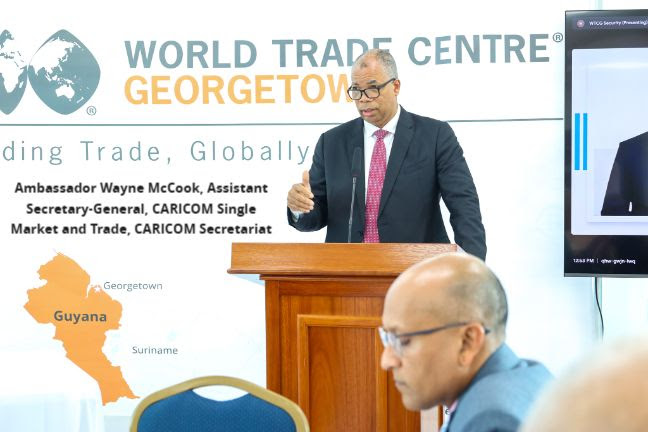
Ambassador Wayne McCook, Assistant Secretary-General, CARICOM Single Market and Trade, was a panelist discussing Prospects for International Trade in 2026 in the Context of the Changing Global Geopolitical and Economic Landscape – Impact on Trade and the Challenges and Opportunities for the Caribbean and Latin America. The discussion was held on Wednesday, 28 January, at the World Trade Centre in Georgetown, Guyana.
Contextualising the Region’s position, Amb. McCook said: “For our Region, the scars of the immediate past are visible. The devastating passage of Hurricane Melissa encapsulated the dual challenge we face: the existential threat of climate change and the inherent economic vulnerabilities of our CARICOM Member States. Simultaneously, we have navigated dramatic shifts in global trade, driven largely by an intensified “America First” trade policy that has significantly impacted our exports, value chains and supply chains through a suite of unprecedented tariff measures.”
Against the background of what he described as “a truly tumultuous 2025” for international and regional trade, Amb. McCook highlighted CARICOM’s “oneness” and its resilience to navigate the “choppy waters” of the 21st century.
Amb. McCook warned that the erosion of multilateral trade norms is no longer theoretical, but already affecting investment, supply chains, and growth prospects worldwide.
According to UN Trade and Development (UNCTAD), global foreign direct investment fell by 11 per cent in 2024, marking a second consecutive year of decline, with further weakness expected in 2026. Global trade growth has slowed dramatically, falling below one per cent in 2025, even as uncertainty and geopolitical rivalry reshape supply chains.
Despite these headwinds, CARICOM’s trade performance has shown resilience. Between 2023 and 2024, CARICOM exports grew by 32 per cent to US$34.7B, with exports to the United States increasing by 86 per cent. However, recent data reveals uneven impacts across Member States.
The Assistant Secretary-General pointed to the recent steps toward full free movement of people by Barbados, Belize, Dominica, and St. Vincent and the Grenadines as tangible progress toward a more integrated Community.
“Fundamentally, CARICOM integration should be seen as a strategic response to a shifting global order,” he emphasised.
Addressing prospects for international trade in 2026, he advanced a multi-pronged strategy focused on strengthening intra-regional trade, strengthening existing relationships while diversifying global partnerships beyond traditional allies, and deepening economic integration. Central to this approach is the CARICOM Industrial Policy and Strategy (CIPS), and the 25×25+5 food security agenda aimed at reducing food import dependence and boosting regional production.
Read his presentation here: https://caricom.org/deeper-caricom-integration-key-to-navigating-fractured-global-trade-order-amb-wayne-mccook/
Category: Caribbean
-
Deeper CARICOM integration key to navigating fractured global trade order – CARICOM ASG
-
Boosting island economies’ trade through education
Alicia D. Nicholls
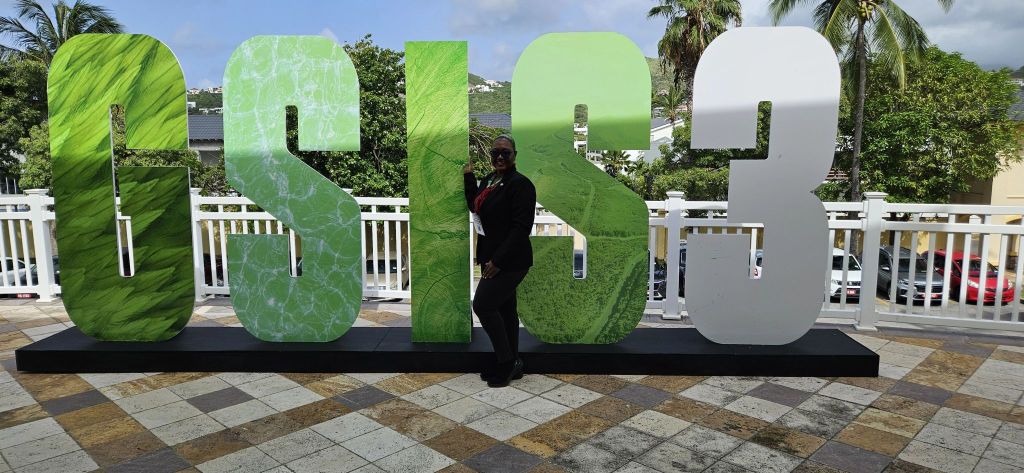
From May 27-29, 2025, I had the honour of participating in the Main Summit of the Global Sustainable Islands Summit (GSIS) in my capacity as an academic. Organised by Island Innovation, this third edition of the GSIS was co-hosted with the Government of the Federation of St. Kitts & Nevis. The event welcomed over 200 delegates, mainly from island states and territories from across the Caribbean and world, some coming as far away as the Marshall Islands and Tuvalu!
In this article, I expand on some of the key points I raised as a speaker on the Day 2 panel “Identifying Opportunities to strengthen relationships between global island states”. I focussed on the critical role of education not just as a social good, but an economic asset indispensable for boosting trade both from and between island economies. To this end, I offer at least three interconnected ways in which education can contribute to boosting island economies’ trade: building human resource capacity generally, enhancing trade capacity and serving as a tradeable service.
Building Human Resource Capacity
For many small island economies, their most valuable resource is their human resource endowment. Poor in natural resources, countries like Barbados and Mauritius for example have since their political independence in the 1960s invested significantly in providing universal access to education, a key component of the development success these two countries have enjoyed.
Investments in education not onlyfoment well-being, but also cultivate a well-educated population capable of advancing national development and adapting to global shifts. A well-skilled and educated workforce is vital not just for the local private sector which relies on a robust domestic talent pool, but also as a draw for foreign investors interested in finding the talent they need locally.
As trade becomes increasingly digitised and technology-driven, the education systems of island economies and territories must evolve to nurture citizens who are not just literate and numerate in the traditional sense, but are technologically literate. An educational system responsive to these trends can drive the high-value growth that Caribbean island economies aim to pursue.
Enhancing trade capacity
Education not only contributes to trade competitiveness by building a country’s human resource generally, but also by building its capacity to trade and engage in trade policy making, more specifically.
The University of the West Indies’ Shridath Ramphal Centre’s Masters in International Trade Policy (MITP) programme, now approaching its 23rd cohort, has played a significant and often understated role in developing a cadre of highly skilled trade professionals across the Caribbean region and even beyond these shores. Many of the MITP alumni sit in the highest echelons of governments (including within the cabinet of Barbados), international organisations, donor agencies, business support organisations and private sector firms. Indeed, on the panel on which I spoke at the GSIS 2025, three of the panelists (myself including) were MITP alumnae, and all women.
Understanding trade rules and standards and conducting market intelligence are fundamental for Caribbean businesses to convert the market access they have on paper through the trade agreements and other trading arrangements Caribbean countries have into market presence. Expanding education in areas like sustainability standards, logistics and compliance will ensure the region can fully harness the benefits of trade and regional integration as it seeks to consolidate the CARICOM Single Market and Economy (CSME).
Education as a tradeable service
Education is itself a tradeable service, and one in which Caribbean island economies already participate across the four modes of supply of service defined by the World Trade Organisation (WTO)’s General Agreement on Trade in Servicess (GATS).
Under Mode 1 (Cross-border supply), Caribbean educational institutions increasingly offer online courses, some of which are taken by students abroad, effectively exporting education services. Under Mode 2 (consumption abroad), students from across the Caribbean travel between islands for tertiary education, while foreign students also come to attend offshore medical universities. Under Mode 3 (commercial presence), foreign universities, especially medical schools like Ross University and St. Georges University, have established physical campuses, resulting in a commercial presence/foreign direct investment. Under Mode 4 (temporary movement of natural persons), Caribbean professionals deliver lectures or courses physically on other campuses or other countries, thereby providing educational services physically in another country on a temporary basis.
With certain countries tightening access to their universities for international students, this presents an opportunity for Caribbean universities to strengthen their value proposition not only to serve local students who might have intended to go overseas, but to attract more international students from the Global South and the Global North.
Despite the allure of Global North universities because of their prestigious names and globally recognised faculty, Caribbean universities like The University of the West Indies, already have several advantages: a history of contributing to Caribbean development and well-recognised faculty in many areas, programmes which are tailored to small states’ and developing realities and promoting solutions grounded in our realities, cognisant of our regional history and development concerns, and a well-established track record of research in many areas like climate change, regional integration, development economics and cultural studies. Let us not forget that we are the region which has produced many thought leaders, including one of the world’s foremost development economists – Sir W. Arthur Lewis!
In other words, Caribbean students’ options are not limited to Global North universities and we need a paradigm shift in the thinking that only Global North universities provide good quality education. Many universities here in the Caribbean have educated persons who are excelling at the highest levels in their field, including current and former statesmen, while there are many global South countries which offer scholarships yearly to our nationals to study at their universities. By supporting each others’ universities we would also be contributing to boosting south-south trade in educational services!
Toward Knowledge Economies
To maximise the role of education in trade, it must be embedded within a broader knowledge economy ecosystem. During the summit, I was particularly intrigued by the research shared by colleagues from ODI Resilient and Sustainable Islands Initiative (RESI) on how SIDS can build robust knowledge economies. Their findings underscore the importance of prioritising innovation and the role of education in this. Building these ecosystems requires stronger linkages between universities, governments and industry, greater investment in research, intellectual property rights protection and support for entrepreneurship and start-ups.
Ultimately, the role of education is not merely to promote trade per se. It is to ensure that the trade in which we engage is inclusive and sustainable and redounds to the benefit of our societies. Although it was not identified as one of the 7 pillars of St Kitts & Nevis’ Sustainable Island State Agenda (SISA), education will be key to achieving this road map set out by that government in its commendable quest to become the world’s first sustainable island state.
Final thoughts
If island economies are to boost their trade and promote a future grounded in sustainable growth, inclusion and transformation, education must be a strategic pillar and not an after thought. I am grateful to Island Innovation and the Government of St. Kitts & Nevis for hosting a very engaging and forward-looking summit and for the opportunity afforded to me to contribute to these conversations.
Alicia D. Nicholls, B.Sc., M.Sc., LL.B. is an international trade specialist and the founder of the Caribbean Trade Law and Development Blog.
-

Caribbean Hosting Global Supply Chain Forum & SIDS4 Summit
Alicia Nicholls
While cricket fans are glued to the upcoming International Cricket Council (ICC) Men’s T-20 World Cup, policy nerds like me have our sights set elsewhere. Over these next two weeks, the Caribbean will host two high-level international conferences gathering together delegates from across the world to discuss issues which are germane to Small Island Developing States (SIDS). In this piece, I discuss briefly what these two upcoming conferences and their themes mean for SIDS.
Global Supply Chain Forum
This week, May 21-24, the Government of Barbados will co-host with UN Trade & Development (formerly UNCTAD) the historic Global Supply Chain Forum. Its delegates from drawn from all over the world and include Heads of Government and other high-level political officials, experts, academics, practitioners and other stakeholders. Its high-level panels will encompass discussions on transport, logistics and trade facilitation for sustainable development.
Issues around logistics and supply chains occupy significant importance for SIDS which due to their high dependence on international trade. Their small size, geographic isolation and climate-vulnerability also generate particular logistics and transportation challenges. As such, these panels will discuss, inter alia, practicable solutions for helping these countries better integrate into global supply chains, and to improve the sustainability, efficiency and resilience of their transportation and logistics networks.
Among the anticipated outcomes will be the adoption of the Barbados Ministerial Declaration on Sustainable and Resilient Transport and Logistics in SIDS which will be presented at the upcoming Fourth International Conference on Small Island Developing States (SIDS 4) conference.
SIDS4 Conference
From May 27-30, Antigua & Barbuda will host the UN Fourth International Conference on SIDS (SIDS4) under the theme “Charting the Course Toward Resilient Prosperity”. In addition to the conference, there will be a number of side events, including the SIDS Global Business Network Forum 2024 immediately preceding the conference.
In 1992, SIDS were declared a special case for environment and development at the UN Conference on Environment and Development. Barbados hosted the first Global SIDS conference in 1994. Subsequent SIDS conferences were held in Mauritius (2005) and Samoa (2014). As with each of these decennial conferences, the main outcome document will be a new Programme of Action for SIDS for the next ten years.
Topics on the agenda include climate change, biodiversity loss, ocean conservation, disaster risk reduction, access to finance, debt sustainability, and the overall sustainable development of SIDS, according to the host government of Antigua & Barbuda. As such, yet again, the Caribbean will play a pivotal role in shaping the SIDS agenda for the next decade.
Why it matters
The Caribbean’s role in hosting these conferences brings both practical benefits in terms of tourism arrivals and spend, and international recognition. It places the region at the heart of global discussions and decision-making on issues crucial to SIDS, giving us a hand in crafting our fate. With the UN SDG deadline just six years away and climate challenges intensifying, these discussions are even more urgent now than ever.
Exciting times await us! We at Caribbean Trade Law & Development will be in attendance at both and look forward to bringing you, our readers, updates from these two important events.
Alicia Nicholls, B.Sc., M.Sc., LL.B. is an international trade consultant and founder of the Caribbean Trade Law & Development Blog www.caribbeantradelaw.com.
-

CARICOM and Canada launch a Strategic Partnership
The Caribbean Community (CARICOM) and Canada have launched a strategic partnership. Building on many years of political and economic ties between Canada and the Caribbean region, this new partnership is an outcome of their recently concluded Canada-CARICOM Summit. The Summit’s theme was “Strategic Partners for a Resilient Future” and was held in Ottawa, Canada, October 17-19, 2023.
Please see below from the CARICOM Secretariat:
- INTRODUCTION
Bound by an unwavering friendship, Canada and the Caribbean Community (CARICOM) seek to formalize their vibrant and multi-faceted partnership, as natural hemispheric partners, with strong and lasting foundations built on deep people-to-people, historical and cultural ties, and mutual respect. Among the first to recognize the independence of CARICOM Member States, Canada remains steadfast in its trusted relationship with CARICOM over the years. This relationship, forged in the birth of new Caribbean nations, has evolved into an enduring strategic partnership amongst equals, based on a shared commitment to democracy, the rule of law, respect for human rights and the rules-based international order, and which aims to advance common foreign policy, trade, security, and development priorities.
As global actors, Canada and CARICOM join forces to navigate evolving geopolitical events, including our most recent engagement in the triple crises of COVID-19, climate change, and food and energy insecurity. Together we commit to joint action on shared priorities such as climate resilience; building inclusive and sustainable economies; enhancing multilateral cooperation; and bolstering bilateral and regional security, including working together to help restore the security and stability of Haiti for the benefit of its people. We are also committed to working together to promote gender and racial equality and inclusion in the hemisphere, and to strengthening our already deep people-to-people ties. We are committed to achieving the sustainable development goals (SDGs) and building strong, resilient and inclusive societies and economies.
Marking the occasion of our first Summit to be held in Canada, we launch the Canada-CARICOM Strategic Partnership, to embed our close collaboration and cooperation on mutually agreed sectors.
- OBJECTIVES
The Canada-CARICOM Strategic Partnership:
- Serves as a permanent joint mechanism for regular dialogue, as well as for ad hoc consultations on issues of mutual interest, with responsibility for preparation, follow-up and implementation of joint actions, decisions and agreements between Canada and CARICOM.
- Fosters the existing relationship between Canada and CARICOM through regular leader, ministerial and senior official level meetings to advance time-bound and agreed-upon roadmaps for action.
- STRUCTURE AND COORDINATION
3a.General Coordination and Management
Global Affairs Canada and the CARICOM Secretariat will co-lead the general coordination and management of the Strategic Partnership. Collaborative partnerships can be forged between competent institutions in Canada and relevant regional organizations in CARICOM in order to drive dialogue and implement initiatives.
3b. Structure and Frequency of MeetingsThe Canada-CARICOM Strategic Partnership is comprised of regular leader-level engagement to set overarching priorities and interests to advance and further deepen the partnership in addition to concurrent formal and ad hoc fora:
- Canada-CARICOM Foreign Ministers’ Group (CCFMG): meet annually to advance overarching priorities through substantive discussions on issues impacting the Caribbean region and the hemisphere, emerging trends and solutions to common challenges. Based on the agenda and discussions during the CCFMG, Ministers will set annual priorities for officials to guide the implementation of a Canada-CARICOM evergreen Roadmap for action. Foreign Ministers will report to Leaders through a joint letter from Canada’s Foreign Minister and the Council for Foreign and Community Relations (COFCOR) pro-tempore Chair of CARICOM describing engagement, progress to date and joint action to advance the Strategic Partnership.
- Canada-CARICOM Ministerial Meetings: ad-hoc ministerial-level meetings to advance specific thematic priorities, including on Trade, Development, Finance, Health, Environment, and Defence, etc.
- Canada-CARICOM Senior Officials’ Dialogue: the annual CCFMG meeting is preceded by the Senior Officials’ Dialogue, which serves as a preparatory meeting for Foreign Ministers’ substantive discussions on topline issues, and reviews progress and implementation of the Canada-CARICOM Roadmap.
- Canada-CARICOM Expert Dialogues: ad-hoc expert dialogues between relevant Canadian and CARICOM Institutions could be established to advance thematic priorities and actions listed in the Canada-CARICOM Roadmap, including bilateral, regional and multilateral initiatives. Expert groups would meet before and after major international summits, including – but not limited to – UNGA, the OAS, WHO, the Commonwealth, the G7 and the G20, to deepen coordinated action on multilateral priorities of democracy, human rights, and the rules based international order and amplify advocacy for hemispheric challenges. Expert groups would report on concrete progress at the annual Senior Officials’ Dialogue, to ensure effective and sustainable progress is being made on thematic lines of activity.
- Capacity Building and Technical Assistance: to deepen institutional linkages through training, knowledge exchange, capacity building and technical assistance initiatives, including considering secondments as a form of exchange program, where a CARICOM official is embedded in a federal organisation and vice-versa in the Secretariat or within a CARICOM Member State’s organisation.
- Special ad-hoc meetings: could be held at the request of Canada or CARICOM.
- LAUNCH OF THE CANADA-CARICOM STRATEGIC PARTNERSHIP
Pursuant to the Co-Chairs’ Statement of the Second Meeting of the Canada-CARICOM Foreign Ministers’ Group, the Canada-CARICOM Strategic Partnership is hereby launched by Leaders at the Canada-CARICOM Summit in Ottawa, 18 October 2023.
 Caribbean Trade Law and Development