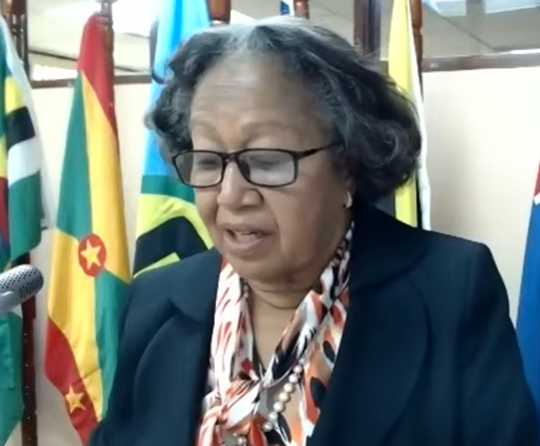
Photo credit: CARICOM (Photo of incoming CARICOM SG, Dr. Carla Barnett)
Alicia Nicholls
On August 15, 2021, Dr. Carla Barnett will formally assume office as the eighth Secretary-General (SG) of the forty-eight year old Caribbean Community (CARICOM). Although Ambassador Lolita Applewhaite briefly acted as SG during the period January-August 2011, Dr. Barnett will be the first female and Belizean to be appointed to this position. She was selected unanimously by the Conference of Heads of Government at a virtual special meeting held on May 11, and succeeds regional stalwart Ambassador Irwin Larocque of Dominica whose second term is coming to an end.
Dr. Barnett joins a growing pantheon of distinguished women to lead international trade organisations and groupings at a time of mounting global uncertainty. A well-respected economist, she will be at the helm of the Caribbean’s foremost regional bloc which is fighting a number of proverbial fires of both endogenous and exogenous origin. This article discusses what lies ahead for the incoming CARICOM SG and some ways in which she might be able to make a difference within the confines of her position.
The role of the SG
The CARICOM SG heads the CARICOM Secretariat based in Georgetown, Guyana as outlined in Article 23 of the Revised Treaty of Chaguaramas (RTC). Article 24(2) of the RTC provides, inter alia, that the SG is the Chief Executive Officer of the Community. He or she is not an all-powerful figure, however. The SG’s role is primarily administrative as it is the Conference of the Heads of Government that is not just the supreme organ of the Community but determines and provides policy direction to the Community as per Article 12 (1) &(2) of the RTC.
Among the tasks assigned to the SG under Article 23 is to make an annual report to the Conference on the work of the Community. The tasks outlined in Article 24(2) of the RTC include, for instance, that the SG represents the Community. It also assigns to the SG various other functions broadly associated with implementing Community decisions and achieving Community objectives. His or her functions throughout the RTC are often exercised in conjunction with, or on the direction of the competent organs or the Conference.
The SG is supposed to be independent in the exercise of his or her functions. That is, Article 23(4) forbides the SG and staff from seeking or receiving instructions from any Government of the Member States or from any other authority external to the Community in the performance of their duties.
There is also the ‘soft power’ that the SG holds. For instance, the SG is tasked under Article 26 with assisting the Community Council in collaboration with competent authorities of the Member States to establish and maintain an efficient system of consultations at the national and regional levels in order to enhance the decision-making process in the Community. Under Article 191, disputant Member States can also use the good offices of a third party, including the SG, to settle their dispute, for example.
The road ahead
Dr. Barnett will be assuming office at a time of unprecedented social and economic challenges for the Community – some endogenous and others exogenous in origin, some longstanding and others of newer vintage. She will be heading an intergovernmental organization whose Member States are all classified as Small Island Developing States and whose pre-COVID-19 realities included generally low growth rates, limited export diversification, a rising incidence of chronic non-communicable diseases (NCDs) and high vulnerabilities to macroeconomic and weather-related shocks. Member States continue to battle the climate crisis, arbitrary blacklisting from metropolitan countries in the areas of tax and anti-money laundering/terrorist financing (AML/CFT) matters, border disputes, and the list goes on.
These longstanding issues are further compounded by the COVID-19 pandemic, which brings with it the attendant issue of access inequalities caused by richer nations’ hoarding of COVID-19 vaccines and placing export restrictions on needed medical supplies. While it is hoped that the worst of the health crisis provoked by the COVID-19 pandemic will be over by August, it is evident that the economic and social effects will be with us for some time. All independent CARICOM Member States, with the exception of newly oil-rich Guyana, saw economic contractions in 2020. Unemployment and under-employment, especially among the youth, remains a chronic problem, while crime remains a concern. COVID-19 has given greater urgency to regional calls for debt forgiveness and expanded criteria for access to concessional financing.
CARICOM as an organisation itself confronts enduring issues which have been well-documented in a lengthy list of reports and studies, including the 1992 ‘Time for Action’ Report of the Ramphal Commission, the Golding Report commissioned by the Government of Jamaica and the recently released draft report of the CARICOM Commission on the Economy. There are persistent concerns over CARICOM’s implementation deficit, the suitability of its current governance model and its ‘top down’ approach, the need for greater transparency of CARICOM’s work, enhanced and meaningful engagement of ordinary citizens and civil society, and even questions over CARICOM’s continued relevance. While the sentiment is a bit unfair, the average man or woman on the street is generally of the opinion that CARICOM either does ‘nothing’ or decisions made do not meaningfully impact livelihoods
How can the SG make a difference?
The power to make the bold and transformative change that CARICOM needs does not rest with the SG, but with the Member States themselves. However, an SG with a strong vision and the necessary technical and soft skills can parlay these into helping to effect the change so greatly needed. Dr. Barnett brings to the post an impressive resume of qualifications, expertise and experience which make her well-suited and equipped for tackling the enormity of the tasks ahead. She is a well-respected economist who has held several key ministerial positions in the Belizean government and in financial institutions in that country, including former deputy governor of the Belize Central Bank. She was also a former Deputy Secretary-General of CARICOM.
It is timely that Dr. Barnett will be taking office when the draft report of the CARICOM Commission on the Economy has been published. The report outlines the findings of an eminent group comprised of both regional and extra-regional luminaries and headed by noted economist and finance expert Prof. Avinash Persaud. The Commissioners propose a 12-point plan.
Unlike the process with the selection of the World Trade Organization (WTO)’s Director-General where we had the benefit of successive statements and videos in which the candidates outlined their visions for the WTO and answered questions publicly on their plans and positions, there is regrettably no similar publicly accessible exercise for the CARICOM SG.
However, in scouring the internet, I was able to come across a few articles which give some insight into Dr. Barnett’s vision. In the press release announcing Belize’s nomination of Barnett, she is quoted as stating her vision for CARICOM as follows:
“a Caricom that the ordinary woman and man will defend because they feel the impact in their daily lives through economic and social advancement that comes from community action”.
Based on this statement, it is clear that Dr. Barnett supports greater citizen involvement and engagement in the regional process and the need for enhanced community action for economic and social impact that permeates down to the man or woman on the street.
There are some ways in which the new SG can make a difference, such as to the extent possible, promoting greater transparency of the Secretariat’s operations, the status of Member States’ implementation of decisions and the availability of up-to-date disaggregated statistics. For instance, what is the status of each Member States’ implementation of decisions made? This information should be in reports easily accessible by the public.
The new SG can find ways to improve engagement, awareness and interest by the ordinary CARICOM citizen in the work of CARICOM and the opportunities the regional integration process present. With few exceptions, such as the CSME Townhalls or by following CARICOM’s website or social media, there are limited opportunities for the average CARICOM citizen to learn what is happening in regional bodies or have their voices heard in regional decision-making. Even so, improvements can be made in what and how the information is disseminated and the channels through which it is done.
As I conclude, I wish to applaud the excellent work being done by the CARICOM Youth Ambassadors. I particularly want to highlight the two Barbadian ambassadors Java Sealy and Meagan Theobalds, who have hit the ground running in continuing the work of their successors to raise the profile of CARICOM among the youth who are the inheritors of this region. The unquenchable enthusiasm and passion of young persons like these two is needed for any organization or regional movement to thrive and advance. As such, the establishment of a CARICOM Young Professionals Programme, similar to those offered by other organisations around the world, would be a value-added to CARICOM and perhaps something the incoming SG could champion.
Alicia Nicholls, B.Sc., M.Sc., LL.B. is a trade and development consultant with a keen interest in sustainable development, international law and trade. All views herein expressed are her personal views and should not be attributed to any institution with which she may from time to time be affiliated. You can read more of her commentaries and follow her on Twitter @LicyLaw.

 Caribbean Trade Law and Development