Category: Citizenship by Investment

  • Could citizenship by investment be a homegrown solution to address loss and damage?

    Could citizenship by investment be a homegrown solution to address loss and damage?

    Javier Spencer, Guest contributor

    Javier Spencer

    “We have lost everything” is the harrowing cry you would hear from someone in the aftermath of a climate disaster. And ‘everything’ in this context is not a hyperbole but a stark reality. For instance, the paradise islands of Barbuda (part of Antigua & Barbuda) and Dominica were hit by catastrophic hurricanes in September 2017. The hard blow experienced by both islands resulted in permanent infrastructural damages, economic losses, and losses of lives and livelihoods. The onset of these disasters has been coming at an increased frequency with incomparable strength. Citizens of Caribbean Small Island Developing States (SIDS) have no choice but to toil forward in fear – not knowing when or how strong the next hit will be.

    After the catastrophe has departed, it leaves a dismal recovery for these Caribbean SIDS. These countries are characterized by small size, high debt burdens, and limited physical resources that make it particularly challenging to address the adverse impact of climate change disasters. This is what we call “loss and damage”. The consequences of climate change fast outpace the ability to adapt, coupled with the lack of resources to exploit in the face of a climate disaster. Out of curiosity, could Citizenship By Investment Programmes (CBI) in the Caribbean be one way to raise urgent finance to address loss and damage? This article considers whether these programmes could be one way to raise quick cash to address loss and damage.

    The binary view of loss and damage shows one side as economic losses and the other as non-economic, but both categories are often woven tightly together. On the one hand, economic loss and damage emanates from productive sectors being negatively affected by climate change. In contrast, non-economic loss and damage, on the other hand, is simply the unreckonable human casualties – that is, the loss of life, the human displacement, and even the proliferation of physical and mental illnesses.

    The writing on the wall is that Caribbean SIDS lack the requisite resources to build resilience and to merely implement adaptation and mitigation strategies equivalent to the extent of the resulting damage. Owing to this, developing countries, particularly SIDS, have for thirty years vociferously implored developed countries to agree to establish a multilateral fund that would assist them in tackling loss and damage.

    The key tenets of the multilateral fund, however, are ‘new’ and ‘additional’. This means that the funding arrangement should be separate and distinct from existing global financial structures marred by eligibility criteria checkboxes that would exclude most SIDS – the most climate vulnerable – from accessing these funds. Furthermore, a specific, fit-for-purpose multilateral funding arrangement that is governed under the oversight of the United Nations Framework Convention on Climate Change (UNFCCC) would guarantee access for vulnerable countries, establish legitimacy and enhance transparency.

    The logic is solid and cohesive. Yet, the road to a consensus to establish the fund was daunting and met with resistance from developed countries. Nevertheless, history was made by the sound of the gavel at COP27 in Sharm el-Sheikh, Egypt. Parties finally agreed to establish a long-awaited loss and damage fund for assisting developing countries that are particularly vulnerable to the adverse effects of climate change. This would compensate the most climate-vulnerable countries, which have contributed inconsequentially to the climate crisis.

    Now that there is an agreement, what’s next? The next hurdle is negotiating the operationalisation of the fund – what are the sources of finance? What will the fund look like? How will it be administered? And more importantly, how soon will beneficiaries be able to access the fund? With these looming questions and details to iron out, operationalising the fund could be lengthy. But time is a luxury that SIDS cannot afford.

    As cynical as this question may be, what if the fund takes another 30 years to operationalise? Some reports have indicated that the cost of weather-related events in 2021 is estimated at US $329 billion globally. In the context of Caribbean SIDS, out-of-the-box fundraising might have to be employed to fill the void and supplement a fund.

    Citizenship by Investment (CBI) Programmes have met favour with some Governments in the Caribbean in generating quick revenue outside of traditional revenue streams to repay debts, invest in development projects, and fund other initiatives. CBI Programmes grant investors citizenship for significant investment contributions to the economy. These programmes currently exist in Saint Kitts and Nevis, Dominica, Grenada, Saint Lucia, and Antigua and Barbuda.

    So far, these programmes are proving to be one way to generate foreign investment quickly. For instance, between 2016 to 2021, reports have shown that  the CBI programme generated an annual average for  Saint Lucia, XCD $ 30 million; Grenada, XCD $ 3 million; and Antigua Barbuda, XCD $ 33 million.

    Looking at the dollars and cents at the surface shows that CBI programmes could be a veritable income generator. Zooming in, with specific reference to the one in Antigua and Barbuda, the investment options for investors are the National Development Fund (NDF), Real Estate, Business Investment, and the University of the West Indies (UWI) Fund.

    In spite of the dollars and cents, these programmes have received negative global press – bringing into question governance, accountability and transparency. Ironically, the same carbon-emitting developed countries are the ones scrutinising CBI programmes in Caribbean SIDS. The increased scrutiny has certainly impacted these countries through blacklisting, tax haven labelling, and visa restriction for passport holders from these countries.

    Very soon, we could see a rapid decline or even a sudden halt in CBI programmes. But while they are still alive, now is the time to consider adding a new investment stream: Climate Resilience Fund. This new revenue stream would be exclusively used to address loss and damage. Establishing this would require the integration of relevant local and authorised environmental agencies and a robust transparency and accountability framework that governs these programmes. This article should not be misconstrued to replace the multilateral loss and damage fund but rather a speedy self-fundraising mechanism to supplement the fund. Is this feasible?

    Javier Spencer is an International Trade & Development professional with keen interests and specialization in Global Business, Communications and Diplomacy.  You are free to reach out to Javier via email at javier@javierspencer.com or on LinkedIn.


  • Caribbean Citizenship by Investment Programmes and Climate Resilience

    Caribbean Citizenship by Investment Programmes and Climate Resilience

    Alicia Nicholls

    Citizenship by investment programmes (CIPs) are currently operated by five countries in the Caribbean. These are St. Kitts & Nevis, Dominica, Grenada, Antigua & Barbuda and St. Lucia. Caribbean CIPs face increasing threats stemming from reputational risks, increased regional and international competition and heightened international scrutiny. Despite these challenges, some Caribbean CIP-operating countries are utilising CBI revenues to finance climate change adaptation/mitigation initiatives in order to build climate resilience.

    The Climate Change Challenge

    June 1st of each year marks the official start of the Atlantic Hurricane Season. It is exemplified in the rhyme many Caribbean school children learn: “June – too soon, July – standby, August – you must prepare, September – remember, and October – it’s all over”.

    Rhymes aside, Caribbean countries are no strangers to the human, economic, financial and social devastation inflicted by weather systems around this time of the year. 2017 was an unforgetable year as Hurricanes Maria and Irma caused significant damage to a number of Caribbean islands, most notably Dominica, the island of Barbuda (part of Antigua & Barbuda) and the US territories of Puerto Rico and the US Virgin Islands.

    In a 2016 International Monetary Fund (IMF) study, Acevedo wrote that in the Caribbean, “storms cause on average 1.6 percent of GDP in damages every year, but that figure could be 1.6 to 3.6 times larger due to underreporting of disaster and damages.” One of the many adverse impacts of climate change is more intense weather systems. As such, the level of damage from hurricanes and tropical storms is expected to rise.

    Whereas climate change mitigation focuses primarily on emissions reduction, adaptation recognizes the irreversibility of some climate change impacts and emphasizes resilience building through targeted programmes, initiatives, policies and projects. Caribbean countries’ domestic financing constraints necessitate their disproportionate reliance on international financing and support for their climate change adaptation efforts. High debt overhangs mean they often lack the fiscal space to respond quickly and adequately to climatic shocks. Rebuilding requires significant capital, which can be burdensome for small countries beset by narrow tax bases and limited ability to attract the large inflows of FDI required. In some cases,  high gross national income (GNI) per capita restrict their access to most official development assistance and concessional funding from multilateral agencies.

    Role of CBI Revenues

    In light of these constraints, revenues from CIPs are increasingly attractive sources of inflows for funding development programmes and initiatives. In its Staff Concluding Statement of the 2019 Article IV Mission for Grenada published in May 2019, the IMF noted that “robust FDI flows, including from the citizenship-by-investment (CBI) program, are financing the external deficit while supporting economic growth.” It further noted that these inflows “have helped channel sizable resources to the contingency fund that could be used for mitigating the effects of natural disasters”.

    In September 2017, St Kitts & Nevis introduced a temporary third investment option, the Hurricane Relief Fund, to prepare for future hurricanes, repair property damage and support Caribbean neighbours in need. The minimum contribution is US$150,000. The Fund was controversial because it was criticised as further evidence of a “race to the bottom” among Caribbean CIPs. Nonetheless, it was reported that over 900 persons benefited from the Hurricane Relief Fund. A reported 1200 applications were received under the Fund, but it is unclear how many were successful.

    CBI assisting Dominica’s recovery

    In September 2017, category five Hurricane Maria caused Dominica pervasive human, social and economic damage equivalent to 226% of its GDP (Post Disaster Needs Assessment 2017), resulting in 31 confirmed deaths and 34 missing. According to the Government of Dominica, CBI inflows have been pivotal in financing Dominica’s recovery. In its Article IV Report on Dominica, the International Monetary Fund (IMF) noted that “fiscal performance deteriorated sharply due to the fall in tax revenue after the hurricane, but was partially offset by a surge in grants and buoyant Citizenship-by-Investment (CBI) sales revenues.”

    Following Hurricane Maria, Dominica has sought to become “the world’s first climate-resilient nation”. The island nation has emphasized resilience-focused rebuilding with the help of international donor funding coordinated through its Climate Resilience Executing Agency for Dominica (CREAD). This includes building climate-resilience structures.

    In a recent article, the Dominica Citizenship by Investment Unit (CBIU) noted as follows:

    After Hurricane Maria last year, Dominica’s CBI Programme was responsible for funding housing and hotel developments, as well as tourism and agriculture projects that cumulatively helped the island recover. The collected financial resources also enabled the Dominican authorities to make payments to affected home owners in the region of £26 million, whilst a government scheme to build 5,000 new homes is financed entirely by CBI income, according to Prime Minister Roosevelt Skerrit.

    Moreover, it was announced that the Housing Revolution, which is providing climate resilient low income housing is “completely funded by Dominica’s Citizenship by Investment (CBI) Programme”. 

    Conclusion

    CIPs have significant risks, but can also be tools for promoting sustainable development. The revenue inflows can assist cash-strapped governments in financing climate climate adaptation and mitigation programmes.

    This is not to suggest, however, that CIP revenues are a panacea for financing resilience. Firstly, heavy dependence on these revenues is a real risk which must be guarded against due to the potential volatility of CBI revenue inflows. Fiscal discipline, including prudent management of these inflows, is important to ensure these countries have the fiscal space to respond to any shocks. Fiscal responsibility frameworks such as that adopted by Grenada are important.

    Secondly, due diligence standards of CIPs must be maintained and should not be lowered or compromised just to attract greater inflows.   

    Thirdly, any special climate/disaster relief funds financed by CBI revenues should be situated within a coherent national policy framework for catalyzing and making optimum use of these and other resources for building climate resilience.

    Fourthly, transparency is also important. This also includes timely data on the number of applications received under special funds, timely audits of the funds and reporting of the audits of these special funds. It also requires sensitizing the general public about the use to which the funds are being put.

    Alicia Nicholls, B.Sc., M.Sc., LL.B., is an international trade and development consultant with a keen interest in sustainable development, international law and trade. You can also read more of her commentaries and follow her on Twitter @LicyLaw.

    DISCLAIMER: All views expressed herein are her personal views and do not necessarily reflect the views of any institution or entity with which she may be affiliated from time to time.

  • Have Caribbean Citizenship by Investment Programmes Run Their Course?

    Have Caribbean Citizenship by Investment Programmes Run Their Course?

    Alicia Nicholls

    Caribbean Citizenship by Investment (CBI) programmes, and to a lesser but growing extent, residence by investment (RBI) programmes, are facing a rough ride. The latest blow came when the Paris-based Organisation for Economic Cooperation and Development (OECD) deemed CBI/RBI programmes operated by 21 jurisdictions, including those in the Caribbean, as “high risk to the integrity of the Common Reporting Standard”. While the OECD has clarified that this was not a blacklist, the list puts another glaring spotlight on Caribbean CBI/RBI programmes which are already battling to justify their existence to an increasing choir of skeptics.  In October, the European Union (EU) released a report analysing the state of play, issues and impacts of its own members’ programmes. With the mounting scrutiny being placed on Caribbean countries’ CBI/RBI programmes and stiffened competition from other investment migration programmes globally, have Caribbean countries’ CBI programmes run their course?

    What are CBI Programmes?

    CBI programmes are one of the two main types of investment migration programme – programmes which offer high net worth (HNW) investors accelerated citizenship or residence of the host country in exchange for a pecuniary contribution. Unlike RBI programmes which only confer accelerated permanent residence status, CBI programmes grant a qualifying investor, upon making a specified economic contribution to the host country (usually in real estate, investment in a business or in a specified government fund), accelerated citizenship for himself/herself and his/her qualifying spouse and/or dependents, once all relevant fees are paid and due diligence requirements are met. It means that a person can acquire citizenship or residence of another country in just a few months, compared to several years under regular naturalisation procedures.

    Five Caribbean countries currently operate CBI programmes: St. Kitts & Nevis (the world’s oldest CBI programme), Dominica, Grenada, Antigua & Barbuda and St. Lucia. International examples include the EU member states of Austria, Cyprus and Malta, and the Pacific island nation of Vanuatu.

    Second citizenship is a booming international industry reportedly worth US $3 billion, according to Citizenship by Investment.ch. There are now over one hundred CBI/RBI programmes worldwide, which seek to lure an expanding and highly mobile class of global High Net Worth Individuals (HNWIs) seeking the advantages a more favourable second passport could bring for themselves and their families. These advantages include greater mobility and security, tax planning advantages, and business opportunities.

    The British Overseas Territory of Anguilla is the most recent Caribbean jurisdiction to commence a RBI programme, but versions of these programmes are also operated in the Bahamas, Barbados, Montserrat and Turks & Caicos, for example. Examples of RBI programmes in developed countries include the United States’ EB-5 programme and the United Kingdom’s Tier 1 Visa.

    Challenges to Caribbean CBI/RBI programmes

    Those Caribbean countries which operate them view these programmes as a pathway for economic diversification and development, bringing greatly needed foreign exchange and foreign direct investment (FDI) inflows, infrastructure development, and employment opportunities. In its Article IV Report on Dominica, which had been badly affected by category five Hurricane Maria in September 2017, the International Monetary Fund (IMF) noted that “fiscal performance deteriorated sharply due to the fall in tax revenue after the hurricane, but was partially offset by a surge in grants and buoyant Citizenship-by-Investment (CBI) sales revenues.”

    Despite their economic benefits, CBI programmes have always been controversial due to some governments’ philosophical aversion to what many have called the “commodification of citizenship” or “selling of passports”. Indeed, CARICOM Member States remain philosophically divided on the desirability of CBI programmes.

    There have also been, in some cases, legitimate concerns about the efficacy of the due diligence procedures, the perceived absence of a ‘genuine link’ between recipients of citizenship under CBI programmes and the host country, and reports of alleged instances of misuse of passports obtained under CBI programmes, which have brought increased international scrutiny of Caribbean countries’ CBI programmes.

    One of the pull factors of Caribbean countries’ CBI programmes is the visa free access. For example, on the Henley & Partners Passport Index published by the world’s leading investment migration firm, Henley & Partners, St. Kitts and Nevis ranked the highest among Caribbean CBI countries in the strength of its passport,  providing visa-free access to 151 countries. Unfortunately, this advantage may be undermined if third countries, as is their right, decide to revoke visa-free access to citizens originating from countries offering CBI programmes, due to national security concerns. For example, Canada imposed visa requirements for citizens from St. Kitts & Nevis in 2014 and from Antigua & Barbuda in 2017 over similar concerns. Both countries have subsequently made changes to their programmes, but their citizens have not yet regained visa-free access to Canada.

    The US Government has also repeatedly flagged Caribbean CBI programmes as possibly being used for financial crime, including in its International Narcotics Control Strategy Report 2017. With the current US administration taking an even tougher stance on national security,  US scrutiny of Caribbean CBI programmes is likely to continue or even intensify.

    The European Commission has already sounded the alarm about the potential security risks that golden passport programmes operated by its own members could pose to the bloc. It reiterated this in its recently released report on those programmes operated in the EU.  But this scrutiny is not limited to EU CBI/RBI programmes. In a recently released report, global NGOs, Transparency International and Global Witness, also recently called on the EU to review its visa waiver schemes with those Caribbean countries operating CBI programmes.

    In light of this scrutiny, other CARICOM Member States which do not operate programmes have feared that they themselves may suffer reputational and security risks due to the CBI programmes of other Member States. The CARICOM Secretariat has been examining the issue of CBI programmes operated by member states, but there appears to be no public information on what have been the outcomes of this examination thus far.

    The other risk comes from increased global competition. The list of countries offering some kind of CBI or RBI programme has grown exponentially in the years since the global economic and financial crisis. For instance, this year Moldova started its own CBI. Moreover, while St. Vincent & the Grenadines is currently the only independent member of the Organisation of Eastern Caribbean States (OECS) to not offer a CBI programme due to the current government’s philosophical opposition to these programmes, the leader of St. Vincent & the Grenadines’ opposition party recently reaffirmed his support for launching a CBI programme there. What this shows is that countries around the world still see the economic potential of these programmes and it also means that competition is increasing.

    Caribbean countries’ CBI programmes have ranked high on the Professional Wealth Management (PWM) Index. Regrettably, the increased competition between Caribbean CBI programmes both inter se and with other CBI programmes internationally has led to an apparent ‘race to the bottom’ among Caribbean CBI programmes in the form of price competition.

    The OECD Challenge to CBI/RBI programmes

    In early 2018, the OECD announced that it was examining CBI/RBI programmes as part of its Common Reporting Standard (CRS) loophole strategy and requested public input into the misuse of these programmes and effective ways of preventing abuse. The CRS is an information standard approved by the OECD Council in 2014 for the automatic exchange of tax information among tax authorities of countries which are signatories. CRS jurisdictions are required to obtain certain financial account information of their tax residents from their financial institutions and automatically share this information with other CRS jurisdictions on an annual basis. Most Caribbean IFCs are early adopters of the CRS.

    While noting that CBI/RBI programmes may have legitimate uses, the OECD stated that CBI/RBI programmes are a risk to the CRS because they can be misused by persons to hide their assets offshore and because the documentation (such as ID cards) obtained through these programmes could be used to misrepresent an individual’s jurisdiction of tax residence. This, the OECD noted, could occur when persons fail to report all the jurisdictions in which they are resident for tax purposes.

    In April 2018, the OECD published a compilation of the responses it had received, which also included responses by countries in the Caribbean offering CBI programmes. In its list of ‘high risk CBI/RBI” programmes to the integrity of the CRS” published in October 2018,  the OECD focused on those CBI/RBI programmes which gave access to a lower personal income tax rate on offshore financial assets and those which did not require an individual to spend a significant amount of time in the host jurisdiction.

    It should be noted that reporting for CRS purposes is based on tax residence and that just because an investor has obtained citizenship of a country under a CBI programme, does not mean that he or she is automatically deemed to be a tax resident of the country. For example, a person may obtain St Lucian citizenship under St. Lucia’s CBI programme pursuant to the Citizenship by Investment Act and regulations, but under the St. Lucia Income Tax Act, he or she is only deemed to be resident for income tax purposes in St. Lucia for a given income year if he/she has been physically present there for not less than 183 days in that income year.

    While the OECD has clarified that the list of ‘high risk CBI/RBI programmes’ was not a blacklist, there is concern about what reputational impact this list may have on the countries whose programmes were named. Financial institutions have been told by the OECD to bear in mind its analysis of high-risk CBI/RBI schemes when performing their CRS due diligence, which potentially brings increased scrutiny for Caribbean countries, which are already suffering the loss of correspondent banking relationships due to de-risking practices by risk-averse global banks.

    Have CBI programmes run their course?

    Given the growing array of challenges outlined, have CBI programmes run their course? While I do not think Caribbean CBI programmes have run their course, I think that there needs to be strong consideration by each of the countries concerned, and their citizens, of whether the economic benefits justify the increasing reputational and security risks, and to consider what further changes could be made to make their programmes more sustainable.

    Caribbean countries are well aware that it is not in their interest for their CBI/RBI programmes to be perceived as loopholes for tax evasion or other criminal activity. It is, therefore, in their interest to work with the OECD to address the concerns raised about the potential for misuse of their CBI programmes.

    According to the communique released at the 66th Meeting of the Organisation of Eastern Caribbean States (OECS) Authority, that organisation’s highest body, it was noted  as follows:

    “The Heads engaged in extensive discussions on the matter, noting the unreasonableness of the OECD position, and resolved to undertake comprehensive reviews of the respective CBI and RBI Programmes to ensure that areas where they may be limitations are identified and strengthened.”

    This is a promising development and it is hoped that these reviews will be conducted in a timely manner, that the results will be made public in the spirit of transparency and that the recommendations made will be implemented.

    To their credit, there already exists cooperation among the Citizenship by Investment Units or equivalents of the Caribbean CIP countries through the Association of the Citizenship By Investment (CIPA). They have also been receiving the assistance of  the Joint Regional Control Centre arm of the CARICOM Implementation Agency for Crime and Security (IMPACS).

    There is the real risk that countries may become overly dependent on CBI programme revenues for their fiscal and macroeconomic stability during boom times, leaving them vulnerable during periods of leaner revenue inflows. Since 2010, revenues from its programme have buoyed St. Kitts & Nevis’ economy, but the IMF in its Article IV Report of 2017 warned that “ the recent slowdown in CBI-related inflows and the ending of the five-year holding period for CBI properties call for close monitoring of the implications for the financial sector through the real estate market and banks’ exposure to real-estate-related activities.”

    On a broader note, a comprehensive study of the economic contribution these CBI programmes have made and are making to the economies and societies of these Caribbean countries is recommended. This would provide empirical evidence of whether the macroeconomic benefits outweigh the reputational and national security risks. In this regard, the recent EU study on its own programmes could provide a good model for CARICOM or the OECS in terms of analysing the state of play and the impacts of Caribbean countries’ CBI/RBI programmes and making recommendations for mitigating the risks identified.

    Such a study will require sound data. This brings me to another problem with these programmes – the transparency deficit, which was also highlighted by Transparency International and Global Witness in their report. Obtaining data on these programmes remains regrettably difficult due to the unfortunate reluctance by some authorities to share data publicly, even with researchers. Though some data on the macroeconomic contribution of these programmes may be obtained from those countries’ IMF Article IV reports, other data, such as employment generated by these programmes, are not.

    Making data on these programmes publicly available will not only negate the perceived opacity of these programmes’ operation, but facilitate evidence-based planning, monitoring and evaluation of these programmes.

    Alicia Nicholls, B.Sc., M.Sc., LL.B., is an international trade and development consultant with a keen interest in sustainable development, international law and trade. You can also read more of her commentaries and follow her on Twitter @LicyLaw.

  • Caribbean Citizenship/Residence by Investment Programmes among those deemed “high risk” by OECD

    Caribbean Citizenship/Residence by Investment Programmes among those deemed “high risk” by OECD

    Alicia Nicholls

    UPDATED: The OECD has indicated that the list is not a blacklist.

    A new threat to Caribbean countries’ citizenship and residency by investment programmes (CBI/RBI programmes) has emerged. Today the Paris-based think tank, the Organisation for Economic Cooperation and Development (OECD) published a ‘black list’ of sorts of CBI and RBI programmes that “potentially pose a high-risk to the integrity of the Common Reporting Standard”.

    What are CBI/RBI programmes?

    Citizenship by investment programmes and residence by investment programmes provide citizenship (in the case of the former) or residency (in the case of the latter) to an investor (and often his or her dependents) in exchange for that investor making a significant investment in the host country, subject to that jurisdiction’s eligibility criteria.

    St. Kitts & Nevis operates the oldest CBI programme in the world. As part of their efforts to diversify and attract much needed foreign direct investment, four other Caribbean countries (Antigua & Barbuda, Dominica Grenada and St. Lucia) have since adopted their own programmes.  The British Overseas Territory of Anguilla has also recently established an RBI programme. Outside of the Caribbean, there is now an ever-growing list of CBI or RBI programmes operated across the world.

    OECD’s examination of CBI/RBI programmes

    Earlier this year, the OECD announced that it would be examining the prevention of abuse of these programmes to circumvent the Common Reporting Standard (CRS).

    Nicknamed Global FATCA because it was inspired by the US’ Foreign Account Tax Compliance Act (FATCA), the CRS is an information standard approved by the OECD Council in 2014 for the automatic exchange of information among tax authorities. CRS jurisdictions are required to obtain certain financial account information from their financial institutions and automatically share this information with other CRS jurisdictions on an annual basis.

    The OECD has argued that CBI/RBI programmes are a risk to the CRS because they can be misused by persons to hide their assets offshore and because the documentation (such as ID cards) obtained through these programmes could be used to misrepresent an individual’s jurisdiction of tax residence.

    The OECD used two vague criteria to determine whether a CBI/RBI programme was high risk to the CRS: (1) it gives access to a lower personal income tax rate on offshore financial assets and (2) it does not require an individual to spend a significant amount of time in the host jurisdiction.

    Out of the 100 CBI/RBI programmes the OECD analysed, programmes from the following twenty-one jurisdictions were identified as high risk: Antigua & Barbuda, The Bahamas, Bahrain, Barbados, Colombia, Cyprus, Dominica, Grenada, Malaysia, Malta, Mauritius, Monaco, Montserrat, Panama, Qatar, Saint Kitts & Nevis, St. Lucia, Seychelles, Turks and Caicos, United Arab Emirates and Vanautu.

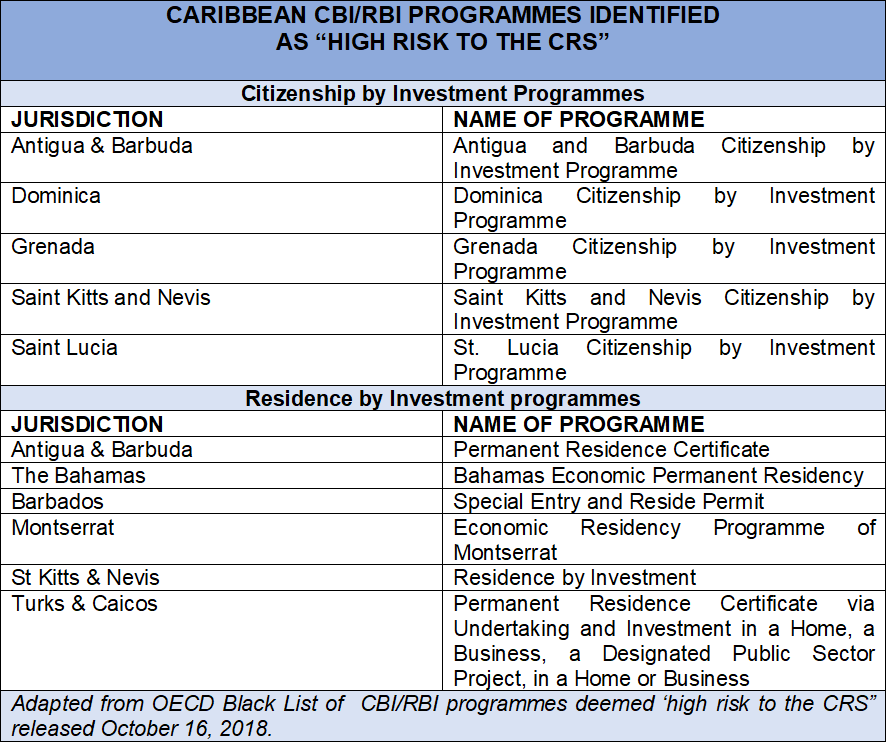
    Caribbean Programmes Identified as ‘High Risk’

    The following Caribbean CBI and RBI programmes were identified:

    OECDCaribbeanCBIRBI

    As a result, the OECD requires that financial institutions “take the outcome of the OECD’s analysis of high-risk CBI/RBI schemes into account when performing their CRS due diligence obligations”.

    Why is this development of concern to the Caribbean?

    This development is of concern to Caribbean countries which operate these programmes for several reasons. Firstly, it adds to the reputational backlash which Caribbean CBI  programmes have been facing, with implications for these programmes’ attractiveness to investors.  Caribbean CBI programmes are already facing competition not only inter se, but with other programmes around the world, including those in Europe which offer the prospect of free movement within the EU.

    Secondly, this seeming blacklist, which is based on vague criteria, casts an unfair shadow on those countries which operate these programmes and may affect their attractiveness as jurisdictions for international business. Moreover, those countries which operate only RBI programmes , which have much less reputational risk, have also been painted with the same brush.

    Thirdly, a reduction in CIP revenues would have an adverse economic impact on those countries which have come to depend on these revenues for their macroeconomic stability.

    The results of the OECD’s analysis may be found here.

    Alicia Nicholls, B.Sc., M.Sc., LL.B., is an international trade and development consultant with a keen interest in sustainable development, international law and trade. You can also read more of her commentaries and follow her on Twitter @LicyLaw.