
Category: Trade

  • Could Promoting Bilingualism Give Caribbean Countries a Trade and Investment Advantage?

    Could Promoting Bilingualism Give Caribbean Countries a Trade and Investment Advantage?

    Alicia Nicholls

    What do Mauritius, Malaysia, and Singapore have in common? Besides being examples of highly competitive emerging economies, these countries have multilingual populations which they proudly count as part of their country’s competitive advantage.

    Prime Minister of Jamaica, the Most Honourable Andrew Holness, recently announced his government’s hope to adopt Spanish as a second language given the longstanding and growing importance of foreign direct investment (FDI) from Spain to Jamaica’s economy. Spanish chains are a growing presence in Jamaica’s tourism, wellness and construction  sectors and have injected US$1.7 billion in Jamaica’s tourist industry, according to the Prime Minister in his speech.

    Similar statements on the need for improving our populations’ language competencies have also been made by current and previous Commonwealth Caribbean governments. Could the promotion of bilingualism give our hitherto monolingual Commonwealth Caribbean countries a trade and investment edge in an increasingly interconnected global marketplace?

     ‘Everyone speaks English!” Or do they?

    I am not aware of any data on the rates of bilingualism (that is, proficiency in two or more languages) in the Commonwealth Caribbean. However, anecdotal evidence suggests that aside from local dialects, anglophone Caribbean countries have mostly monolingual (one language) populations.

    It is not uncommon to hear some persons strongly proclaim “everyone speaks English, so why must I learn another language?”. Though English is currently the most learnt second language internationally, this chart from the World Economic Forum shows that English is actually the third most spoken mother tongue in the world, with 372 million first-language speakers in 2017. The second most spoken language was Spanish, with 437 million speakers. But the most spoken was Chinese (Mandarin) with 1,284 million speakers, which is not surprising given the population of China.

    While the English language has been the global lingua franca since the 20th century, it has not always been, and it may not always be either given China’s growing economic dominance and promotion of its culture and language.  In recognition of this fact, China Daily has reported that there is growing interest in western countries for learning Mandarin. In Russia, for example, the number of Chinese language learners has reportedly increased from 17,000 in 2007 to 56,000 in 2017 and Mandarin is now an elective language in that country’s national college entrance examination.

    That aside, the Commonwealth Caribbean is surrounded not only by its Spanish, French and Dutch speaking Caribbean island neighbors, but also Spanish-speaking Latin American countries and Portuguese-speaking Brazil, which present still largely undertapped export and tourist markets.

    Bilingualism enhances labour force quality

    There is a corpus of research highlighting the cognitive, psychological and social advantages to human beings learning a second language. These include sharpened memory, improved decision-making skills, multi-tasking capability, problem-solving and mental dexterity. Knowledge of another language also increases a person’s employability, cultural sensitivity, earning potential and labour market opportunities. As a multilingual person, I can personally attest to the doors which knowledge of other languages have opened for me professionally.

    Internationally, employers’ demand for bilingual persons has increased not only as trade with other countries has increased, but because of the recognition by firms of the benefits to their export strategies of employing bilingual persons. A report of March 2017 by New American Economy found that demand for bilingual workers in the US is growing at both the higher and lower ends of the employment spectrum. This is further supported by a report by the Economic Intelligence Unit, which surveyed 572 executives globally and found that organisations with international ambitions were increasingly expecting prospective employees to be fluent in key foreign languages.

    Taken as a whole, improving a population’s language competency makes for a more attractive labour force to international investors. This advantage has not gone unrecognized by some countries. Mauritius, whose population speaks French, English and French Creole, proudly touts its bilingual population as one of its unique selling points as a place for international business. In Switzerland, which has four national languages, a report from 2008 estimated that country’s linguistic advantage as equivalent to about 9% of its GDP.

    In an increasingly interconnected world, I believe monolingualism will put our human resource, which is our greatest resource, at a distinct disadvantage in attracting international investment and tourism.

    Bilingualism/Biculturalism as Business Advantages in Cross-Border Transactions

    Effective communication is essential to the success of cross-border deals, which means that linguistic and cultural differences are frequent barriers to cross-border trade and investment. The previously mentioned report by the Economic Intelligence Unit found that “misunderstandings rooted in cultural differences present the greatest obstacle to productive cross-border collaboration”. For instance, a handshake or kiss on the cheek may be perfectly acceptable in one culture, but may cause offense in another.

    A UK-based report also found that “over time the trade cost to the UK resulting from language barriers has varied in magnitude, but has been consistently large.”  While I am unaware of similar research conducted in the Commonwealth Caribbean, anecdotal evidence shows that this may also be the case here as well.

    It is not uncommon for some businesses seeking to export to feel that it is not necessary to invest in developing a multilingual strategy or capacity given the increasing availability and accuracy, for example, of online translation services. However, online translation services miss subtle cultural nuances, which may be fatal when engaging in cross-border business negotiations, especially with enterprises from ‘high context cultures’. ‘High context’ is the term used in international business to describe those cultures which place greater emphasis on context, non-verbal cues and on interpersonal relations when conducting business. Examples would be most African, Middle Eastern and Asian countries. ‘Low context’ cultures usually rely mainly on verbal cues, and interpersonal relationships have less importance in the business context. These cultures include many Western European countries, the US and Canada.

    In the Commonwealth Caribbean most of our international trade is currently with low context cultures with which we share cultural, linguistic and historical ties. But, as our firms seek to diversify, and as China (a high context culture) expands its economic footprint in the region, there will be need for greater understanding of the Chinese language and culture.

    Prior knowledge of the language and cultural norms of a target export market is also invaluable when conducting market research into the business, legal and regulatory environment of that potential export market.

    Bilingualism can foster wider Caribbean integration

    Promoting bilingualism can foster closer Caribbean integration. By accident of geography, the Caribbean Region is divided by water. By accident of history, these divisions are furthered by language. However, greater linguistic and cultural awareness among our islands can bridge these divisions.

    As an example, the French-speaking island of Martinique is one of the top tourist source markets for St. Lucia, its neighbor just 40 miles to the south.  Its tourist and business ties with Martinique are facilitated not just by geography and reliable transportation links, but also the mutual intelligibility of the Martinican and St. Lucian creoles and some shared cultural similarities. St. Lucia, nicknamed Helen of the West, changed colonial hands fourteen times between France and England, giving the island a unique culture and patois which is a mélange of its French and English colonial roots.

    A new programme called the Trade Enhancement for the Eastern Caribbean (TEECA) programme seeks to promote trade and investment between Member States of the Organisation of Eastern Caribbean States (OECS) and Martinique, which became an OECS associate member in 2015. The success of this programme will undoubtedly hinge on OECS firms seeking to create or expand business with those in Martinique having an understanding of the Martinican cultural, business and legal context and knowledge of the French language.

    Building a Bilingual Advantage

    Promoting greater language competency among our populations could bring trade and investment advantages to Caribbean countries which rely disproportionately on their human resource. While not a panacea, it can provide for a more employable and attractive labour force, facilitate our export market diversification efforts, strengthen integration with the non-anglophone Caribbean and improve trade and investment ties with the wider LAC region

    Of course, creating a bilingual society cannot happen overnight. First of all, we need to determine what language competencies our Governments will seek to promote. Spanish and French are increasingly being taught in Commonwealth Caribbean secondary schools, but should Mandarin also be included on the curriculum?

    Moreover, expanding language instruction at the primary school level would be key, as well as promoting greater cultural exchanges. Languages should not be seen  solely as subjects for study, but as a door to further business opportunities, creating an edge for our people in an increasingly interconnected and competitive global environment.

    As it is firms which trade and not countries, it is incumbent on regional firms to increase their in-house language capacity by employing persons with the linguistic skills and cultural knowledge of their export target markets, and also, where appropriate, invest in developing the language proficiency of their existing staff.

    Alicia Nicholls, B.Sc., M.Sc., LL.B., is an international trade and development consultant with a keen interest in sustainable development, international law and trade. You can also read more of her commentaries and follow her on Twitter @LicyLaw.
  • Caribbean Trade & Development Digest – October 14-20, 2018

    Caribbean Trade & Development Digest – October 14-20, 2018

    Welcome to the Caribbean Trade & Development Digest for the week of October 14-20, 2018! We are happy to bring you the major trade and development headlines and analysis from across the Caribbean Region and the world from the past week.

    THIS WEEK’S HIGHLIGHTS

    In its latest Investment Trends Monitor, UNCTAD has reported that global FDI fell by 41% in the first half of 2018 due primarily to the large repatriations by US parent companies of accumulated foreign earnings from their foreign affiliates due to US government tax reforms. The full report may be found here.

    The OECD has published a list of citizenship and residence by investment programmes which it deems “high risk” to the Common Reporting Standard, and names several programmes operated by Caribbean countries.

    Nearly 700,000 protesters in London participated in the People’s March calling for a referendum on the UK’s final Brexit deal with the EU. Closer to home, in Haiti, President Moise has agreed to protesters’ calls for an investigation into the alleged misuse of funds received by Haiti under the PetroCaribe Agreement with Venezuela. Venezuela has announced it will replace the US dollar for the euro for use in international payments.

    Please see further headlines below:

    REGIONAL

    Jamaica Prime Minister wants Spanish to be second language

    Magnetic Media: Prime Minister, the Most Hon. Andrew Holness, says it is of strategic importance that the appropriate programmes be put in place, making Spanish a second language in Jamaica. Read more 

    Support grows for marijuana decriminalisation across the region

    Jamaica Observer: The chairperson of the Caricom Regional Commission on Marijuana Professor Rose-Marie Belle Antoine says there’s much support across the region for the decriminalisation of marijuana. Read more

    Haiti’s President Launches Petrocaribe probe

    VoA: Responding to protester demands to “tell us where the PetroCaribe money is” Moise tweeted Thursday that his administration would investigate the allegations of misuse of funds and would hold all those responsible accountable. Read more 

    Haiti protests over politicians’ misuse of Petrocaribe funds

    Al Jazeera: Protests in Haiti have turned violent as anger grows over billions of dollars of missing funds that were meant to provide social care and improve public services. Read more

    IMF Outlook for Latin America and the Caribbean

    IMF: Amid escalating trade tensions, tighter financial conditions, and volatile commodity markets, economic recovery in Latin America and the Caribbean (LAC) has both moderated and become more uneven.  However, activity is recovering in the Caribbean, reflecting the uptick in tourism owing to robust US and global growth. Read more 

    Is the Caribbean becoming a junkyard for Japanese excesses? (Commentary)

    St Lucia News Now: Statistics from the islands show that thousands of cars are imported into the Caribbean from Japan annually. Eight of every ten cars imported have or are nearing the age of serviceability. Many of these vehicles will retire after a few years of use with the stark reality being that they will need to be disposed of.  Read more 

    Caribbean countries set to reduce trade hurdles

    UNCTAD: Senior trade officials from the Organisation of Eastern Caribbean States (OECS) have met with UNCTAD experts to discuss a new drive to help them improve the efficiency of their cross-border trade. Read more 

    Will Mexico’s free zones affect Belize?

    LoveFM: Tracy Taeger-Panton, the Minister of State Responsible for Investment, Trade and Commerce says it is still unclear what Mexico’s plans are but the Government is looking at ways to develop the economy of the northern districts. Read more 

    Bahamas elected to UN Human Rights Council

    Magnetic Media: The Bahamas was elected by the United Nations General Assembly (UNGA), on 12 October 2018 to serve on the Human Rights Council (HRC).  The HRC was created by the UNGA in 2006, replacing the former UN Human Rights Commission, and is the UN organ responsible for promoting and protecting human rights worldwide. Read more 

    WHO removes Caribbean from Zika classification

    Jamaica Observer: The World Health Organisation (WHO) has removed its Zika virus country classification scheme from countries in the region. The scheme had categorised most of the Caribbean territories as having active Zika virus transmission. Read more

    INTERNATIONAL

    Overseas investment failing, developing countries largely unscathed: UNCTAD

    UN: Foreign direct investment (FDI) has dropped 40 per cent year-on-year so far, the UN Conference on Trade and Development (UNCTAD) said on Monday, but the $470 million decline is happening mainly in wealthy, industrialized nations, especially in North America and Western Europe. Read more 

    Venezuela ditching US dollar for euros in international trade

    Caribbean360: Venezuela will drop the US dollar from its exchange market in favour of the Euro, in reaction to crippling sanctions imposed by the United States. Read more

    Canada launches safeguard investigation on certain steel products

    WTO: On 12 October 2018, Canada notified the WTO’s Committee on Safeguards that it initiated on 11 October 2018 a safeguard investigation on certain steel products. Read more 

    WTO members review use, application of preferential rules of origin for LDCs

    WTO: At a meeting of the Committee on Rules of Origin on 15-16 October, WTO members further reviewed the use and application of preferential rules of origin programmes for least developed countries (LDCs) in line with commitments made at the WTO’s 2013 Bali and 2015 Nairobi ministerial conferences. Read more 

    DG Azevêdo: Debate on WTO reform should reflect all perspectives

    WTO: At a meeting of the full WTO membership today (16 October), Director-General Roberto Azevêdo noted the emerging debate on ‘WTO reform’ and highlighted the importance that this discussion is inclusive. Read more

    Australia accepted as new party to government procurement pact

    WTO: On 17 October 2018, parties to the WTO plurilateral Government Procurement Agreement (GPA) unanimously approved a decision to welcome Australia as the 48th WTO member to be covered by the Agreement. Read more

    WTO members fix dates for Astana Ministerial Conference

    WTO: WTO members have agreed that the organization’s next Ministerial Conference will take place from 8 to 11 June 2020 in Astana, Kazakhstan. The dates were endorsed at an 18 October meeting of the WTO’s General Council. Read more 

    670,000 march to demand final say on Brexit

    The Independent: Masses overflowed through the streets of London for more than a mile, from Hyde Park Corner to Parliament Square, as an estimated 670,000 protesters took their demand for a fresh Brexit referendum right to Theresa May’s doorstep.  Read more

    Singapore, EU ink landmark free trade agreement

    ChannelNewsAsia: Singapore and the European Union (EU) on Friday (Oct 19) inked a landmark trade deal that will eliminate tariffs and give businesses across various sectors, especially small- and medium-sized enterprises (SMEs), better market access.
    Read more

    Trump embarks on bilateral trade talks to pressure China

    New York Times: Fresh off securing trade agreements with South Korea, Canada and Mexico, President Trump is embarking on a new plan: refashioning the Trans-Pacific Partnership to his liking through a flurry of bilateral trade deals. Read more

    Australia insists trade agreement with Indonesia on track despite Israel comments

    Channel News Asia: Australian Prime Minister Scott Morrison said on Wednesday a billion-dollar free trade agreement with Indonesia will be signed this year despite a furious reaction to Canberra’s potential move to recognise Jerusalem as Israel’s capital.
    Read more

    2018 Update of the EU Control List of Dual-Use Items

    EU: On 10 October 2018, the Commission adopted the annual Delegated Regulation that updates the EU dual-use export control list in Annex I to Regulation (EC) No 428/2009 and brings it in line with the decisions taken within the framework of the international non-proliferation regimes and export control arrangements in 2017. Read more

    EU completes second round of negotiations with New Zealand

    EU: EU negotiators were in Wellington, New Zealand from 8 to 12 October 2018 for the second round of negotiations for a trade agreement. Read more 

    NEW ON CTLD BLOG

    Caribbean Citizenship/Residence by Investment Programmes among those deemed “high risk” by OECD

    If you take away multilateralism, who will hear us?

    Alicia Nicholls, B.Sc., M.Sc., LL.B., is an international trade and development consultant with a keen interest in sustainable development, international law and trade. You can also read more of her commentaries and follow her on Twitter @LicyLaw.
  • Caribbean Citizenship/Residence by Investment Programmes among those deemed “high risk” by OECD

    Caribbean Citizenship/Residence by Investment Programmes among those deemed “high risk” by OECD

    Alicia Nicholls

    UPDATED: The OECD has indicated that the list is not a blacklist.

    A new threat to Caribbean countries’ citizenship and residency by investment programmes (CBI/RBI programmes) has emerged. Today the Paris-based think tank, the Organisation for Economic Cooperation and Development (OECD) published a ‘black list’ of sorts of CBI and RBI programmes that “potentially pose a high-risk to the integrity of the Common Reporting Standard”.

    What are CBI/RBI programmes?

    Citizenship by investment programmes and residence by investment programmes provide citizenship (in the case of the former) or residency (in the case of the latter) to an investor (and often his or her dependents) in exchange for that investor making a significant investment in the host country, subject to that jurisdiction’s eligibility criteria.

    St. Kitts & Nevis operates the oldest CBI programme in the world. As part of their efforts to diversify and attract much needed foreign direct investment, four other Caribbean countries (Antigua & Barbuda, Dominica Grenada and St. Lucia) have since adopted their own programmes.  The British Overseas Territory of Anguilla has also recently established an RBI programme. Outside of the Caribbean, there is now an ever-growing list of CBI or RBI programmes operated across the world.

    OECD’s examination of CBI/RBI programmes

    Earlier this year, the OECD announced that it would be examining the prevention of abuse of these programmes to circumvent the Common Reporting Standard (CRS).

    Nicknamed Global FATCA because it was inspired by the US’ Foreign Account Tax Compliance Act (FATCA), the CRS is an information standard approved by the OECD Council in 2014 for the automatic exchange of information among tax authorities. CRS jurisdictions are required to obtain certain financial account information from their financial institutions and automatically share this information with other CRS jurisdictions on an annual basis.

    The OECD has argued that CBI/RBI programmes are a risk to the CRS because they can be misused by persons to hide their assets offshore and because the documentation (such as ID cards) obtained through these programmes could be used to misrepresent an individual’s jurisdiction of tax residence.

    The OECD used two vague criteria to determine whether a CBI/RBI programme was high risk to the CRS: (1) it gives access to a lower personal income tax rate on offshore financial assets and (2) it does not require an individual to spend a significant amount of time in the host jurisdiction.

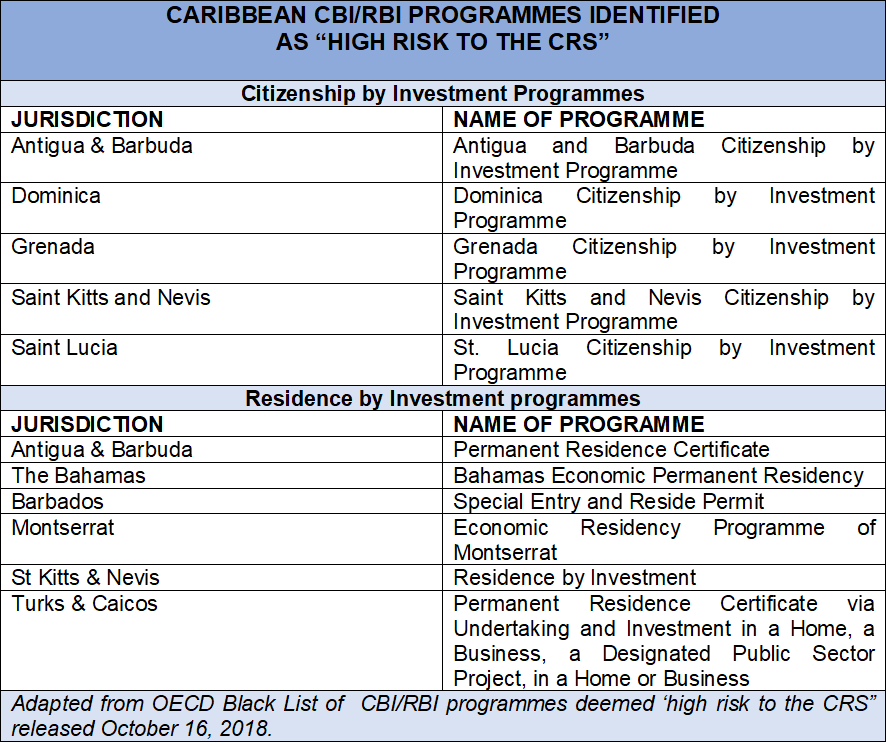
    Out of the 100 CBI/RBI programmes the OECD analysed, programmes from the following twenty-one jurisdictions were identified as high risk: Antigua & Barbuda, The Bahamas, Bahrain, Barbados, Colombia, Cyprus, Dominica, Grenada, Malaysia, Malta, Mauritius, Monaco, Montserrat, Panama, Qatar, Saint Kitts & Nevis, St. Lucia, Seychelles, Turks and Caicos, United Arab Emirates and Vanautu.

    Caribbean Programmes Identified as ‘High Risk’

    The following Caribbean CBI and RBI programmes were identified:

    OECDCaribbeanCBIRBI

    As a result, the OECD requires that financial institutions “take the outcome of the OECD’s analysis of high-risk CBI/RBI schemes into account when performing their CRS due diligence obligations”.

    Why is this development of concern to the Caribbean?

    This development is of concern to Caribbean countries which operate these programmes for several reasons. Firstly, it adds to the reputational backlash which Caribbean CBI  programmes have been facing, with implications for these programmes’ attractiveness to investors.  Caribbean CBI programmes are already facing competition not only inter se, but with other programmes around the world, including those in Europe which offer the prospect of free movement within the EU.

    Secondly, this seeming blacklist, which is based on vague criteria, casts an unfair shadow on those countries which operate these programmes and may affect their attractiveness as jurisdictions for international business. Moreover, those countries which operate only RBI programmes , which have much less reputational risk, have also been painted with the same brush.

    Thirdly, a reduction in CIP revenues would have an adverse economic impact on those countries which have come to depend on these revenues for their macroeconomic stability.

    The results of the OECD’s analysis may be found here.

    Alicia Nicholls, B.Sc., M.Sc., LL.B., is an international trade and development consultant with a keen interest in sustainable development, international law and trade. You can also read more of her commentaries and follow her on Twitter @LicyLaw.
  • If you take away multilateralism, who will hear us?

    If you take away multilateralism, who will hear us?

    Alicia Nicholls

    The title of this week’s article is borrowed from the impromptu but impassioned appeal made by Prime Minister of Barbados, the Hon. Mia Amor Mottley, QC, MP, in her maiden address on September 28th during the General Debate of the 73rd Session of the United Nations General Assembly (UNGA). With only one notable exception, support for multilateralism was a common thread linking the speeches given by world leaders during the General Debate.

    Perhaps the most compelling case for multilateralism was that made by Foreign Minister of Singapore, Dr. Vivian Balakrishnan. While warning that multilateralism was at a crossroads and was facing a crisis of confidence, Foreign Minister Balakrishnan made an articulate case for the indispensability of multilateralism to the global community, especially to small states.

    Indeed, multilateralism affords small states a microphone that they would otherwise lack on the international stage. Despite the successes of the rules-based multilateral system, there are widening cracks in the system. These require immediate remedial action to enhance the system’s structural integrity to withstand the threat of creeping unilateralism, and to more effectively serve the needs of the global community in a changing geopolitical and economic world.

    What is multilateralism?

    Multilateralism, in the most rudimentary sense, refers to cooperation among three or more nation states to achieve a common goal. In contrast to the current isolationist US government stance, previous US governments were central to the establishment of the present-day multilateral system, which bears their footprint.

    The modern day multilateral system was fashioned in the wake of the Second World War (1939-1945) with the aim of promoting global peace and stability. It was based on the liberal theory of international relations which posited, inter alia, that states which cooperate would not resort to war. It was in that immediate post-war era that the United Nations, the progeny of the League of Nations (1920-1946), was formed in 1945. The Bretton Woods institutions (the International Monetary Fund and the World Bank), the watchdogs of the global economic order, were established at a conference held in Brettons Woods, New Hampshire, US in 1944.

    Multilateralism recognizes that no one Government alone can handle the growing plethora of challenges confronting the global community, and that by pooling resources, wisdom and ideas through shared institutions, optimum solutions could be found. In the years that followed, a spaghetti bowl of multilateral organisations has flourished in areas as diverse as health, telecommunications, the environment, migration, international transportation, labour, among others.

    With respect to trade governance, an attempt was made by a US-led group of countries to establish an International Trade Organisation (ITO) in the mid 1940s but failed after the US Congress repeatedly declined to approve the ITO Charter. As such, an informal organization known as the General Agreement on Tariffs and Trade (GATT) governed world trade from 1945 until January 1995 when the World Trade Organisation (WTO) came into being.

    Why Multilateralism Matters to Small States

    The majority of today’s developing countries were still colonies when many of these multilateral institutions were birthed. However, upon attaining independence, acceding to these institutions was viewed as a requisite rite of passage. This is particularly true for the world’s small states which have overwhelmingly been supporters of multilateralism.

    But why is that? Small states, with their diminutive economies and populations, weak political leverage and inherent vulnerabilities, would be the “bullied kids” in an anarchic global system where “might is right”. The rules-based multilateral system provides a buffer of stability and predictability for small states. Its norms-based system, undergirded by international law, helps to constrain and contain great power aggression. In a general sense, multilateral institutions provide some semblance of accountability for those States which contravene global norms. I say in a general sense as history has proven that this has not always been the case with big countries. In the area of trade, the WTO’s dispute settlement system gives small states the opportunity, at least in theory, to hold hegemons to account.

    Multilateral engagement gives small states, which would otherwise be Liliputians in the international system, a voice. Whereas by itself a small states’ voice is a little more than a squeak, by building coalitions small states have managed to achieve a roar on some issues. One of the most notable cases was the success of the Alliance of Small Island States (AOSIS) in the UNFCCC negotiations leading up to the signature of the Paris Climate Agreement during the COP21 in 2015. Though not perfect, that agreement is an important milestone in the fight against anthropogenic global warming.

    Small states have also been able to benefit from capacity building and technical assistance from multilateral institutions. An example is the research done by multilateral financial institutions on the issue of de-risking which has led to the loss of correspondent banking relations, with implications for these states’ financial sectors and commercial relations. In the wake of the financial crisis, several Caribbean countries, and most recently Barbados, have had to enter IMF structural adjustment programmes.

    Some small states have also played a key role in the establishment of multilateral institutions. Trinidad & Tobago was instrumental in pushing for the establishment of the International Criminal Court (ICC), and small states helped to push for the United Nations Convention on the Law of the Sea (UNCLOS). Moreover, small states have had some success in attaining high positions in international organisations.

    Why is Multilateralism Under Threat?

    Why is a system which has given the world relative peace and prosperity for some seventy years now facing what Singapore Foreign Minister Balakrishnan called a “crisis of confidence”? Questions about the efficacy and legitimacy of multilateral institutions have long been raised, but rising populism and anti-globalisation sentiment, in the wake of uneven recovery from the financial crisis has led to rising nationalism, xenophobia and unilateralism. Indeed, the recently published UNCTAD Trade and Development Report 2018 noted that trade tensions were a “symptom of a greater problem”, that is, failure to address rising global inequality and imbalances caused by “hyper-globalisation”.

    But many of the problems are not the fault of multilateralism but due to inappropriate policy responses by Governments and by disruptive technologies which have replaced labour with machines. As such, as noted by Foreign Minister Balakrishnan in his UNGA speech, it is up to governments to address this through retooling workers and reformulating their education systems to equip the next generation with the tools to exploit these technologies.

    Small states in their successive UNGA addresses have often expressed frustration at the slow pace of action on some fronts of concern to them, including financing for climate change. Antigua & Barbuda’s Prime Minister, Gaston Browne, voiced disappointment with his country’s inability to receive compensation from the US after the WTO dispute settlement body ruled in Antigua & Barbuda’s favour in the US Gambling dispute. Moreover, Caribbean leaders have frequently bemoaned the lack of support for discontinuing the use of GDP per capita as a basis against which to measure development status. This criterion has excluded middle and high income Caribbean countries from most concessional loans and official development assistance.

    Making Multilateralism Work Better

    The question is not whether multilateralism works, but how can it work better. There are legitimate concerns about whether today’s multilateral institutions, many of which were forged during different economic and geopolitical times, remain “fit for purpose” for today’s global realities and challenges. Former UN Secretary General, Kofi Annan recognised this when he asserted in 2002 that “the United Nations exists not as a static memorial to the aspirations of an earlier age but as a work in progress – imperfect as all human endeavours must be capable of adaptation and improvement.”

    On the trade front, for example, there have been increased calls for reform of the WTO. Several members, including the US, Canada and the EU, have made proposals for reform. As it stands, the WTO’s negotiation function remains in a state of paralysis, while the US blocking of the appointment of judges to its Appellate Body over the US government’s dissatisfaction with the dispute settlement system risks creating a crisis in that body’s ability to be an arbiter of trade disputes between WTO members. The renewed appetite for WTO reform provides a window of opportunity for small states to redouble their advocacy efforts for their own reform proposals, while making sure they are not excluded from having a seat at the table.

    There is the need to address democratic and transparency deficits within multilateral institutions. The configuration and operation of the UN Security Council, for example, stills reflects a geopolitical reality that no longer exists. Decisions made by the Paris-based Organisation for Economic Cooperation and Development (OECD), where developing states do not have a seat at the table, have had devastating consequences for the offshore financial services sectors of Caribbean states.

    Institutional reform would require, where feasible, strengthening the secretariats of these organisations to better serve the needs of member states, especially the most vulnerable. In addition to fostering a greater space for civil society to be heard in multilateral organizations, there should also be greater emphasis on building the capacity of small states to effectively participate in meetings and the day-to-day operations of these organisations.

    The challenges which face the world call for more multilateralism, not less. Multilateralism is important for achieving Agenda 2030, including the seventeen UN Sustainable Development Goals (SDGs). Multilateral institutions also have a pertinent role to play in developing rules to address emerging global issues. Singapore Foreign Minister Balakrishnan, for example, called for the UN to develop norms and rules for cybersecurity.

    In the past week alone, several events have further reiterated why multilateralism is needed now more than ever. One of which is the IPCC Special Report on Global Warming of 1.5ºC which showed that the world was already experiencing the effects of warming of 1.0 degrees Celsius above pre-industrial levels. The devastation caused by Hurricane Michael to the Florida Panhandle in the US this week reiterates the urgency of the need for redoubled climate action. Rising global trade tensions, protectionism and unilateralism have made trade top of mind for global economic leaders. In their communique released following the Annual Meetings of the Boards of the IMF and World Bank, it was specifically noted that the IMF would facilitate multilateral solutions for global challenges.

    Carrying on the multilateralism baton

    Prime Minister Mottley concluded her UNGA speech by asking “Will we carry and hand over to future generations, the baton left us by those who dreamed of a world of united nations or will we drop it?” For small states, it is important that we do not allow this baton to be dropped.

    Alicia Nicholls, B.Sc., M.Sc., LL.B., is an international trade and development consultant with a keen interest in sustainable development, international law and trade. You can also read more of her commentaries and follow her on Twitter @LicyLaw.