Blog

  • Happy 50th Anniversary of Independence Barbados! Tribute to Barbados at 50

    Happy 50th Anniversary of Independence Barbados! Tribute to Barbados at 50

    Alicia Nicholls

    I would like to take this opportunity to extend a happy 50th Anniversary of Independence to all my fellow Barbadians both at home and in the diaspora. Our country Barbados, with an area of just 166 sq miles and a population of around 280,000, may be little more than a small dot on the geographical map but it is hard to deny how far we have come from a small British colony prior to November 30, 1966.

    Barbados lacks any real natural resources. But thanks to the steady hand of successive governments, we became a country that former UN Secretary General, Kofi Annan, once described as “punching above its weight”. We are known as the inventors of road tennis, home to the third oldest Parliament in the world, the birthplace of international superstar Rihanna, the greatest cricketer the world has ever seen Sir Garfield Sobers and the inventor of the precursor to the search engine Alan Emtage, just to name a few.

    We cultivated a reputation both in the Caribbean and abroad as a country with an enviable level of social development, respect for the rule of law, good governance, a strong democratic tradition,  a 99% literacy rate, and a well-educated people who make our country proud wherever we roam. We punch above our weight on social indicators, ranking high on the Human Development Index. We are classified by the World Bank as a high income non-OECD country. In our 50 years of independence, we can boast of always having peaceful transitions of power. Political assassinations, coup d’etats, dictatorships and civil wars are alien to the Barbadian way and have never occurred in our country.

    On the global stage we have earned the respect of fellow countries by joining with other developing countries to provide decisive leadership on international issues affecting small island developing states such as climate change, and on issues critical to small vulnerable economies in the World Trade Organisation (WTO).

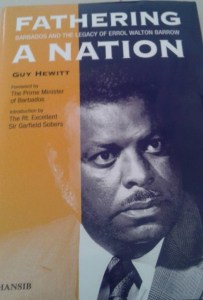
    Like every country, Barbados is not without its challenges. The post-Global Recession years have not been kind, exposing structural weaknesses which have festered for too long and need to be addressed by decisive leadership. There are things we need to improve upon to ensure that the gains our forefathers, like the late father of independence, Errol Walton Barrow, worked hard to build, will remain for future generations. Complacency will do us no favours.

    However, despite the challenges, I have no doubt we have the skills and creativity to overcome them. We just need the will. When I saw the recent newspaper article which showed some 110 people became new Barbadian citizens at the latest citizenship ceremony, it reiterated to me why we Barbadians are so proud of our country. For all its faults, there is no place like the 246. No matter where we roam, the “Rock” will always be home.

    Happy 50th Anniversary of Independence, Barbados!

    Alicia Nicholls, B.Sc., M.Sc., LL.B., is a trade and development consultant with a keen interest in sustainable development, international law and trade. You can also read more of her commentaries and follow her on Twitter @LicyLaw.
  • Dominica Ratifies WTO Trade Facilitation Agreement

    Dominica Ratifies WTO Trade Facilitation Agreement

    Photo source: Pixabay

    Alicia Nicholls

    Dominica has become the latest Caribbean Community (CARICOM) member state to ratify the World Trade Organisation’s (WTO) Trade Facilitation Agreement, according to a WTO press release. On November 28, 2016 Dominica, along with Mongolia, deposited its instrument of acceptance to the WTO. These two ratifications bring the number of WTO member states to have ratified the Agreement to 100, just 10 shy of the number (two thirds of WTO membership) needed for the Agreement to go into effect, according to the press release.

    The Trade Facilitation Agreement, which was concluded at the WTO’s Bali Ministerial in 2013, aims to lower trade costs by expediting the movement, clearance and release of goods, thereby cutting red tape, and improving cross-border customs cooperation on trade and customs compliance issues. Upon the request of developing and least developed country (LDC) WTO members, a Trade Facilitation Agreement Facility  was established in 2014 to assist them with implementing and gaining the benefits from the Agreement.

    The WTO expects the Agreement to  boost global merchandise exports by up to $1 trillion per year if fully implemented. As I had noted in a previous post on the Agreement, ratification and full implementation  of the Trade Facilitation Agreement by all CARICOM states could also improve Caribbean regional integration by easing transaction costs of exporting across CARICOM states. Implementing these reforms would also send a strong signal to the international business community of these countries’ commitment to improving their ease of doing business.

    The following other CARICOM countries have already ratified the Agreement: Trinidad & Tobago, Belize, Guyana, Grenada, St. Lucia, Jamaica and St. Kitts & Nevis.

    The WTO press release may be viewed here.

    Alicia Nicholls, B.Sc., M.Sc., LL.B., is a trade and development consultant with a keen interest in sustainable development, international law and trade. You can also read more of her commentaries and follow her on Twitter @LicyLaw.

  • WTO Panel Rules US Tax Incentive to Boeing a Prohibited Subsidy

    WTO Panel Rules US Tax Incentive to Boeing a Prohibited Subsidy

    Photo source: Pixabay

    Alicia Nicholls

    In the latest saga of the on-going battle between aircraft giants Airbus and Boeing, a World Trade Organisation (WTO) dispute settlement body panel on November 28, 2016 has ruled that Washington State’s business and occupation (B&O) aerospace tax rate for the manufacturing or sale of commercial airplanes under Boeing’s 777X programme currently in development is a prohibited subsidy under the WTO’s Subsidies and Countervailing Measures (SCM) Agreement. The tax breaks to Boeing had been extended by Washington State in 2013 from 2024 to 2040.

    The Dispute

    The dispute DS487: United States — Conditional Tax Incentives for Large Civil Aircraft was brought by the European Union (EU) which claimed that seven tax incentives extended by Washington State to the civil aerospace industry, which would benefit Boeing’s 777x programme, constitute prohibited subsidies under Articles 3.1(b) and 3.2 of the WTO’s Subsidies & Countervailing Measures Agreement because they de jure require Boeing to use domestically assembled and not imported body and wings for its 777x jets.Such a measure would fall under a prohibited subsidy under Article 3.1(b) of the SCM Agreement as it is a subsidy tied to the use of local content. The EU had claimed that Boeing would gain over $5.7 billion in benefits from the measures.

    Findings

    The Panel found that all seven of the measures at issue were subsidies under Article 1 of the SCM but found that only the B&O aerospace tax rate for the manufacturing or sale of commercial airplanes under the 777X programme was a prohibited subsidy under the SCM Agreement as it was contingent on the use of domestic over imported goods.

    The Panel recommended that the US withdraw this prohibited subsidy without delay and within 90 days.

    With respect to the six other challenged measures, the Panel held that the EU did not demonstrate that the aerospace tax measures are de jure contingent upon the use of domestic over imported goods and were therefore not prohibited subsidies.

    Reactions

    Interestingly, both sides appear to have claimed victory which is perhaps not surprising as the WTO ruled only one out of the seven contested measures to be prohibited.

    The European Commission has hailed the ruling a “major win” in its press release following the ruling. In that release EU Trade Commissioner, Cecilia Malmstrom is quoted as stating:

    “Today’s WTO ruling is an important victory for the EU and its aircraft industry. The panel has found that the additional massive subsidies of USD 5.7 billion provided by Washington State to Boeing are strictly illegal. We expect the US to respect the rules, uphold fair competition, and withdraw these subsidies without any delay”.

    Boeing’s rival, the EU-based Airbus termed it a “knock-out blow”. In its own press release, Airbus claimed that “Boeing has caused at least $95 billion in commercial harm to Airbus, opening the door to trade sanctions against the US in an equivalent amount.”

    In its response to the ruling, Boeing stated that “the World Trade Organization (WTO) today rejected virtually all of the European Union’s challenges to the Washington state tax incentives”. Boeing’s General Counsel, J. Michael Luttig stated that “we fully expect Boeing to preserve every aspect of the Washington state incentives, including the 777X revenue tax rate.”

    What next?

    Either party can appeal the ruling and it is expected that this will occur. This dispute is just the latest in the 12-year old dispute between aerospace rivals Airbus and Boeing over the extent of “illegal” government support the manufacturers have received from EU member countries in the case of Airbus, and the US in the case of Boeing.

    The ruling comes on the heels of a report by a WTO compliance panel released September 2016 which held that the EU had not complied fully with a ruling against support provided to Airbus in the EC and certain member States – Large Civil Aircraft dispute. In 2017 the WTO is also expected to issue its ruling on another case regarding US support for Boeing.

    The full panel report may be viewed here.

    Alicia Nicholls, B.Sc., M.Sc., LL.B., is a trade and development consultant with a keen interest in sustainable development, international law and trade. You can also read more of her commentaries and follow her on Twitter @LicyLaw.

  • Fidel Castro: Friend to the Caribbean and Anti-Imperialist Hero

    Fidel Castro: Friend to the Caribbean and Anti-Imperialist Hero

    (Photo source: Pixabay)

    Alicia Nicholls

    Former Cuban President and leader of the 1959  Cuban Revolution, Fidel Castro Ruz, took leave of this earthly realm on November 25, 2016 at the age of 90. Coincidentally, his passing took place on the anniversary of the Granma’s departure from Mexico in 1959 to liberate Cuba.

    Despite the prevailing Washington narrative of Comrade Castro as a “brutal despot and tyrant” who trampled human rights and impoverished his people, most of us in the Caribbean remember “El Comandante” as a revolutionary figure, a freedom fighter, a friend to the Caribbean and an anti-imperialist hero.

    In these few paragraphs, I will outline some of the things that are often forgotten in the common narrative about the bearded Commander who seized power from corrupt dictator Fulgencio Batista in 1959 and ruled Cuba for nearly five decades, until transferring power to his younger brother, Raul Castro, in 2006 during a period of illness. On February 24, 2008 Raul Castro officially became President.

    Friend to the Caribbean

    Since the 1970s, Caribbean countries have enjoyed close diplomatic ties with Cuba and have repeatedly called for the US to bring an end to the embargo.  Thanks to Mr. Castro, thousands of Caribbean students have benefited from Cuban government scholarships to study medicine at Cuban universities. Many other persons have benefited from medical treatment, particularly ophthalmological treatment, by Cuban doctors.

    Cuba’s solidarity with its Caribbean sisters has continued under current President Raul Castro. Cuba has sent medical doctors to assist Caribbean countries in the wake of disasters, including to Haiti following Hurricane Georges in 1998, the earthquake in 2010 and more recently, sending over 30 additional doctors to the country to provide assistance after Hurricane Matthew.

    Mr. Castro’s Cuba was a founding member of the ALBA, pioneered by the late Venezuelan president, Hugo Chavez Frias, and which in English translates to the Bolivarian Alternative for the Americas.

    Social Justice Icon

    Today it hurts us if a Cuban is hungry, if a Cuban has no doctor, if a Cuban child suffers or is uneducated, or if a family has no housing. It hurts us even though it’s not our brother, our son or our father. Why shouldn’t we feel hurt if we see an Angolan child go hungry, suffer, be killed or massacred?” — President Fidel Castro, March 30, 1977

    Despite his well-off social status, being a law graduate from the University of Havana and the son of a Spanish-born sugar planter, Mr. Castro fought for social justice for the Cuban people and drew inspiration from  the late Jose Marti “Apostle of Cuban Independence”.

    Comrade Castro, along with eighty other revolutionaries including another iconic figure, Argentine-born Ernesto “Che” Guevara, set sail from Mexico on November 25, 1959 aboard a yacht called the Granma with the aim to liberate Cuba from President Batista. Under Batista’s rule Cuba had been a hedonistic enclave for wealthy Americans and US multi-national companies, while income inequality in Cuba widened and the Cuban economy stagnated.

    During his presidency, Mr Castro proposed reforms to return sovereignty to the Cuban people, including land reforms, agrarian reforms and economic diversification. He  started a literacy campaign and introduced free universal education and health care for each Cuban citizen. By controversially expropriating foreign owned lands, he sought to end US domination of the Cuban economy and retake Cuba for Cubans. Criticism is made of the poverty under which many of Cuba’s 11 million residents still live but little mention is made of the role the US’ illegal trade, financial and economic embargo has played in retarding Cuba’s economic progress.

    Moreover, very little is generally said in western media about the social strides Cuba has made despite the embargo. For example, Cuba has the lowest HIV/AIDS infection rate in the Caribbean, and one of the lowest in the world. Its  literacy rate of 99.8% is one of the highest in the world, while its low infant and maternal mortality rates were praised by the UN Population Fund in 2012. Even in the face of the US embargo, Cuba has pioneered medical research as noted in this Huffington post article, and has willingly shared its medical, education and scientific expertise with other developing countries. Cuba has also distinguished itself in the area of sport.

    In the early years, Cuba sought to export its revolution to the world with Soviet help. Castro’s right hand man, Che Guevara, was murdered in Bolivia in 1967 while trying to promote revolution in that South American country. In more recent years, Cuba has shifted to soft power, exporting its highly-trained doctors and other health care professionals to countries in need of humanitarian aid. His offers of assistance were not limited to allies and developing countries. Notably, in 2005 then President Fidel Castro offered to send 1,600 Cuban doctors, field hospitals and medical supplies to the US after Hurricane Katrina devastated New Orleans, a gesture which Washington refused.

    Anti-Apartheid

    Mr. Castro also fought against racism and oppression. When western governments unapologetically supported the racist apartheid government in South Africa, Mr. Castro’s Cuba instead supported anti-apartheid movements in that African country, a fact which Jacob Zuma, current South African president reiterated in his statement on Mr. Castro’s death:

    “[Fidel Castro] inspired the Cuban people to join us in our own struggle against apartheid. The Cuban people, under the leadership and command of President Castro, joined us in our struggle against apartheid”. – Jacob Zuma

    Anti-Imperialist & Anti-colonialist Hero 

    Cuba is not opposed to finding a solution to its historical differences with the United States, but no one should expect Cuba to change its position or yield in its principles. Cuba is and will continue to be socialist. Cuba is and will continue to be a friend of the Soviet Union and of all the socialist states.” President Fidel Castro, December 20, 1980

    For anti-imperialists, the “David and Goliath” analogy is no more blatant than in a small island state like Cuba openly defying and provoking the ire of the United States, the most powerful country in the world. Located just 90 miles off the Florida coast, Cuba went from being “America’s whorehouse” to becoming Washington’s public enemy number one because of its embrace of Communism and of the Soviet Union at the height of the Cold War. As a result, successive US governments have since the 1960s punished Cuba with an illegal economic, trade and financial embargo, which despite the detente started by now outgoing US President Obama in 2014, remains in effect.

    While weaker men would have bowed to western pressure, Mr. Castro’s  defiant fight against western imperialism was not limited to Cuba. Cuba provided soldiers, military training and moral support for revolutionary movements in Latin America, and anti-colonial, independence movements throughout Africa, including most notably Angola.

    Recalling Cuba’s assistance to the people of South Africa and of other African countries, then South African President Nelson Mandela is reported to have said on his  1991 visit to Cuba as follows:

    The Cuban people hold a special place in the hearts of the people of Africa. The Cuban internationalists have made a contribution to African independence, freedom, and justice unparalleled for its principled and selfless character, President Nelson Mandela

    In global politics, Castro’s Cuba also played a leading role, including being a founding member of the Non-Aligned Movement (NAM) and later assuming the presidency of that organisation from 1979-1983 and again from 2006-2009.

    Global Reaction to his passing

    Mr. Castro was a polarising figure in both life and death. Predictably, US President-elect Donald Trump in a statement released following news of Mr. Castro’s death noted that “Today, the world marks the passing of a brutal dictator who oppressed his own people for nearly six decades.” Aside from the nausea-inducing rejoicing by US media, politicians and Cuban-Americans at the news of Mr Castro’s passing, the heart-felt reactions of many of the world’s leaders are testimony to the friend and Great man which many regarded him to be:

    Irwin LaRocque (Secretary General of the Caribbean Community – CARICOM) – “The passing of Fidel Castro marks the end of a life dedicated to fighting for the dignity of all people which ensures his place in history.”

    Enrique Pena Nieto (President of Mexico) – “Fidel Castro fue un amigo de México, promotor de una relación bilateral basada en el respeto, el diálogo y la solidaridad” (A.N. Translated: Fidel Castro was a friend of Mexico, promoter of a bilateral relationship based on respect, dialogue and solidarity.)

    Narendra Modi (Prime Minister of India) – “Fidel Castro was one of the most iconic personalities of the 20th century. India mourns the loss of a great friend.”

    Xi Jinping (President of the People’s Republic of China) -“the Chinese people have lost a close comrade and a sincere friend.”

    Justin Trudeau (Prime Minister of Canada) – “Fidel Castro was a larger than life leader who served his people for almost half a century. A legendary revolutionary and orator, Mr. Castro made significant improvements to the education and healthcare of his island nation.”

    Outgoing US President Obama’s carefuly worded statement was not marked by effusive praise of Mr. Castro, possibly not to offend the Cuban Americans, but it avoided the inflammatory tone of the President-elect’s. Mr. Obama did, however, make note of the warming of relations between the US and Cuba under his watch and stated that  “the Cuban people must know that they have a friend and partner in the United States of America.”

    His Legacy will live on

    “Condemn me. It does not matter. History will absolve me.” — Fidel Castro while on trial on October 16, 1953

    A thorn in Washington’s side, Mr. Castro has survived over 600 assassination attempts, as well as the Bay of Pigs invasion of 1961. He was not perfect (No leader is!). He jailed dissenters, for example, and publicly accepted responsibility for the persecution of LGBT persons during the 1960s and 70s. But despite his faults, he was far from the inhumane despot the West portrayed him to be and is generally beloved by the Cuban people. Moreover, western countries’ support of brutal and repressive regimes in the name of preserving their geopolitical and economic interests while demonising Fidel Castro smacks of nothing less than hypocrisy at the highest level.

    Comrade Castro’s contribution to the anti-imperialist movement is immeasurable. His strength of conviction in the face of opposition by the world’s most powerful nations was without comparison. He was a freedom fighter and revolutionary hero who was quick to lend humanitarian support and expertise to other countries and provide global leadership against imperialism, racism, fascism, foreign aggression and oppression.

    Whatever his faults, his heart was in the right place. His failings were outweighed by his achievements. For us in the Caribbean, Castro’s Cuba will always be a symbol of anti-imperialist strength. His friendship to the Caribbean region and to other nations of the Global South will always be remembered. His death leaves an unfillable void, but his legacy is indelible. I express my empathy and solidarity with the Cuban people as they endure these days (and years) of mourning.

    Que descanses en paz, camarada Fidel (Rest in peace, Comrade Fidel).

    Alicia Nicholls is a trade and development consultant with a keen interest in sustainable development, international law and trade. You can also read more of her commentaries and follow her on Twitter @LicyLaw.