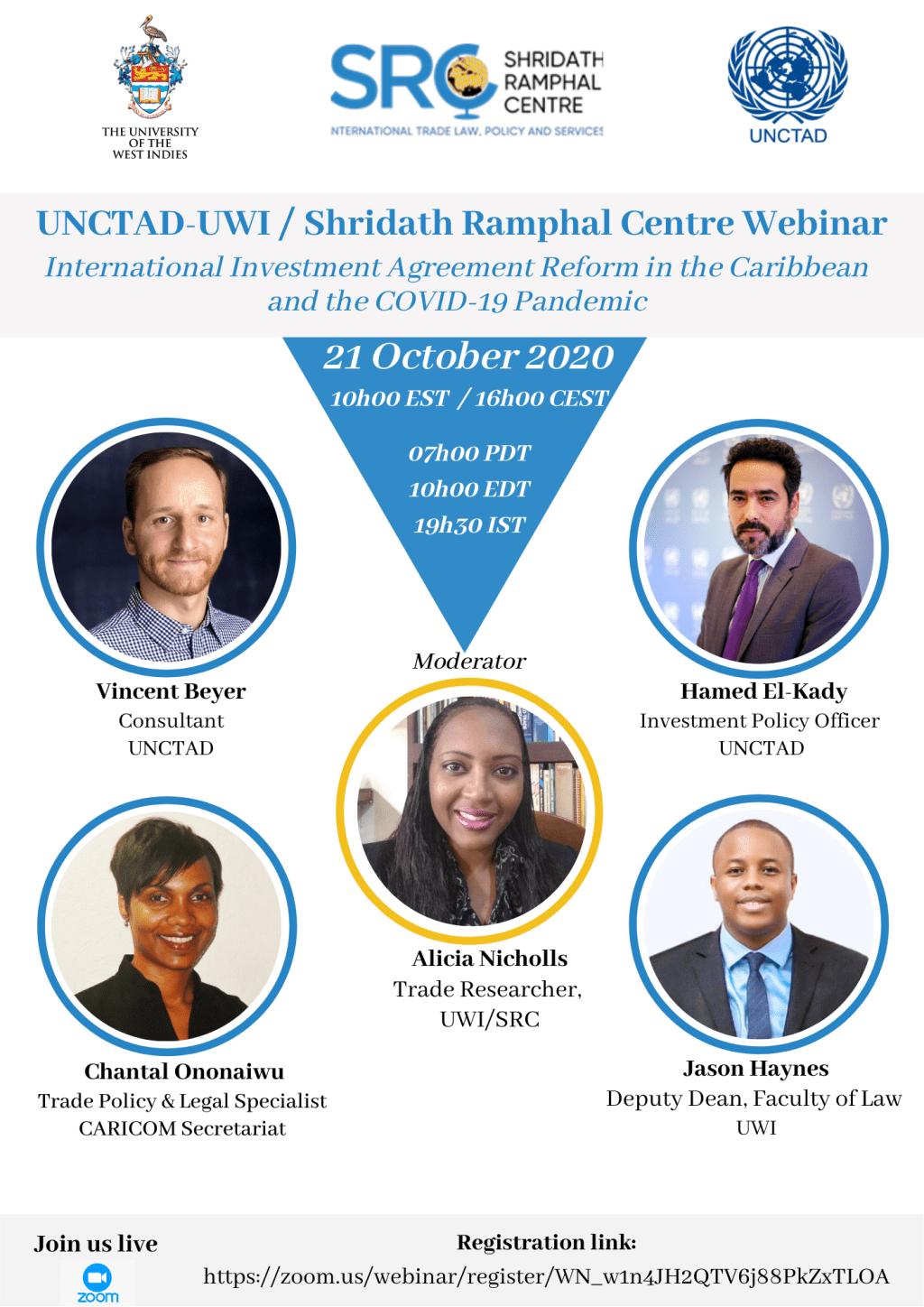
Coming up this Wednesday, October 21st, I will be moderating this exciting UNCTAD-SRC Webinar on “International Investment Agreement (IIA) Reform in the Caribbean and the COVID-19 Pandemic“! See the flyer below.
Welcome to the Caribbean Trade & Development News Digest for the week of October 11-17, 2020! We are going pink for Breast Cancer Awareness Month! We are pleased to bring you the major trade and development news headlines and analysis from across the Caribbean Region and the world from the past week.
THIS WEEK’S HIGHLIGHTS
UK Prime Minister, Boris Johnson, has declared Brexit talks with the EU ‘over’ and according to this BBC report, argued that “there was “no point” in discussions continuing next week unless the EU was prepared to discuss the detailed legal text of a partnership”. Read more here.
A WTO arbitrator issued its decision on the level of countermeasures the EU may request with respect to the US in “United States — Measures Affecting Trade in Large Civil Aircraft — Second Complaint” (DS353). Read the decision here.
US President Donald Trump has signed H.R. 991 the “Extension of the Caribbean Basin Economic Recovery Act” into law which extends the preferential access certain Caribbean countries enjoy for eligible goods into the US market under the CBERA and the CBTPA, the latter of which was to expire September 30, 2020.
Speaking on behalf of the CARICOM Group at the WTO, the OECS Permanent Delegation at Geneva raised the issue of the EU’s blacklisting of certain CARICOM Member States before the WTO’s General Council this week. Read the press release which includes the full statement here.
REGIONAL NEWS
U.S. Congress Passes Haiti-Led Trade Agreement Between America And The Caribbean
Haitian Times: The renewal of the Caribbean Basin Trade Partnership Act is expected to secure 60,000 jobs in Haiti, mostly in textiles and apparel. The U.S. Congress has renewed the Caribbean Basin Trade Partnership Act, an agreement that allows countries in the region to continue importing and exporting goods with America. Read more
CBERA extended, US-Caribbean trade ties strengthened
Trinidad Guardian: According to a news release from T&T’s Ministry of Trade and Industry, the new law –which was signed by President Donald Trump on October 10th, will remain in force until 30th September 2030, ensuring continued preferential duty treatment for certain goods produced in the Caribbean Basin. Read more
Blue BioTrade project set to improve fortunes in the eastern Caribbean
UNCTAD: A new project launched on 7 October by UNCTAD, the Organisation of Eastern Caribbean States (OECS) and the Convention on International Trade in Endangered Species of Wild Fauna and Flora (CITES) seeks to change the fortune of small scale coastal producers of queen conch in the Eastern Caribbean. Read more
Belize accuses St Kitts & Nevis of importing sugar outside of CARICOM
SKNVibes: The Government has been informed that it would face the court for allegations of breaching several sections of the Revised Treaty of Chaguaramas by reportedly importing sugar from outside the Caribbean Community. Read more
Trade-related claim against SKN discussed in National Assembly
ST Kitts & Nevis Observer: The public was updated on a trade-related claim that has recently been brought by the Government of Belize against the Government of St. Kitts and Nevis and the Government of Trinidad and Tobago regarding sugar imports from two non-CARICOM Member States by Minister of International Trade, Industry, Commerce and Consumer Affairs, the Honourable Wendy Phipps during a Sitting of the National Assembly on October 15. Read more
OECS Permanent Delegation Protests Blacklisting Of Caribbean ‘Tax Havens’ At World Trade Organization
St Kitts & Nevis Observer: At the General Council of the World Trade Organization, the organization’s highest decision-making body, the Permanent Delegation of the Organization of Eastern Caribbean States (OECS), speaking on behalf of the CARICOM group, addressed several critical issues currently affecting Caribbean countries, including efforts by some WTO members to blacklist, CARICOM Member States. Read more
CARPHA Partners with, PAHO to Ensure Caribbean States’ Equitable Access to COVID-19 Vaccine
CARICOM: The Caribbean Public health Agency (CARPHA), with funding from the European Union (EU), has entered into an agreement with the Pan American Health Organisation (PAHO) to support Member States’ participation in the COVAX Facility. Read more
CARICOM complaints form available
Nation News: Caribbean Community (CARICOM) nationals who believe that they may have been hindered from accessing the rights afforded to them through the CARICOM Single Market and Economy (CSME), now have a mechanism by which their concerns may be addressed. Read more
Caricom stakeholders push for legally binding Caribbean Sea biodiversity agreement
Newsday: Caricom stakeholders are calling for regional collaboration and strong stakeholder involvement in global efforts to ensure Caricom people get equitable access to and shared benefits from the ocean. Read more
CARICOM Ambassador says hefty air taxes need to be re-examined
CARICOM: The COVID-19 pandemic is forcing Caribbean countries to re-examine intra-regional travel and seek solutions to the high travel taxes problem. Read more
CARIFESTA XV in Antigua postponed until 2022
Caribbean Life: The Gaston Browne administration in Antigua and Barbuda announced on Oct. 8 that, after consultations with the Guyana-based Caribbean Community (CARICOM) Secretariat, the Caribbean Festival of Arts (CARIFESTA) XV has been postponed until 2022. Read more
INTERNATIONAL NEWS
Brexit: Trade talks with the EU are over, says No 10
BBC: Talks between the UK and EU over a post-Brexit trade agreement are “over”, Downing Street has said. No 10 argued there was “no point” in discussions continuing next week unless the EU was prepared to discuss the detailed legal text of a partnership. Read more
Brexit brinkmanship: Johnson says prepare for no-deal, cancels trade talks
Reuters: Prime Minister Boris Johnson said on Friday it was now time to prepare for a no-trade deal Brexit unless the European Union fundamentally changed course, bluntly telling Brussels that there was no point in continuing the negotiations. Read more
WTO Members Advance Text Negotiations on Fisheries Subsidies
IISD: World Trade Organization (WTO) members began work on a consolidated draft document towards an agreement on curbing harmful fisheries subsidies. Members reviewed draft language on subsidies contributing to overcapacity and overfishing, subsidies to distant water fishing, transparency provisions, and special and differential treatment of developing and least developed countries (LDCs). Read more
The China-Cambodia FTA to Become Cambodia’s First Bilateral Free Trade Agreement
ASEAN Briefing: China and Cambodia signed a free trade agreement (FTA) between the two countries on October 5, 2020. The deal was inked virtually between Cambodia’s Commerce Minister Pan Sorasak and Chinese Commerce Minister Zhong Shan. Cambodia’s Prime Minister Samdech Techo Hun Sen and visiting Chinese State Councilor and Foreign Minister Wang Yi were also present to witness the signing. Read more
How Biden would use trade agreements to fight global warming
Politico: The former vice president and key Democrats in Congress want to use trade agreements to fight global warming, but reversing four years of Trump’s “energy dominance” is no easy task. Read more
WTO boss’ recent early exit a warning shot to multilateralism
Swissinfo.ch: The embattled World Trade Organization has announced two shortlist candidates to be its new leader. In a historic first, both are women. But they are unlikely to find the job any easier than Brazil’s Roberto Azevedo. Read more
EU trade policy needs more than just repainting the front door
Euractiv: The EU’s trade policy needs a radical overhaul following Parliament’s opposition to the EU-Mercosur treaty, write Raphael Glucksmann and Agnes Jongerius. Read more
UK statement to the WTO Trade Negotiations Committee
Gov.uk: The UK’s Deputy Permanent Representative to the WTO in Geneva, Andy Staines delivered the following statement to the WTO Trade Negotiations Committee on 12 October 2020. Read more
WTO DG: Okonjo-Iweala gets the backing of 79 countries so far
Nairametrics: Okonjo-Iweala has disclosed that she has gotten the endorsement of 79 out of the 164 countries that comprise the WTO. Read more
Hong Kong lashes out at US ‘Made in China’ labelling rule at the World Trade Organization
South China Morning Post: Hong Kong has formally denounced at the World Trade Organization (WTO) a Trump administration regulation that goods made in the city for export to the US must be labelled as “Made In China”. Read more
Trump warns of backlash if the EU levies around $4 billion in tariffs after WTO ruling
Business Insider: President Donald Trump on Thursday told reporters he will “strike much harder” if the European Union impose tariffs on US goods after winning a World Trade Organization ruling earlier this week. Read more
Trump’s triple failure: Virus control, stimulus and the trade deficit
Washington Post: Given the precarious state of the economy, President Trump’s reckless decision to walk away from stimulus negotiations last week was a consequential act of political malpractice. Read more
China is making up some ground on its U.S. trade deal commitments
Fortune: On Tuesday, data from China’s General Administration of Customs showed a surge in imports and exports in September, with 13.2% and 9.9% growth year on year, respectively. Read more
Turkey-South Africa trade to rise in post-pandemic period
Anadolu: Bilateral trade and investments between Turkey and South Africa are expected to grow as the two countries recover from the effects of the novel coronavirus, the Turkish ambassador to South Africa said. Read more
More trade, less aid: EU and Africa renew their relationship
The Brussels Times: Both the EU and the AU made it clear at the Africa-Europe Civil Society Conference 2020 on Friday that they are looking to renew the quality of the Africa-Europe Partnership in the near future, with higher involvement for the people of the two continents. Read more
AfCFTA To Commence On January 1 As planned
Modern Ghana: Mr Wamkele Mene, Secretary General of the African Continental Free Trade Area (AfCFTA), says the continental trade regime will take off as planned on January 1 next year. Read more
Trade ministers chart final road to AfCFTA
Southern Times Africa: South Africa’s Trade, Industry and Competition Minister Ebrahim Patel has been elected chair of a continental ministerial body tasked with finalising negotiations on terms for commencement of preferential trade under the African Continent Free Trade Area (AfCFTA). Read more
Coming up this Wednesday, October 21st, I will be moderating this exciting UNCTAD-SRC Webinar on “International Investment Agreement (IIA) Reform in the Caribbean and the COVID-19 Pandemic“! See the flyer below.
The Caribbean Trade & Development Digest is a weekly trade news digest produced and published by the Caribbean Trade Law & Development Blog. Liked this issue? To read past issues, please visit here. To receive these mailings directly to your inbox, please subscribe to our Blog below:
“China’s engagement in the region does not necessarily have to be negative, it could be a big positive for growth… There must be a better more equitable vision for a mutually beneficial operating model, for the management of the relationship with China.“
Perry Douglas
Perry Douglas, Guest Contributor
Perry Douglas, Guest Contributor
In the recent article titled: China’s Opaque Caribbean Trail: Dreams, Deal, and Debt by Caribbean Investigative Journal Network (CIJN.), this piece is filled with many examples of the Chinese debt-trap strategy. For Caribbean countries, one of the most visible, expansive, and expensive forms of Beijing’s engagement with the region is its financing of large-scale infrastructure projects. The CIJN investigation unveiled a trail of official secrecy, questionable procurement processes, and the looming threat of potentially insurmountable debt. The Chinese playbook is the same everywhere—huge hotel projects, highways, agriculture projects, even building a Prime Ministers fancy new house. According to CIJN, “China’s Caribbean portfolio is extensive. It includes highways and bridges, housing, energy, mining, air and seaports, tourism projects, hospitals, and even official residences, forming a part of that country’s strategic thrust into Latin American and the Caribbean.”
The investigating team uncovered, that in most cases, the precise terms of agreements are not routinely publicized, the procurement processes and concessions are a mystery. The Chinese often end up with all the labour contracts, and their labour practices lack adherence to any type of building code and other health and safety standards.
A 2012 independent forensic audit of the Jamaica Development Infrastructure Programme (JDIP) and the Palisadoes Shoreline Protection, and Rehabilitation Works Project concluded there was “non-adherence to allocations approved by Parliament and the Ministry of Finance. There was also the arbitrary issuance of Variation Orders and selection of sub-contractors along with the unprogrammed and arbitrary allocation of funds for institutional strengthening,” according to the audit document.
According to clause 13.3 of the contract ($630 million North-South Highway project signed with China Harbour Engineering Corporation (CHEC) on June 21, 2012):
“The Government shall unconditionally and irrevocably waive any right of immunity (to the fullest extent permitted by applicable law) which it or any of its assets now has or may acquire in the future in any jurisdiction.”
To add insult to injury, the highway deal, in a case study conducted by the Caribbean Development Bank (CDB,) found there was “no way costs could be recouped through toll payments.” Hence, China now said that since the investment couldn’t be recouped through toll payments, land adjacent to the highway should be given as compensation. Jamaica of course had already agreed to those terms in the clause. China of course enforced it and the Chinese company promptly brought in 1000+ workers from China to begin work on a commercial project—free land, no Jamaican worker participation, no contracts for Jamaican firms, no economic benefit to Jamaica.
“New roads, new businesses, new hotels, and booming Chinese immigration has led to many companies being staffed with more Chinese workers than local Bahamians.” Forbes
In practical terms, this meant that the Jamaican state allowed China, in a case of a breach of contract by the Government of Jamaica, or actions that the Chinese have determined results in non-performance, would be actionable on Jamaica’s sovereignty. When contextualized, the clause essentially allows for the GOJ to forfeit any current or future owned assets to China, for debt recovery by seizure. A blatant neocolonialism play and encroachment on sovereignty.
In Trinidad and Tobago, the sudden termination of the Government’s $71.7 million project between China Gezhouba Group International Engineering Company and the Housing Development Corporation (HDC) in 2019 has drawn attention to a lack of transparency in the awarding of the contract, and what has been described as overly generous concessions to this Chinese company.
In Suriname, there are increasingly alarming rising fears that mounting debt to China, spanning decades, can have the impact of stalling future development and exposing the country to liabilities way above its ability to pay.
Economics has never been a morality play; so, it’s not China’s responsibility to look after the interest of our people, it is the responsibility of leaders, in consultation with the people, to lead and look after the interest of their nations. We must be committed to real change, otherwise, nothing will ever change! The highly skilled Chinese negotiators need to be matched with our powerful team of negotiators, weaponized with the tools and resources of Artificial Intelligence and Machine Learning algorithms, and systems that can process and provide actionable solutions at a simple keystroke.
China’s engagement in the region does not necessarily have to be negative, it could be a big positive for growth. Notwithstanding, it will all depend on how we play our cards—understand the historical colonialism playbook of others and develop counter offenses…be proactive, not reactive, and control the narrative. There must be a better more equitable vision for a mutually beneficial operating model, for the management of the relationship with China.
This operating ecosystem must be formattable, backed up by strong executable mechanisms, progressive regulatory environments, compliance, and governance, abiding by sturdy democratic principles…the rule of law, freedom of information, and enhanced transparency, in the context of an anti-corruption agenda.
Assets belonging to the people becoming collateralized property in business deals is beyond the pale, way beyond the bounds of any acceptable actions and behaviour by any government, and it is fundamentally illegal. Sovereignty represents a state’s most precious right and freedom under international law.
“The borrower hereby irrevocably waives any immunity on the grounds of sovereignty or otherwise for itself or its property in connection with any arbitration proceeding…or with the enforcement of any arbitral award pursuant thereto.” Project in Guyana signed on January 9, 2017; in Article 8.1:
“This is Guyana dangerously agreeing to cede sovereignty. It plays into the Chinese strategy of using economic weaponry in the pursuit of influence and domination,” says attorney and chartered accountant Christopher Ram. In short, these governments have signed away their nation’s sovereignty, dignity, and basic self-respect, to China. China could simply walk in and take control of Guyana’s assets through its pre-set “debt trap.”
Very recently, July 2020, a Kenyan Appellate Court halted a construction deal, by pronouncing the $3.2 billion contract between Kenya and China for the construction of the Standard Gauge Railways (SGR,) as illegal. The recent judgment effectively lifted the lid on the “dragon’s debt-trap diplomacy.” China had been pressuring Kenya to pay the huge debt, while in the middle of battling a pandemic.
Since 2013, Kenya has saddled itself with more than $5 billion in loans from China for construction on the project. However, in just its first year of operation, the project reported losses of about $98 million US, making servicing the debt impossible. And of course, the terms of the deal made it such, that if Kenya couldn’t repay, it could end up giving China control over some of its most important assets. In this case, it would have been Mombasa Port, Kenya’s largest and most valuable port in east Africa, the gateway into Kenya and landlocked neighboring nations Burundi, Congo, Rwanda, South Sudan, and Uganda. “Therefore, losing control over the port would mean erosion of Kenya’s sovereignty.” The implications are freighting, thousands of port workers would be forced to work under its Chinese lenders—colonialism would have crept back. Fortunately, Kenya’s court system saved the day, bringing a wakeup call to all those involved in similar entanglements with China. We hope Caribbean leadership took the call!
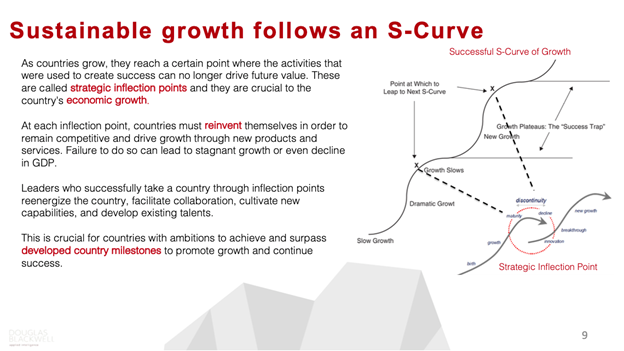
COVID-19 has provided us with a pause, an inflection point, to shift our thinking and strategy focus towards a better future, we can’t get stuck in the past, behind amateurish politicians, with nothing but stale ideas that have never worked out for the people. If we stand still, we perish; we must move in the same direction the world is moving in or be left behind!
(c) Perry Douglas – Douglas Blackwell
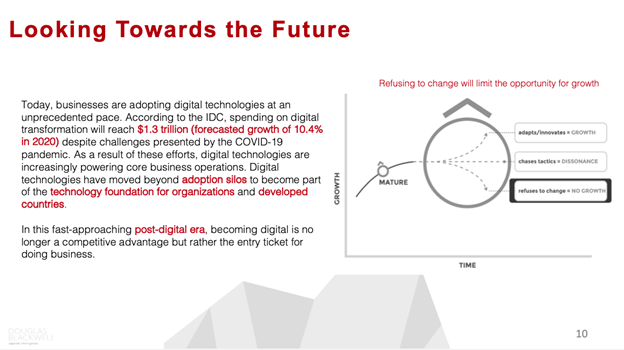
In short, greater investment focus on digital commerce needs to be applied, become the priority. It is counterintuitive to build backward and in line with China’s geopolitical and economic objectives when the rest of the world is moving in another direction.
Domestic success depends on global commerce, but for over 400 years we’ve been on the wrong side of that curve. Digital transformation underpins a prosperity reality and must be the government’s top policy development priority. Resources need to be mobilized with the stated objective being to leapfrog the regional economy into the more prosperous global economy, our ambitions have to be focused, and big!We can’t just sit there, letting others decide our future for us.
We must invest to diversify the entire region to protect our society from future global shocks, as witnessed by the pandemic, which has essentially wiped out the tourism economy. We need diversification and foresight.
If we had a vibrant commerce based agricultural and fisheries industry, for example, with robust global digital sales and marketing capabilities, we would be able to achieve food security and effectively export meaningfully for-profit simultaneously. Pandemic or no pandemic!
A diversified economy is a resilient economy.
A fundamental change in approach and the underlying variables is relative to how development should logically be carried out—a fundamental change in basic thinking, concepts, and practices, highly relevant to the digital era in which we live in, is paramount! Grenada needs a new Investment Policy Statement, a new operating paradigm, one that is progressive, inclusive, with empathy towards sustainable socio-economic development. Politicians should no longer be put in charge of investment decisions, instead, a professional data and applied intelligence-driven performance approach must be taken up immediately! Scientific ecosystems coupled with highly qualified investment committees, responsible to the people, is the push! Driven by intelligent scientific data-based decisioning and predictable modeling, powered by Artificial Intelligence, followed up with fearless implementation and actions, transparent and measurable—is the push! This new paradigm includes an advanced level of due diligence, governance, and transparency, all of which must be brought to the investment decisioning forefront, in examining the probability of desired outcomes in future ‘worlds’ scenarios.
(c) Perry Douglas – Douglas Blackwell
Throughout history, technology-driven economic investment and infrastructure development have driven civilizations to prosperity, always! History shows, through evidence and analysis, that those nations that have deliberately focused on facilitating technology-led growth, went on to forge empires. Today, the world is at another transitioning inflection point, and good decisions taken here can change the directional curvature of prosperity for the entire Caribbean. History shows, like other periods of great technological transition opportunities before it, mishandling it at this critical juncture, will set the entire region back behind the prosperity curve, for generations to come!
The genesis of our future prosperity begins with how we first choose to think! Instinctive and emotional thinking must be put aside for a more slow, deliberative, and logical process—with an entrepreneurial mindset being at the forefront. Increased efficiencies and productivity will increase a nation’s profits and intergenerational wealth curve trajectory, upwards. Growing the standard of living through the development of a highly-skilled, tech-savvy middle-class, throughout the region. This is our best and most optimal opportunity; lets push! Socioeconomic also history tells us that we must resist the intuitive nature of our human condition, towards decision-making processes and choices. Think and focus logically instead, find the data-driven solutions, and put emotions and ego aside. Playing the long game is critical to future success. Decisions based on intelligence gathering and actions are central to good outcomes. Such focused thinking is paramount and can be the genesis of a true Caribbean Renaissance.
Perry C. Douglas is an Entrepreneur and Innovator…for Inclusive Caribbean Economies. Read more of his work at his blog The Inclusive Agenda: http://theinclusiveagenda.blogspot.com.
The views and opinions expressed herein are solely those of the guest author and are not necessarily representative of those of the Caribbean Trade Law & Development Blog.
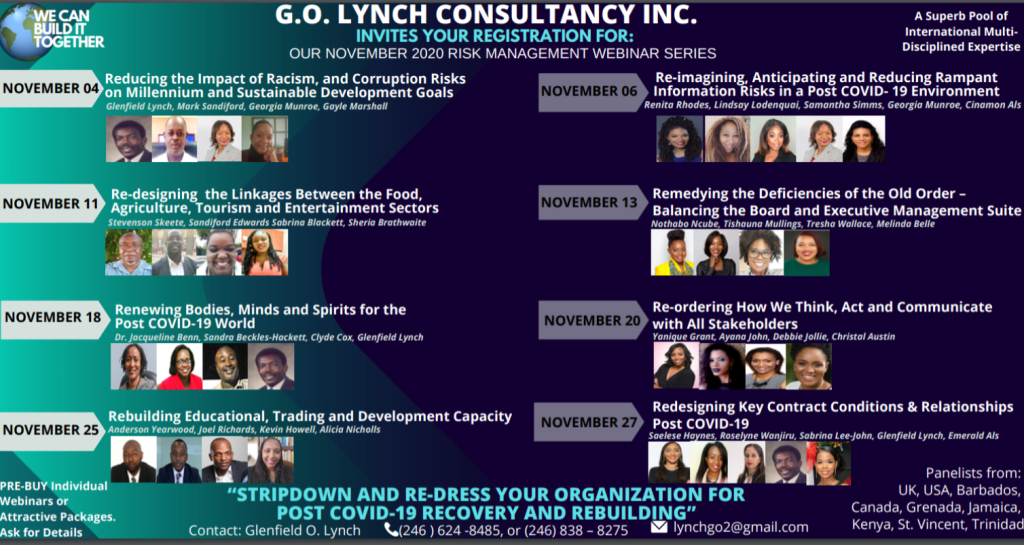
I’m excited to be one of the speakers in the second part of this G.O. Lynch Risk Management Webinar II series entitled “Stripdown and Re-dress your Organization for Post-COVID-19 Recovery and Rebuilding” to take place November 2020.
For further details, download the PDF of the flyer here:




 Caribbean Trade Law and Development
You must be logged in to post a comment.