By Tracia Leacock, PhD – Guest contributor

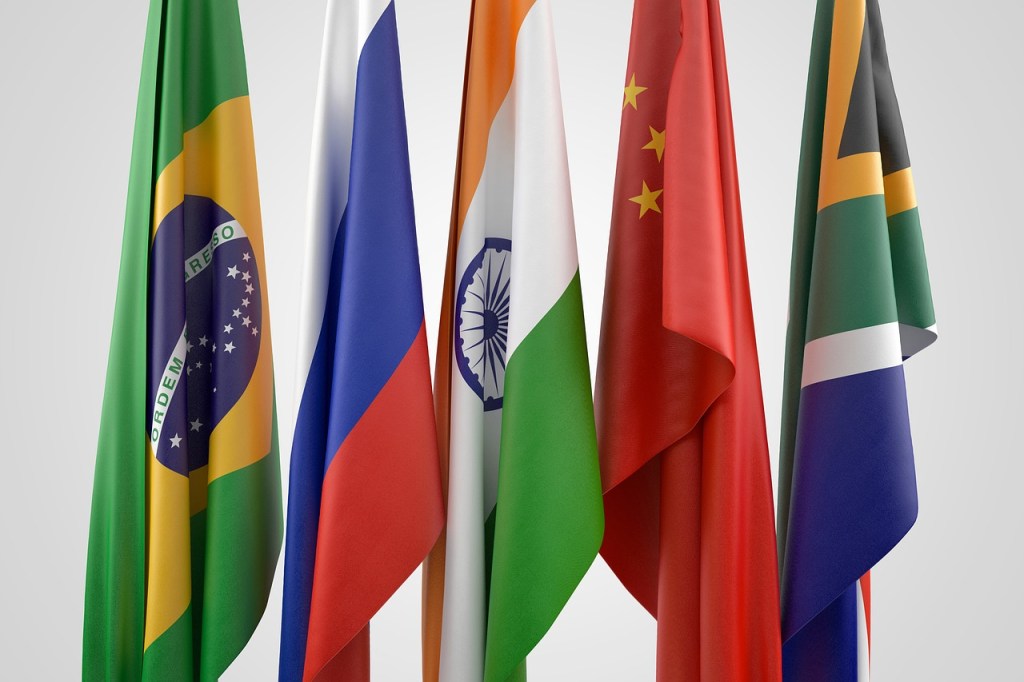
The 15th BRICS Summit was convened from Tuesday, August 22 to Thursday, August 24, 2023, in Johannesburg, South Africa. The BRICS acronym represents the fact that the current grouping comprises the five nations of Brazil, Russia, India, China, and South Africa, among the world’s largest and fastest growing emerging markets and developing countries, across continents. BRICS aims to serve as a platform for the voices and interests of the Global South.
As of 2022, the current five BRICS nations accounted for approximately 25 percent of global GDP (but 31.5 percent in terms of purchasing power parity (PPP), already surpassing the G7’s 30 percent), nearly 20 percent of global trade, 42 percent of the entire global population, and 26 percent of the world’s landmass. Intra-BRICS trade in 2022 topped $762 billion.
All five BRICS nations were represented at the leaders’ discussions by their heads of state (Russia’s President, Vladimir Putin, attended via videoconference, with Foreign Minister Sergey Lavrov leading the in-person delegation).
This year’s gathering garnered the most media attention of any BRICS summit and was the most heavily attended. South Africa’s President, Cyril Ramaphosa, invited the leaders of all 54 African states, as well as of 15 other Global South nations, in addition to representatives of major international organisations and regional groupings, including the United Nations and the G77+China (which presently includes 134 developing nations, and was represented by Cuba’s President, Miguel Díaz-Canel Bermúdez).
During this highly anticipated BRICS summit, member states deliberated on various global affairs issues. Some salient points are as follows[1]:
Clarification about what BRICS represents
BRICS leaders emphasised that, contrary to rumours in some pre-summit news coverage, the group is not aiming to challenge the West.
Brazil’s President Lula da Silva said, “We do not want to be a counterpoint to the G7, G20 or the United States.” “We just want to organise ourselves.” India’s Prime Minister Narendra Modi called on BRICS to be “the voice of the Global South.” Chinese President Xi Jinping also rejected “bloc confrontation,” insisting that “hegemonism is not in China’s DNA,” and called on BRICS to build a more just and equitable international order.
Reform of global financial institutions
“…We require a fundamental reform of the global financial institutions so that they can be more agile and responsive to the challenges facing developing economies…,” Ramaphosa told the summit’s Business Forum on Tuesday, August 22.[2] He lauded the achievements made by the New Development Bank (NDB). Known as the BRICS bank, NDB was established by the group in 2015 as an alternative to traditional Multilateral Development Banks (MDBs) such as the IMF and the World Bank.
In an August 22 interview with Financial Times (FT), Dilma Rousseff, former President of Brazil, and now President of the Shanghai-based NDB, stated that the bank, which already makes loans in China’s renminbi (yuan) currency, would also lend in the national currencies of other BRICS states: Brazilian real, Indian rupee, and South African rand.[3]
Per FT:
Rousseff said lending in local currency would allow borrowers in member countries to avoid exchange rate risk and variations in US interest rates. “Local currencies are not alternatives to the dollar,” she said. “They’re alternatives to a system. So far the system has been unipolar…it’s going to be substituted by a more multipolar system.”
The Brics bank has also tried to distinguish itself from the World Bank and IMF by not setting lists of political conditions on loans. “We repudiate any kind of conditionality,” Rousseff said. “Often a loan is given upon the condition that certain policies are carried out. We don’t do that. We respect the policies of each country.”[4]
NDB aims to issue 30 percent of its loans in local currencies by 2026, and 40 percent of funding is allocated to climate change mitigation and adaptation, including energy transition.
Global governance reform
In his plenary address, Ramaphosa said: “The world is changing. New economic, political, social and technological realities call for greater cooperation between nations. These realities call for a fundamental reform of the institutions of global governance so that they may be more representative and better able to respond to the challenges that confront humanity.”
Point 7 of the summit’s final communiqué also calls for “a comprehensive reform of the UN, including its Security Council, with a view to making it more democratic, representative, effective and efficient, and to increase the representation of developing countries.…”
Point 8 supports “the open, transparent, fair, predictable, inclusive, equitable, non-discriminatory and rules-based multilateral trading system with the World Trade Organisation (WTO) at its core, with special and differential treatment (S&DT) for developing countries, including Least Developed Countries.”
Sustainable development goals (SDGs) and climate mitigation
UNCTAD Secretary General, Rebeca Grynspan, in an interview with Xinhua news service ahead of the BRICS summit, called for a more inclusive multilateral system, naming China’s Belt and Road Initiative (BRI) as an example for cooperation on sustainable development.
“We need the voice of the South in revitalizing the sustainable development goals as the only real commitment for solidarity and collective action at the global level,” said Grynspan. “All the BRICS countries are also in the G20. We want to make multilateralism more vibrant, more inclusive, and to help build a more multilateral world even in a moment of more multipolarity.” “It’s important to have another platform that represents the perspective of the developing world and the need for development and more opportunities.”[5]
South African President Ramaphosa said that “…BRICS nations need to advance the interests of the global south and call for industrialised countries to honour their commitments to support climate actions by developing economic progress….”
Options for global trade currencies and payment settlement systems
At a BRICS summit plenary session Putin said, “…we see a need in increasing the role of our states in the international monetary and financial system, the development of interbank cooperation, the expansion of the use of national currencies and the deepening of cooperation between tax, customs, and antimonopoly authorities.”
Pointing out that “Global economic recovery relies on predictable global payment systems and the smooth operation of banking, supply chains, trade, tourism and financial flows,” Ramaphosa also added that BRICS “will continue discussions on practical measures to facilitate trade and investment flows through the increased use of local currencies.”
At present, BRICS members China and Brazil conduct their $170 billion of trade in their national currencies. China and Russia also settle 80 percent of their $190 billion trade in renminbi (yuan) and ruble using China’s CIPS and Russia’s SPFS payments settlement systems. Other nations settling part of their trade in yuan include Bolivia and Argentina, which recently also used yuan for an IMF loan payment. India offers rupee accounts with a growing number of trade partners, including Guyana.
Additionally, each of the current five BRICS nations is piloting or trialling its own Central Bank Digital Currency (CBDC), a concept invented and pioneered on the Caribbean island of Barbados.
Anil Sooklal, South Africa’s BRICS Sherpa said, “What we are talking about is creating more financial inclusion in terms of global financial transactions, global financial trade and how we conduct our payment.”
The group indicated that complex discussions about a common trade currency are ongoing and would be explored at next year’s summit. Currency deliberations were led by Standard Bank Group CEO Sim Tshabalala, who indicated that the BRICS Business Forum gave noteworthy consideration to Afreximbank’s Pan-African Payment and Settlement System (PAPSS) for cross-border payments within Africa.[6]
Reuters also reported that “South Africa’s finance minister said on Thursday that the BRICS grouping would not be looking to replace international payment systems including SWIFT, but rather consider creating one that would strengthen trade in local currencies.”[7]
Such a BRICS platform would hold potential for “networking the networks,” i.e., serving as an umbrella mechanism interconnecting geographically dispersed “satellite” national, regional, and coalitional payment systems.
Expansion of BRICS grouping to incorporate more Global South nations
In 2022 BRICS announced that it would consider accepting new members, and in the lead-up to this year’s summit, over 40 nations expressed interest in joining, with 22 nations submitting formal applications and another 20 making informal enquiries.
At the end of the summit, current BRICS members announced that they have invited six nations, Argentina, Egypt, Ethiopia, Iran, Saudi Arabia, and the United Arab Emirates (UAE), to become full members of BRICS effective January 1, 2024.
By including three OPEC nations (Saudi Arabia, UAE, and Iran), BRICS membership will now count six of the world’s top 10 oil producing nations (with almost 50 percent of both global oil production and reserves), and at least four of the world’s top 10 gas producing nations (in total, seven of the top 20) in its fold. By including Argentina, the group now has three of the top five lithium producing countries (Brazil and China being the other two). Recently, Iran also has discovered vast lithium deposits, potentially the world’s second largest reserves. In addition, BRICS includes four of the top five agricultural producing countries (now seven of the top 20). This expanded BRICS group includes seven of the G20 nations, thereby solidifying the input of the Global South.[8]
South Africa’s Minister of Finance, Enoch Godongwana, has indicated that this is just the first phase of admission of new members. BRICS leaders already have embarked on a second round of discussions, seeking consensus on additional member nations.[9] More countries are still in the queue to join BRICS, with Algeria, Bangladesh, Bolivia, Cuba, Indonesia, Kazakhstan, Kuwait, Thailand, Venezuela, and Vietnam among them. By next year’s summit, BRICS also aims to develop further guidelines for accepting prospective partner countries.
Fortification and diversification of global supply chains
In point 33 of the BRICS Summit 2023 final communiqué, the members state: “We encourage further cooperation among BRICS countries to enhance the interconnectivity of supply chains and payment systems to promote trade and investment flows.”
A cursory glance at a map of the globe will suffice to demonstrate the impact of this new phase of BRICS member expansion on stabilising global supply chains and securing key maritime and overland trade routes. The following graphic from an article by Marcus Lu (and Bhabna Banerjee) is useful[10]:

Russia–Ukraine conflict
Addressing the open plenary session of the summit, Ramaphosa said, “BRICS has proven itself to be a credible entity that stands in solidarity and seeks to promote a more equitable global system. We thank you also for the efforts that are being made by a number of BRICS countries to bring about a peaceful end to the conflict between Ukraine and Russia…. We agree that… these types of conflicts are best brought to an end by negotiations…BRICS members will continue to be supportive of the various efforts to bring this conflict to an end through dialogue, mediation and negotiation.”
Tracia Leacock, Ph.D. is an Independent Research and Content Consultant, with a keen interest in international relations. She may be contacted via Linkedin here.
[1] The full joint statement for BRICS Summit 2023 is accessible at member states’ government websites. PDF link at South Africa presidency website, “XV BRICS Summit Johannesburg II Declaration,” August 23, 2023, https://www.thepresidency.gov.za/content/xv-brics-summit-johannesburg-ii-declaration-24-august-2023
[2] In point 10 of the BRICS Summit 2023 final communiqué, the members state: “We call for reform of the Bretton Woods institutions, including for a greater role for emerging markets and developing countries, including in leadership positions in the Bretton Woods institutions, that reflect the role of EMDCs in the world economy.”
[3] NDB lending in Russian ruble was suspended with the onset of the Russia–Ukraine conflict.
[4] Michael Stott, Financial Times (FT), August 22, 2023, “Brics bank strives to reduce reliance on the dollar,” https://www.ft.com/content/1c5c6890-3698-4f5d-8290-91441573338a
[5] Martina Fuchs, Xinhua, August 22, 2023, “Interview: UNCTAD chief urges ‘inclusive multilateral system’ ahead of BRICS summit,” https://english.news.cn/20230822/f8ed708a1c074b2b8f7f2d71bbd96f0a/c.html
[6] Siphelele Dludla, DFA, August 23, 2023, “BRICS nations reach stalemate on potential common reserve currency,” https://www.dfa.co.za/opinion-and-features/brics-nations-reach-stalemate-on-potential-common-reserve-currency-2e19b006-2340-41a0-ac5a-05256b8befea/
[7] Reuters, August 24, 2023, “BRICS payment system would not replace SWIFT—S. Africa finance minister,” https://www.reuters.com/world/africa/brics-payment-system-would-not-replace-swift-safrica-finance-minister-2023-08-24/
[8] See Marcus Lu (and Bhabna Banerjee), Visual Capitalist, August 24, 2023, “Visualizing the BRICS expansion in 4 charts,” https://www.visualcapitalist.com/visualizing-the-brics-expansion-in-4-charts/, for a detailed overview of the impact of the BRICS expansion.
[9] Nokukhanya Mntambo, Eyewitness News (EWN), August 26, 2023, “Algeria likely to be among second batch of countries to join BRICS—Godongwana,” https://ewn.co.za/2023/08/26/algeria-likely-to-be-among-second-batch-of-countries-to-join-brics-godongwana
[10] Marcus Lu (and Bhabna Banerjee), Visual Capitalist, August 24, 2023, “Visualizing the BRICS expansion in 4 charts,” https://www.visualcapitalist.com/visualizing-the-brics-expansion-in-4-charts/
 Caribbean Trade Law and Development
You must be logged in to post a comment.