Welcome to our Caribbean Trade & Development News Digest for the week March 1 – 7, 2026!
📌THIS WEEK’S HIGHLIGHTS
Below are this week’s headlines!
US Treasury Secretary Scott Bessent has stated that the 15% global tariff under section 122 of the Trade Act, 1974, will be implemented some time in the coming days.
A coalition of 24 U.S. states filed a lawsuit arguing the tariff exceeds presidential authority and infringes on Congress’s control over trade policy.
A U.S. trade court ordered the government to start refunding more than $130 billion in tariffs previously ruled unlawful. Thousands of companies have filed for refunds.
🌴CARIBBEAN AND HEMISPHERIC TRADE STORIES
Minister: Becoming part of Mercosur would benefit T&T
Daily Express: Trinidad and Tobago’s potential membership in the South American trade bloc Mercosur (short for Spanish Mercado Común del Sur, or Southern Common Market) could bring significant benefits, according to Foreign and Caricom Affairs Minister Sean Sobers. Read more
Trump threatens Cuba again, says island nation may face ‘friendly takeover’
Al Jazeera: United States President Donald Trump has signalled that his administration is still pursuing a government overthrow in Cuba even as the US-Israeli war on Iran enters its second week. Read more
Can Belize Grow Its Cacao Industry Into a Major Export Sector?
Greater Belize Media: The government of Belize has launched the National Cacao Committee, a new body tasked with driving growth in the country’s cacao industry. Read more
Belize Records Modest Growth in Niche Agricultural Exports to Asia Business, Companies & Organizations
LoveFM: Belize is gaining encouraging signals on two economic fronts tonight, modest but steady growth in niche agricultural exports to Asia and renewed international attention as a competitive retirement destination in the Caribbean. Read more
Afreximbank raises CARICOM financing cap to $5 billion to accelerate regional transformation
Afreximbank: Pan African Multilateral Bank, African Export-Import Bank (Afreximbank), has announced a major expansion of its engagement with the Caribbean Community (CARICOM), increasing its regional financing limit from US$3 billion over the next four years. Read more
Worrell: Barbados can’t get cheaper oil deals in CARICOM as regional trade still in US dollars
Barbados Today: Former Central Bank Governor Dr Delisle Worrell has warned that Barbados should abandon any expectation of getting cheaper oil deals from its Caribbean partners, since oil and fuel trade within CARICOM is priced and paid for in US dollars — just like imports from the United States or India. Read more
Bessent says global 15% tariff starts this week, predicts Trump duties will return to old levels later this year
CNBC: President Donald Trump’s recently announced 15% global tariff will likely be implemented sometime this week, rising from its current rate of 10%, Treasury Secretary Scott Bessent said Wednesday. Read more
US trade court orders tariff refunds in setback for Trump administration
BBC: A federal judge has cleared the way for thousands of businesses to receive refunds for tariffs that the US Supreme Court struck down last month. Read more
Small business owners doubt they’ll see refunds after supreme court invalidates Trump’s tariffs
Guardian: Ruling could free $175bn, but legal hurdles and higher costs have left businesses questioning if claims are even worth it. Read more
Judge rules companies are entitled to refunds for Trump tariffs overturned by the Supreme Court
NBC: In a defeat for the Trump administration, the U.S. Court of International Trade said all “importers of record” were “entitled to benefit” from the ruling against the sweeping tariffs. Read more
Mexican companies eager to keep USMCA treaty, report shows
Reuters: Mexican businesses are eager to maintain a trilateral trade agreement with the United States and Canada that is up for review this year, according to a report summarizing Mexico’s public consultation, released on Monday. Read more
📢 STRAIGHT FROM THE WTO!
Coordinators of Plastics Dialogue ready ministerial statement and other outcomes for MC14
The coordinators of the Dialogue on Plastics Pollution and Environmentally Sustainable Plastics Trade (DPP) on 6 March finalized the ministerial statement for the 14th Ministerial Conference (MC14), scheduled to take place on 26-29 March in Cameroon. The statement was first introduced by the co coordinators in November 2025 and has been continuously updated to reflect members’ perspectives following intensive consultations. Read more
Chair of agriculture talks circulates revised draft text, as MC14 outline emerges
The Chair of the negotiations on agriculture, Ambassador Ali Sarfraz Hussain (Pakistan), has circulated a revised draft text ahead of the WTO’s 14th Ministerial Conference (MC14) in Yaoundé, Cameroon, from 26 to 29 March. Most WTO members welcomed the draft as a basis for consensus at a meeting of the negotiating body on 6 March, although a couple of members said they do not find it acceptable in its current form. Read more
DG Okonjo-Iweala urges members to explore new ways to revitalize WTO at South-South event
Speaking at the 8th South-South Dialogue on Least-Developed Countries (LDCs) and Development on 6 March in Geneva, Director-General Ngozi Okonjo-Iweala highlighted the importance of members’ work to reform the WTO in the run-up to the 14th Ministerial Conference (MC14) to be held on 26-29 March. She acknowledged the progress they have made in addressing LDCs’ trade priorities and encouraged LDCs to continue pursuing their trade interests. Read more
Ahead of Women’s Day, WEIDE Fund announces US$ 1.76-million grants to women-led businesses
To mark the upcoming International Women’s Day on 8 March, the Women Exporters in the Digital Economy (WEIDE) Fund on 6 March announced its plans to disburse US$ 1.76 million in grants in the first quarter of 2026 to benefit 219 women-led enterprises in the Dominican Republic, Mongolia and Nigeria. The first disbursement sets in motion the innovative design of the WEIDE Fund, which introduces a new model of grant financing supported by technical assistance and exposure to a multistakeholder ecosystem for enterprises. Read more
EU contributes EUR 75,000 to support LDC participation at MC14
The European Union has contributed EUR 75,000 (approximately CHF 69,500) to support the participation of government officials from least developed countries (LDCs) at the WTO’s 14th Ministerial Conference (MC14), to be held from 26 to 29 March 2026 in Yaoundé, Cameroon. The contribution aims to ensure broad and inclusive participation in the WTO’s highest decision making body. Read more
WTO members conclude month-long reform discussions in Geneva
WTO members on 5 March completed a series of meetings dedicated to advancing work on WTO reform. Over the past month, members have exchanged views on a draft ministerial statement and a work plan intended to frame the scope of reform efforts following the 14th Ministerial Conference (MC14) on 26-29 March. They also finalized preparations for the ministerial level political discussion on reform to be held at MC14 in Yaoundé, Cameroon. The reform facilitator, Ambassador Petter Ølberg of Norway, described the exchanges as substantive, thoughtful and conducted throughout in a positive spirit. Read more
EU contributes EUR 1 million to strengthen trade capacity in developing economies, LDCs
The European Union is contributing EUR 1 million (approximately CHF 928,000) to support developing economies including least developed countries (LDCs) in strengthening their participation in the multilateral trading system for 2026–2027. Read more
Government Procurement Committee discusses GPA implementation, progress in accessions
At a meeting of the Committee on Government Procurement on 4 March, parties to the Government Procurement Agreement (GPA) discussed issues concerning GPA implementation and progress in accession negotiations. Parties also elected a new Committee chair, Mr William Westerveld Jensen of Norway. Read more
Heads of WTO, EIB sign landmark agreement to boost trade and investment
The WTO Secretariat and the European Investment Bank (EIB) Group signed a Memorandum of Understanding (MoU) on 4 March to enhance sustainable trade and investment worldwide. The agreement marks the beginning of a partnership that will leverage the EIB’s financial resources and investment facilitation tools developed under the Investment Facilitation for Development Agreement concluded by a large number of WTO members to improve the regulatory environment, unlock investment and expand opportunities for developing countries. Read more
WTO members consider new e-commerce proposal and previous submissions ahead of MC14
At a meeting on the Work Programme on E-Commerce on 3 March, WTO members considered a proposal to establish a Committee on Digital Trade as part of a draft decision on e-commerce for the 14th Ministerial Conference (MC14), which will take place from 26 to 29 March in Yaoundé, Cameroon. Members also continued discussions on the reinvigoration of the Work Programme and on the moratorium on the imposition of customs duties on electronic transmissions on the basis of two other proposals. Read more
WTO members review five regional trade agreements, discuss transparency issues
At a meeting of the Committee on Regional Trade Agreements (CRTA) on 3 March, WTO members reviewed five regional trade agreements (RTAs) involving Comoros, the European Union, Mozambique, Indonesia, China, Serbia, Kazakhstan, Azerbaijan, Türkiye and the Faroe Islands. They also reviewed other topics relevant to the Committee’s work under the Transparency Mechanism for RTAs. Read more
🌎 GLOBAL TRADE STORIES
Voice of Nigeria: Nigeria has intensified efforts to consolidate its leadership under the African Continental Free Trade Area (AfCFTA) while strategically positioning itself ahead of the 14th World Trade Organization Ministerial Conference. Read more
EU keeps U.S. trade deal frozen over tariff uncertainty
Financial Post: Top EU lawmakers on the parliament’s trade committee made the choice on Wednesday, saying they wanted more information from Washington about how it will preserve a 15 per cent ceiling on most EU products — a level both sides agreed to in last summer’s trade pact. Parliament initially halted ratification several days after the ruling. Read more
Business mobilisation grows to 189 chambers and associations backing WTO reform and Moratorium renewal
ICC: A growing number of chambers of commerce and business associations from around the world are urging governments to deliver concrete outcomes at the 14th Ministerial Conference of the WTO, as concerns mount over fragmentation in the global trading system. Read more
China exports surge despite Trump tariffs
BBC: Official figures show exports jumped by more than 20% in January and February, which is almost three times the rate predicted by economists. It puts the country on track to top the record-breaking annual trade surplus it saw in 2025. Read more
Indonesia to file suspension of concessions against EU on palm oil dispute in WTO
Reuters: Indonesia’s trade ministry said on Saturday that the government will file a suspension-of-concessions request against the European Union at the World Trade Organization’s (WTO’s) dispute settlement body, citing the block’s failure to meet a WTO ruling in a palm oil case. Read more
Thank you for reading the Caribbean Trade & Development News Digest, a product of the Caribbean Trade and Development blog. If you found this edition useful, subscribe to our Blog to ensure you never miss a weekly update.
Rahym R. Augustin-Joseph (Mr.) (Guest contributor)
Early last week, the Prime Minister of Trinidad and Tobago, Hon. Kamla Persad-Bissessar, indicated via Press Release, that, her government unequivocally supported the deployment of American Military assets into the Caribbean Region in order to destroy the terrorist drug cartels.
Interestingly enough, the Prime Minister noted that it was not the government’s intention to engage CARICOM, as the foreign policy of each CARICOM state is within their sovereign domain and must be articulated for and by themselves. After all, one’s foreign policy is indeed based on one’s national interests, values, pragmatism, ideology, et cetera.
Albeit, accurate in theory, but not truly in praxis, particularly when a country is within a regional integration movement and history has shown that greater results emanate from the Caribbean speaking as one voice within the global political ecosystem, by virtue of their bargaining power as a bloc which eclipses our size constraints. In fact, some naysayers will argue that when the foreign policy dictates of a country is not solely influenced internally, it is reflective of a reduction in sovereignty. But sovereignty is also an action which permits the island’s foreign policy to be in sync with other countries.
Thus, the utilisation of polar opposition positions within the Caribbean, encourages a colonial ‘divide and conquer’ strategy for developed countries which only elevates their position and agenda, at the expense of the interests of the Caribbean.
Of course, there has been many instances of Caribbean disunity propagated by the USA, such as the Ship Riders Agreement in the 1990’s, debates over permitting the US invasion of Grenada, inability to support one candidate in the Commonwealth SG Race of 2022, recognition of Jerusalem as the capital of Israel, Venezuela- USA Debacle under President Trump, among others.
What is generally done, is the major powers co-opt CARICOM States to be against each other or pick them off one by one through inducements such as aid, financial and technical aid et cetera. It is for this reason I support the Golding Commission’s Report Recommendation 26 which suggested “a review of the procedures for foreign policy consultation and coordination in order to avoid as far as possible, the types of conflict and embarrassing positions that have emerged from time to time among CARICOM members depriving it of the collective force it is capable of exerting.”
While the Prime Minister is accurate that CARICOM countries, reserve the sovereign authority to articulate their individual foreign policy position, it is a known fact that her unilateral position undermines one of the core pillars of the regional integration movement, i.e., foreign policy coordination, as noted in Article 6 (h) of the RTC which notes in part that one of the Community’s objectives is “enhanced co-ordination of Member states’ foreign and foreign economic policies.” It is where countries within the Caribbean Community, seek to find common ground on our individual national positions on these myriad of hemispheric and international issues of great importance to the Caribbean Community, such as the Venezuela- Guyana Dispute and the infiltration of overseas drug cartels which affect Trinidad and Tobago and the wider Caribbean.
But what is also ironic and confusing about the Prime Minister’s position, is that she, without the concurrence of her CARICOM colleagues endorsed the American deployment in the ‘Caribbean Region’, not only in the waters close to Trinidad and Tobago, but the Caribbean, while quickly denouncing her Government’s intention to engage CARICOM on the subject matter.
But, even beyond this foreign policy vernacular, Trinidad and Tobago should not make decisions under the guise of the sovereign name of Trinidad and Tobago when these decisions have life and death implications for the wider Caribbean Region peoples without consulting CARICOM.
Thus, the invitation of war to the shores of the Caribbean, with wanton disregard for the potential effects on human life, through the permitting of US military operations which can have counter-military responses within the small landmass in the Caribbean region potentially affecting multiple Caribbean countries is a decision that should not be taken as fiat by one Caribbean country.
As one online commentator noted, decisions about war are not akin to putting on the call of duty video game, but requires careful deliberation, analysis, consultation, respect for international law et cetera.
It is as if the Prime Minister, in the absence of the Chair of CARICOM is speaking for the region without their concurrence, while still attempting to confine her foreign policy position to Trinidad and Tobago.
But, the articulation of such position should have been even more circumspect, because under the Quasi-Cabinet of CARICOM, Prime Minister Bissessar is the Lead for Security (Drugs and Illicit Arms). As such, when she speaks and takes definitive positions, both for Trinidad and Tobago and implicitly for the Caribbean, it is as akin to a response from the CARICOM, which makes it even more problematic, questionable and worrying. After all, CARICOM is one of the bastions of Caribbean sovereignty.
As such, if the regional Quasi Cabinet works anything like our domestic cabinet, Prime Minister Bissessar has just articulated a policy position of CARICOM, while admitting ‘boldfacely’ that she would not be consulting with her CARICOM colleagues.
But one would believe though that such a request for the deployment of military assets has already been made to the Government of Trinidad and Tobago, which prompted this press release. But, instead, the Prime Minister indicated that, no requests have ever been made by the American government for their military assets to access Trinidad and Tobago territory for any military action against the Venezuelan regime.
But, still, she offers it, citing that should the Maduro regime launch any attack against the Guyanese people, her government will provide the access if required to defend the people of Guyana against Venezuela.
What is also concerning about this policy position by Bissessar is that at the domestic level, it is a confining and narrowing of liberal democracy to the political elite, such that the people of Trinidad and Tobago have not been given any meaningful opportunity to form any opinion on whether they are supportive of the utilisation of foreign military assets by the USA, to fight drug cartels and/ or, as a launching pad for war against the Venezuela regime, with significant potential for retaliatory measures against Trinidad and Tobago which will affect their peoples.
Certainly, Bissessar has shown that the people of Trinidad and Tobago, at the recent ballot box, engaged in what Jean Jacques Rosseau calls a simultaneous exercise in, and surrender of sovereignty, such that the very moment they made the x, was the same moment they surrendered their sovereignty to her, such that all decisions of national importance are only decided by the political elite. They remain excluded from engaging in the political lives of their society and have surrendering all of their power to their representatives.
Of, course the common retort of her colleagues and supporters would be that ‘the people voted for a promise of the reduction of crime and violence’ and provided the government with the latitude to engage in measures such as this to pursue the outcome.
A typical example of the ‘ends justify the means’ only that in governance the means, more than ‘the ends’ matter. How and why, you do what you do matters in politics.
But this position is also at odds with other positions taken in Trinidad and Tobago, in the past under Dr. Eric Williams, where in response to internal turmoil with the Black Power Movement, the USA entered the territorial waters; in order to quell the uprising and they were not welcomed by the Government.
But the policy position is also bewildering because is the administration providing their support for the ‘stationing of military assets to destroy drug cartels’ which emanate from or do not emanate from Venezuela?
Or is it to provide the Americans with the launching pad for war against Venezuela if they attack Guyana? Or is it both?
Under the latter, such a retaliatory response under collective self-defence as per International Law, can only be invoked where there was indeed an ‘armed attack’, the victim state must have declared itself to be under attack, and must request assistance, and that this assistance should still be necessary and proportionate.
It apparently is both because days later, we then see video footage of American military assets destroying an alleged Venezuelan vessel on the waters which was allegedly carrying drugs. What this confirms is that there seems to possibly be a request by the Americans for deployment, contrary to the Prime Minister’s assertion which was accepted by the Prime Minister. Further, the aim of the deployment is not only to respond to the Venezuelan state against Guyana, but to also respond to drug cartels emanating from the state of Venezuela.
In any instance, both are problematic.
Certainly, the former is because, notwithstanding the realities that Trinidad and Tobago faces, wherein the data suggests that there has been an infiltration of violence because of the Venezuelan political and economic crisis, it also places Bissessar in a diplomatic chokehold and at odds with the regional position which also recognises that the influx of unlicenced firearms are due in part to the second amendment right under the USA constitution, to bear arms.
Such that, guns continue to be rampant in our countries, which allegedly also come from the USA without the necessary support from the USA, to revisit their internal background checks and support stronger border control to reduce the influx of firearms.
As noted, in a recent peer-reviewed journal article published in the European Journal of International Security by Dr Yonique Campbell, Professor Anthony Harriott, Dr Felicia Grey and Dr Damion Blake titled “From the ‘war on drugs’ to the ‘war on guns’: South–South cooperation between Mexico and the Caribbean” diagnoses the burgeoning gun violence epidemic permeating the Caribbean is as a result of the illegal trafficking of guns stemming from the illegal trafficking of guns from the US, given that an “estimated 60–90% of guns used in criminal acts in LAC are trafficked from the United States”. Further, the article also notes that some of the necessary pragmatic solutions include a “ban on the sale of military-grade weapons to civilians” and “punitive measures against legitimate carriers that convey illegal weapons across national borders as well as monitoring and performance reviews.”
As noted in an instructive piece assessing this situation through the lens of realism, in International Relations Theory, by Dr. Emmanuel Quashie, lecturer in International Relations, notes and he is quite accurate that, “the Trump administration should also declare a War on the illegal trafficking of guns from the US that is responsible for the bloody violence ravaging our communities and destroying and slaughter of our people as the Prime Minster of Trinidad and Tobago Kamala Persad-Bissessar stated in which she seems to blame the issue solely on “evil traffickers”.
Sidestepping this reality, repeating of the American narrative shared by Vice President Vance which does not apportion responsibility and culpability for the crime and violence in this region equally, and not factoring the American complicity into the policy and diplomatic response and engagement is certainly antithetical to the reduction of crime and violence.
As a matter of fact, it continues to sidestep and pass the difficult task of reduction of crime and violence to the United States of America, ignoring the internal national efforts that Trinidad and Tobago could engage in to reduce crime and violence.
As no amount of warships parked outside of Trinidad can fix the issues of trust in the institutions, corruption of the police force, court backlogs, income inequality, lack of youth opportunities which provide an environment for crime to fester, broken education system which creates tiers of citizens, broken family and community structures, border control which reduces the influx of illegal firearms, et cetera.
After all, crime emerges as the data has shown, not simply out of the existence of drugs and guns i.e., manifest tools of crime and violence. But there is an economic, social and political explanation, which lies in the government’s inability to adequately provide for the majority of citizens. Thus, government inadequacy, which cannot be replaced with warships in seas of foreign vessels, must be blamed and responded to.
It is a short-term knee jerk reaction to appease the West and to remove culpability on the nation-state’s complicit role in festering crime and violence through inaction in a time when long-term sustainable actions are necessary.
But the decision is also at odds with prevailing data from the US itself, which notes that as per academic and departmental research, that 84% of the cocaine seized in the US comes not from Venezuela, as they are not a cocaine producer, but from Colombia.” In fact, the major cartels that pose a threat to the USA according to the U.S. DEA are the Sinaloa Cartel, and the New Generation Cartel from Mexico. As such, Dr. Quashie argues and he may be accurate that this position has less to do with Trinidad’s benevolence and altruistic foreign policy in advancement of Guyana’s self-determination, or alternatively in reduction of violence in Trinidad and Tobago, but in the destabilisation of the Maduro regime which may result in their view in a return of the Oil market for Trinidad and Tobago, which was obliterated with the Petro-Caribe Initiative.
But, the naivety of the Prime Minister, unless this is exactly what it was meant to be, seems to be unaware that regime change only benefits the USA’s self-interest of reduction of communism, socialism and other ‘isms’ and is a continuation of their entrenched doctrines in the Caribbean.
Her support as a friendly host will not result in any benefits for the peoples of Trinidad and Tobago and the wider Caribbean but only be a lesson in the realist nature of geopolitics and the international political economy of war and conflict as noted by Dr. Emmanuel Quashie.
Haile Sellasie words are thus instructive when he lamented the inaction of the League of Nations, during the League of Nations address when his country was defeated by the Italian army of Mussolini, that “today it is us, but tomorrow it will be you.”
Dr. Quashie is also thus also instructive and accurate when he noted that, “thus, the idea that the US military presence in the Caribbean will result in a reduction in illegal guns, drugs and violent crimes is to have a fanciful and superficial understanding of Us foreign policy. Plain and simple, it’s about Venezuela’s oil, because they hold the largest oil reserves in the world and nothing to do with supposed “drug cartels,” or “narco-terrorists” or even the issue of illegal guns that actually comes from the United States and are the main source of the burgeoning gin violence that is ravaging our Caribbean communities.”
But it is important for citizens to not be distracted by the Prime Minister’s utilisation of the trauma of the victims as an excuse for diplomatic prostitution, as she implicitly suggest that it is an all-or-nothing approach. Such, that, if the USA warships are not stationed in the waters, crime and violence cannot be solved.
Scholar Lowenthal is thus accurate then as he is now, when he said that “it is a deceptively attractive policy because it seemed cheap and simple, but it is a dangerously short signed, since it amounted to putting out the fires while doing nothing to remove the flammable material.”
The actualisation of the position was thus seen in the US illegal strike on a boat that the Trump administration claimed were carrying 11 Venezuelan gang members from the Tren De Aragua cartel that was loaded with drugs bound for the US which resulted in the destruction of the vessel and the killing of the individuals. The Prime Minister’s response praising the military operation “that the US Military should kill them all violently” is an affront to the rule of the law, due process, right to a fair hearing, proportionality, among other human rights safeguards enshrined in domestic Constitutional and international human rights treaties.
Certainly, in Trinidad and Tobago and within the USA, these offences are not meted out with ‘death’ ‘vigilante justice’ or an ‘eye for an eye’. There is no legal penalty for drug trafficking which is summary execution without due process, i.e., being arrested, charged, provided with a trial and permit the prosecution to prove its case beyond a reasonable doubt. In fact, even in circumstances where guilt is proven, or plead by the perpetrators, the penalty is not death by execution as witnessed over the last few days.
As such, why should this be the policy position on the waters by these states, in flagrant disregard for domestic and international law?
Instead, in these countries, which boast and are rated highly their admiration for the ‘rule of law’ officials could have simply conducted maritime interdiction of the drug shipments utilising their intelligence, and the subsequent processing, charging, prosecuting and sentencing of the individuals without attacking the vessel’s occupants.
In some reports, they have noted that in most instances, those transporting the drugs are not big drug traffickers, but rather very young poor people from the region utilised for the enhancement of the drug trade.
But, in typical Caribbean Prime Minister fashion, anyone who interrogates the policy is somehow an enemy of progress, the state, unpatriotic and not a law-abiding citizen, as opposed to embracing critics who question the rationale, nature, safeguards et cetera of the policy position. And hosting forums, conversations among other forms of public engagement meant to address these concerns and invite people into the confidence of the decision making of the political elite.
Patriotism and active citizenship is certainly not clothed in selling Caribbean sovereignty to the highest bidder, but in being self-reflective and interrogating the societal issues and the responses by the political elite.
But the policy position is also problematic because it lacks the necessary details, which can cause citizens to possibly rally and interrogate the position.
It reeks of an unquestioning endorsement of the Ship Riders Agreement, such that the USA can continue to deploy and operate their coast guard outside their territorial waters, to respond to terrorism and other related activities.
So, it is important to ask:
What of any benefit is the parking of warships in the Caribbean Sea, and how will it actually seek to reduce crime and violence?
Under what conditions are they present?
How can any ordinary fisherfolk be certain that with the mechanisms utilised they too would not be randomly killed by military arsenal from the US, as young black men are killed in America, by killing first and finding out they do not possess any weapons after? After all, there have been many cases where some Jamaican fishermen have been subjected to abusive measures by the US Coast Guards who accused them of drug smuggling, burning their boats, stripped searched, and shackled like slaves as noted by Bekiempis in a 2019 article published on the subject.
For how long will they remain the Caribbean Sea?
What are the safeguards in place to ensure that they will only pursue their purpose?
What have the two states and the Caribbean region agree should not be done during this military deployment, such as killing of children, women, among other ‘rules of war’, or is it summary execution of every boat on the seas?
What if any are the ramifications if the conditions are breached?
How does the Caribbean people reconcile the history of the West, of utilising our waters and countries as pawns for their own political agenda, at the expense of our small island interests?
Does the President truly mean his friends in the Caribbean will not be terrorised by Venezuela, or is that there is an ulterior motivation of staving off communism as has been embedded within the US-Caribbean relations?
Moreover, as one saw with the recent attack, how can one be assured that the intelligence of the USA and Trinidad and Tobago is accurate such that they are indeed attacking drug cartels, and not just immigrants?
How can we be assured that the execution of the policy is in response to a genuine threat or merely a response to the critics to show that there is a threat?
When the Prime Minister noted that “all traffickers” should be killed violently, how will they ensure if they engage in summary execution that the individuals killed are traffickers as opposed to the trafficked?
And, also, what of the diplomatic courtesies of notification and other forms of engagement with neighbouring states when actions will have regional impacts, or is the Prime Minister still of the insular belief that Trinidad’s actions have no impact elsewhere?
How does the Prime Minister countenance the potential of a return of the US ships and the possible retaliation by Venezuelan authorities on Trinidad and Tobago and potentially the Caribbean region?
Has the Prime Minister engaged in any analysis of the international law surrounding the abovementioned and satisfied herself that it is being followed, or is there just a disregard for law and order?
How does this alter the Caribbean philosophical position of being a zone of peace?
Naturally, the Caribbean people could remember the pretence of the USA, when they claimed they were ‘saving medical students in Grenada’, only to realise that it was an attempt to destabilise and destroy the Revolutionary Government led by Maurice Bishop. Or one only has to remember the USA’s interventions in Dominican Republic, Guyana, among others to maintain their hegemonic status and stave off potential communism in their backyard, i.e., the Caribbean.
But, even today with the onslaught of attacks on Grenada’s ability to retain Cuban medical professionals, under the false pretence of solving human trafficking, only to further isolate Cuba’s medical internationalism, is another apt example of the USA utilising their big stick for their own foreign policy outcomes.
History can repeat itself, only if we are not conscious enough to know it and take corrective action. And even if it does not repeat itself, certainly this is a rhyme.
But, in all of these instances, it is important for the defenders of Caribbean freedom and sovereignty to be conscious of how embedded within the US foreign policy has been the Monroe Doctrine, Big Stick Policy, Platt Amendment, among others which advance the USA first interest, and an assumption of an innate hegemonic status in the Western hemisphere.
Such that, any political squabbles in another state would be interpreted as a hostile act against the USA, that they must respond to. Further, that the region continues to be their backyard, such that any action that is taken, must be in consonant with their underlying interests.
It is in contradistinction to the Barbados foreign policy position, which other CARICOM leaders have supported, and seem to adopt at their own, at Independence by Prime Minister Errol Barrow, when he said that “we should be friends of all, and satellites of none.”
But this position by the Prime Minister of Trinidad and Tobago is also a satellite position because in the latter, it advocates pre-emptively responding to war, as opposed to advocating for the Caribbean sea to continue to be a zone of peace.
Prime Minister Bissessar could have taken the opportunity instead to play a leading role in the Caribbean Region to enhance dialogue over preparation for war. As done in the previous Arnos Vale Accord, Venezuela and Guyanese parties were brought together for dialogue with the ultimate goal of peace. More particularly, the Summit resulted as you know in a Joint Declaration of Argyle for Dialogue and Peace between Guyana agreeing to: “.. directly or indirectly not threatening or using force against one another in any circumstances, including those consequential to any existing controversies between the two States.” This, of course, is in keeping with international law, particularly the customary rule of Article 2(4) of UN Charter, which “prohibits the threat or use of force and calls on all Members to respect the sovereignty, territorial integrity and political independence of other States.”They also agreed “that any controversies between the two States will be resolved in accordance with international law, including the Geneva Agreement dated February 17, 1966.
And that the talks have not completely yielded peace, does not provide an impetus for the preparation and support of war.
Or are we so satisfied with being the choir singers of the West that we believe that the more we support the West interest and imperatives, we will be included in the ‘America First’ policy, especially with the endorsement of President Trump, that we are his friends and he will protect us.
The words of Prime Minister Mia Amor Mottley of Barbados in one of her first UNGA Speeches in 2019 are instructive and should be followed by other Caribbean leaders when she noted, “The time for dialogue, the time for talk, my friends can never be over in a world that wants peace and prosperity. We do not take sides, but what we know is that you cannot propel war over dialogue.”
Eternal vigilance is truly the price of liberty! Let us advocate that peace and good sense prevails!
Rahym Augustin-Joseph is the 2025 Commonwealth Caribbean Rhodes Scholar. He is a recent political science graduate from the UWI Cave Hill Campus and an aspiring attorney-at-law. He can be reached via rahymrjoseph9@ gmail.com and you can read more from him here.
On May 5, 2025 I had the opportunity and pleasure of being a panelist on the Canada Caribbean Institute (CCI)’s webinar entitled “Canada-CARICOM Relations in the Trump Era”. In this blog post, I share and expand on some of the reflections I made at this session around the theme of reinvigorating CARICOM-Canada trade in this current global dispensation.
While the US remains an important partner for Caribbean Community (CARICOM) countries, it is well understood in international trade and development circles that overreliance on any single market or partner increases exposure to geopolitical, economic and other shocks emanating in that partner. For the small island developing states (SIDS) of CARICOM whose economies are already highly open and vulnerable, diversifying trade and economic relationships is not a luxury, but a necessity. Diversification entails not only expanding south-south ties with Africa, China, and Latin America, as CARICOM countries have increasingly been doing, but also strengthening partnerships with long-standing allies like Canada. In this storm of uncertainty, Canada stands out as a stable and values-aligned safe harbour—a reality reinforced by the presence of a sizable Caribbean diaspora in Canada and a not insignificant Canadian diaspora presence here in the Caribbean, serving as bridges between us.
The foundations of the Canada-CARICOM trading relationship stretch back to the colonial era when trade between the British West Indies and British North America (now Canada) involved an exchange of sugar, molasses, and rum for Canadian fish, lumber, and flour. That historical trade has evolved in structure and content, but the essence of mutual respect and cooperation remains. Today, our trade is anchored by the Canada Caribbean Trade Agreement (CARIBCAN)—a non-reciprocal preferential trade arrangement established in 1986 under which Canada grants unilateral duty-free access to eligible goods from Commonwealth Caribbean countries and territories. This covers most CARICOM countries’ exports to Canada, excluding goods in Harmonised System (HS) chapters 50-65 (mainly textile products) and goods subject to most favoured nation (MFN) tariffs of over 35%.
CARIBCAN beneficiary countries or territories are Anguilla, Antigua & Barbuda, Bahamas, Barbados, Belize, Bermuda, The BVI, the Cayman Islands, Dominica, Grenada, Guyana, Jamaica, Montserrat, St. Kitts & Nevis, St Lucia, St. Vincent & the Grenadines, Trinidad & Tobago and the Turks and Caicos Islands. Notably, CARICOM member States Suriname and Haiti are not CARIBCAN beneficiaries.
The arrangement is unilateral which means that beneficiary countries and territories are not required to reciprocate by lowering duties on Canadian imports, reflecting the agreement’s original development-oriented rationale: to enhance the region’s export capacity, promote economic development, and stimulate regional integration. The arrangement is subject to a World Trade Organisation (WTO) waiver, which was most recently extended in 2023 for another ten year period (until 2033).
Despite this favourable arrangement, CARICOM’s trade performance with Canada has seen signs of stagnation. According to data gleaned from ITC’s Market Access Map, bilateral trade between CARICOM and Canada was valued at just US $1.2 billion in 2024. This is relatively modest when compared to CARICOM’s trade volumes with other partners. Notably, CARICOM enjoyed a trade surplus with Canada until 2019, but that dynamic has since reversed and Canada now enjoys a surplus with the region. CARICOM countries’ margin of preference in the Canadian market has declined as Canada has concluded agreements with other partners and its tariffs have lowered. Moreover, utilization rates of CARIBCAN preferences vary significantly across countries, with some utilising the preferences for significant shares of their exports and others failing to capitalize on the access afforded. CARICOM’s share of Canadian imports has declined, from 0.17% in 2014 to just 0.09% in 2024. Conversely, Canada’s share of CARICOM’s imports also dropped from 2.5% in 2014 to 1.5% in 2024.
Digging deeper into the data reveals more about what is being traded and where opportunities lie. CARICOM’s leading exports to Canada include gold, aluminum, methanol, rum and spirits, root crops and seafood. On the flip side, Canada exports oil, wheat, iron ores, medicines, and meats to the Caribbean. According to ITC’s Export Potential Map, there remains significant unrealized export potential—estimated at around $1.4 billion. Gold alone, in its unwrought, non-monetary form, represents a good portion of this untapped potential. There may also be scope to expand exports of products like Caribbean rum, especially as Canadian consumers seek alternatives to U.S. products, including spirits and other alcoholic beverages.
On the services side, tourism, commercial services and transportation services form the bedrock of the Canada–CARICOM relationship. Canadian banks have a long history in the region and for Barbados, Canadian firms are the major players in its global business sector. Travel remains one of the most vital service links, with Canada emerging as the region’s second-largest source market in 2024, sending 3.3 million visitors—a 4% increase from 2023, although still below pre-pandemic figures. With Canadians traveling less frequently to the US due to geopolitical tensions between these two countries, there is real potential for the Caribbean to capture more of this outbound market through targeted marketing, improved airlift, and creative offerings such as multi-destination packages. The education link is also noteworthy. Many CARICOM nationals study at Canadian institutions, bolstering ties through Mode 2 (consumption abroad) services trade.
In addition to bilateral trade and services, Canada and CARICOM share values that manifest in their joint positions on the multilateral stage on issues like climate action, support for the Sustainable Development Goals (SDGs), and championing on-going and badly needed reform of the rules-based multilateral trading system. As global multilateralism comes under increasing strain, these alignments become even more critical.
Some concrete recommendations
The 2023 Canada–CARICOM Strategic Partnership, launched at the Ottawa Summit, marked an important milestone. This framework creates a permanent mechanism for structured dialogue and coordination—a platform we must now leverage more ambitiously. There are several immediate and medium-term actions worth considering.
First, we need to better understand and address the reasons behind the low utilization of CARIBCAN by firms in beneficiary countries and territories and ensure evidence-based interventions to remedy this. This might involve empirical research in partnership with institutions like the University of the West Indies. Technical assistance to help exporters meet rules of origin, the simplification of customs procedures, and the creation of digital trade platforms or business missions could strengthen small and medium-sized enterprise (SME) readiness. As most CARICOM countries’ exports (except those exempted from the baseline tariff) now face additional 10% tariffs in the US market where they might have entered either duty-free or reduced rates of duty under the Caribbean Basin Initative (CBI) programmes, some CARICOM exporters will be seeking alternative markets for their products and Canada’s market of 40 million people and where most CARICOM goods can enter duty-free under CARIBCAN, beckons.
Second, the question of whether CARIBCAN should be modernized or replaced with a reciprocal but development-sensitive agreement must be considered seriously before it is up for renewal of the waiver in 2033. While negotiations for a reciprocal trade agreement began in 2007, they eventually stalled due to divergent priorities. Today’s changed global landscape may offer a window to revisit the idea, possibly with a WTO-compatible trade and development agreement better tailored to CARICOM and Canada’s current needs.
Third, Canada and CARICOM could benefit from updating their bilateral investment treaties (BITs) to reflect contemporary standards. Most are older generation BITs which prioritise investor protection over promoting and facilitating investment for sustainable development. In the absence of the negotiation of an FTA with a comprehensive investment chapter, Canada and CARICOM countries with which it has BITs should consider renegotiating their BITs and integrating development-friendly provisions, environmental safeguards, and mechanisms that encourage responsible investment.
Fourth, greater attention should be paid to emerging sectors like digital trade, creative industries, fintech, scientific research and development, and digital health. These are areas where Canadian and Caribbean firms can collaborate meaningfully, and where mutual capacity-building could lead to innovation and job creation. I am always reminded of and inspired by the story of Barbadian-born scientist, Dr. Juliet Daniel, who is doing significant cancer research in Canada. This shows that the possibilities do indeed exist, especially given the strong ties between many Canadian universities and The UWI here in the Caribbean.
Fifth, Canadian tourism is on a growth trend towards its pre-pandemic levels but could be boosted not just through more aggressive marketing in Canada, but through product innovation and better coordination across the region. Multi-destination tourism packages, for instance, could offer Canadians a richer Caribbean experience while distributing tourism benefits more evenly within CARICOM.
Finally, the new Canada–CARICOM Strategic Partnership should also be used as a platform for closer multilateral coordination, including on WTO reform to strengthen the rules-based multilateral trading system. Although the Liberal Party in Canada won the elections in the just concluded election, there is a new Prime Minister and it remains to be seen to what extent he will continue some of the work of his predecessor.
In all of this, the Caribbean diaspora in Canada and the Canadian community in the Caribbean serve as vital bridges that can drive trade, investment, cultural exchange, and policy dialogue, and are important players and allies as we seek to strengthen this relationship.
In a world increasingly shaped by geopolitical unpredictability and economic volatility, deepening our economic relationship with Canada is not simply a reactive response. It is a logical and strategic one. Canada is already a valued partner with shared values, historical ties and a demonstrated commitment to inclusive and sustainable development. But the current level of trade and investment does not yet reflect the true potential of this relationship. There is considerable scope for deeper growth.
Let me thank the Canada Caribbean Institute for the great work it is doing on fomenting this relationship, including its advancement of thinking on forging deeper Canada-Caribbean ties in the backdrop of Trump 2.0, as well as some of the concrete policy recommendations it has highlighted in a recent blog post. In these headwinds of global uncertainty, we should view Canada as not just a buffer in times of crisis, but as a cornerstone in our efforts to build a more resilient, prosperous, and sustainable CARICOM. Strengthening this partnership is more than a policy option—it is a strategic imperative.
Alicia Nicholls, B.Sc., M.Sc., LL.B. is an international trade and development specialist with over 15 years experience and is the founder of the Caribbean Trade Law and Development Blog.
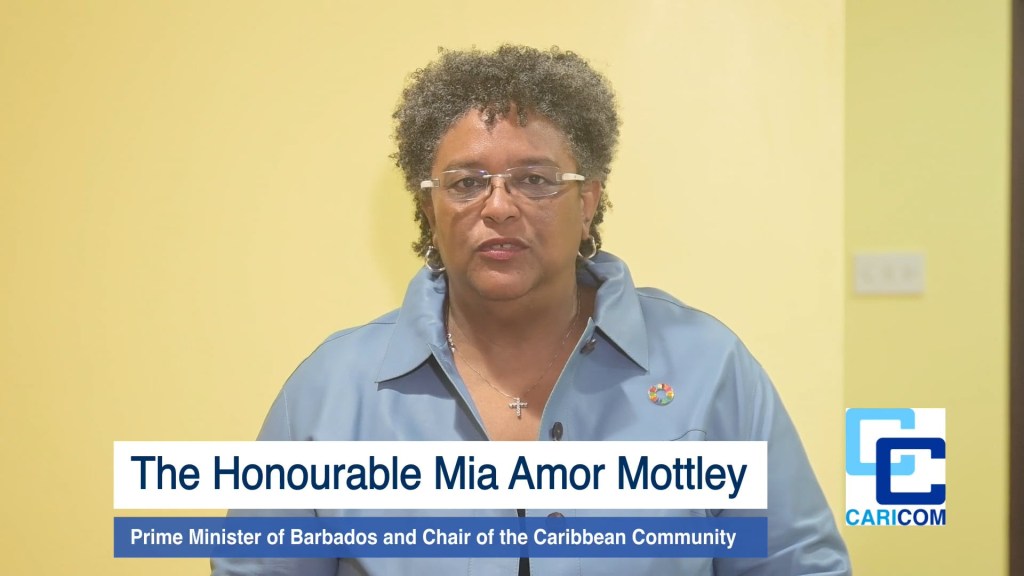
The transcript of the Statement from the Honourable Mia Amor Mottley, Chair of the Caribbean Community (CARICOM) on the impact of the global crises on the Caribbean.
I speak to all our Caribbean brothers and sisters today, not as the Prime Minister of Barbados, but in my capacity as Chair of the Caribbean Community.
Our world is in crisis. I will not sugarcoat it. These are among the most challenging of times for our region since the majority of our members gained their independence. Indeed, it is the most difficult period our world has faced since the end of World War II, 80 years ago. Our planet faces a climate catastrophe that worsens every year. We have a cost-of-living crisis that has been bedevilling us since the disruption of supply chains, when the COVID-19 Pandemic triggered the shutdown of the majority of countries.
Misinformation, disinformation and manipulation are relevant. The mental health crisis is causing hopelessness among many of our young people, and regrettably, crime and fear are on the rise. We’re fighting wars in the Holy Land, in Europe and in Africa. Countries are distrustful of countries and neighbours are distrustful of neighbours. The international order, the international system, my friends, is in great danger of collapse, and now we are on the precipice of a global trade war.
Our Caribbean economies are largely reliant on imports. Just go to the supermarket or visit the mall or the hardware shop or the electronic store, and you will see that most of the things there are not produced in this Region. Many of those commodities are either purchased directly from the United States of America or passed through the United States of America on their way to the Caribbean region. That, my friends, is a legacy of our colonial dependence. Together with colleague Heads of State and Heads of Government, we have been working to diversify ourselves away from this dependence.
We’ve already started to reap some successes, especially in the field of agriculture, for example, but we still have a long way to go. As we do this work, we have to be mindful that those recent announcements that have been made in the last few days will impact us very directly as a Region and as a Caribbean people.
We are working and will continue to work to become more self-sufficient, but I want every Caribbean man and every Caribbean woman to hear me. This trade war and the possibility of a US $1 million to $1.5 million levy on all Chinese made ships entering US harbours will mean higher prices for all of us at the corner shop, higher prices at the supermarket, higher prices at the electronic store, higher prices for us at the shop, higher prices for us at the restaurant, higher prices for us at the current dealership and beyond.
A lot of Caribbean people will think that these things that you are seeing on television news or reading about are far away and “They don’t impact on me.” A lot of people think “I’m just a farmer”, “I’m just a schoolteacher”, or “I’m just a mechanic.” They say, “I live in Saint Lucy in Barbados”, or “I live in Portmore in Jamaica”, or Kingstown in St Vincent, or Arima in Trinidad or Basseterre in St Kitts & Nevis, or San Ignacio in Belize.
“These problems are far away from me, and they don’t impact me.” That is what you will hear them say. But the reality, my friends, is that if you buy food, if you buy electronics, if you buy clothes, it will impact you. It will impact each of us.
My brothers and sisters, our Caribbean economies are not very large. So, we are, and have always been, at the whims of global prices. If Europe and China and the U.S. and Canada and Mexico are all putting tariffs on each other, that is going to disrupt supply chains, that is going to raise the cost of producing everything, from the food you eat, to the clothes on your back, to the phone in your pocket, to the car you drive down the road, to the spare parts that you need for critical infrastructure. That means higher prices for all of us to pay, and sadly, yes, this will impact all of us, regardless of what any of our Caribbean governments will do.
We could lower our tariffs to zero in CARICOM, and it will not make a lick of difference, because our economies are small and vulnerable. This crisis, my friends, will impact not only goods, but it may also have a large spillover effect on tourism. We suggest that the region takes steps to sustain the tourism industry as likely worsening conditions and many of our source markets will have negative impacts on people’s ability to travel. We call on our regional private sector and the tourism sector to come together and to work with governments to collaborate for an immediate tourism strategy to ensure that we maintain market share numbers as a region.
My friends, I pray that I’m wrong, and I’m praying that cooler heads prevail across the world, and leaders come together in a new sense of cooperation, to look after the poor and the vulnerable people of this world, and to leave space for the middle classes to chart their lives, to allow businesses to be able to get on with what they do and to trade.
But truly, I do not have confidence that this will happen.
So, what must we do?
First, we must re-engage urgently, directly, and at the highest possible level with our friends in the United States of America. There is an obvious truth which has to be confronted by both sides. That truth is that these small and microstates of the Caribbean do not, in any way or in any sector, enjoy a greater degree of financial benefit in the balance of trade than does the United States. In fact, it is because of our small size, our great vulnerability, our limited manufacturing capacity, our inability to distort trade in any way, that successive United States administrations, included, and most recently, the Reagan administration in the early 1980s went to great lengths to assist us in promoting our abilities to sell in the United States under the Caribbean Basin Initiative. We will see how these tariffs will impact on that. That spirit of cooperation largely enabled security, social stability and economic growth on America’s third border in the Caribbean, or as we have agreed as recently in our meeting with Secretary of State Rubio, what is now our collective neighbourhood.
Secondly, we must not fight among each other for political gain. Because my dear brothers and sisters, as the old adage goes “United, we stand and divided, we fall.”
Thirdly, we must redouble our efforts to invest in Caribbean agricultural production and light manufacturing. The 25 by 2025 initiative, ably led by President Ali, seems too modest a target now, given all that we are confronting. We must grow our own and produce our own as much as possible. We can all make the decision to buy healthy foods at the market instead of processed foods at the supermarket.
Fourthly, we must build our ties with Africa, Central and Latin America, and renew those ties with some of our older partners around the world, in the United Kingdom and Europe, and in Canada. We must not rely solely on one or two markets. We need to be able to sell our Caribbean goods to a wider, more stable global market.
My brothers and sisters, in every global political and economic crisis, there is always an opportunity. If we come together, put any divisions aside, support our small businesses and small producers, we will come out of this stronger.
To our hoteliers, our supermarkets and our people, my message is the same. Buy local and buy regional. I repeat, buy local and buy regional. The products are better, fresher and more competitive in many instances. If we work together and strengthen our own, we can ride through this crisis. We may have to confront issues of logistics and movement of goods, but we can do that too.
To the United States, I say this simply. We are not your enemy. We are your friends. So many people in the Caribbean region have brothers and sisters, aunties, uncles, grandmothers, grandfathers, sons and daughters, God children living up in Miami or Queens or Brooklyn or New Jersey, Connecticut, Virginia, wherever. We welcome your people to our shores and give them the holidays, and for many of them, the experiences of a lifetime.
I say simply to President Trump; our economies are not doing your economy any harm in any way. They are too small to have any negative or distorted impact on your country. So, I ask you to consider your decades-long friendship between your country and ours. And look to the Caribbean, recognizing that the family ties, yes, are strong. Let us talk, I hope, and let us work together to keep prices down for all of our people.
My brothers and sisters, there’s trouble in our Caribbean waters, but the responsibility each and every day for much of what we do and what much of what we grow must be ours, if we take care of each other, if we support each other, if we uplift each other, and if we tap into the strength and innovation of our common Caribbean spirit, we will see this through.
Our forefathers faced tribulations far worse than we will ever do and yes, they came through it.
My friends, my brothers and sisters, we can make it.




 Caribbean Trade Law and Development
You must be logged in to post a comment.