Welcome to our Caribbean Trade & Development News Digest for the week March 1 – 7, 2026!
📌THIS WEEK’S HIGHLIGHTS
Below are this week’s headlines!
US Treasury Secretary Scott Bessent has stated that the 15% global tariff under section 122 of the Trade Act, 1974, will be implemented some time in the coming days.
A coalition of 24 U.S. states filed a lawsuit arguing the tariff exceeds presidential authority and infringes on Congress’s control over trade policy.
A U.S. trade court ordered the government to start refunding more than $130 billion in tariffs previously ruled unlawful. Thousands of companies have filed for refunds.
🌴CARIBBEAN AND HEMISPHERIC TRADE STORIES
Minister: Becoming part of Mercosur would benefit T&T
Daily Express: Trinidad and Tobago’s potential membership in the South American trade bloc Mercosur (short for Spanish Mercado Común del Sur, or Southern Common Market) could bring significant benefits, according to Foreign and Caricom Affairs Minister Sean Sobers. Read more
Trump threatens Cuba again, says island nation may face ‘friendly takeover’
Al Jazeera: United States President Donald Trump has signalled that his administration is still pursuing a government overthrow in Cuba even as the US-Israeli war on Iran enters its second week. Read more
Can Belize Grow Its Cacao Industry Into a Major Export Sector?
Greater Belize Media: The government of Belize has launched the National Cacao Committee, a new body tasked with driving growth in the country’s cacao industry. Read more
Belize Records Modest Growth in Niche Agricultural Exports to Asia Business, Companies & Organizations
LoveFM: Belize is gaining encouraging signals on two economic fronts tonight, modest but steady growth in niche agricultural exports to Asia and renewed international attention as a competitive retirement destination in the Caribbean. Read more
Afreximbank raises CARICOM financing cap to $5 billion to accelerate regional transformation
Afreximbank: Pan African Multilateral Bank, African Export-Import Bank (Afreximbank), has announced a major expansion of its engagement with the Caribbean Community (CARICOM), increasing its regional financing limit from US$3 billion over the next four years. Read more
Worrell: Barbados can’t get cheaper oil deals in CARICOM as regional trade still in US dollars
Barbados Today: Former Central Bank Governor Dr Delisle Worrell has warned that Barbados should abandon any expectation of getting cheaper oil deals from its Caribbean partners, since oil and fuel trade within CARICOM is priced and paid for in US dollars — just like imports from the United States or India. Read more
Bessent says global 15% tariff starts this week, predicts Trump duties will return to old levels later this year
CNBC: President Donald Trump’s recently announced 15% global tariff will likely be implemented sometime this week, rising from its current rate of 10%, Treasury Secretary Scott Bessent said Wednesday. Read more
US trade court orders tariff refunds in setback for Trump administration
BBC: A federal judge has cleared the way for thousands of businesses to receive refunds for tariffs that the US Supreme Court struck down last month. Read more
Small business owners doubt they’ll see refunds after supreme court invalidates Trump’s tariffs
Guardian: Ruling could free $175bn, but legal hurdles and higher costs have left businesses questioning if claims are even worth it. Read more
Judge rules companies are entitled to refunds for Trump tariffs overturned by the Supreme Court
NBC: In a defeat for the Trump administration, the U.S. Court of International Trade said all “importers of record” were “entitled to benefit” from the ruling against the sweeping tariffs. Read more
Mexican companies eager to keep USMCA treaty, report shows
Reuters: Mexican businesses are eager to maintain a trilateral trade agreement with the United States and Canada that is up for review this year, according to a report summarizing Mexico’s public consultation, released on Monday. Read more
📢 STRAIGHT FROM THE WTO!
Coordinators of Plastics Dialogue ready ministerial statement and other outcomes for MC14
The coordinators of the Dialogue on Plastics Pollution and Environmentally Sustainable Plastics Trade (DPP) on 6 March finalized the ministerial statement for the 14th Ministerial Conference (MC14), scheduled to take place on 26-29 March in Cameroon. The statement was first introduced by the co coordinators in November 2025 and has been continuously updated to reflect members’ perspectives following intensive consultations. Read more
Chair of agriculture talks circulates revised draft text, as MC14 outline emerges
The Chair of the negotiations on agriculture, Ambassador Ali Sarfraz Hussain (Pakistan), has circulated a revised draft text ahead of the WTO’s 14th Ministerial Conference (MC14) in Yaoundé, Cameroon, from 26 to 29 March. Most WTO members welcomed the draft as a basis for consensus at a meeting of the negotiating body on 6 March, although a couple of members said they do not find it acceptable in its current form. Read more
DG Okonjo-Iweala urges members to explore new ways to revitalize WTO at South-South event
Speaking at the 8th South-South Dialogue on Least-Developed Countries (LDCs) and Development on 6 March in Geneva, Director-General Ngozi Okonjo-Iweala highlighted the importance of members’ work to reform the WTO in the run-up to the 14th Ministerial Conference (MC14) to be held on 26-29 March. She acknowledged the progress they have made in addressing LDCs’ trade priorities and encouraged LDCs to continue pursuing their trade interests. Read more
Ahead of Women’s Day, WEIDE Fund announces US$ 1.76-million grants to women-led businesses
To mark the upcoming International Women’s Day on 8 March, the Women Exporters in the Digital Economy (WEIDE) Fund on 6 March announced its plans to disburse US$ 1.76 million in grants in the first quarter of 2026 to benefit 219 women-led enterprises in the Dominican Republic, Mongolia and Nigeria. The first disbursement sets in motion the innovative design of the WEIDE Fund, which introduces a new model of grant financing supported by technical assistance and exposure to a multistakeholder ecosystem for enterprises. Read more
EU contributes EUR 75,000 to support LDC participation at MC14
The European Union has contributed EUR 75,000 (approximately CHF 69,500) to support the participation of government officials from least developed countries (LDCs) at the WTO’s 14th Ministerial Conference (MC14), to be held from 26 to 29 March 2026 in Yaoundé, Cameroon. The contribution aims to ensure broad and inclusive participation in the WTO’s highest decision making body. Read more
WTO members conclude month-long reform discussions in Geneva
WTO members on 5 March completed a series of meetings dedicated to advancing work on WTO reform. Over the past month, members have exchanged views on a draft ministerial statement and a work plan intended to frame the scope of reform efforts following the 14th Ministerial Conference (MC14) on 26-29 March. They also finalized preparations for the ministerial level political discussion on reform to be held at MC14 in Yaoundé, Cameroon. The reform facilitator, Ambassador Petter Ølberg of Norway, described the exchanges as substantive, thoughtful and conducted throughout in a positive spirit. Read more
EU contributes EUR 1 million to strengthen trade capacity in developing economies, LDCs
The European Union is contributing EUR 1 million (approximately CHF 928,000) to support developing economies including least developed countries (LDCs) in strengthening their participation in the multilateral trading system for 2026–2027. Read more
Government Procurement Committee discusses GPA implementation, progress in accessions
At a meeting of the Committee on Government Procurement on 4 March, parties to the Government Procurement Agreement (GPA) discussed issues concerning GPA implementation and progress in accession negotiations. Parties also elected a new Committee chair, Mr William Westerveld Jensen of Norway. Read more
Heads of WTO, EIB sign landmark agreement to boost trade and investment
The WTO Secretariat and the European Investment Bank (EIB) Group signed a Memorandum of Understanding (MoU) on 4 March to enhance sustainable trade and investment worldwide. The agreement marks the beginning of a partnership that will leverage the EIB’s financial resources and investment facilitation tools developed under the Investment Facilitation for Development Agreement concluded by a large number of WTO members to improve the regulatory environment, unlock investment and expand opportunities for developing countries. Read more
WTO members consider new e-commerce proposal and previous submissions ahead of MC14
At a meeting on the Work Programme on E-Commerce on 3 March, WTO members considered a proposal to establish a Committee on Digital Trade as part of a draft decision on e-commerce for the 14th Ministerial Conference (MC14), which will take place from 26 to 29 March in Yaoundé, Cameroon. Members also continued discussions on the reinvigoration of the Work Programme and on the moratorium on the imposition of customs duties on electronic transmissions on the basis of two other proposals. Read more
WTO members review five regional trade agreements, discuss transparency issues
At a meeting of the Committee on Regional Trade Agreements (CRTA) on 3 March, WTO members reviewed five regional trade agreements (RTAs) involving Comoros, the European Union, Mozambique, Indonesia, China, Serbia, Kazakhstan, Azerbaijan, Türkiye and the Faroe Islands. They also reviewed other topics relevant to the Committee’s work under the Transparency Mechanism for RTAs. Read more
🌎 GLOBAL TRADE STORIES
Voice of Nigeria: Nigeria has intensified efforts to consolidate its leadership under the African Continental Free Trade Area (AfCFTA) while strategically positioning itself ahead of the 14th World Trade Organization Ministerial Conference. Read more
EU keeps U.S. trade deal frozen over tariff uncertainty
Financial Post: Top EU lawmakers on the parliament’s trade committee made the choice on Wednesday, saying they wanted more information from Washington about how it will preserve a 15 per cent ceiling on most EU products — a level both sides agreed to in last summer’s trade pact. Parliament initially halted ratification several days after the ruling. Read more
Business mobilisation grows to 189 chambers and associations backing WTO reform and Moratorium renewal
ICC: A growing number of chambers of commerce and business associations from around the world are urging governments to deliver concrete outcomes at the 14th Ministerial Conference of the WTO, as concerns mount over fragmentation in the global trading system. Read more
China exports surge despite Trump tariffs
BBC: Official figures show exports jumped by more than 20% in January and February, which is almost three times the rate predicted by economists. It puts the country on track to top the record-breaking annual trade surplus it saw in 2025. Read more
Indonesia to file suspension of concessions against EU on palm oil dispute in WTO
Reuters: Indonesia’s trade ministry said on Saturday that the government will file a suspension-of-concessions request against the European Union at the World Trade Organization’s (WTO’s) dispute settlement body, citing the block’s failure to meet a WTO ruling in a palm oil case. Read more
Thank you for reading the Caribbean Trade & Development News Digest, a product of the Caribbean Trade and Development blog. If you found this edition useful, subscribe to our Blog to ensure you never miss a weekly update.
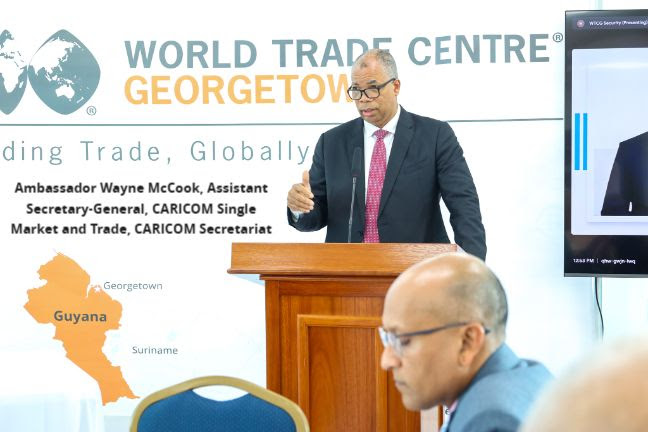
CARICOM Secretariat | Turkeyen, Greater Georgetown, Guyana | Thursday, 29 January 2026: A senior Caribbean Community (CARICOM) official has positioned deeper regional integration as a strategic response to an increasingly fragmented and uncertain global trade environment, as global rules-based systems weaken and economic nationalism intensifies.
Ambassador Wayne McCook, Assistant Secretary-General, CARICOM Single Market and Trade, was a panelist discussing Prospects for International Trade in 2026 in the Context of the Changing Global Geopolitical and Economic Landscape – Impact on Trade and the Challenges and Opportunities for the Caribbean and Latin America. The discussion was held on Wednesday, 28 January, at the World Trade Centre in Georgetown, Guyana.
Contextualising the Region’s position, Amb. McCook said: “For our Region, the scars of the immediate past are visible. The devastating passage of Hurricane Melissa encapsulated the dual challenge we face: the existential threat of climate change and the inherent economic vulnerabilities of our CARICOM Member States. Simultaneously, we have navigated dramatic shifts in global trade, driven largely by an intensified “America First” trade policy that has significantly impacted our exports, value chains and supply chains through a suite of unprecedented tariff measures.”
Against the background of what he described as “a truly tumultuous 2025” for international and regional trade, Amb. McCook highlighted CARICOM’s “oneness” and its resilience to navigate the “choppy waters” of the 21st century.
Amb. McCook warned that the erosion of multilateral trade norms is no longer theoretical, but already affecting investment, supply chains, and growth prospects worldwide.
According to UN Trade and Development (UNCTAD), global foreign direct investment fell by 11 per cent in 2024, marking a second consecutive year of decline, with further weakness expected in 2026. Global trade growth has slowed dramatically, falling below one per cent in 2025, even as uncertainty and geopolitical rivalry reshape supply chains.
Despite these headwinds, CARICOM’s trade performance has shown resilience. Between 2023 and 2024, CARICOM exports grew by 32 per cent to US$34.7B, with exports to the United States increasing by 86 per cent. However, recent data reveals uneven impacts across Member States.
The Assistant Secretary-General pointed to the recent steps toward full free movement of people by Barbados, Belize, Dominica, and St. Vincent and the Grenadines as tangible progress toward a more integrated Community.
“Fundamentally, CARICOM integration should be seen as a strategic response to a shifting global order,” he emphasised.
Addressing prospects for international trade in 2026, he advanced a multi-pronged strategy focused on strengthening intra-regional trade, strengthening existing relationships while diversifying global partnerships beyond traditional allies, and deepening economic integration. Central to this approach is the CARICOM Industrial Policy and Strategy (CIPS), and the 25×25+5 food security agenda aimed at reducing food import dependence and boosting regional production. Read his presentation here: https://caricom.org/deeper-caricom-integration-key-to-navigating-fractured-global-trade-order-amb-wayne-mccook/
Days after two Trinidadian nationals were believed to have been among the victims in one of the latest extrajudicial killings by US military forces in the Caribbean Sea off the coast of Venezuela, the Caribbean Community (CARICOM) has released a carefully worded statement condemning the build-up of military assets in the Caribbean Sea.
While not specifically mentioning the killings, the statement reiterated, inter alia, support for the “safety and livelihoods of the people of the region”. It should also be noted that the statement was released on behalf of all CARICOM Heads of Government, except Trinidad & Tobago which has “reserved its position”.
The full statement taken from the CARICOM website can be viewed here:
“Heads of Government of the Caribbean Community (CARICOM) met and discussed various issues on the regional agenda including the increased security build up in the Caribbean and the potential impacts on Member States. Save in respect of Trinidad and Tobago who reserved its position, Heads agreed on the following:
They reaffirmed the principle of maintaining the Caribbean Region as a Zone of Peace and the importance of dialogue and engagement towards the peaceful resolution of disputes and conflict. CARICOM remains willing to assist towards that objective.
CARICOM Heads of Government reiterated their continued commitment to fighting narcotrafficking and the illegal trade in small arms and light weapons which adversely affect the Region. They underscored that efforts to overcome these challenges should be through ongoing international cooperation and within international law.
They reaffirmed unequivocal support for the sovereignty and territorial integrity of countries in the Region and the safety and livelihoods of the people of the Region.”
Rahym R. Augustin-Joseph (Mr.) – Guest contributor
Rahym R. Augustin-Joseph
CARICOM countries must always be lauded for their international advocacy at the United Nations General Assembly (UNGA) among other global forums, as the “conscience of the world” as aptly put by Prime Minister Mia Amor Mottley of Barbados, on Geopolitical Issues, Climate Change, Reformation of the International Economic and Political Architecture, AI regulation, Threats to Democracy, Reversal of Modern forms of Imperialism and Neo-colonialism, et cetera.
But they must also be bemoaned for their cognitive dissonance and inertia. Most CARICOM Countries in the recent week, when discussing the recent actions by the United States of America in the destruction of the Venezuelan “drug cartel” vessels in the Caribbean Sea, contrary to International Law and in flagrant disregard for the sovereignty of the Caribbean Region, and consequent permanent stationing in the Caribbean Sea to respond to crime and violence, skilfully omitted the explicit acceptance and endorsement of the above mentioned by our own sister island, Trinidad and Tobago.
It is as if the United States of America on their own, without explicit endorsement determined this security position.
Most countries who discussed the issue only sought to dedicate two lines in their speech to the issue and sought to lay the blame solely at the feet of the United States of America.
It is as if the Caribbean Leaders have forgotten that Imperialism always has benevolent friends, aiders and supporters, who mask their support for imperialism in domestic interests and particularly national security, at the expense of others who are a stone’s throw away. Moreover, they utilise the victimised electorate (whom they have not consulted) and are affected by crime and violence as their justification, for ‘action’ contrary to the rule of law, international diplomacy, peace and established democratic principles.
Obviously, it is impolite, and certainly not diplomatic courtesy for the CARICOM member States to drop our dirty laundry in public, appear fragmented, and bemoan actions of others within the CARICOM grouping at a public forum. This is certainly not the central thesis of this Article.
It is certainly prudent for us to settle our internal diplomatic and political differences (and defend the guardrails of regional integration internally).
But, in the absence of any notable action on the latter, as evidenced through the radio silence of the hierarchy of the Secretariat, Chairman of CARICOM- Hon. Andrew Holness of Jamaica, Institutions of CARICOM et cetera, it raises cause for some concern as to whether the former or the latter is being undertaken.
Should the states have also addressed the issue in a fulsome manner at the UNGA, or should they also be addressing it internally?
However, I am more concerned, with the lack of dialogue, conversation and action internally within the Community to address actions by Trinidad and Tobago that are not in concordance with the objectives, principles, spirit, and positions of the regional grouping as a whole. I interrogate the extent to which CARICOM as an institution can rein in a member who possibly violates the Community principles. And if they are unable to, due to the constrains of functional cooperation, which permits sovereignty of foreign policy, what tools can the regional grouping equip itself with in order to respond to these instances?
Dismissing Some Myths
Now, this is not to suggest nor propose that there is any requirement on any state in CARICOM to sing at the same tone, pace, and volume on every international issue, as the RTC provides not for a ‘unified singular foreign policy’, but ‘coordination on foreign policy’ as noted in Article 6 (h) of the RTC.
So, the Prime Minister is accurate when she suggested that it is her ‘sovereign’ right of her country to articulate their foreign policy position. But, where I disagree is that the unilateral position of Trinidad and Tobago, is certainly at odds with the core pillars of the regional integration movement i.e., foreign policy coordination, as this policy does not contemplate nor advance any type of common ground, deliberative or consultative approach within the region on the resolution to the issue through the utilisation of the American military to supposedly reduce the infiltration of overseas drug cartels which affect Trinidad and Tobago and the wider Caribbean.
Moreover, it is certainly at odds with the long held customary principle within the Region that the Caribbean Sea must always be a zone of peace.
Even as a practical matter, Trinidad actually manages and earns money from the airspace for the Southern Caribbean and is the repository of all flight information for every craft flying in and through the space. As such, their obligations are both essential to our safety and evidence-based posture as a zone of peace.
But the reclaiming of this “lost ideal of a zone of peace” as evidenced by massive murder rates, interregional gang networks and organised crime, as noted by Hon. Kamla Persaud Bissessar from Trinidad and Tobago in her recent UNGA Address, is certainly not going to be achieved through the stationing and utilisation of American Military.
It may see short term results, as evidenced in the ‘neutralisation of supposed threats’ of Venezuela, but the ends may not be successful overtime as this measure is unsustainable, an avenue for retaliatory measures by other countries which can affect the lives and livelihoods of the Caribbean peoples, and a victim of the fleeting geopolitics of the four-year term of the US Presidency. It is also not directly responsive to the research which suggest that a huge percentage of illicit trafficking of firearms and drugs which cause crime and violence originate in the USA, by virtue of their liberal Constitutional gun laws. It is akin to a thief assisting you to look for the stolen goods elsewhere, knowing that they possess it.
But, additionally, it does not deal adequately with the guns and drugs already present within the country, which can be utilised for continuous crime and violence. Nor does it engage in the development and utilisation of technology to track and destroy transnational criminal networks, that do not utilise the ‘sea’ or originate from Venezuela as their route of access to the Caribbean.
But it also does not respond to the local economic and social disenfranchisement among people which fuel crime and violence. Certainly, the USA and Trinidad and Tobago cannot execute ‘all criminals’, in order to respond to crime. As such, other measures must be contemplated and utilised. Those that are in conjunction with the rule of law, international law and other rules-based systems.
It means that overtime the crisis will not dissipate.
Moreover, the literalistic text- which is the cushion upon which these decisions sit does not confines foreign policy in the hands of the individual governors but should always be analysed and assessed in the context of the unspoken conventions and practices from our own individual countries and the CARICOM. As such, the coordination of foreign policy within the Community, is always optimised when countries within CARICOM are singing from the same page of the hymnal, because as I noted in another Op-Ed, history has shown us that “greater results emanate from the Caribbean speaking as one voice within the global political ecosystem, by virtue of their bargaining power as a bloc which eclipses our size constraints. Thus, the utilisation of polar opposition positions within the Caribbean, encourages a colonial ‘divide and conquer’ strategy for developed countries which only elevates their position and agenda, at the expense of the interests of the Caribbean.”
Certainly, one must remember, even at the most basic example, when in December 2011, the government of Trinidad and Tobago was forced to change the venue of the CARICOM-Cuba summit from the Trinidad Hilton Conference Center to the National Academy for the Performing Arts (NAPA). The reason for the change of location offered was that even though the government of Trinidad and Tobago owns the Hilton Hotel plant, the U.S.-owned Hilton Company manages it. Delegates to the conference were all expected to stay at the Hilton Hotel; however, the presence of Cuban president Raul Castro posed a problem for the hotel. This is in contradistinction to other parts of the world where this was tried by the United States and the respective companies and governments protested the actions, on the basis that engaging in the decision of the USA would be enabling discrimination on the grounds of nationality.
Instead, if the interests of the Caribbean were at the forefront of the mindset of these partners or actors- there would be an engagement of CARICOM as a bloc, through a deliberative, consultative and transparent process in order to arrive at a regional agreement on mechanisms and methods to respond to overseas drug cartels infiltrating the Caribbean.
As such, one is only reminded of the many instances of Caribbean disunity propagated by the USA, such as the Ship Riders Agreement in the 1990’s, debates over permitting the US invasion of Grenada, inability to support one candidate in the Commonwealth SG Race of 2022, recognition of Jerusalem as the capital of Israel, Venezuela- USA Debacle under President Trump, among others. What is generally done, is the major powers co-opt CARICOM States to be against each other or pick them off one by one through inducements such as aid, financial and technical aid et cetera.”
One of the best examples of the abovementioned philosophy in practice is not only the statement of Kissinger, that “America has no friends or enemies, just interests”, but instead the remarks by Abrams- who held foreign policy positions during the Raegan and George Bush administrations, when commenting on the Ship Riders Agreement after the objections raised by Jamaica and Barbados noted that: But the anti-colonial mind-set, and the insistence on full independence, that marked the 1960s should be relegated to the past. Development in the world economy, and indeed, international criminal activity, have made full independence tantamount to full vulnerability for the smallest states. Far more valuable would be a relationship with the United States that helped guarantee prosperity, security, and liberty.”
But, even beyond that, she identified the underlying ethos of the United States foreign policy when she noted later on that, “ostensibly the Shipriders Agreement is an integral part of the strategy for restructuring American hegemony within global capitalism, national states and sovereignty.”
But, even beyond the legal and historical examples, there is an unspoken convention in the Caribbean that we will always advance the causes that are based on a core set of pillars that have been denied from our peoples for a long time through enslavement i.e., human rights, democracy, the rule of law, people-centred development, and an advancement of resolving the inherent vulnerabilities of small states in the world.
Dr. the Hon. Kenny D. Anthony, as a former leader within CARICOM words must he remembered when he said that “we [must] see our democracy as the main defence against recolonisation. Without it, we would have no choice but to bow to the dictates of global economic forces, which are neither accountable to our populations nor constrained by popular intervention and choice.”
But this unspoken conventions, which CARICOM must protect, even if it means bemoaning or intervening when one of their members acts at odds with it, is buttressed by the fact that all the “CARICOM countries have committed their countries to the Charter of Civil Society, which is a firm statement of the determination to uphold human rights and the pursuit of good governance. As part of this process, there is also an agreement to establish National Monitoring Committees to ensure compliance to the principles of the Charter.”
As such, the actions of Trinidad and Tobago may be contrary to the non-binding Charter of Civil Society i.e., the permitting and encouraging the destruction of vessels and summary executions of peoples in the Caribbean Sea on the suspicion of drugs and crime without criminal due process and respect for human rights.
This is particularly relevant in circumstances where Prime Minister of Trinidad and Tobago, as Lead for Security in the Quasi Cabinet of CARICOM, has noted in effect at her UNGA Address that, forceful and aggressive action must be taken in order to respond to the evil drug cartels, and because they believe affected nations will always unreservedly resort to morals and ethics and human rights considerations which they blatantly flout and disregard. We will thus fight fire with fire “within the law” because they do not adhere to these values.
This is not only problematic and dangerous language because it defies the domestic, regional and international conventions and laws that Trinidad and Tobago have signed unto.
But the tacking on, almost grudgingly and forgetfully “within the law”, at the end of the statement of fire, is certainly not occurring presently because of the breaches of various conventions and treaties. As a matter of fact, it would be interesting to ascertain what “the law” provides in these instances, and whether there are any legal safeguards for the military intrusion, which are being followed?
But it is dangerous and problematic because it positions war and military interventions as the solution to crime and violence, ignoring the potential innocent death toll and destruction of war as evidenced in history, the length of war without results, and the inability of Trinidad and Tobago to make a definitive statement on the Caribbean Sea and by extension the Caribbean region, without consultation with other CARICOM members. Trinidad and Tobago cannot willingly invite war to the Caribbean, with significant implications for other countries based on geography and a possible spin-off for immigration et cetera, without the buy-in from these respective countries.
But it is also dangerous and problematic because it positions fundamental human rights and international law as being conditional on the actions of criminals, such that if they do not respect human rights, we must not in our response.
But, implicit in this argument is a question of the extent to which this thought, if adopted by every political official, and every citizen, who is also armoured with the power of a military, believed and actualises this, whether you would have any peace, people or prosperity in the respective countries. It is akin to the commencement of a dictatorship where the centre will ultimately determine who and what is worthy of life and death.
This is a slippery slope. The words of Martin Niemoller is thus instructive when he reminded us that “First they came for the socialists, and I did not speak out—because I was not a socialist. Then they came for the trade unionists, and I did not speak out—because I was not a trade unionist. Then they came for the Jews, and I did not speak out—because I was not a Jew. Then they came for me—and there was no one left to speak for me.”
Applied in our context, it would possibly mean, that they came for ‘criminals’, ‘immigrants’ and then, the list goes on.
Permitting the application of human rights, which everyone should be entitled to, by virtue of their humanity to be subject to the whims and fancies of political officials is dangerous as it does not create clear, accessible, verifiable, and equal treatment of individuals. But, implicit in the statement is also a suggestion that by utilising the law to dismantle gangs in its current form will only render countries “in name, but without substance.” It is as if, there are not formulae which shows us that both the rule of law and suppression of gang violence cannot coexist.
It is as if there is an absence of laws and processes which can be utilised to suppress and destroy gangs in the Caribbean and the wider world, without resorting to an eye for an eye mechanisms. As a matter of fact, it only signals that we are no different from them and have lost any ingenuity required for responding.
But, even beyond the bemoaning and identification of the problematic areas of the foreign policy position of the Government, there must be an interrogation and assessment of some of the tools within the arsenal of CARICOM which should be equipped to respond to these stances by a member state.
For example, implicit in the role of the Chairman of CARICOM is the underlying obligation to provide definitive statements and a position of the Heads of the Community on major issues facing the Caribbean Region. Obviously, this position and particular response by the Heads of Government and wider Caribbean, must be provided after a deliberative, engaging and consultative process, among themselves even outside the limitations of the scheduled meetings of Heads of Government. Certainly, any division among the Heads of Government, marked by differing voices or deafening silence undercuts the foreign policy coordination objective of CARICOM. It also permits a repeat of history where developed countries continue to employ a divide and conquer strategy, pitting the heads against each other at the expense of the Caribbean people’s safety and maintenance of our democratic traditions.
With the ubiquitous nature of technology, the Heads of Government and specifically the Chairman, cannot thus argue that the lack of a statement is because of the inability to have a forum to receive a common position on the abovementioned.
Certainly, the late Ramphal is instructive when he noted that “we have become casual, neglectful, indifferent and undisciplined in sustaining and advancing Caribbean integration: that we have failed to ensure that the West Indies is West Indian and are falling into a state of disunity which by now we should have made unnatural. The process will occasion a slow and gradual descent from which a passing wind may offer occasional respite; but, ineluctably, it will produce an ending.”
However, to date, and particularly prior to the UNGA, and even within the UNGA, the Chairman of CARICOM, Hon. Holness has tiptoed and circumvoluted around the particular issue, while still notably ringfencing the action by the USA when he noted that “Jamaica welcomes cooperation with all partners in this fight, including the interdiction of drug trafficking vessels, provided that such operations are carried out with full respect for international law, human rights, and with the coordination and collaboration of the countries of the region. The Caribbean has created regional security mechanisms, but these efforts alone cannot match the scale of the threat. What we need is a unified front with the same urgency, resources, and coordination the world has applied to terrorism. Only then can we turn the Caribbean and indeed the wider region into a true zone of peace.”
As such, since the Prime Minister was assertive enough to identify that he will only support actions that respect international law, human rights and collaboration. I take this to mean that he could not thus support these interventions by the United States and aided by Trinidad and Tobago.
But, he does not say that!
But one can glean that since these actions are in flagrant disregard for international human rights law and other international treaties that both these states and others in the Caribbean have signed, that they would be condemned by the Chairman and other Heads of Government.
Certainly, it is clearly evident that these strikes are at odds with (i) due process of law that the ‘drug dealers’ require wherein they must be charged, arrested and be prosecuted in accordance with the relevant criminal laws as opposed to being executed summarily in the seas, (ii) the rule of law which also suggest that everyone must have a fair trial, and that states must comply with their international obligations, which do not provide for summary execution of suspected drug dealers, such as the UN Convention on Narcotic Drugs, which suggest that under Article 35 that individuals who are believed to be engaging in illicit trafficking of drugs, shall be liable to adequate punishment particularly by imprisonment and other penalties of deprivation of liberty, provision of reporting mechanisms and procedures to ensure that the interdiction of the parties are being done in accordance with international best practices and standards, or that the principle of no one being above the law such that these states cannot be the judge, jury and executioner without due process, et cetera.
Further, for example the United Nations Convention against Illicit Traffic in Narcotic Drugs and Psychotropic Substances, also notes under Article 17, that respective parties must board, search, and take appropriate action if illicit drugs are found on the vessel. It certainly does not contain any provisions which permit the execution of drone strikes on the vessel. Implicit in this convention also is the satisfaction that there are illicit drugs on the vessel, which in accordance with international best practices must be safeguarded for the evidentiary basis for prosecution of the criminals. But this is not occurring as the drone strikes destroy any ‘evidence’ of drugs and fuels constructive cynicism and lack of trust for political officials among peoples who question whether there were any drugs to begin with. Or, whether these drone strikes are only for strategic geopolitical reasons or only done to justify the earlier position of having the US military stationed in the Caribbean Sea.
As I argued in the other piece on this subject, there must be the provision of appropriate safeguards i.e., reporting, ensuring adequate and accurate intelligence is received and communicated to the political officials and the wider Caribbean Community, proper accessible policies and procedures that provide us with some information on the authority to engage in such intervention and the four corners in which it is occurring, and other requisite communication with other geographically closer member states to prevent unforeseen harm and damage. In effect, these safeguards are to ensure that the objective of the mission is met and is also in accordance with International Law, the rules-based order and best practices.
But certainly, there must be the utilisation of the corridors of power to articulate that view or the public platforms in the Commonwealth Caribbean, in a clearer way to permit the citizenry to be aware of the clear position of the Chairman of CARICOM and by extension the CARICOM itself. Moreover, beyond the speeches at the United Nations, the Chair of CARICOM must provide some definitive position and work towards providing and resolving some of the issues that arise from this intervention as I have identified above.
But, what of the purpose of the Bureau established by CARICOM, which is made up of the former, current and future Chairman of CARICOM, as per Article 12 of the RTC.
Albeit its role is textually limited to focusing on the assistance in the implementation of the decisions of CARICOM, in order to cure the malaise of the implementation deficiency disorder, there is an argument to be made that, their role in “providing guidance to the Secretariat on policy issues, or initiating proposals for development and approval by the Ministerial Councils” can be interpreted as an opportunity to ensure interrogating, analysing, and development of solutions to the question of whether the USA should be utilising our seas to intercept alleged Venezuelan drug dealers, without any due process of law and protection of the law.
As a matter of fact, notwithstanding the RTC does not explicitly specify a role for the Bureau in resolution of disputes, the Bureau has provided leadership along with the Secretary General in the past, in for example, seeking cooperation between two member states, Guyana and Suriname, over the disputed Tigri Area.
As such, the bureau’s informal powers can be utilised again to assist in this resolution, and the agency must have the internal conviction and courage to hold members accountable internally for their actions.
But the problem is not only that of the Leadership but inclusive of the Ministerial Councils, such as the Council for Foreign and Community Relations (COFCOR), which is made up of Ministers responsible for Foreign Affairs of Member States, and is responsible for ensuring that there is a coordination and articulation of a clear position on the subject matter. As noted in Article 16, the Council is responsible for establishing “measures to co-ordinate the foreign policies of the Member States of the Community, including proposals for joint representation, and seek to ensure, as far as practicable, the adoption of Community positions on major hemispheric and international issues. Further, “to coordinate, in close consultation with the Member States, Community policy on international issues with the policies of States in the wider Caribbean Region in order to arrive at common positions in relation to Third States, groups of States and relevant inter-governmental organizations.”
As it currently stands the abovementioned has been otiose.
There is also a case to be made for the quietness of Ministerial Councils, such as the Council for National Security and Law Enforcement (CONSLE) which is responsible for “the coordination of the multi-dimensional nature of security and ensuring a safe and stable community.”
More particularly, Article 17(a), provides an impetus to promote the development and implementation of a common regional security strategy to complement the national security strategies in individual member states, and establish and promote measures to eliminate threats to national and regional security, which also include the mobilisation of resources to manage and defuse regional security crises, of which this is certainly included. These among other responsibilities are included in Article 17(a).
But, even as recent as this year where the CARICOM Heads of Government signed in Jamaica, the Montego Bay Declaration for Organised Transnational Crime and Gangs. Yet still, the resolution to the ‘infiltration of drugs from Venezuela to the Caribbean’ is not being enacted through the principles and practical steps that is provided in this Declaration.
It provided that one of the main aims would be to “renew our commitment to strengthening the Region’s response by implementing effective measures to monitor new trends in illicit firearms trafficking, enact robust legislation to include stringent penalties for firearm and gang-related offences, and to strengthen public awareness on the issues relating to the prevention and prosecution of all forms of organised criminal activities.”
But more importantly, it responded in text to one of the burning desires to maintain sovereignty while still responding to these ordeals, through the strengthening of the regional institutional security structures, to include CARICOM Implementation Agency and implementation of programmes such as the Caribbean Basin Security Initiative (CBSI), to effectively enhance collaboration and sharing of information, to disrupt criminal networks, as well as, leverage shared resources to enable law enforcement and support border security efforts.
However, the Chairman and by extension CARICOM, has only paid lip service to this Declaration and have not engaged in the above which can be assistive in responding to the ordeal. Instead, the regional institutional security structures have been ignored and sidelined in favour of military assistance by the United States, with many disastrous trade-offs that has not been debated, distilled, or get consensus, under the aegis of “ensuring that the friends in the Caribbean are safe.”
What should have been pursued is the strengthening of IMPACS, in order to assist in the identification and interception of the illicit trafficking of drugs, in accordance with International Law and other best practices.
And in circumstances where the abovementioned cannot be pursued, the partnering with the US agencies to ensure oversight and that the objectives of the mission are met and the appropriate safeguards are included in the intervention.
For example, is there a regionally produced satellite mapping of the placement and movement of the American Vessels? Are we certain that these vessels are actually ‘striking’ Venezuelan Vessels and peoples carrying illicit drugs and firearms? Have we agreed on some of the rules of engagement that is sensitive to immigrants, women and children, who may be coerced and trafficked along with the drugs? What is the intelligence utilised to determine whether these interceptions do not disastrously affect Caribbean fisherfolk, especially when Vice President of the United States, JD Vance felt the idea of collateral damage of peoples funny, when he noted “I wouldn’t go fishing right now in that area of the world.”
And how do we alleviate and address the fears of ordinary people on the seas and in communities across the region, who may fear that the Indians would not come to their rescue as suggested by the Minister but agonise over the destruction of their communities with retaliatory strikes by any of the respective parties? Certainly, it is not as tranquil as Prime Minister of Trinidad and Tobago suggested that it is only those who are criminal masterminds who should be afraid.
All of these could have been components of a collaborated effort between IMPACS and other agencies. Or even alternatively, a new deal could have encompassed equipping IMPACS with these competencies to address the abovementioned, in accordance with International Law.
However, this willing transferring of sovereignty to the USA, is certainly reflective of what Lamming describes as “the staggering nature of the region to resolve the contradiction of being at once independent and neocolonial, and the struggling of new definitions of itself to abandon the protection of being a frontier created by nature, a logistical basin serving some imperial necessity and struggling to move away from being a regional platform for alien enterprise to the status of being a region for itself, with the sovereign right to define its own reality and order its own priorities.”
The abovementioned concerns are those of ordinary peoples across the Caribbean, which must be addressed by their leadership across the Caribbean, even while they fear local gangs and crime and violence.
But the RTC under Chapter 9: Dispute Settlement, does however also provide some recourse for CARICOM Member States to rein in the actions of the Government of Trinidad and Tobago, which may contravene the objectives of the Community or prejudice the object and purpose of the Treaty, required by Article 187(a).
As such, should any CARICOM country feel compelled to act, they could utilise good offices, mediation, consultations, conciliation, arbitration and adjudication as their modes of dispute settlement as noted by Article 188 of the RTC, cognisant that should any of the methods prove unsuccessful, they can easily resort to another mode to arrive at a resolution.
Under good offices, the member states could easily engage the Secretary General of CARICOM or a third party, as required by Article 191. Should they consider mediation as the better mode, they can also agree on a mediator or request one from the Secretary General who will appoint one from the list within CARICOM as noted in Article 196.
Moreover, a member state can also request consultations, where they assert or allege that the actions taken by the other member state constitutes a breach of obligations arising from or under the provisions of the Treaty. After which, they must comply with all of the procedural requirements for consultations established in the Treaty.
Should the Member States assert that these mechanisms are insufficient, they can also resort to the more formal mechanisms of arbitration or conciliation, which establishes commissions and tribunals for adjudication, and provides for an empanelling a list of arbitrators or conciliators, and permits third party intervention, reports, evidence, expert advice et cetera. Recognising the significance of the issue, member states may be tempted to engage in this mode but must be cognisant of the ability of this mode to potentially fracture the inter-Caribbean dialogue and unity because of its ability to become acrimonious and combative. Notwithstanding the above, some member states have still demonstrated diplomatic maturity and Community comradery, even when they have brought each other before the CCJ to adjudicate on matters arising from the Treaty. This option pursuant to Article 211 of the RTC though is also always available to the member states on this matter, should they be able to conjure an argument of a violation of a treaty provision as opposed to the lofty ideals of ‘objectives’ and ‘principles.’ It not only provides that the CCJ has compulsory and exclusive jurisdiction regarding the interpretation of the Treaty, between member states who are parties to the agreement, but also provides the court with the ability to issue an Advisory Opinion, concerning the interpretation and application of the Treaty should a member state request it.
However, one should be more amenable to one of the earlier modes of dispute settlement at the commencement of this process as opposed to the latter.
CARICOM’s silence in the face of Trinidad and Tobago’s endorsement of U.S. military intervention in the Caribbean Sea exposes a deeper crisis of coherence, conviction, and courage within the regional movement. For decades, our leaders have spoken boldly on the global stage yet hesitated to confront contradictions at home invoking sovereignty when convenient and overlooking its erosion when politically expedient. This selective diplomacy undermines both the credibility and moral authority of the Caribbean voice in international affairs. If CARICOM is to remain the “conscience of the world,” it must also have the courage to be the conscience of itself: defending international law, sovereignty, and the Caribbean Sea as a genuine “zone of peace,” not a theatre for external militarisation disguised as partnership.
The instruments for accountability already exist from the Caribbean Court of Justice to the dispute-settlement provisions of the Revised Treaty of Chaguaramas but they remain dormant without political will. What the moment demands is not procedural caution but principled leadership: the willingness to speak truth to power, even within our own ranks. To remain silent is to invite the gradual erosion of the West Indian spirit that once defined our integration. If the region cannot summon unity in defence of peace, law, and dignity, it risks becoming not a community of nations but a collection of states, sovereign only in name and subdued by convenience.
Rahym Augustin-Joseph is the 2025 Commonwealth Caribbean Rhodes Scholar. He is a recent political science graduate from the UWI Cave Hill Campus and an aspiring attorney-at-law. He can be reached via rahymrjoseph9@ gmail.com and you can read more from him here.


 Caribbean Trade Law and Development
You must be logged in to post a comment.