Tag: CARICOM

  • CARICOM-Private Sector Engagement Requires Sustainable Development as its ‘Guide Star’

    CARICOM-Private Sector Engagement Requires Sustainable Development as its ‘Guide Star’

    Alicia Nicholls

    The novel coronavirus virus disease (COVID-19) pandemic has reiterated the need for Caribbean Community (CARICOM) Member States to not only diversify their economies and trading partners, but to deepen intra-regional integration as part of their economic recovery and sustainable development efforts. The astronomical term ‘guide star’ – the star used by a telescope to keep focus on a celestial object as the telescope moves – is a useful reference in seeking to contextualise the promise of a more structured CARICOM-private sector relationship in assisting in the region’s integration, trade and post-COVID-19 recovery.

    As recognized by the Addis Ababa Action Agenda on financing for development, the private sector is an important driver of growth, economic activity and job creation and can, therefore, be a valued development partner to governments in the formulation of policies and mobilisation of resources for achieving the 17 United Nations Sustainable Development Goals (SDGs) and their 169 targets. To achieve this, the private sector must move from being a mere passive actor which is simply informed of government policy, to a more active actor consulted on and involved in policy dialogue, but not in a way that encourages corruption or rent-seeking behaviour.  

    On December 3, 2020, CARICOM took further steps towards a structured relationship with the region’s private sector through the signing of a Memorandum of Understanding (MOU) with the recently formed CARICOM Private Sector Organisation (CPSO) for achievement of the CARICOM Single Market and Economy (CSME). This article discusses why these recent developments are both laudatory and encouraging, but that sustainable and inclusive development, and not merely CSME achievement, should be the ‘guide star’ for this relationship if it is to redound to the benefit of the region’s people on a whole.

    The new CPSO and the CARICOM-CPSO MOU

    Institutionalisation of a CARICOM- private sector relationship has been mooted on previous occasions and more recently, was one of the recommendations (recommendation 31) made in the Report of the Commission to Review Jamaica’s Relations within the CARICOM and CARIFORUM Frameworks (the Golding Report). The most recent ground work for the establishment of a regional body to facilitate more structured engagement between CARICOM and the regional private sector was laid at a meeting of regional private sector officials in June 2019. A year later on June 2, 2020, the CPSO was incorporated as a non-profit in Barbados, where it is presently headquartered.

    On October 29, 2020,  the CPSO was designated as a CARICOM associate institution, establishing a formal functional relationship with CARICOM. The MOU, whose text is thankfully available on the CARICOM website, establishes a mechanism “for substantive and effective cooperation” between CARICOM and the CPSO in pursuit of a fully implemented CSME. As such, the scope of the parties’ cooperation will be on achieving elements of the CARICOM work programme conducive to the goals of the CSME which seeks to transform CARICOM from a single market to a single economy in which there is free movement of goods, services, skills, capital and the right of establishment.

    Without doubt, the private sector’s active involvement is a necessary precondition for the successful implementation and monitoring of the CSME. Under the MOU, the CPSO will have the opportunity to participate in meetings of the Organs of the Community as an Observer and may be invited by CARICOM to participate in Committees, Working Groups and Technical Teams established by the Organs of the Caribbean Community. According to the press release announcing the MOU, the CPSO has already been engaging in several important CSME-related regional discussions.

    However, CPSO’s involvement in meetings does not entail a right to vote or to prevent consensus, which likely seeks to ensure that decision-making remains the purview of the government representatives and there is no undue special interest influence on decision-making. The MOU also provides for the appointment of a Joint Technical Team comprising representatives of the CARICOM Secretariat and the CPSO Technical Secretariat, and for working groups to be established for the furtherance of the MOU’s objectives.

    Potential benefits of a more structured CARICOM-private sector relationship

    There are several potential benefits which this push towards institutionalization of greater private sector engagement could have for enhancing the CSME more specifically, and trade and sustainable development more broadly. While it is governments which negotiate and sign trade agreements, it is firms which must convert this market access on paper into market penetration in practice. The private sector’s knowledge, expertise and experience are important for identifying priorities for CSME implementation, providing feedback on what aspects of the CSME are not working optimally and what barriers they face in regional markets. Additionally, any attempt to flesh out a regional export development strategy, trade policy or industrial policy requires active private sector involvement and engagement in their formulation, implementation and monitoring if these policies are to be effective.

    Policy-making at the national and regional level must be sensitive to and account for the diversity within the region’s private sector. The bigger firms of some Member States, such as Trinidad & Tobago, Jamaica and to a lesser extent Barbados, tend to be more experienced in exporting than those of some smaller Member States. It should not just be the larger firms – those whose operations often expand beyond the region – whose views are represented by the CPSO in its dealings with CARICOM organs and bodies. The voice of smaller firms like the micro-firms must also be represented and taken into account. Regional policy making should also appreciate the unique challenges facing women-owned enterprises, such as the difficulty in accessing financing on equal terms as male-owned enterprises, as well as those businesses owned by vulnerable groups, such as the youth and indigenous peoples.

    Private sector engagement will also be necessary for informing regional business and investment climate reforms. Despite some noteworthy business climate reforms, especially by Jamaica, ease of doing business remains a problem in many Caribbean countries. Where ranked, no CARICOM Member States ranks within the top fifty countries on World Bank’s Doing Business Index or the World Economic Forum’s Global Competitiveness Index. Besides improving ease of doing business at the national level, many of the Golding Report’s recommendations, such as the need for greater harmonization of laws and procedures, would also be beneficial for regional firms seeking to expand within the region by improving the predictability, transparency and ease of the regional business and investment environment.

    Up-to-date and disaggregated CARICOM-wide trade and FDI data, as well as data on the region’s private sector remains a perennial problem. Private sector firms in the region do not always like to participate in data collection surveys, either because of distrust of what the data will be used for or they fail to see the importance of such exercises, which makes data collection difficult. It is hoped that a structured CARICOM-private sector relationship through the CPSO could lead to better data collection and availability regionally – data which could help inform business decisions and national and regional policy making.

    Although the extent of formal CARICOM-CPSO cooperation under the MOU is limited to the CSME,  there are other development areas such as public health, climate action, gender equality, finance (including the blacklisting issue) and such like, where more structured private sector involvement in regional discussions could be beneficial. It could be that the framers of the MOU see the CSME as an initial priority, but intend to amend the MOU, as provided for under its amendment clause, to expand the areas of CARICOM-CPSO cooperation at a later date.

    If the general public is to trust that this closer CARICOM-private sector relationship will redound to the interest of the public and not special interests, transparency is key. It is therefore regrettable that, despite some improvement, there is still limited detailed information provided to the public on CARICOM meetings held, decisions taken and the status of the implementation by Member States of certain initiatives.

    Conclusion

    Without doubt, a dynamic, engaged and informed private sector is a necessary condition for expanding Caribbean trade and deepening regional integration with the aim of boosting growth and development. The private sector, which itself has been impacted by COVID-19, will be an invaluable partner in charting the region’s economic recovery post-COVID-19. The CPSO’s creation, its status as an associate institution of CARICOM and the MOU’s signature are promising initiatives for strengthening the institutional mechanisms for private sector consultation in the regional policy making process. That this will lead to regional development is, however, not a fait accompli but a work in progress. It will require commitment by both sides, including trust by the private sector that these initiatives are more than ‘pomp and show’, but that CARICOM Heads of Government see the private sector as a credible partner whose views they will take into account in charting the region’s future development trajectory.

    Greater information on the CPSO’s mission, composition and work would be welcomed, including the nature of its relationship and level of cooperation with other region-wide private sector associations such as the Network of Caribbean Chambers of Commerce (CARICHAM), the Caribbean Hotel and Tourism Association (CHTA), the Caribbean Network of Service Coalitions, the Caribbean Poultry Association and the newly formed CARICOM Manufacturers’ Association. Hopefully, these disparate regional private sector organisations will not work in silos but will cooperate and collaborate with each other on areas of mutual interest. If it has not already done so, CPSO should also establish links with cross-regional private sector associations, such as the Caribbean Chamber of Commerce in Europe (CCCE), the Caribbean-ASEAN Council (CAC) and the American Caribbean Chamber of Commerce (ACCC), which can be valuable sources of market information, networks and expertise on current and potential export markets.

    It is hoped that this structured CARICOM-CPSO relationship towards CSME achievement will evolve into one of mutual trust and information-sharing between regional governments and the regional private sector in the interest not of a few, but one which places sustainable and inclusive development as its ‘Guide Star’.  

    Alicia Nicholls, B.Sc., M.Sc., LL.B. is a trade and development consultant with a keen interest in sustainable development, international law and trade. All views herein expressed are her personal views and should not be attributed to any institution with which she may from time to time be affiliated. You can read more of her commentaries and follow her on Twitter @LicyLaw.

  • CARICOM Private Sector Organisation and Caribbean Community sign MOU to support Regional Growth and Development

    CARICOM Private Sector Organisation and Caribbean Community sign MOU to support Regional Growth and Development

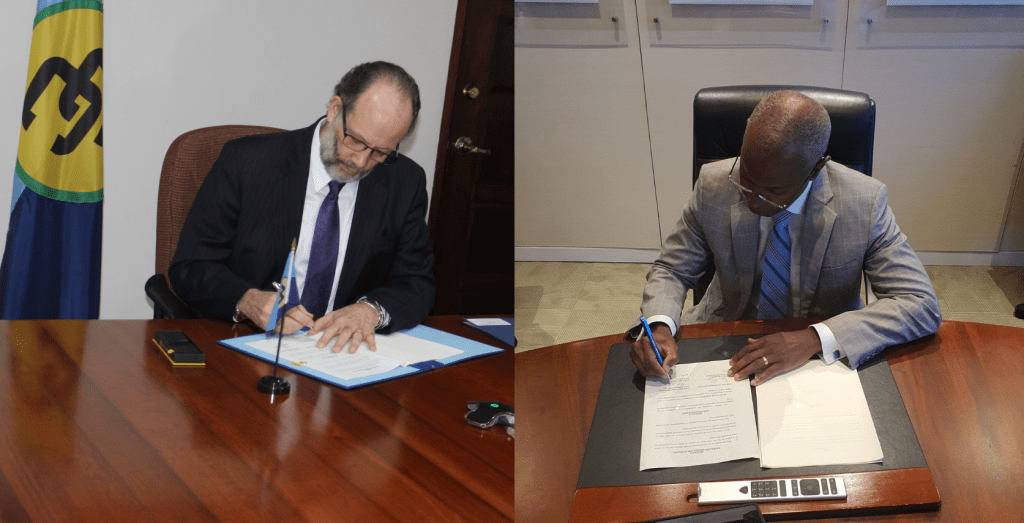
    PHOTO CAPTION:  CARICOM Secretary-General Ambassador Irwin LaRocque (l) and CPSO Chairman Mr Gervase Warner signing the MOU

    GEORGETOWN, Guyana, December 4, 2020 – The CARICOM Private Sector Organisation on Thursday signed a Memorandum of Understanding with the Caribbean Community to cooperate on the full implementation of the CARICOM Single Market and Economy (CSME), regarded as the most viable platform for supporting the Region’s growth and development.

    CARICOM Secretary-General Ambassador Irwin LaRocque signed on behalf of the Community and Chairman Mr Gervase Warner signed for the CPSO in the virtual ceremony.

    The CPSO is the latest Associate Institution of CARICOM, having been so designated on the 29 October 2020. Its status is recognition of the need for more structured engagement between the Community and the Private Sector and Labour to achieve economic development and full realisation of regional integration.

    Barbados Prime Minister Mia Mottley, the Lead Head of Government in the CARICOM Quasi-Cabinet for the CSME, laid the foundation for the CPSO’s formation at a meeting of regional private sector officials in Barbados in June 2019.  The private sector representatives were subsequently invited, along with representatives of the regional labour movement, to the CARICOM Heads of Government Meeting in July 2019, at which they signalled that progress was being made towards the establishment of the regional body.  They confirmed to the Heads of Government at their 31st Inter-sessional Meeting in Barbados in February 2021, that the CPSO had been established as a non-profit organisation with Headquarters in Barbados.

    The CARICOM Secretary-General, in congratulating the CPSO, said while the CARICOM Treaty provides the administrative framework to create the single market and economy, it is the regional stakeholders, such as the private sector who will give practical meaning to it by making use of the opportunities provided.

    He noted that significantly, the MOU gives the CPSO Observer Status at Meetings of the Community’s Organs and Bodies on matters related to the CSME. It also creates a follow-up mechanism, through a joint technical committee drawn from the CARICOM and CPSO Secretariats. The Committee is mandated to meet quarterly to keep track of the programme and to review and report back to the CARICOM Secretary-General and the CPSO Chairman and subsequently to the CARICOM Heads of Government.

    The Secretary-General noted the pro-active efforts of the CPSO, which has already found itself on regional committees established by the Community including; the Committee on Mergers and Acquisitions policy; the E-Commerce Committee; the Committee on Front of Label Packaging; the sub-committee on the Food Security Plan; and the CET and Rules of Origin sub-committee.

    He praised the CPSO’s work on the development of its “Twenty-Five by 2025” document in which it lists priority areas for investment  in the Region in response to concerns about the Region’s significant food import bill. This he expects to lead to  an implementable Plan of Action.  

    “The CPSO also submitted to us a risk assessment on how to reopen our economies in this difficult time of COVID-19 which was disseminated to all Member States,” the Secretary-General noted.
    Mr Warner express confidence that the private sector’s collaboration with the Community will help to realise the Region’s development goals.

    “We are confident that the goodwill that has been engendered and the cooperation fostered, and the resources applied to the fulfilment of the MOU, will set us unmistakably on the path of accelerated development for our Region and in particular towards the achievement of the goal of full implementation of the CSME,” the CPSO Chairman said.

    The preceding was a press release from the CARICOM Secretariat.

  • RCEP and Caribbean-Asian Economic Relations

    RCEP and Caribbean-Asian Economic Relations

    Photo credit: Pixabay

    Alicia Nicholls

    On November 15, 2020, fifteen Asia-Pacific countries signed the Regional Comprehensive Economic Partnership (RCEP) agreement on the sidelines of the virtually held 37th Association of South East Asian Nations (ASEAN) summit. RCEP is the first mega-regional trade agreement (MRTA) to be concluded since the Trans-Pacific Partnership (TPP) was signed in 2016. As readers would recall, the TPP was replaced by the Comprehensive and Progressive Agreement for Trans-Pacific Partnership (CPTPP) after the United States (US) under the Trump Administration withdrew, leaving the remaining parties scrambling to salvage the agreement. Negotiations on the other long awaited MRTA, the Trans-Atlantic Trade and Investment Partnership (TTIP) between the US and EU, ended abruptly in 2016 without a deal.

    As the centre of global economic gravity shifts eastward (and not for the first time in history), countries around the world are considering what implications and opportunities this new agreement might pose for their political, strategic and economic relations with China and the other countries in the fast-growing Asia-Pacific region.

    This article offers some preliminary thoughts on the RCEP Agreement and the small but growing Caribbean-Asian economic relationship. It argues, inter alia, that the RCEP agreement presents another reason why Caribbean Community (CARICOM) Member States should not discount Asia-Pacific countries as partners for trade, foreign direct investment (FDI) and other economic cooperation as we diversify our economies as part of COVID-19 economic recovery efforts.

    What is RCEP?

    RCEP negotiations were launched in Phnom Penh, Cambodia eight years ago on November 20, 2012, with the stated objectives, inter alia, of broadening and deepening integration to create employment, raise living standards and improve the welfare of the peoples in the region. Though not particularly ambitious in the depth of its obligations, the 20-chapter RCEP text covers trade in goods, services and investment with an up to twenty year window for liberalization.

    RCEP at a glance

    Population (market size)2.2 billion
    % of world populationAlmost 30%
    Combined GDP (US$)26.2 trillion
    % of world GDPAbout 30%
    % of global trade28%
    Source: Figures taken from RCEP Joint Leaders’ Statement of November 15, 2020. Accessible here: https://asean.org/joint-leaders-statement-regional-comprehensive-economic-partnership-rcep-2/.

    RCEP creates the world’s largest trading bloc. It comprises the 10 ASEAN Member States which are Brunei Darussalam, Cambodia, Indonesia, Laos, Malaysia, Myanmar, the Philippines, Singapore, Thailand and Vietnam, plus five other key Asia-Pacific powerhouses: Australia, China, Japan, South Korea and New Zealand. It will enter into force once at least six ASEAN Member States and three signatory States other than ASEAN Member States have ratified the agreement.

    RCEP is, however, missing one big player, India, which withdrew from the RCEP negotiations in November 2019 over fears of its market being flooded with cheaper Chinese goods. Cognizant of the strategic importance India’s accession would bring both politically and economically to the agreement, RCEP parties released a Ministers’ Declaration on India’s Participation in the RCEP, leaving the door open for that country to accede at a later date if it so chooses.

    Much ink has been spilt on the geopolitical implications of RCEP which is widely seen in the west as a China-backed rival to the Trans-Pacific Partnership (TPP) which had been spearheaded by the US under the Obama administration, but from which President Trump withdrew upon assuming office. China was not part of the TPP negotiations and analysts opine that RCEP will help to further cement China’s influence as an economic power in the Asia-Pacific region.

    Taiwan (Republic of China), which is still recognized by five Caribbean States (Belize, Haiti, St. Kitts & Nevis, St. Lucia and St. Vincent & the Grenadines), is also not a part of the agreement. Taipei, has to some extent, vocalized concerns about what its exclusion could mean for its exports to those countries in the agreement.

    Caribbean-Asia/Pacific relations

    CARICOM countries’ overall trade with the Asia-Pacific remains small and is mainly with China, and less so Japan and South Korea. The region lacks free trade agreements (FTAs) with any Asian or Pacific countries. Guyana’s trade agreement with China signed September 2001 is more aptly described as an economic cooperation agreement due to its predominantly best endeavour nature and lack of binding market access commitments. As such, trade between CARICOM and Asian countries is on World Trade Organization (WTO) most favoured nation (MFN) terms. This means Caribbean firms do not have preferential access to any Asian or Pacific market nor do Asian and Pacific firms have in ours.

    Although the Asia-Pacific region has become a major source of outward FDI globally, FDI inflows to the Caribbean remains mainly from the US, Europe and Canada. Among CARICOM countries, Barbados, Guyana, Jamaica, The Bahamas and Trinidad & Tobago have bilateral investment treaties with China, although not all are in force. Guyana, Jamaica and Trinidad & Tobago also have BITs with South Korea which are in force. Suriname’s BIT with Indonesia was signed in 1995 but never entered into force.

    Though Chinese FDI to the Caribbean remains small, Beijing has become a major provider of development finance in the region. Many Caribbean countries have signed memoranda of understanding (MOUs) with China under its Belt and Road Initiative (BRI). There are also various other initiatives such as the China/Caribbean Economic and Trade Forum and the CARICOM/Korea Consultation and Cooperation Mechanism, as examples.

    Similar to the Caribbean, notable heterogeneity exists among the RCEP parties in terms of culture, language, geography, religion, political systems, income levels , poverty rates, and population size. These are nuances, of course, to which Caribbean firms looking to tap into the Asian market must be sensitive.

    Five ways RCEP is of interest to the Caribbean

    Here are five ways that RCEP might be of interest to the Caribbean.

    First, RCEP marks another way in which the Asia-Pacific region is showing strategic global leadership in promoting multilateralism and a rules-based approach to trade. Both are important issues for CARICOM, especially at a time when unilateralism and protectionism appear ascendant. Admittedly, the commitments in the agreement are shallower than in the CPTPP and other similar agreements. For example, the provisions on e-commerce and on SMEs are predominantly best endeavour efforts at cooperation. In some cases, the rules just reinforce Members’ existing multilateral commitments or what exists in the existing trade agreements the Members have with each other. Nonetheless, a June 2020 study by the US-based Peterson Institute found that “RCEP could add $209 billion annually to world incomes, and $500 billion to world trade by 2030”. Moreover, the Agreement’s general review clause (Article 20.8) mandates the parties to undertake a general review of this Agreement with a view to updating and enhancing it five years after the date of entry into force of the Agreement, and every five years thereafter.

    Second, China, Japan and South Korea – the major Asian countries with which CARICOM trades – are all party to the RCEP Agreement. The benefits of RCEP to the parties extend beyond merely lowering tariffs. Although, some parties to the RCEP agreement already have FTAs with each other, RCEP will streamline customs procedures, converge rules of origin requirements and promote regulatory harmony across the fifteen parties. This will potentially reduce transaction costs for firms (including CARICOM firms) operating in the Asia-Pacific market, allowing them to only have to obtain one certificate of origin and to build more efficient supply chains within the Asia-Pacific region.

    Third, Asia is playing a growing role in the global economy and RCEP could cement this even further by accelerating that region’s COVID-19 economic recovery. With the notable exception of India, Asia-Pacific economies have generally seen a less pronounced COVID-19-induced economic contraction and have been recovering from the COVID-19 pandemic faster than the US, UK and the EU-27 – CARICOM countries’ traditional tourism source markets and trade partners. The IMF’s October 2020 Outlook forecasts ‘emerging and developing Asia’ economies to grow 6% in 2021, while ‘advanced economies’ (in which Japan is included) to grow a little more than half as fast at 3.9% in 2021. According to an IMF blog written by Ostry (2020), the Fund forecasts the Asia-Pacific region to grow by 6.9 percent in 2021, although headwinds remain ahead.

    While China alone accounts for a population over 1 billion and is now the world’s second largest economy by GDP, other Asia-Pacific countries have been rising in their economic importance. Their growing middle class present a possible tourism source market and potential consumers for Caribbean goods and services. Japan has become, for example, the major export market for Jamaican Blue Mountain coffee. Soca music and steel pan, both originating in Trinidad & Tobago, have also attracted a growing following in Japan. Reggae, a world-renowned musical genre born in Jamaica, is popular in South Korea and there are several reggae bands there. This shows that there are elements of Caribbean culture which appeal to Asian tastes, which present opportunities for creating demand for other quintessential Caribbean goods like our rums, for example.

    Besides trade and economic cooperation, possible opportunities for deepening Asia-Pacific cooperation and technical assistance exist in areas of mutual interest such as education, biomedical research, Artificial Intelligence and other spheres of technology, renewable energy, and sustainable agriculture, as examples.

    Fourth, although RCEP is just a trade agreement and not a political arrangement per se, it further strengthens the economic prowess and geopolitical significance of those participating countries on the multilateral stage, which could be to CARICOM’s benefit. RCEP might shape future trade and trading rules within Asia and could serve as a clue of what any future agreement between CARICOM and ASEAN agreement could possibly look like. It does not cover environmental and labor provisions, however.

    There is also the commitment in the Agreement to not only create an RCEP Joint Committee which is standard for FTAs, but an RCEP Secretariat (Article 18) which shows some desire by the parties for RCEP to be more than a standard FTA, but a forum for discussing rules of trade amongst themselves. In the future, RCEP as a negotiating bloc could have an influential role in the WTO, for example, in setting rules in new and emerging areas of trade. In the WTO, CARICOM has a long history of cooperating with similarly minded countries. CARICOM has also cooperated with Asian countries, inter alia, in intergovernmental and other multilateral fora, such as in the Organisation of Africa, Caribbean and Pacific States (OACPS), the Commonwealth, and the United Nations through the Alliance of Small Island States (AOSIS), on climate change. CARICOM also requested Indonesia’s assistance with combatting arbitrary blacklisting practices.

    Fifth, as CARICOM’s own regional integration movement remains stuck in neutral, RCEP, though not as ambitious as Africa’s continental free trade agreement aims to be, shows that there is still a desire for economic cooperation among larger, often more economically endowed countries than ours.

    Stepping stones across the pond

    Similar to Caribbean-China economic relations, Caribbean relations with the wider Asia-Pacific region hold promise. However, in addition to the physical distance separating the two regions, the ‘psychic distance’ between the Caribbean and the Asia-Pacific region may seem at first intimidating to some CARICOM firms, especially those with limited exporting experience or limited knowledge of the Asia market.

    On this front, the region has some underutilized resources from which it could draw to use as stepping stones to get across the pond to the Asia-Pacific market. As I have argued in a previous article, Caribbean returning scholars from China and other Asian countries are an undertapped resource whose knowledge of the language, culture and their networks could be deployed for the benefit of deepening general understanding and knowledge of the business culture of that market. The Caribbean-ASEAN Council can also be a valuable resource for Caribbean firms interested in the ASEAN and wider Asia-Pacific region.  

    Another resource at Caribbean countries’ fingertips is the region’s small Asia diaspora pocket, such as Chinese and Indians, who in some cases still retain ties with their ancestral homelands. Suriname’s Javanese diaspora are descendents of persons who came from the Indonesian island of Java (then also a Dutch colony) to work on plantations in Suriname. Suriname has leveraged this shared history to its advantage and is a member of the Islamic Development Bank, has an embassy in Jakarta (capital of Indonesia) and together has the Suriname-Indonesia Joint Commission.

    Additionally, there are English-speaking countries, such as Australia and New Zealand, and to a lesser extent Singapore and Malaysia where English is an important second language, which not only share a common language with the anglophone Caribbean but also to some extent similar laws and institutions. They could be markets in themselves for Caribbean goods and services, but could also be seen as ‘jump off’ markets to more ‘psychic distant’ markets in the wider Asia-Pacific region.

    In closing, this article sought to offer some preliminary thoughts on the RCEP agreement and what possible implications it might have for Caribbean-Asian economic relations. As Caribbean countries redouble their trade and tourism diversification efforts to pull their economies out of the COVID-19 doldrums, the region’s governments and private sector should embrace the possible economic opportunities RCEP might present for the region in terms of trade, FDI, and wider cooperation with the Asia-Pacific region.

    The full text of the RCEP agreement may be accessed here.

    Alicia Nicholls, B.Sc., M.Sc., LL.B. is a trade and development consultant with a keen interest in sustainable development, international law and trade. All views herein expressed are her personal views and should not be attributed to any institution with which she may from time to time be affiliated. You can read more of her commentaries and follow her on Twitter @LicyLaw.

  • Caribbean Community (CARICOM) congratulates US President-elect Biden and VP-elect Harris

    Caribbean Community (CARICOM) congratulates US President-elect Biden and VP-elect Harris

    The 15-Member Caribbean Community (CARICOM) has extended its congratulations to President-elect Joe Biden and Vice President-elect Kamala Harris. The congratulatory message was sent by the current chairman under the grouping’s rotating chairmanship system, Dr. The Hon. Ralph Gonsalves, Prime Minister of St. Vincent and the Grenadines.

    The full statement may be viewed below:

    Heads of Government of the Caribbean Community (CARICOM) congratulate the President-elect of the United States, Mr Joseph Biden, on his victory in the elections of 2 November.

    The historic nature of this victory is exemplified by the election of Vice-President-elect Kamala Harris, a person of Caribbean and South Asian descent, as the first woman to achieve that position.

    Mr Biden will assume office during one of the most challenging periods of recent history and his vast experience will be of great value to the global community at this time.

    The President-elect has been a friend to CARICOM and the Community looks forward to working with the new administration of the United States, in pursuing our common goal of advancing the wellbeing of our people. It is a country with which the Community is inextricably linked through geography, shared values, familial ties, and economic and security relations.

    The Community wishes President-elect Biden and Vice President-elect Harris every success in their tenure.