Tag: CARICOM

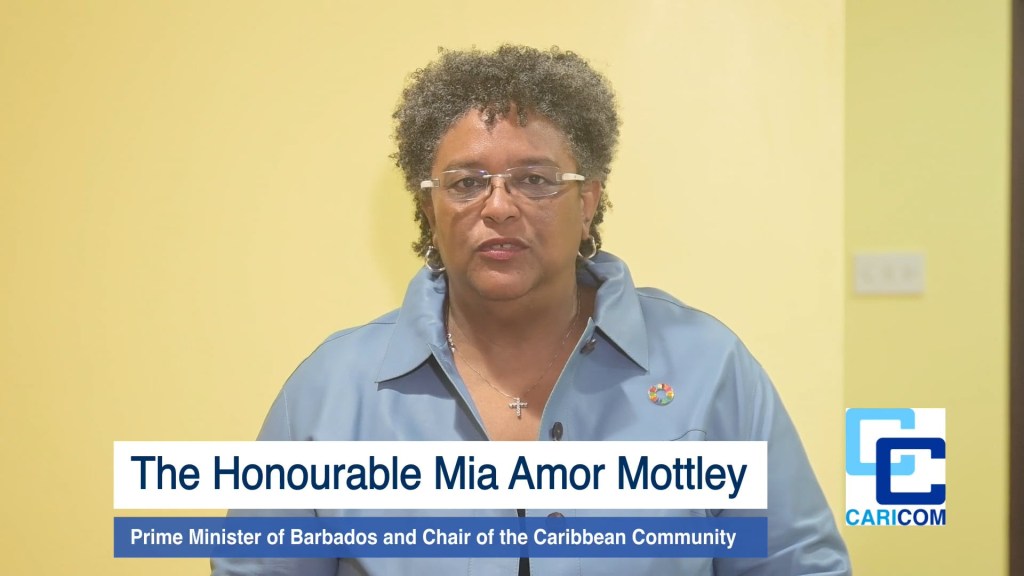
  • Statement from Chair of CARICOM, Hon. Mia Amor Mottley on Impact of the Global Crises on the Caribbean

    Statement from Chair of CARICOM, Hon. Mia Amor Mottley on Impact of the Global Crises on the Caribbean

    (CARICOM Secretariat, Turkeyen, Greater Georgetown, Guyana – Friday, 4 April 2025)  –

    The transcript of the Statement from the Honourable Mia Amor Mottley, Chair of the Caribbean Community (CARICOM) on the impact of the global crises on the Caribbean.

    I speak to all our Caribbean brothers and sisters today, not as the Prime Minister of Barbados, but in my capacity as Chair of the Caribbean Community.

    Our world is in crisis. I will not sugarcoat it. These are among the most challenging of times for our region since the majority of our members gained their independence. Indeed, it is the most difficult period our world has faced since the end of World War II, 80 years ago. Our planet faces a climate catastrophe that worsens every year. We have a cost-of-living crisis that has been bedevilling us since the disruption of supply chains, when the COVID-19 Pandemic triggered the shutdown of the majority of countries.

    Misinformation, disinformation and manipulation are relevant. The mental health crisis is causing hopelessness among many of our young people, and regrettably, crime and fear are on the rise. We’re fighting wars in the Holy Land, in Europe and in Africa. Countries are distrustful of countries and neighbours are distrustful of neighbours. The international order, the international system, my friends, is in great danger of collapse, and now we are on the precipice of a global trade war.

    Our Caribbean economies are largely reliant on imports. Just go to the supermarket or visit the mall or the hardware shop or the electronic store, and you will see that most of the things there are not produced in this Region. Many of those commodities are either purchased directly from the United States of America or passed through the United States of America on their way to the Caribbean region. That, my friends, is a legacy of our colonial dependence. Together with colleague Heads of State and Heads of Government, we have been working to diversify ourselves away from this dependence.

    We’ve already started to reap some successes, especially in the field of agriculture, for example, but we still have a long way to go. As we do this work, we have to be mindful that those recent announcements that have been made in the last few days will impact us very directly as a Region and as a Caribbean people.

    We are working and will continue to work to become more self-sufficient, but I want every Caribbean man and every Caribbean woman to hear me. This trade war and the possibility of a US $1 million to $1.5 million levy on all Chinese made ships entering US harbours will mean higher prices for all of us at the corner shop, higher prices at the supermarket, higher prices at the electronic store, higher prices for us at the shop, higher prices for us at the restaurant, higher prices for us at the current dealership and beyond.

    A lot of Caribbean people will think that these things that you are seeing on television news or reading about are far away and “They don’t impact on me.” A lot of people think “I’m just a farmer”, “I’m just a schoolteacher”, or “I’m just a mechanic.” They say, “I live in Saint Lucy in Barbados”, or “I live in Portmore in Jamaica”, or Kingstown in St Vincent, or Arima in Trinidad or Basseterre in St Kitts & Nevis, or San Ignacio in Belize.

    “These problems are far away from me, and they don’t impact me.” That is what you will hear them say. But the reality, my friends, is that if you buy food, if you buy electronics, if you buy clothes, it will impact you. It will impact each of us.

    My brothers and sisters, our Caribbean economies are not very large. So, we are, and have always been, at the whims of global prices. If Europe and China and the U.S. and Canada and Mexico are all putting tariffs on each other, that is going to disrupt supply chains, that is going to raise the cost of producing everything, from the food you eat, to the clothes on your back, to the phone in your pocket, to the car you drive down the road, to the spare parts that you need for critical infrastructure. That means higher prices for all of us to pay, and sadly, yes, this will impact all of us, regardless of what any of our Caribbean governments will do.

    We could lower our tariffs to zero in CARICOM, and it will not make a lick of difference, because our economies are small and vulnerable. This crisis, my friends, will impact not only goods, but it may also have a large spillover effect on tourism. We suggest that the region takes steps to sustain the tourism industry as likely worsening conditions and many of our source markets will have negative impacts on people’s ability to travel. We call on our regional private sector and the tourism sector to come together and to work with governments to collaborate for an immediate tourism strategy to ensure that we maintain market share numbers as a region.

    My friends, I pray that I’m wrong, and I’m praying that cooler heads prevail across the world, and leaders come together in a new sense of cooperation, to look after the poor and the vulnerable people of this world, and to leave space for the middle classes to chart their lives, to allow businesses to be able to get on with what they do and to trade.

    But truly, I do not have confidence that this will happen.

    So, what must we do?

    First, we must re-engage urgently, directly, and at the highest possible level with our friends in the United States of America. There is an obvious truth which has to be confronted by both sides. That truth is that these small and microstates of the Caribbean do not, in any way or in any sector, enjoy a greater degree of financial benefit in the balance of trade than does the United States. In fact, it is because of our small size, our great vulnerability, our limited manufacturing capacity, our inability to distort trade in any way, that successive United States administrations, included, and most recently, the Reagan administration in the early 1980s went to great lengths to assist us in promoting our abilities to sell in the United States under the Caribbean Basin Initiative. We will see how these tariffs will impact on that. That spirit of cooperation largely enabled security, social stability and economic growth on America’s third border in the Caribbean, or as we have agreed as recently in our meeting with Secretary of State Rubio, what is now our collective neighbourhood.

    Secondly, we must not fight among each other for political gain. Because my dear brothers and sisters, as the old adage  goes “United, we stand and divided, we fall.”

    Thirdly, we must redouble our efforts to invest in Caribbean agricultural production and light manufacturing. The 25 by 2025 initiative, ably led by President Ali, seems too modest a target now, given all that we are confronting. We must grow our own and produce our own as much as possible. We can all make the decision to buy healthy foods at the market instead of processed foods at the supermarket.

    Fourthly, we must build our ties with Africa, Central and Latin America, and renew those ties with some of our older partners around the world, in the United Kingdom and Europe, and in Canada. We must not rely solely on one or two markets. We need to be able to sell our Caribbean goods to a wider, more stable global market.

    My brothers and sisters, in every global political and economic crisis, there is always an opportunity. If we come together, put any divisions aside, support our small businesses and small producers, we will come out of this stronger.

    To our hoteliers, our supermarkets and our people, my message is the same. Buy local and buy regional. I repeat, buy local and buy regional. The products are better, fresher and more competitive in many instances. If we work together and strengthen our own, we can ride through this crisis. We may have to confront issues of logistics and movement of goods, but we can do that too.

    To the United States, I say this simply. We are not your enemy. We are your friends. So many people in the Caribbean region have brothers and sisters, aunties, uncles, grandmothers, grandfathers, sons and daughters, God children living up in Miami or Queens or Brooklyn or New Jersey, Connecticut, Virginia, wherever. We welcome your people to our shores and give them the holidays, and for many of them, the experiences of a lifetime.

    I say simply to President Trump; our economies are not doing your economy any harm in any way. They are too small to have any negative or distorted impact on your country. So, I ask you to consider your decades-long friendship between your country and ours. And look to the Caribbean, recognizing that the family ties, yes, are strong. Let us talk, I hope, and let us work together to keep prices down for all of our people.

    My brothers and sisters, there’s trouble in our Caribbean waters, but the responsibility each and every day for much of what we do and what much of what we grow must be ours, if we take care of each other, if we support each other, if we uplift each other, and if we tap into the strength and innovation of our common Caribbean spirit, we will see this through.

    Our forefathers faced tribulations far worse than we will ever do and yes, they came through it.

    My friends, my brothers and sisters, we can make it.

    We shall make it.

    God bless our Caribbean civilization.

    Thank you.

  • Denial and Banning of Dancehall and Trinibad Artists across CARICOM : Compatible or Incompatible with Regional Integration Law

    Denial and Banning of Dancehall and Trinibad Artists across CARICOM : Compatible or Incompatible with Regional Integration Law

    Rahym R. Augustin-Joseph (Mr.) (Guest contributor)

    Overtime, there has been a discernible increase in the denial of entry or even banning of certain dancehall and Trinibad artists, who were scheduled to perform in Caribbean countries in 2024 such as K-Mann 6IXX in Antigua and Barbuda and DJ Punz in St. Kitts and Nevis.    

    Earlier, in 2022, Skeng was denied future permits for any show he was scheduled to have in Guyana, after the Baderation event he had, was disrupted by gunfire and bottles turned missiles. In response, the Guyanese Government therefore noted that they would no longer issue permits to skeng or other artists whose lyrics included violence and public disorder to perform in Guyana. In 2024 however, it appears that this position was reversed as Skeng performed in Guyana.

    But these refusals and banning of artists from other Caribbean countries is not a new phenomenon, as in 2014 Jamaican artiste Tommy Lee Sparta, or Cabral Douglas was denied entry into Dominica, where he was supposed to perform, but it raised concerns for public safety. In 2010, Vybz Kartel was issued a performance ban in Saint Lucia and Barbados, citing his lewd lyrics and raunchy performances, and in 2009, Bounty Killer was also denied entry into Trinidad and Tobago, allegedly without reasons, while Vybz Kartel his reputed rival was allowed to enter and perform. There are many more examples of the denial of entry and banning of artists in the Caribbean.

    On the one hand, a wide cross section of the Caribbean peoples listen and engage with the music of these artists, and see it is a citadel of modern Caribbean culture. However, political leaders and technocrats have noted that these artists and their music are in the main, vulgar, misogynistic, crude, and have a major influence in the increased crime and violence in our society. It is their view that this music is contributing towards the increase in gang recruitment and violence, as people continue to be influenced by the lyrical component and call to action elicited by this music. Young people are therefore not seeing this music for its ‘creative expression’ but instead seeing this music for its literal meaning.

    One only has to listen to the words uttered by Dr. Mohamed Irfaan Ali of Guyana, when he noted during the 46th Regular Meeting of the Conference of the Heads of Government of CARICOM. He urged leaders to prevent the proliferation of violent music in their respective nations. “We do not need lyrics that promote violence in this region, We have the ability to promote positive lyrics that inspire people to think, act, and behave positively. As leaders, we must take this matter seriously and ensure that the region’s lyrics reflect the positivity embodied by Bob Marley and encourage positive living and change.”

    This debate however is to be had at another time, and within our respective countries, wherein one can examine properly whether the music which portrays violence has been having an effect on the perpetrators of violence within the Caribbean, such that if it is reduced, curtailed or banned across various mediums, that it would reduce violence significantly. This is a task for researchers across the region, which political leaders must take their cues from if they are to sustain such an argument.

    But, beyond just the consumption of the music by nationals in the respective Caribbean countries, it is also being packaged and sold through concerts and other mediums across the Caribbean. As such, the banning and denial of entry of the artists has effects on trade in services, and also possibly implicates regional integration law of which will be discussed briefly here.

    So, how is the banning and denial of entry of artists to ply their trade within the Caribbean a regional integration law problem?

    As you may be aware, every CARICOM national has an automatic right of entry and stay within another CARICOM country for a maximum of 6 months pursuant to the 2007 Conference Decision of the CARICOM Heads of Government, Article 45 of the Revised Treaty of Chaguaramas, and the seminal case of Shanique Myrie v. The State of Barbados. This automatic right must also be hassle free, or without harassment or the imposition of impediments. Beyond just the mere right of entry, cases such as Tamika Gilbert v. The State of Barbados also notes that the right extends to being able to move freely within the particular country without any harassment and impediments.

    In restricting such right however, the offending state can only do so on two strict and narrowly applied grounds i.e., if the individual is an undesirable or a charge on public funds. Under the first prong, the offending state must show that the individual presents a genuine, present and sufficiently serious threat to national security and safety, public morals, and national health of the member state affecting one of the fundamental interests of the society. So, individuals who actually pose or can reasonably be expected to pose such a threat. It is interesting however, that the cases from the European Court of Justice also suggest that one cannot refuse an individual of another state to one’s territory by reason of or of the threat of conduct which when attributable to their own nationals, do not give rise to repressive measures or other genuine and effective measures intended to combat such conduct. One must show essentially that their own nationals who engage in the behaviour which is refused are prosecuted regularly or otherwise subjected to some legal action.  This begs the question of whether the states which have denied entry and banned artists altogether, have similarly banned local artists which share similar lyrical content in their songs?

    In the latter, one must show that the individual does not have sufficient funds, such that they will become a charge on public funds, wherein they do not have sufficient monies for the duration of their visit, lack possession of online cash and card among other considerations. Further, when refusing an individual, there are certain procedural elements that the offending country must satisfy, which include inter alia, that they must (I) inform the individual in writing why they are being refused entry, (II) state the reasons why they are refused entry (III) provide them with the right to challenge such decision, through an effective appeal or review procedure with adequate safeguards to protect the rights of the persons denied entry and (IV) allow them the opportunity to consult with an attorney or their consular official of their country.

    The probing questions is therefore whether reasons have been given to these artists justifying their performance ban, how long are these measures in effect and is there is a review mechanism for these artists to allow them to appeal against the performance ban and what do these review mechanisms look like. These are according to Dr. Waite, “serious legal and policy questions that have implications for our regional integration movement, cultural exchange, vibrancy of socio-political commentary and our community rights. In order to answer them, a probing review is necessary, not a knee-jerk emotional and moral response.”

    However, the right which the refused artists will be captured under is the Article 46 right, which is where community nationals who are skilled nationals are able to travel freely across the region to ply their skills upon attainment and presentation of their CARICOM Skills Certificate. As such, the artists or musicians should be able to travel to any CARICOM state, hassle- free, without any impediments or harassment for a period of 6 months.

    Should the abovementioned artists have their CSME Certificate, which is attained by artists after they provide, (I) copies of their portfolio work which include pictures, videos, news, reports, examples of their work, (II) letters from their previous employers which state the period of employment and a job description- which is a bit problematic of a criteria, recognising the entrepreneurial nature of most of our artists and their engagement in the gig economy, (III) letters of reference from previous individuals attesting to work previously and (IV) five invoices dated within the last six months. However, the artists can only enjoy such right of freedom of movement with the acquisition of the CSME Certificate which would validate their status as a skilled national.  As such, on a prima facie level, the banning of artists and the denial of entry into certain countries within the Caribbean already has affected and infringed on their community rights as a CARICOM citizen, wherein they can receive redress before the Caribbean Court of Justice in its original jurisdiction.

    Of course, any state, which has banned the artists who had upcoming and scheduled performances and shows in their respective countries if challenged would argue that these artists can be classified as ‘undesirables.’ As such they would argue that these artists represent a genuine, present and sufficiently serious threat to their national security, safety, and public morals, and they affect one of the fundamental interests of society. Their argument would possibly be that these artists by virtue of their lyrical component of their music could or have elicited violence in their respective countries, especially with increasing crime and violence statistics and as such is a threat to the national security. Further, they may argue that the lyrics of the artists may also be against public morals, particularly violent music which encourage gun violence. Recognising that there has been no cases within the region which have touched and concerned the exceptions, with regards to the nexus of violence and national security and public morals, one has to look towards the European Court of Justice jurisprudence, which the CCJ would look to.

    Within the ECJ, Catherine Barnard in her text, The Substantive Law of the European Union, Four Freedoms has noted that, the court grants member states a certain latitude and margin of discretion to determine what constitutes national security or public security in light of the national circumstances. It would therefore vary from one member state to another as noted in Van Duyn v. Home Office [1974]. Moreover, the courts provide the relevant national authorities an area of discretion within the limits imposed by the treaty, particularly as it does not provide a uniform set of values related to conduct which may be considered contrary to the national security interests of a country. However, the court still maintains its overarching view that there must be a genuine and sufficiently serious threat affecting the fundamental interests of the society.

    However, the court has noted in Shanique Myrie, which is a slight departure from the abovementioned, when they noted that public policy cannot be used as a justification for derogation from the fundamental principle of freedom of movement and hassle-free travel of community nationals wholly or unilaterally be determined by each member state without being subject to control by the major community organs, in particular the conference and ultimately by the court as the guardian of the RTC.

    The unfortunate or fortunate thing about the law and the decision by the court is that it forces a ‘culture of justification’ as coined by the South African public law scholar Etienne Mureinik, albeit post-law and decision making, wherein our officials must justify their decisions utilising evidence, logical reasoning as the court does not provide a carte blanche to the decision maker, which is critical for policy making and decision making. While members of the public may see it as being heavy handed, Article 211 of the RTC, provides the CCJ with this exclusive and compulsory jurisdiction to interpret and apply the RTC.

    As such, questions which have been posed by Dr. Neto Waite, on this subject are instructive and worthy of repetition here, when he asked whether it is right to argue that salacious lyrics undermine public morality and national security, is it true that lyrics about violence and rebellion against government harm public order? Has it ever posed a serious and sufficient risk and if so what does such intelligence tell us? Is the performance ban the best mechanism to deal with it, is it not too draconian and shouldn’t adult concertgoers be left to decide for themselves what sort of lyrics they wish to enjoy? In addressing whether the concern is minors being exposed to such music, he also argues correctly, whether it would be more appropriate for the government In consultation with civil society, implement a parental rating system for concerts based on the lineup of artists which can protect minors and respect the agency of adults to determine what types of music they want to listen to.

    However, from the reports in the media, it appears that save and except for Tommy Lee Sparta or Cabral Douglas, of which the CCJ has ruled on, the artists are not being denied entry after they have attempted to enter the respective countries. Instead, they are being banned from before. This does not mean they are not captured under the abovementioned. It just means that existing domestic Immigration legislation is being utilised to preclude entry which has been addressed in Maurice Tomlinson v. The State of Belize and Trinidad and Tobago. The court has therefore noted however that the mere existence of incompatible legislation, which suggests that there are categories of individuals who may not be eligible to enter the respective country, without it being harmonised with community law is not ipso facto, incompatible. Instead, the court will assess the state practice of the particular state to decide whether the legislation is incompatible with regional integration law.

    Therefore, this denial and banning of dancehall and trinibad artists would be assessed on a country-by-country basis in order to assess whether the individual country has a history of banning of dancehall and trinibad artists, which would be determinative of the legislation and state practice being incompatible. As such, countries such as Guyana, St. Kitts and Nevis among others may be found inconsistent, and the artists can make a claim even prior to entering that they will be denied entry, because of the legislation and also the application of the legislation with the banning of the artists. The artists would therefore have a claim before the CCJ in its OJ.

    However, CARICOM countries should take heed of the warning of the CCJ, who noted in Maurice Tomlinson, “that the court does not condone the indefinite retention on the statute book of a national law which in appearance seems to conflict with obligations under Community Law, and member states must ensure that national laws, subsidiary legislation and administrative practices are transparent in their support of the free movement of all CARICOM nationals and there should be harmonisation of the legislation with Community Law. If there is any permanent or indefinite discord between administrative practices and the literal reading of the legislation, then the rule of law requires clarity and certainty especially for nationals of other Member states who are to be guided by such legislation and practice.”

    Another right of the Artists, which may be affected is the right to not be discriminated on the grounds of nationality, as per Article 7 of the RTC. Essentially, in refusing entry to the artist, the offending state cannot discriminate on the artist solely on the basis of their nationality. Essentially, the artists must therefore show that similar individuals i.e., individuals who sing music similar to them have not been denied entry and that these individuals have no separate distinction other than their nationality. The unfortunate hurdle that they will face however is the high and unreasonable evidentry burden, as noted in Shanique Myrie v. Barbados, where the court noted that to show discrimination one has to show that there is statistical data which shows discrimination against the particular nationality that the individual artist has come from. It does not allow discrimination to be seen on a case-by-case basis, with the evidence being solely attributed from the particular case.

    The last right however which may affect the artist is the right to provision of services under Article 36 of the RTC, which is connected to the right to freedom of movement as noted in Shanique Myrie v. Barbados. Cabral Douglas v. The State of Dominica notes that an individual can be a service provider, if they satisfy condition precedent in Article 36 which is that (I) it must be within an approved activity in an approved sector, which music and performances are, (II) It must be supplied cross-border, which is satisfied as the artists are moving from one country to another. This would be different from Cabral Douglas, which has been critiqued, where the court held that he could not show that he was providing services because he was from Dominica attempting to provide services in Dominica and therefore the cross-border element was not satisfied. Thirdly, the element of temporary nature will be satisfied as they are travelling for a concert or some other performances which would be temporary. Finally, there must be renumeration as they are going to benefit from the payment by the patrons among other forms of income arising from the concert.

    Recognising the above, it would be advisable that these artists troubleshoot their cases in the OJ of the CCJ in order for the court to provide a definitive ruling on this matter, to guide or instruct states as to how to treat with these artists as a collective, ensuring state decisions are compatible with community law, as individual states believe they may be affecting their public morals, national security among other fundamental interests of the society.

    This is particularly opportune as there are further promises to increase freedom of movement in the region. The region cannot continue to address these matters in isolation and also ignore the trade and possible incompatibility implications of the individual countries with the RTC.

    Rahym Augustin-Joseph is the 2025 Commonwealth Caribbean Rhodes Scholar. He is a recent political science graduate from the UWI Cave Hill Campus and an aspiring attorney-at-law. He can be reached via rahymrjoseph9@ gmail.com and you can read more from him here.

    Photo credit: WordPress AI-generated image

  • CARICOM YOUNG PROFESSIONAL PROGRAMME TO ENHANCE YOUTH INVOLVEMENT IN CSME IMPLEMENTATION

    CARICOM YOUNG PROFESSIONAL PROGRAMME TO ENHANCE YOUTH INVOLVEMENT IN CSME IMPLEMENTATION

    “We must prioritise educational reform, targeted outreach, youth engagement, and skills development to bridge the gap in awareness and empower young people to actively participate in and benefit from the CSME’s opportunities.”
    – Michele Small-Bartley, Programme Manager for Youth Development at the CARICOM Secretariat
     
    CARICOM Secretariat, Turkeyen, Greater Georgetown, Guyana – Friday, 6 September 2024:  Many Caribbean youth remain unaware of the CARICOM Single Market and Economy (CSME) and its benefits to their lives and future prosperity. This is due to several issues, including the fact that the CSME is not adequately incorporated into educational curricula and limited engagement and interest from youth. These barriers hinder their potential for growth and advancement through regional integration. 

    The recently launched CARICOM Young Professionals Programme (CYPP) is a solution to these challenges as it will better position young people in the Region to benefit from the advances in regional integration.

    Achieving Integration through Collective Efforts 

    Ms Michele Small-Bartley, Programme Manager for Youth Development at the CARICOM Secretariat believes that the CYPP can bridge gaps and create renewed interest in CSME among youth.  She affirms that the CSME is a critical vehicle to drive economic growth and foster regional cooperation in the Caribbean. 

    “We must prioritise educational reform, targeted outreach, youth engagement, and skills development to bridge the gap in awareness and empower young people to actively participate in and benefit from the CSME’s opportunities,” stated Small-Bartley.

    The CYPP is a four-month programme which aims to build the capacity of CARICOM nationals aged  24 to  35 years by providing them with the relevant knowledge and skills to promote the implementation of the CSME regime. It will also focus on helping young people better understand and navigate the complexities of the CSME through comprehensive training, workshops, and educational resources using an experiential approach to enhance their knowledge, skills, and competencies. 

    Through this process, young professionals will be empowered to advocate for their interests and priorities within the CSME framework, thus ensuring their voices are heard in policy discussions and decision-making processes at the national and regional levels.

    The initiative will facilitate platforms, forums, and networking events where young professionals can connect, collaborate, and exchange ideas with peers, mentors, policymakers, and business leaders across the Caribbean region.  It also seeks to establish a CARICOM Young Professional Network, fostering a sense of community and advocating for greater youth involvement in the decision-making process related to the implementation of the CSME regime.   

    Ms Small-Bartley is also advocating for prioritising educational reform, targeted outreach, youth involvement, and skills development so stakeholders can bridge the gap in awareness and empower young people to actively participate in and benefit from the CSME’s opportunities. “The vision of a prosperous and integrated Caribbean region can only be realised through collective effort,” stated Small-Bartley.

    Selection of the first cohort of programme participants is in progress.

    Source: Press Release from the CARICOM Secretariat
  • CARICOM and Canada launch a Strategic Partnership

    CARICOM and Canada launch a Strategic Partnership

    The Caribbean Community (CARICOM) and Canada have launched a strategic partnership. Building on many years of political and economic ties between Canada and the Caribbean region, this new partnership is an outcome of their recently concluded Canada-CARICOM Summit. The Summit’s theme was “Strategic Partners for a Resilient Future” and was held in Ottawa, Canada, October 17-19, 2023.

    Please see below from the CARICOM Secretariat:

    1. INTRODUCTION

    Bound by an unwavering friendship, Canada and the Caribbean Community (CARICOM) seek to formalize their vibrant and multi-faceted partnership, as natural hemispheric partners, with strong and lasting foundations built on deep people-to-people, historical and cultural ties, and mutual respect. Among the first to recognize the independence of CARICOM Member States, Canada remains steadfast in its trusted relationship with CARICOM over the years. This relationship, forged in the birth of new Caribbean nations, has evolved into an enduring strategic partnership amongst equals, based on a shared commitment to democracy, the rule of law, respect for human rights and the rules-based international order, and which aims to advance common foreign policy, trade, security, and development priorities.

    As global actors, Canada and CARICOM join forces to navigate evolving geopolitical events, including our most recent engagement in the triple crises of COVID-19, climate change, and food and energy insecurity.  Together we commit to joint action on shared priorities such as climate resilience; building inclusive and sustainable economies; enhancing multilateral cooperation; and bolstering bilateral and regional security, including working together to help restore the security and stability of Haiti for the benefit of its people. We are also committed to working together to promote gender and racial equality and inclusion in the hemisphere, and to strengthening our already deep people-to-people ties. We are committed to achieving the sustainable development goals (SDGs) and building strong, resilient and inclusive societies and economies.

    Marking the occasion of our first Summit to be held in Canada, we launch the Canada-CARICOM Strategic Partnership, to embed our close collaboration and cooperation on mutually agreed sectors.

    1. OBJECTIVES

    The Canada-CARICOM Strategic Partnership:

    • Serves as a permanent joint mechanism for regular dialogue, as well as for ad hoc consultations on issues of mutual interest, with responsibility for preparation, follow-up and implementation of joint actions, decisions and agreements between Canada and CARICOM.
    • Fosters the existing relationship between Canada and CARICOM through regular leader, ministerial and senior official level meetings to advance time-bound and agreed-upon roadmaps for action.
    1. STRUCTURE AND COORDINATION

    3a.General Coordination and Management

    Global Affairs Canada and the CARICOM Secretariat will co-lead the general coordination and management of the Strategic Partnership. Collaborative partnerships can be forged between competent institutions in Canada and relevant regional organizations in CARICOM in order to drive dialogue and implement initiatives.

    3b.       Structure and Frequency of Meetings

    The Canada-CARICOM Strategic Partnership is comprised of regular leader-level engagement to set overarching priorities and interests to advance and further deepen the partnership in addition to concurrent formal and ad hoc fora:

    1. Canada-CARICOM Foreign Ministers’ Group (CCFMG): meet annually to advance overarching priorities through substantive discussions on issues impacting the Caribbean region and the hemisphere, emerging trends and solutions to common challenges. Based on the agenda and discussions during the CCFMG, Ministers will set annual priorities for officials to guide the implementation of a Canada-CARICOM evergreen Roadmap for action. Foreign Ministers will report to Leaders through a joint letter from Canada’s Foreign Minister and the Council for Foreign and Community Relations (COFCOR) pro-tempore Chair of CARICOM describing engagement, progress to date and joint action to advance the Strategic Partnership.
    2. Canada-CARICOM Ministerial Meetings: ad-hoc ministerial-level meetings to advance specific thematic priorities, including on Trade, Development, Finance, Health, Environment, and Defence, etc.
    3. Canada-CARICOM Senior Officials’ Dialogue: the annual CCFMG meeting is preceded by the Senior Officials’ Dialogue, which serves as a preparatory meeting for Foreign Ministers’ substantive discussions on topline issues, and reviews progress and implementation of the Canada-CARICOM Roadmap.
    4. Canada-CARICOM Expert Dialogues: ad-hoc expert dialogues between relevant Canadian and CARICOM Institutions could be established to advance thematic priorities and actions listed in the Canada-CARICOM Roadmap, including bilateral, regional and multilateral initiatives. Expert groups would meet before and after major international summits, including – but not limited to – UNGA, the OAS, WHO, the Commonwealth, the G7 and the G20, to deepen coordinated action on multilateral priorities of democracy, human rights, and the rules based international order and amplify advocacy for hemispheric challenges. Expert groups would report on concrete progress at the annual Senior Officials’ Dialogue, to ensure effective and sustainable progress is being made on thematic lines of activity.
    5. Capacity Building and Technical Assistance: to deepen institutional linkages through training, knowledge exchange, capacity building and technical assistance initiatives, including considering secondments as a form of exchange program, where a CARICOM official is embedded in a federal organisation and vice-versa in the Secretariat or within a CARICOM Member State’s organisation.
    6. Special ad-hoc meetings: could be held at the request of Canada or CARICOM.
    1. LAUNCH OF THE CANADA-CARICOM STRATEGIC PARTNERSHIP

    Pursuant to the Co-Chairs’ Statement of the Second Meeting of the Canada-CARICOM Foreign Ministers’ Group, the Canada-CARICOM Strategic Partnership is hereby launched by Leaders at the Canada-CARICOM Summit in Ottawa, 18 October 2023.