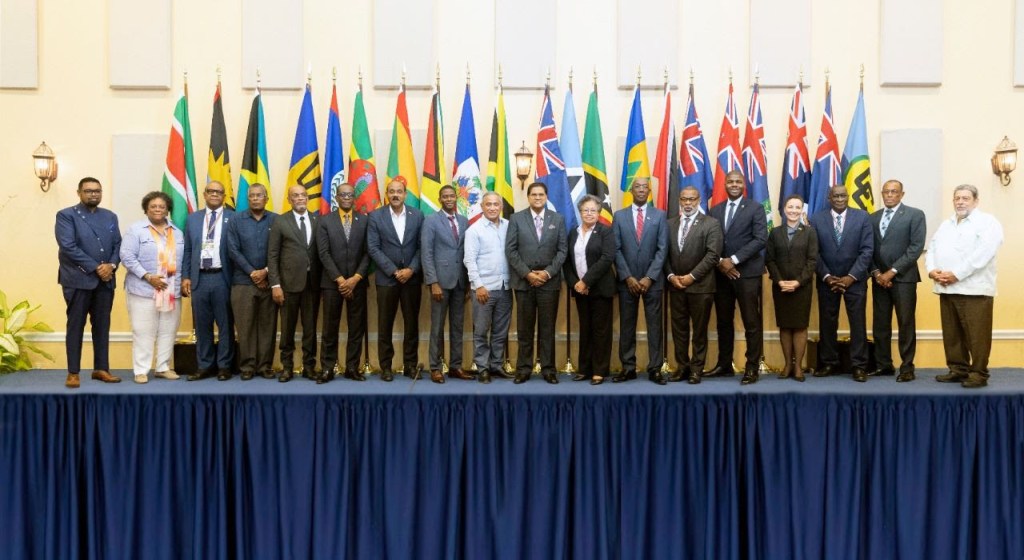
CARICOM Secretariat: The Forty-Third Regular Meeting of the Conference of Heads of Government of the Caribbean Community (CARICOM) was held from 3-5 July 2022. Chair of the Conference, the President of Suriname, His Excellency Chandrikapersad Santokhi presided over the proceedings.
Other Members of the Conference in attendance were: Prime Minister of Antigua and Barbuda, the Honourable Gaston Browne; Prime Minister of The Bahamas, Honourable Philip Davis; Prime Minister of Barbados, Honourable Mia Amor Mottley, Q.C; MP; Prime Minister of Belize, Honourable John Briceño; Prime Minister of Dominica, Honourable Roosevelt Skerrit; Prime Minister of Grenada, Honourable Dickon Mitchell; President of Guyana, His Excellency Mohamed Irfaan Ali; Prime Minister of Haiti, the Honourable Ariel Henry; Premier of Montserrat, Honourable Joseph Farrell; Prime Minister of Saint Lucia, Honourable Philip Pierre; the Prime Minister of St. Vincent and the Grenadines, Dr the Honourable Ralph Gonsalves; and the Prime Minister of Trinidad and Tobago, Dr the Honourable Keith Rowley.
Jamaica was represented by Senator the Hon. Kamina Johnson-Smith Minister of Foreign Affairs and Foreign Trade; St Kitts and Nevis was represented by Ambassador Lionel Sydney Osborne, Ambassador to CARICOM.
Associate Members in attendance were: Bermuda represented by Hon. Walter H. Roban Deputy Premier and Minister of Home Affairs; British Virgin Islands represented by Premier, Honourable Dr. Natalio Wheatley; and the Turks and Caicos Islands represented by Premier Honourable Charles Misick.
OPENING CEREMONY
The Opening Ceremony was addressed by the Chair of Conference His Excellency Chandrikapersad Santokhi, outgoing Chair Honourable John Briceño; Prime Minister of The Bahamas, Honourable Philip Davis; Prime Minister of Grenada, Honourable Dickon Mitchell; Prime Minister of Saint Lucia, Honourable Philip Pierre; Secretary-General of the Caribbean Community, Her Excellency Carla Barnett, and the Secretary-General of the United Nations, His Excellency António Guterres.
Secretary-General Barnett underscored the need for the work of the Community to make a difference in the lives of its citizens. She said that the Conference was meeting at a time of severe global crisis in three vital areas, namely, food, energy, and finance.
“Addressing solutions for our Region requires collective intellect and will to act together. This task is not beyond us, as we have proven time and again. Let us, therefore, once more unto the breach and make a difference in the lives of our people,” Secretary-General Barnett added.
The United Nations Secretary-General said the meeting came at a moment of maximum peril for people and planet alike. He noted that CARICOM Member States were victims of the myth that middle-income countries did not need concessional financial support – a need that completely disregarded vulnerability to external shocks.
He pointed to three areas of concern for consideration. He identified climate action that matches the scale and urgency of the crisis; reform of the morally bankrupt global financial system and the fight against the COVID-19 pandemic.
The Prime Minister of The Bahamas said it was striking that so many of the Community’s most urgent struggles derived in great part from external causes. He noted that although responsibility for making the individual countries stronger and more resilient to the impact of external events lay within each government, the history of the Region made it clear that “we can have a greater impact if we also join forces and stand together.”
“Too many times, our countries have acquiesced to the pressures of larger, more developed states. Their approach of divide and conquer has hurt us all,” he added. “The scaffolding for our regional architecture –the scaffolding for our future — is in our hands,” he said.
The Prime Minister of Grenada noted that July 4th marked the 49th anniversary of the signing of the Treaty of Chaguaramas and provided an opportune time to pause and reflect on the many experiences in pursuit of regional integration. “Over the last 49 years, we have had many moments of celebration coupled with moments that required solemn reflection, still all the while envisioning the future,” he said.
The Prime Minister said he was excited and fully on board with the CARICOM 25% by 2025 Food Import bill Reduction strategy. “We must however transition to the next generation, along with new technologies and knowledge application to enhance agriculture production,” the Prime Minister said.
He said now was a time for all the young people across the Caribbean Community. “This is your moment, where it is a Time for Action and a Time of Choosing,” he said.
Prime Minister of Saint Lucia stated that the Russia-Ukraine war had left the entire world suffering from rising inflation, making life for most households very difficult, more so for the people of the region who were still reeling from the effects of the COVID-19 Pandemic, which brought with it business closures, loss productivity, reduced tourism arrivals and the reduction in government revenues.
“The demands on our public health system, which we shouldered to keep our people safe and the provision of social protection and support measures for vulnerable citizens have left governments of the region with very little fiscal space to move ahead to grow their respective economies,” he added.
The Prime Minister said that despite those dangerous winds, Saint Lucia’s faith in CARICOM remained strong and unshaken and continued to believe in the potential strength and protective shelter that CARICOM could provide.
The Prime Minister of Belize noted that the Community should be proud that it had been able to effectively exert strong and influential leadership at the global level. He said CARICOM’s leadership on climate and on access to finance was starting to bear fruit.
“We have a standing invitation from the G20 Presidency of Indonesia to participate in their work, which is now extended to Suriname as the Incoming Chair. The IMF’s new Resilience and Sustainability Trust — not without its imperfections— is a direct response to our advocacy. The finalisation of the multidimensional vulnerability index is within sight,” he said.
Chair of Conference, the President of Suriname said we found ourselves at a crossroads and it was the moment, to re-assess, refocus and recommit our endeavours, to ensure sustainable development and prosperity, for the people of the Region, ultimately aimed, at leaving no one behind.
“But we require leadership and willingness, to go for broad cooperation. To go for a creative approach. To go for innovation in our approach, for new strategies. To go, for private sector involvement. To go, for the participation of the youth,” the Chair stated.
He proposed the establishment of a Caricom Private Equity Fund, to support Caricom Enterprises and the facilitation of Partners, to set up private equity and debt funds, in the Region, to bolster employment and growth.
All the full statements are available at www.caricom.org.
ORDER OF THE CARIBBEAN COMMUNITY
During the Opening Ceremony, three outstanding CARICOM citizens were conferred with the Community’s highest award the Order of the Caribbean Community (OCC). Dame Billie Miller, former Deputy Prime Minister of Barbados; Ambassador Irwin LaRocque, former CARICOM Secretary-General; and Sir Isaac Vivian Alexander Richards, one of the greatest cricketers of all time.
A fourth awardee was announced, Mr David Rudder, the exceptional calypsonian and he will be conferred at a later date.
Ambassador LaRocque and Sir Vivian expressed their appreciation for being conferred with the award and Senator the Honourable Dr Jerome Walcott, who received the award on behalf of Dame Billie expressed appreciation on her behalf.
The citations for the three who were awarded are available on www.caricom.org
AGREEMENTS SIGNED AND RATIFIED
Protocol to Amend Article 32 of the Revised Treaty of Chaguaramas establishing the Caribbean Community including the CARICOM Single Market and Economy (ratified by Barbados)
Protocol to Amend the Revised Treaty of Chaguaramas establishing the Caribbean Community including the CARICOM Single Market and Economy to Allow for Enhanced Cooperation among Member States and to Address Related Issues. (ratified by Barbados; signed by Saint Lucia)
Protocol on Public Procurement for the Caribbean Community (signed by Haiti)
Declaration of Intent to Provisionally apply the Protocol on Public Procurement for the Caribbean Community. (signed by Haiti)
Protocol Amending the Revised Treaty of Chaguaramas to Incorporate the Council for National Security and Law Enforcement (CONSLE) as an Organ of the Community and the CARICOM Implementation Agency for Crime and Security (IMPACS) as an Institution of the Community. (signed by Haiti)
Agreement Establishing the Caribbean Accreditation Authority for Education in Medicine and other Health Professions. (signed by Haiti)
HEALTH
COVID-19
Heads of Government acknowledged that COVID-19 still remains a pandemic with a substantial number of cases still being reported across the Region. They commended the Caribbean Public Health Agency (CARPHA)’s continued comprehensive response to COVID-19 in keeping with the Agency’s mandate.
They also acknowledged that the impact of COVID-19 has demonstrated that, as countries advance towards recovery and resilience, a whole-of-government and society approach was needed which carefully balanced public health measures and economic recovery programmes.
Heads of Government urged the multi-lateral financial institutions to recognise the urgent need for assistance as it is critical for Member States to strengthen social safety nets decimated by the support rendered to citizens during the COVID 19 pandemic.
Heads of Government emphasised that this support was critical as there was genuine suffering and hardship being experienced by a significant number of people in the Region. They lamented the loss of face to face schooling time and its impact on the educational performance and all-round development of the students in the Community.
Heads of Government emphasised responsible individual behaviours, vaccination, strengthened health systems and continued and enhanced vigilance, were all essential factors for successfully navigating through this current phase of the pandemic.
Heads of Government recognised that measures should therefore be put in place to reduce the impact of COVID-19 taking into account the incidence of Long COVID which could result in a significant increase in chronic illness and disability that could potentially further overwhelm the health sector including its labour force, especially where countries already had a high burden of Non-Communicable Diseases (NCDs).
Heads of Government noted that as the health sector moved towards recovery after COVID-19, it was an opportunity to restructure health care services and public health programmes using the lessons learnt during the pandemic to respond to re-emerging and new diseases which may cause pandemics.
Heads of Government paid tribute to Dr Douglas Slater the retiring Assistant Secretary-General Human and Social Development at the CARICOM Secretariat and thanked him for his service to the Region.
CARICOM SINGLE MARKET AND ECONOMY (CSME)
Heads of Government expressed disappointment at the slow pace of implementation of the CARICOM Single Market and Economy (CSME) and took immediate steps to move the process forward.
They noted in particular the area of movement of skilled workers and in that regard agreed to definitions of and qualifications for household domestics, an agricultural worker and private security officer which are agreed categories for free movement.
Heads of Government mandated the Secretariat to convene meetings of the Registrars of Companies and the Ministers with responsibility for companies before the end of July 2022 to elaborate the steps to enable Member States to implement the principle of mutual recognition of any company incorporated in another CARICOM Member State and report to the Conference at its meeting in September.
Heads of Government acknowledged online solutions designed to increase efficiency in the delivery of services to the Region have been advanced. These include – the Labour Market Information System (LMIS), Online Companies Registry System (OCRS), the Community Public Procurement Notice Board (CPPNB), the CARICOM Rapid Alert System for Exchange of Information on Dangerous (non-food) Goods (CARREX) and the CARICOM Interactive Marketplace and Suspension Procedure (CIMSuPro).
ADVANCING THE CARICOM AGRI-FOOD SYSTEMS AGENDA
Heads of Government received an update on the progress made by the Ministerial Task Force on Food Production and Food Security (MTF) in advancing the CARICOM Agri-Food Systems Agenda to address the current food security challenges and rising food prices and to achieve the 25 by 2025 Vision – the reduction of the food import bill by 25 percent by 2025.
They noted that a majority of Member States have developed and submitted to the MTF their national targets, which will contribute to the attainment of the 25 by 2025 targets. The MTF, through the Secretariat, has developed a reporting and monitoring tool which Member States are requested to report on monthly.
They mandated the Council for Trade and Economic Development (COTED) to conclude, by the end of July 2022, various initiatives and programmes, aimed at the removal of Non-Tariff Barriers to Intra-Regional Trade.
Heads of Government requested the CARICOM Private Sector Organization Inc. (CPSO) to accelerate implementation for its various agricultural investment projects.
The MTF, working in collaboration with the CPSO, has identified 19 potential investment opportunities for displacing extra-regional agri-food imports among CARICOM Member States.
They commended the Lead Head of Government with responsibility for Agriculture and Agriculture Development in the CARICOM Quasi-Cabinet, His Excellency Mohammed Irfaan Ali, President of the Cooperative Republic of Guyana, for the success of the CARICOM Agri-Investment Forum and Expo held in Guyana from 19-21 May 2022 and endorsed the Action Plan and Outcome Statement of the event.
The Statement called for priority action to be centred around four main areas; Food Insecurity, Regional Transportation, Trade Barriers, and Women and Youth in Agriculture.
Heads of Government welcomed the Draft Terms of Reference (TOR) developed by the Secretariat for the establishment of a Regional Youth in Agriculture Advisory Mechanism which was agreed upon following the Regional Youth in Agriculture Dialogue during the Forum and Expo. This Advisory Mechanism will assist the MTF in ensuring that youth participation and inclusion is accounted for in all its efforts to achieving 25 by 2025.
Heads of Government endorsed and encouraged participation in the Agri-Investment Forum to be held in Trinidad and Tobago from 19-21 August 2022.
Heads of Government commended the work of the MTF.
TRANSPORTATION
Heads of Government considered the Region’s need for a significantly enhanced transportation system that can bolster food security and deepen regional integration.
Heads of Government welcomed an update from the Prime Minister of Barbados on advanced discussions with the United Arab Emirates regarding support for both a traditional ferry and fast ferry service for the Region and noted that a related proposal from the Capital Abu Dhabi is being awaited.
Heads of Government requested the Caribbean Development Bank (CDB) to commence the proposed roadmap study on the factors needed for successfully establishing a fast ferry service for the transportation of agricultural produce – with an initial focus on trade between Guyana, Trinidad and Tobago, Grenada, and Barbados.
They agreed to establish a Working Group to provide oversight of the project which will include representatives from the Governments of Barbados, Grenada, Guyana and Trinidad and Tobago, as well as the CARICOM Secretariat, Caricom Private Sector Organisation (CPSO), and the CDB.
ENERGY SECURITY
Heads of Government considered and approved a paper on Economic Development and Energy Transition and Climate Change as its overarching strategy in advancing energy security.
They agreed to increase focus and investment in energy security by utilising and harnessing hydrocarbon resources in the region towards reducing dependency on external resources and supplying the growing global needs arising out of the Russia-Ukraine conflict.
Heads of Government agreed to pursue energy diversification and security through making use of significant assets in the Region with immediate existing capacity in LNG and fertiliser for agriculture.
They also agreed to develop the renewable energy sector through building infrastructure to meet regional power generation needs.
Heads of Government agreed, in the context of the bilateral relationship with the United States,to urge for the removal of the sanctions on Venezuela to allow for countries in the Region to benefit from the PetroCaribe initiative and for progress on the exploitation of cross-border natural gas fields between Trinidad and Tobago and Venezuela.
CARICOM INDUSTRIAL POLICY
Heads of Government recognising the need for urgency in the development of an Industrial Policy Strategy for the Community added Suriname, as Lead Head for Industrial Policy, to the core membership of the Prime Ministerial Sub-Committee on the CSME.
Heads of Government agreed to establish a technical working group to focus on the implementation of the Policy and its recommendations would be considered and approved by a Ministerial Task Force (MTF) on Industrial Policy chaired by Suriname.
HAITI
Heads of Government received an informative update on the situation in Haiti and welcomed developments which heralded the possibility of a dialogue process taking place to resolve the protracted multidimensional crisis. They urged that this process should be pursued to ensure a Haitian-owned resolution and encouraged all stakeholders to participate
They also welcomed the possible acceptance of international observers including CARICOM to accompany the dialogue process.
Heads of Government expressed grave concern at the deteriorating security situation and noted the efforts of Haiti’s international partners to strengthen the capacity of the Haitian National Police. They reiterated the offer of assistance to combat the challenge.
Heads of Government underlined the importance of a CARICOM initiative outside the existing parameters to address the situation and which could include other regional partners. In that regard, they mandated the Council for Foreign and Community Relations (COFCOR) to undertake consultations with international partners, including the African Union, the Francophonie and the Community for Latin American and Caribbean States (CELAC) to determine their readiness to assist.
Heads of Government agreed that the Bureau of Conference expanded to include St Vincent and the Grenadines, Barbados and Jamaica should provide CARICOM leadership on Haiti.
Heads of Government also agreed that a CARICOM fact-finding mission at high political level should take place in view of the security assurances given by the Government of Haiti.
Heads of Government noted and supported Suriname’s hosting of a meeting of the International Partners Ministerial Level Meeting on Haiti to be held on 8 July 2022.
Heads of Government support the renewal of the UN Office in Haiti (BINUH) as recommended by the UN Secretary General with a strengthened mandate taking into account the prevailing security situation.
CLIMATE CHANGE
Heads of Government acknowledged that all modelled scenarios indicate that the 1.5°C global warming level will be reached or exceeded in the near term with devastating implications for Small Island and low-lying coastal Developing States (SIDS).
They noted that critical economic sectors and infrastructure would be severely affected by the impact of climate change. This would require considerable public and private investment and necessitate urgent access to adequate, predictable, affordable climate finance, at scale, to achieve climate resilient development.
Heads of Government recognised, however, that the current international climate change architecture was not responsive to the urgent climate resilience requirements of CARICOM SIDS and is in immediate need of reform.
They called for the simplification and streamlining of access criteria across donors and multilateral funds to accelerate climate finance to the Region, taking into account the unique and special circumstances of SIDS.
Heads of Government agreed to the adoption of a two-pronged strategic Programme of Action to scale up climate finance towards building resilient economies and societies. This would entail focussed and active advocacy to secure the fair and equitable allocation of concessional finance, and a strategy for resource mobilisation. In this regard, Heads of Government acknowledged the CDB’s Recovery Duration Adjustor model and called for the early adoption and implementation of a multi-dimensional vulnerability and resilience framework to facilitate the access of SIDS to more bilateral and multilateral concessional climate financing.
Heads of Government further agreed that the CARICOM regional institutions operating in the climate change and climate finance space, would continue to coordinate and collaborate on key issues and emerging trends towards the formulation of a strategic approach to enhancing the Community’s access to climate finance.
COMMUNITY GOVERNANCE
Heads of Government discussed an initial paper on enhancing Community Governance with a view to facilitating more effective decision-making and timely follow up on the Community agenda.
They welcomed the paper which set out a framework for addressing Governance issues in the immediate to medium term, focusing on improving the effectiveness of decision making as a critical factor in strengthening implementation.
Heads of Government acknowledged that the role of the Organs, Bodies and Institutions was linked to the effectiveness of decision-making and implementation therefore a review of the decision-making processes in the Organs and Bodies was a critical precursor to strengthening Community governance.
Heads of Government noted that the paper identified issues which prevented effective progress of the Organs and Bodies as well as the CARICOM Secretariat and outlined possible solutions. They also noted that there was an ongoing review of the Regional Institutions.
Heads of Government mandated the Secretariat to implement the recommendations which did not need further authority from the Revised Treaty of Chaguaramas while consideration was being given to re-constitute the Inter-Governmental Task Force to further revise the Treaty.
Heads of Government commended the Secretary-General for her work on the paper and mandated her to work with the Lead Head of Government for Governance in the Quasi-Cabinet to advance the process.
SECURITY
Heads of Government welcomed a briefing on the security situation in the Community from the CARICOM Implementation Agency for Crime and Security (IMPACS).
They agreed to accept its recommendations and also agreed to convene a meeting of the Conference to address Crime and Violence as a Public Health issue at the earliest opportunity.
They mandated the Council for Security and Law Enforcement (CONSLE) to lead the preparations for the Meeting along with the Council for Health and Social Development (COHSOD) and relevant public health personnel.
Heads of Government further agreed to improve sharing of gun crime intelligence with the regional gun crime unit and to strengthen the co-operation in sharing of intelligence among law enforcement personnel of Member States.
REPARATIONS
Heads of Government reiterated their call for Reparations for the victims of slavery and native genocide.
They welcomed the call by His Royal Highness the Prince of Wales for a conversation on the effects of slavery.
Heads of Government recommitted to advancing the work of the CARICOM Reparations Commission.
Heads of Government agreed to continue seeking the support of the African Union and the Government of India in their quest for reparations for the victims of slavery and native genocide.
SUMMIT OF THE AMERICAS
Heads of Government acknowledged the outcome of the Ninth Summit of the Americas which addressed health and resilience in the Americas, digital transformation, clean, sustainable renewable and just energy transition, sustainable green future, and democratic governance.
They were concerned, however, that its outcome did not adequately reflect issues of significance to the Community such as the post-pandemic recovery; climate financing; debt and debt financing; energy and food security; access to financing; firearms entering the CARICOM Region; and the importance of an inclusive Summit with the full participation of all the countries of the Americas.
Heads of Government welcomed the exchange with the President of the United States to address some of their concerns. They accepted the proposal to establish immediately three joint committees to address cooperation on (i) Finance; (ii) Food Security; and (iii) Energy Security.
Heads of Government agreed that the work of these Committees would be monitored by the relevant Lead Heads of Government in the CARCIOM Quasi-Cabinet: Prime Minister of Barbados, Honourable Mia Amor Mottley, for the Finance Committee; President of Guyana, His Excellency Mohamed Irfaan Ali, for the Food Security Committee; and Prime Minister of Trinidad and Tobago, Dr. the Honourable Keith Rowley, for the Energy Security Committee.
Heads of Government agreed that the co-chairs to represent the Community on the committees were Finance: Professor Avinash Persaud, representing the Lead Head of Government (Barbados); Food Security: Mr. Robert Persaud, Foreign Secretary, Ministry of Foreign Affairs and International Cooperation, representing the Lead Head of Government (Guyana); and Energy Security: Honourable Stuart Young, Minister of Energy and Energy Industries, representing the Lead Head of Government (Trinidad and Tobago).
Heads of Government noted that the CARICOM Secretariat had also submitted to the United States an initial list of “near-term energy security, food security, and development/debt finance priorities” of CARICOM, as advanced by the Co-Chairs of the respective Committees.
BORDER ISSUES
Belize-Guatemala Relations
Heads of Government received an update on the progress of Guatemala’s Territorial, Insular and Maritime Claim (Guatemala/Belize) at the International Court of Justice. They noted that Belize submitted its Counter Memorial to the Court on 3 June 2022.
They noted with concern that the commitment by both countries and the Organization of American States (OAS) to design and develop a mechanism of co-operation for the Sarstoon River still remains pending and called on both countries and the OAS to redouble their efforts to this end.
Heads of Government also urged Belize, Guatemala and the OAS to continue implementing fully the existing Confidence Building Measures.
They reiterated their support for the important role of the OAS in the process aimed at resolving the dispute, arising from Guatemala’s claims on Belize; and called on the international community to continue supporting the OAS Office in the Adjacency Zone.
Heads of Government reaffirmed their steadfast support for the sovereignty, territorial integrity and security of Belize.
Guyana-Venezuela Relations
With respect to the case before the International Court of Justice concerning the Arbitral Award of 3 October 1899 (Guyana v. Venezuela), Heads noted that Guyana had submitted its Memorial on 8 March 2022, in accordance with the schedule set by the ICJ to hear the case, concerning the validity of the Arbitral Award of 1899 and the related question of the definitive settlement of the land boundary between the two countries.
Heads reiterated their full support for the ongoing judicial process that is intended to bring a peaceful and definitive end to the long-standing controversy between the two countries.
Heads reaffirmed their firm and unwavering support for the maintenance and preservation of the sovereignty and territorial integrity of Guyana.
ENGAGEMENT WITH THE PRIVATE SECTOR, LABOUR AND CIVIL SOCIETY
Heads of Government welcomed presentations from the CARICOM Private Sector Organization Inc. (CPSO), the Caribbean Congress of Labour (CCL), the Caribbean Policy Development Centre (CPDC) and a representative of the Youth in keeping with their commitment to engage with all stakeholders in the integration process.
Heads of Government congratulated in particular, the youth of the Community on their active engagement and participation in the CARICOM Youth Forum held on 24 June 2022 and agreed that a format similar to that of the Youth Forum would be used for engagement with Civil Society prior to the meetings of the Conference.
Heads of Government supported the proposal for a Youth Summit to be held in Suriname before the end of 2022.
BRITISH VIRGIN ISLANDS
Heads of Government welcomed the decision of the United Kingdom not to impose direct rule on the British Virgin Islands (BVI), an Associate Member of the Community, but are highly concerned that an Order in Council to impose direct rule on the people of the Territory has been placed on reserve that can be immediately brought into force at the United Kingdom Government’s discretion.
Heads of Government declared that the imposition of direct rule, and the history of such imposition in the Caribbean, was never intended to deliver democratic governance or to be an instrument of economic and social development of our countries and peoples.
Heads of Government recognised that the success and modernization of the BVI is due to the effort and initiative of its homegrown leadership.
Heads of Government stated that the people of BVI and their duly elected representatives must be allowed every opportunity to provide good governance in the country with full transparency and accountability.
They expressed faith in the leadership of Premier Wheatley and the Government of National Unity and commended their commitment to implement the recommendations for reform as mutually agreed by the BVI and the United Kingdom
Heads of Government endorsed the UN Special Committee on Decolonization’s (C-24) approved draft resolution on the Question of the British Virgin Islands and will support its adoption at the next session of the UN Fourth Committee.
They encouraged all parties concerned to approve a C-24 visiting mission to the British Virgin Islands.
Heads of Government acknowledged that Member States will continue to support the British Virgin Islands’ decolonization process.
FIFTIETH ANNIVERSARY
Heads of Government look forward to the Draft Programme for the observance of the Fiftieth Anniversary of the Caribbean Community which will be prepared for their consideration before the end of 2022.
This will allow for the inauguration of the 50th Anniversary Year in January 2023, with special events at the Thirty-Fourth Inter-Sessional Meeting of the Conference, and the main celebratory event at the 44th Regular Meeting of the Conference in July 2023. Celebratory events are expected to take place across the Community throughout a 12-month period.
SPECIAL GUESTS
UN Secretary-General
Heads of Government welcomed the United Nations Secretary-General His Excellency António Guterres for an exchange of views. They re-affirmed the importance of multi-lateralism and thanked the Secretary-General for his interest in the Region and his advocacy on issues of critical importance to Member States.
The Secretary-General stressed that the voice of the Region was very important in the discussions around climate change as the Caribbean was on the front line of the phenomenon.
Heads of Government welcomed the assurance of his continued support in efforts to obtain debt relief, to reform the International Financial System and towards the use of a Multi-dimensional Vulnerability Index.
OACPSSECRETARY-GENERAL
Heads of Government welcomed the presentation of His Excellency Georges Rebelo Pinto Chikoti, the Secretary General of the Organisation of African, Caribbean and Pacific States (OACPS), on addressing the challenges posed by shifts in the current geopolitical environment, climate change, and economic recovery from the COVID-19 pandemic.
They noted that the new OACPS-EU Partnership Agreement has not yet been signed and that the transitional measures of the Cotonou Partnership Agreement have been further extended to June 2023.
They emphasized the importance of intra-ACP collaboration and advocacy on the global issue of migration given the wide-spread acts of discrimination and injustice against migrants.
Heads of Government urged the OACPS to take a leading and active role in supporting CARICOM in its quest for reparations and to obtain redress for slavery and other atrocities committed against persons of African descent.
They agreed on the need to invest more time and effort in strengthening solidarity and cooperation to develop a common, strong stance in advocating on the issues of reparation and migration at the UN and other international fora.
MINISTER OF STATE FOR FOREIGN AFFAIRS OF SAUDI ARABIA
Heads of Government welcomed His Excellency Adel bin Ahmed Al-Jubeir, Minister of State for Foreign Affairs of Saudi Arabia.
Heads of Government also welcomed the Minister’s suggestion that an institutional framework for engagements at the level of Leaders and Ministers should be established as well as a framework for investment in CARICOM.
DATE AND VENUE OF THE THIRTY-FOURTH INTER-SESSIONAL MEETING OF THE CONFERENCE
The 34th Intersessional Meeting of the Conference will take place in The Bahamas in February 2023.
APPRECIATION
Heads of Government expressed deep appreciation to the Government and people of Suriname for the generous hospitality received.

 Caribbean Trade Law and Development