You have been asking for it and it is back – our Caribbean Trade & Development News Digest! It has been a while and there is much in the trade news to catch up on. Let’s get you caught up on some of the major trade stories from the past days.
The Inter-American Development Bank (IDB)’s Trade Trends and Estimates for Latin America report shows that the value of goods exports from Latin America and the Caribbean is estimated to have grown by 6.4% in 2025, following an increase of 4.7% in 2024 aided by higher export volumes. But they warn of “continuing uncertainty surrounding the global economic outlook and the direction of trade policies, which could potentially temper global demand”. Have a read of the report here.
According to UNCTAD’s latest Global Investment Trends Monitor report, global foreign investment rose 14% in 2025, but underlying activity remains weak. The report notes that “a significant share of the increase came from higher flows through major global financial centres. Excluding these, underlying FDI growth would have been closer to 5%”. Have a read here.
REGIONAL AND HEMISPHERIC TRADE STORIES
From blackouts to food shortages: How US blockade is crippling life in Cuba
Al Jazeera: US pressure pushes island nation’s 11 million people to the brink as Cuba imposes emergency measures amid fuel crisis. Read more
CARICOM strengthens relations with three EU nations
St Vincent Times: The Caribbean Community (CARICOM) strengthened its growing relationship with Sweden, Norway and Austria this week as new ambassadors from those countries were accredited to CARICOM. Read more
Africa-CARICOM Trade Poised to Exceed $1 Billion
St Vincent Times: Exports from the Africa Union to CARICOM could cross the US$1 billion mark, according to a CARICOM Private Sector Organization (CPSO) Study unveiled this week, signalling a major opportunity to rewire CARICOM import supply chains. Read more
BPO sector highlighted as key driver of jobs and digital exports at business mixer in Belize
BreakingBelizeNews: CEO Narda Garcia noted that to date, there is a total of 17 BPOs that benefit under Belize’s Designated Process Area Program (the DPA) and that provide over nine thousand jobs to Belizeans. Read more
Caribbean cannabis growers eye budding domestic sales and exports
BBC: Last year marked a decade since Jamaica decriminalised the recreational use of cannabis and legalised its production and sale for medical reasons. Several other Caribbean nations, including the twin island country Antigua and Barbuda in 2018, have since followed suit. Read more
STRAIGHT FROM THE WTO!
Members discuss next steps on WTO reform ahead of MC14
WTO members on 3 February considered next steps in advancing work on WTO reform in the lead-up to the 14th Ministerial Conference (MC14) scheduled to take place in Yaoundé, Cameroon, in March 2026. The facilitator on WTO reform, Ambassador Petter Ølberg of Norway, announced that he will launch a reform month on 5 February aimed at discussing a post-MC14 workplan. He underscored that reform must mean change and that WTO reform will be a central element of MC14. Read more
WTO revamps data portal with new catalogue of WTO datasets
The WTO has revamped the WTO Data Portal, the principal gateway to all trade data published by the organization. A key feature of the portal is a new catalogue of WTO datasets allowing WTO members and other users to explore WTO data in one self-contained area instead of navigating various platforms. Read more
GLOBAL TRADE STORIES
Trump extends AGOA by a year – but wants more US benefits
African Business: President Trump has extended the flagship US-Africa trade act by a year – but his administration wants to rework it to benefit US firms. Read more
Here’s why the India-EU trade pact is the ‘mother of all deals’
WEF: India and the European Union reached a landmark free trade deal last week, concluding negotiations in one of the world’s most ambitious trade pacts. Read more
U.S. and India unveil framework of interim trade deal, move closer to broad pact
CNBC: The United States and India moved closer to a trade pact on Friday, releasing an interim framework that would lower tariffs, reshape energy ties and deepen economic cooperation as both countries seek to realign global supply chains. Read more
EU and Australia revive stalled trade talks over agriculture, raw materials
RFI: The European Union is hoping to conclude a long-sought trade agreement with Australia which will include agricultural products and raw materials. Read more
Trade momentum slows in Asia and the Pacific
UNESCAP: Asia and the Pacific remained a central driver of global trade and investment in 2025, despite slowing momentum amid rising geopolitical and policy uncertainties. Read more
China hits growth goal after exports defy US tariffs
BBC: China said its economy expanded by 5% last year, meeting Beijing’s official target as a record trade surplus boosted growth. Read more
The Caribbean Trade & Development News Digest is a product of the Caribbean Trade and Development blog.
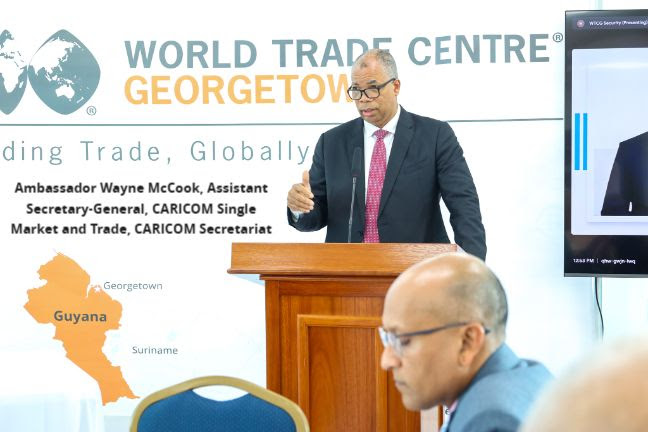
CARICOM Secretariat | Turkeyen, Greater Georgetown, Guyana | Thursday, 29 January 2026: A senior Caribbean Community (CARICOM) official has positioned deeper regional integration as a strategic response to an increasingly fragmented and uncertain global trade environment, as global rules-based systems weaken and economic nationalism intensifies.
Ambassador Wayne McCook, Assistant Secretary-General, CARICOM Single Market and Trade, was a panelist discussing Prospects for International Trade in 2026 in the Context of the Changing Global Geopolitical and Economic Landscape – Impact on Trade and the Challenges and Opportunities for the Caribbean and Latin America. The discussion was held on Wednesday, 28 January, at the World Trade Centre in Georgetown, Guyana.
Contextualising the Region’s position, Amb. McCook said: “For our Region, the scars of the immediate past are visible. The devastating passage of Hurricane Melissa encapsulated the dual challenge we face: the existential threat of climate change and the inherent economic vulnerabilities of our CARICOM Member States. Simultaneously, we have navigated dramatic shifts in global trade, driven largely by an intensified “America First” trade policy that has significantly impacted our exports, value chains and supply chains through a suite of unprecedented tariff measures.”
Against the background of what he described as “a truly tumultuous 2025” for international and regional trade, Amb. McCook highlighted CARICOM’s “oneness” and its resilience to navigate the “choppy waters” of the 21st century.
Amb. McCook warned that the erosion of multilateral trade norms is no longer theoretical, but already affecting investment, supply chains, and growth prospects worldwide.
According to UN Trade and Development (UNCTAD), global foreign direct investment fell by 11 per cent in 2024, marking a second consecutive year of decline, with further weakness expected in 2026. Global trade growth has slowed dramatically, falling below one per cent in 2025, even as uncertainty and geopolitical rivalry reshape supply chains.
Despite these headwinds, CARICOM’s trade performance has shown resilience. Between 2023 and 2024, CARICOM exports grew by 32 per cent to US$34.7B, with exports to the United States increasing by 86 per cent. However, recent data reveals uneven impacts across Member States.
The Assistant Secretary-General pointed to the recent steps toward full free movement of people by Barbados, Belize, Dominica, and St. Vincent and the Grenadines as tangible progress toward a more integrated Community.
“Fundamentally, CARICOM integration should be seen as a strategic response to a shifting global order,” he emphasised.
Addressing prospects for international trade in 2026, he advanced a multi-pronged strategy focused on strengthening intra-regional trade, strengthening existing relationships while diversifying global partnerships beyond traditional allies, and deepening economic integration. Central to this approach is the CARICOM Industrial Policy and Strategy (CIPS), and the 25×25+5 food security agenda aimed at reducing food import dependence and boosting regional production. Read his presentation here: https://caricom.org/deeper-caricom-integration-key-to-navigating-fractured-global-trade-order-amb-wayne-mccook/
On April 2, 2025, United States (US) President, Donald J. Trump, announced additional ad valorem tariffs of 10% on goods imports from all countries, including Caribbean Community (CARICOM) countries, under his new ‘Reciprocal Tariff Policy’. In addition, some countries like Guyana, which have a merchandise trade surplus with the US, will face even steeper additional tariffs. This article discusses these ‘Liberation Day’ developments and what they might mean for CARICOM countries.
The Reciprocal Tariff Policy
Earlier this year, on January 20, 2025, President Trump signed a presidential memorandum outlining the broad contours of his America First Trade Policy 2.0, initiating an investigation into the root causes of the country’s “large and persistent” merchandise trade deficit. This was followed by a second executive order, the Presidential Memorandum on Reciprocal Trade and Tariffs issued on February 13, 2025, which ordered a review of non-reciprocal trade practices and their contribution to the U.S. trade imbalance. On April 1, 2025, the President received the results of these investigations.
The executive order of April 2, 2025 entitled “Regulating Imports with a Reciprocal Tariff to Rectify Trade Practices that contribute to large and persistent annual US goods trade deficits” introduces the so-called Reciprocal Tariff Policy as a response to the national emergency supposedly caused by foreign trade and economic practices.
Using presidential authority pursuant to the International Emergency Economic Powers Act of 1977 (IEEPA), this policy applies an additional ad valorem duty starting at 10% on imports from all of the US’ trading partners, effective April 5, 2025 at 12:01 am (EDT). For countries in Annex I, these tariffs will increase to the country-specific rates outlined in that annex effective April 9, 2025 (EDT). For Guyana, the only Caribbean Community (CARICOM) country on Annex I, its goods exports to the US will be hit with additional ad valorem tariffs of 38%.
These tariffs are to remain in place indefinitely, until the President determines that the conditions warranting them have been “satisfied, resolved, or mitigated”. Additionally, the President has the authority to increase the tariffs if the countries retaliate. A narrow range of goods listed in Annex II of the Memorandum is exempt from the ad valorem tariffs.
These new ‘reciprocal’ tariffs aim to address what the Trump Administration perceives as chronic non-reciprocity in the US’ trade relationships, hampering U.S. manufacturers’ ability to compete in foreign markets and thereby threatening American jobs, manufacturing capacity, and competitiveness. However, the methodology used to determine these tariffs has faced criticism. If it is to be a so-called ‘reciprocal’ tariff, the initial thinking by many of us in the trade policy community was that the US would match the tariffs charged by these countries on US imports. Rather, according to financial journalist James Surowiecki in a post on X and later confirmed by economists and the administration, the formula for calculating the additional tariffs appears to involve simply dividing a country’s trade balance with the U.S. by the value of its exports to the US multiplied by ½ to arrive at the tariff rate. This has led to some of the poorest countries in the world being hit with disproportionately high tariffs based on this dubious formula. Moreover, tariffs have even been imposed on small uninhabited territories like the Heard and McDonald Islands, reiterating doubts about the logic behind the policy and on the more humorous side, giving rise to a raft of penguin memes on social media.
Possible implications for Caribbean economies and firms
However, this is no laughing matter as all goods exported from CARICOM countries to the U.S. will now face the additional 10% tariff, except for Guyana which faces a country-specific 38% tariff. This makes the costs of Caribbean products more expensive in the US, although there is the argument that they will also be competing with goods from other countries which might be subjected to even higher country-specific rates.
The US has a large trade surplus with the region on a whole, and with most Caribbean countries, with the exceptions of the commodity-exporting countries of Guyana and Trinidad & Tobago. Indeed, the US remains a key market for several important Caribbean exports, including energy products like oil, ammonia and methanol, as well as rum, textiles and other manufactured and agricultural products. Since the 1980s most CARICOM countries’ goods exports to the US are eligible to enter duty-free due to the Caribbean Basin Initiative and its constituent Acts. This is not a negotiated trade agreement, but a unilateral preferences programme which has enjoyed bipartisan US support because it benefits US manufacturing as the biennial US International Trade Commission (USITC) reports on the operation of the CBERA have consistently shown.
In her latest article, noted Caribbean economist Dr. Kari Grenade outlined a variety of ways in which these developments could impact Caribbean economies, including inflation as since the Caribbean imports a significant volume of US goods, including essential foodstuffs, this could lead to rising prices on our supermarket shelves. Analysis by Tax Foundation shows that the Trump tariffs amount to an average tax increase of more than $2,100 US per US household in 2025. What does this mean for the Caribbean diaspora in the US? What does this mean for Americans’ travel to the region if US consumers will be paying more for everyday goods and will have less disposable income ? What does this mean for those countries in the Caribbean which depend on the US as a major tourism source market?
What next? Firm and regional responses
The tariffs have not yet come into effect, and it is likely that they could be halted at the last minute given the backlash and stock market volatility the announcement has caused. Nonetheless, it is imperative for firms and Caribbean countries to plan for them. For Caribbean exporters which rely on the CBI concessions, this may necessitate rethinking export strategies, possibly by shifting to non-trade market entry strategies to maintain access to the U.S. market, or by diversifying into new export destinations. For those Caribbean companies which rely on inputs imported from the US, they could face higher costs as US manufacturers pass on their increased costs to intermediate and end consumers. This means they will have to continue to diversify their sourcing. Some firms are already doing this.
Retaliation is not a feasible option for CARICOM countries as we import much of what we consume from the US and already have high tariffs on imported goods. Where feasible, Caribbean countries could lower their applied rates on imported goods to help offset some of the pain consumers would feel. Our other main options are diplomatic, preferably as a grouping. Caribbean governments have been engaging in diplomatic outreach to urge the US to reconsider the policy or at least provide carve-outs for small countries. In a recent article, Antigua & Barbuda’s highly respected Ambassador to the US, Sir Ronald Sanders, has called on the US to revisit these tariffs as they are against the spirit of the CBI and US-Caribbean relations, have human and economic costs and also imperil US strategic interests. Indeed, this policy will make the price of US goods more expensive and further incentivise importers in the region to source more regionally or internationally. Moreover, many Caribbean nationals have customarily gone to the US, especially cities like Miami and New York, to vacation and shop, contributing to the economies of those cities. Caribbean nationals will increasingly go to cheaper destinations like Panama.
The ‘America First Trade Policy 2.0’ reinforces the need for us in CARICOM to accelerate efforts to expand our intra-regional trade and continue our trade diversification efforts. This is nothing novel and it is something we have long recognised. I listened to the speech of EU Commission President, Ursula von der Leyen earlier this week and found it noteworthy that the EU, a market of some 450 million people and with the economic heft to implement meaningful retaliatory measures also saw the salience of deeper integration and economic diversification to helping build its resilience and navigate this period of uncertainty. If deeper integration and diversification are important for the EU, they are doubly vital for us in CARICOM. After all, it is not just these tariffs we must contend with, but also the mooted fees to be placed on vessels which are Chinese made or are part of fleets which have a large number of Chinese-made vessels, which could impact many Caribbean countries.
A broader concern is the pall this beggar thy neighbour trade policy by US as the world’s largest economy casts over the rules-based multilateral trading system and the World Trade Organisation (WTO) which it was critical in establishing. While the multilateral trading rules are far from perfect, they have provided a predictable and rules-based framework where, inter alia, countries agreed to bind their tariffs for tariff lines at specific levels, which ensures some predictability for exporters. However, what the Trump administration is doing is contrary to the spirit of the multilateral trading system and will set off a global trade war as major economic powers react with their own retaliatory measures. As history shows, this will possibly have deleterious implications for the global economy, and just a mere five years after the world was hit by the worst pandemic in 100 years. This latest move heralds a more unpredictable, uncertain, unstable and unilateral era in global trade relations, one in which strategic diplomacy, regional cooperation and diversification will be key for CARICOM countries to navigate.
Alicia Nicholls, B.Sc., M.Sc., LL.B. is an international trade specialist and the founder of the Caribbean Trade Law and Development Blog: www.caribbeantradelaw.com.
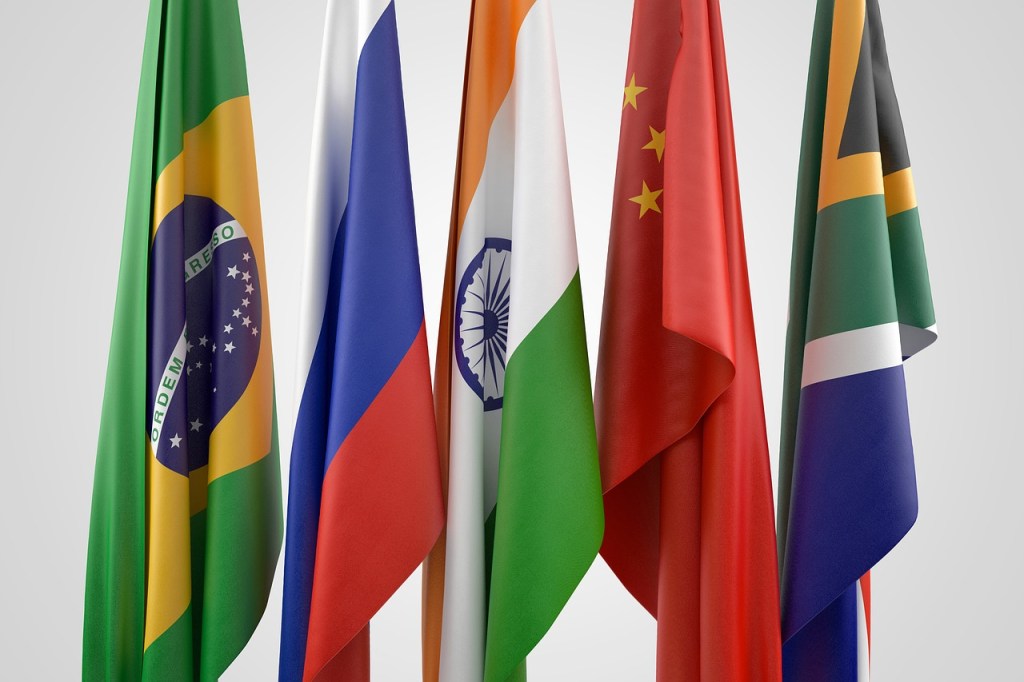
The 15th BRICS Summit was convened from Tuesday, August 22 to Thursday, August 24, 2023, in Johannesburg, South Africa. The BRICS acronym represents the fact that the current grouping comprises the five nations of Brazil, Russia, India, China, and South Africa, among the world’s largest and fastest growing emerging markets and developing countries, across continents. BRICS aims to serve as a platform for the voices and interests of the Global South.
As of 2022, the current five BRICS nations accounted for approximately 25 percent of global GDP (but 31.5 percent in terms of purchasing power parity (PPP), already surpassing the G7’s 30 percent), nearly 20 percent of global trade, 42 percent of the entire global population, and 26 percent of the world’s landmass. Intra-BRICS trade in 2022 topped $762 billion.
All five BRICS nations were represented at the leaders’ discussions by their heads of state (Russia’s President, Vladimir Putin, attended via videoconference, with Foreign Minister Sergey Lavrov leading the in-person delegation).
This year’s gathering garnered the most media attention of any BRICS summit and was the most heavily attended. South Africa’s President, Cyril Ramaphosa, invited the leaders of all 54 African states, as well as of 15 other Global South nations, in addition to representatives of major international organisations and regional groupings, including the United Nations and the G77+China (which presently includes 134 developing nations, and was represented by Cuba’s President, Miguel Díaz-Canel Bermúdez).
During this highly anticipated BRICS summit, member states deliberated on various global affairs issues. Some salient points are as follows[1]:
Clarification about what BRICS represents
BRICS leaders emphasised that, contrary to rumours in some pre-summit news coverage, the group is not aiming to challenge the West.
Brazil’s President Lula da Silva said, “We do not want to be a counterpoint to the G7, G20 or the United States.” “We just want to organise ourselves.” India’s Prime Minister Narendra Modi called on BRICS to be “the voice of the Global South.” Chinese President Xi Jinping also rejected “bloc confrontation,” insisting that “hegemonism is not in China’s DNA,” and called on BRICS to build a more just and equitable international order.
Reform of global financial institutions
“…We require a fundamental reform of the global financial institutions so that they can be more agile and responsive to the challenges facing developing economies…,” Ramaphosa told the summit’s Business Forum on Tuesday, August 22.[2] He lauded the achievements made by the New Development Bank (NDB). Known as the BRICS bank, NDB was established by the group in 2015 as an alternative to traditional Multilateral Development Banks (MDBs) such as the IMF and the World Bank.
In an August 22 interview with Financial Times (FT), Dilma Rousseff, former President of Brazil, and now President of the Shanghai-based NDB, stated that the bank, which already makes loans in China’s renminbi (yuan) currency, would also lend in the national currencies of other BRICS states: Brazilian real, Indian rupee, and South African rand.[3]
Per FT:
Rousseff said lending in local currency would allow borrowers in member countries to avoid exchange rate risk and variations in US interest rates. “Local currencies are not alternatives to the dollar,” she said. “They’re alternatives to a system. So far the system has been unipolar…it’s going to be substituted by a more multipolar system.”
The Brics bank has also tried to distinguish itself from the World Bank and IMF by not setting lists of political conditions on loans. “We repudiate any kind of conditionality,” Rousseff said. “Often a loan is given upon the condition that certain policies are carried out. We don’t do that. We respect the policies of each country.”[4]
NDB aims to issue 30 percent of its loans in local currencies by 2026, and 40 percent of funding is allocated to climate change mitigation and adaptation, including energy transition.
Global governance reform
In his plenary address, Ramaphosa said: “The world is changing. New economic, political, social and technological realities call for greater cooperation between nations. These realities call for a fundamental reform of the institutions of global governance so that they may be more representative and better able to respond to the challenges that confront humanity.”
Point 7 of the summit’s final communiqué also calls for “a comprehensive reform of the UN, including its Security Council, with a view to making it more democratic, representative, effective and efficient, and to increase the representation of developing countries.…”
Point 8 supports “the open, transparent, fair, predictable, inclusive, equitable, non-discriminatory and rules-based multilateral trading system with the World Trade Organisation (WTO) at its core, with special and differential treatment (S&DT) for developing countries, including Least Developed Countries.”
Sustainable development goals (SDGs) and climate mitigation
UNCTAD Secretary General, Rebeca Grynspan, in an interview with Xinhua news service ahead of the BRICS summit, called for a more inclusive multilateral system, naming China’s Belt and Road Initiative (BRI) as an example for cooperation on sustainable development.
“We need the voice of the South in revitalizing the sustainable development goals as the only real commitment for solidarity and collective action at the global level,” said Grynspan. “All the BRICS countries are also in the G20. We want to make multilateralism more vibrant, more inclusive, and to help build a more multilateral world even in a moment of more multipolarity.” “It’s important to have another platform that represents the perspective of the developing world and the need for development and more opportunities.”[5]
South African President Ramaphosa said that “…BRICS nations need to advance the interests of the global south and call for industrialised countries to honour their commitments to support climate actions by developing economic progress….”
Options for global trade currencies and payment settlement systems
At a BRICS summit plenary session Putin said, “…we see a need in increasing the role of our states in the international monetary and financial system, the development of interbank cooperation, the expansion of the use of national currencies and the deepening of cooperation between tax, customs, and antimonopoly authorities.”
Pointing out that “Global economic recovery relies on predictable global payment systems and the smooth operation of banking, supply chains, trade, tourism and financial flows,” Ramaphosa also added that BRICS “will continue discussions on practical measures to facilitate trade and investment flows through the increased use of local currencies.”
At present, BRICS members China and Brazil conduct their $170 billion of trade in their national currencies. China and Russia also settle 80 percent of their $190 billion trade in renminbi (yuan) and ruble using China’s CIPS and Russia’s SPFS payments settlement systems. Other nations settling part of their trade in yuan include Bolivia and Argentina, which recently also used yuan for an IMF loan payment. India offers rupee accounts with a growing number of trade partners, including Guyana.
Additionally, each of the current five BRICS nations is piloting or trialling its own Central Bank Digital Currency (CBDC), a concept invented and pioneered on the Caribbean island of Barbados.
Anil Sooklal, South Africa’s BRICS Sherpa said, “What we are talking about is creating more financial inclusion in terms of global financial transactions, global financial trade and how we conduct our payment.”
The group indicated that complex discussions about a common trade currency are ongoing and would be explored at next year’s summit. Currency deliberations were led by Standard Bank Group CEO Sim Tshabalala, who indicated that the BRICS Business Forum gave noteworthy consideration to Afreximbank’s Pan-African Payment and Settlement System (PAPSS) for cross-border payments within Africa.[6]
Reuters also reported that “South Africa’s finance minister said on Thursday that the BRICS grouping would not be looking to replace international payment systems including SWIFT, but rather consider creating one that would strengthen trade in local currencies.”[7]
Such a BRICS platform would hold potential for “networking the networks,” i.e., serving as an umbrella mechanism interconnecting geographically dispersed “satellite” national, regional, and coalitional payment systems.
Expansion of BRICS grouping to incorporate more Global South nations
In 2022 BRICS announced that it would consider accepting new members, and in the lead-up to this year’s summit, over 40 nations expressed interest in joining, with 22 nations submitting formal applications and another 20 making informal enquiries.
At the end of the summit, current BRICS members announced that they have invited six nations, Argentina, Egypt, Ethiopia, Iran, Saudi Arabia, and the United Arab Emirates (UAE), to become full members of BRICS effective January 1, 2024.
By including three OPEC nations (Saudi Arabia, UAE, and Iran), BRICS membership will now count six of the world’s top 10 oil producing nations (with almost 50 percent of both global oil production and reserves), and at least four of the world’s top 10 gas producing nations (in total, seven of the top 20) in its fold. By including Argentina, the group now has three of the top five lithium producing countries (Brazil and China being the other two). Recently, Iran also has discovered vast lithium deposits, potentially the world’s second largest reserves. In addition, BRICS includes four of the top five agricultural producing countries (now seven of the top 20). This expanded BRICS group includes seven of the G20 nations, thereby solidifying the input of the Global South.[8]
South Africa’s Minister of Finance, Enoch Godongwana, has indicated that this is just the first phase of admission of new members. BRICS leaders already have embarked on a second round of discussions, seeking consensus on additional member nations.[9] More countries are still in the queue to join BRICS, with Algeria, Bangladesh, Bolivia, Cuba, Indonesia, Kazakhstan, Kuwait, Thailand, Venezuela, and Vietnam among them. By next year’s summit, BRICS also aims to develop further guidelines for accepting prospective partner countries.
Fortification and diversification of global supply chains
In point 33 of the BRICS Summit 2023 final communiqué, the members state: “We encourage further cooperation among BRICS countries to enhance the interconnectivity of supply chains and payment systems to promote trade and investment flows.”
A cursory glance at a map of the globe will suffice to demonstrate the impact of this new phase of BRICS member expansion on stabilising global supply chains and securing key maritime and overland trade routes. The following graphic from an article by Marcus Lu (and Bhabna Banerjee) is useful[10]:
Russia–Ukraine conflict
Addressing the open plenary session of the summit, Ramaphosa said, “BRICS has proven itself to be a credible entity that stands in solidarity and seeks to promote a more equitable global system. We thank you also for the efforts that are being made by a number of BRICS countries to bring about a peaceful end to the conflict between Ukraine and Russia…. We agree that… these types of conflicts are best brought to an end by negotiations…BRICS members will continue to be supportive of the various efforts to bring this conflict to an end through dialogue, mediation and negotiation.”
Tracia Leacock, Ph.D. is an Independent Research and Content Consultant, with a keen interest in international relations. She may be contacted via Linkedin here.
[2] In point 10 of the BRICS Summit 2023 final communiqué, the members state: “We call for reform of the Bretton Woods institutions, including for a greater role for emerging markets and developing countries, including in leadership positions in the Bretton Woods institutions, that reflect the role of EMDCs in the world economy.”
[3] NDB lending in Russian ruble was suspended with the onset of the Russia–Ukraine conflict.




 Caribbean Trade Law and Development
You must be logged in to post a comment.