Tag: Correspondent Banking

  • FATF releases Guidance on Correspondent Banking Services

    Alicia Nicholls

    The Paris-based Financial Action Task Force (FATF) has released its long-awaited guidance on the application of FATF standards in the context of correspondent banking services following its plenary session held October 19-21st, 2016. The purpose of the guidance is to address de-risking and has been prepared in collaboration with the Financial Stability Board (FSB).

    The target audience for the guidance includes not just banks and money or value transfer service (MVTS) providers engaged in providing correspondent banking or respondent bank services, but financial institutions with account holders that are MVTS which in turn provide correspondent banking-type services to their own customers, as well as competent authorities (particularly AML/CFT regulators and supervisors of banks and of MVTS providers).

    Key Points from FATF Guidance on Correspondent Banking Services

    Some key points from the Guidance are as follows:

    • FATF recommendations do NOT require the correspondent bank to know its customer’s customers (KYCC). In other words, correspondent banks are not required to conduct CDD (Customer Due Diligence) on the individual customers of its respondent institution.
    • While noting that simplified CDD are never appropriate in the cross-border correspondent banking context, FATF explains that not all correspondent banking services carry the same level of money laundering or terrorist financing risk so enhanced due diligence measures must be commensurate with the degree of risk identified.
    • FATF identified some factors to consider in assessing correspondent banking risks, including the respondent institution’s jurisdiction, products/services offered and customer base. FATF recommended the risk factors included in Annex II of the BCBS Guidelines on Sound Management of Risks related to ML/FT.
    • However, FATF stopped short of defining what constitutes a higher risk on the basis that doing so could lead to ‘a tick the box approach’ which could encourage, rather than discourage, de-risking.
    • The requirements of FATF Recommendations 10 (Customer Due Diligence) and 13 (Correspondent Banking) must be met before correspondent banking services may be provided to a respondent institution.
    • Correspondent institutions may obtain information required by FATF recommendations 10 and 13 directly from the respondent institution but this information MUST be verified in order for it to meet those requirements.
    • FATF provided some examples of sources of verification from BCBS General Guide on Account Opening
    • On-going due diligence of existing and new CBRs is required but the frequency should depend on the level of risk associated with each relationship.
    • FATF recommended maintaining an on-going, open dialogue with correspondents and noted that while FATF requirements require termination of customer relations where identified risks cannot be managed in accordance with the risk-based approach (RBA), the other options offered by recommendation 10 should be explored before the relationship is terminated.

    This is welcomed news especially for Caribbean countries which, according to a World Bank study released in September 2015, appear to be the most affected by the loss of correspondent banking relationships.  This guidance is an important step in tackling de-risking by providing definitive clarity on a number of key areas, including on the hitherto confusing issue of KYCC.

    It also stresses against the wholesale termination of CBRs as a first resort, but rather keeping an open dialogue with respondent banks. If followed, therefore, the guidance should reduce the alacrity with which some banks have restricted or terminated correspondent banking relationships. However, this guidance is not binding and the effectiveness will depend on the level of observance by foreign banks and by their regulators.

    The Guidance on Correspondent Banking Services is to be read in conjunction with FATF recommendations and guidance papers, including the guidance on RBA for the Banking Sector. It also complements other guidance on correspondent banking services previously released by the Wolfsberg Group and the Committee on Payments & Market Infrastructure (CPMI).

    The full FATF Guidance on Correspondent Banking Services may be read here.

    Alicia Nicholls, B.Sc., M.Sc., LL.B. is a trade and development consultant with a keen interest in sustainable development, international law and trade. You can also read more of her commentaries and follow her on Twitter @LicyLaw.

  • Caribbean States raise de-risking concerns at the 71st United Nations General Assembly

    Caribbean States raise de-risking concerns at the 71st United Nations General Assembly

    Alicia Nicholls

    De-risking was one of the myriad of developmental issues raised by small states of the Caribbean Community (CARICOM) at the 71st Regular General Assembly of the United Nations in New York over the past few days. The theme of the general debate of the 71st session was “The Sustainable Development Goals: a universal push to transform our world.”

    De-risking practices by banks involve the avoidance of risk by discontinuing business with whole classes of customers without taking into account their levels of risk. This is in direct contradiction to the risk-based approach advocated by the Financial Action Task Force (FATF). The major manifestation of bank de-risking has been the restriction or termination by large banks (particularly in the US) of correspondent banking relationships with banks and discontinuing relationships with money transfer operators (MTOs).

    While countries across the world have been affected by de-risking in varying degrees, a World Bank study published in 2015 found that the Caribbean region appeared to be the most affected by a decline in correspondent banking relationships. This situation is even more vexing considering CARICOM countries’ adherence to international regulations and best practices, including the recommendations of the Financial Action Task Force.

    Arguing that correspondent banking services are a public good, CARICOM countries launched a high-level diplomatic offensive over the past months to raise awareness and mobilise action on this serious issue. The restriction and loss of correspondent banking relationships not only threaten the region’s financial stability but also threaten to de-link Caribbean countries from the global financial and trading system, undermining their sustainable development prospects. There has, however, been limited international progress on this front despite strong advocacy and a myriad of studies on the issue by regional and international development agencies.

    Singing from the same hymn sheet, CARICOM representatives consistently raised the issue in their national speeches before the UN General Assembly.  In perhaps one of the most comprehensive and impassioned statements, Minister for Foreign Affairs of the Bahamas, H.E. Frederick Mitchell,  made de-risking the starting point in his speech, emphasizing not only the difficulty being faced in opening accounts, but also the impact on tourism, remittance and financial flows. Calling it a “moral imperative,” he reiterated Caribbean countries’ adherence to anti-money laundering rules, while condemning the over-regulation which has had led to the de-risking phenomenon. He also termed the attacks on the Bahamas and the CARICOM region as “inaccurate and unfair”.

    Touching on the sustainable development implications of de-risking, representative of Trinidad & Tobago, Senator the Honourable Dennis Moses, Minister of Foreign and CARICOM  Affairs, poignantly stated as follows:

    “The 2030 Sustainable Development Agenda recognizes that national development efforts need to be supported by an enabling international economic environment through international business activity and finance, international development cooperation, and international trade. However, the issue of financial institutions terminating or restricting correspondent banking relations in the CARICOM Region has destabilized the financial sectors of our Member States and has disrupted the Region’s growth and economic progress.”

    On behalf of Trinidad & Tobago and CARICOM, Senator Moses further called on “international banks to engage collaboratively with affected Member States to restore normal financial relationships between domestic banks and international markets.”

    Prime Minister of St. Kitts & Nevis, the Hon. Timothy Harris noted that “[a]lready, in the Caribbean, as of the first half of this year, some 16 banks, across five countries have lost all or some of their correspondent banking relationships putting the financial lifeline of these countries at great risk”. Highlighting Caribbean countries’ dependence on tourism and remittance flows, he further explained that “such [de-risking] actions threaten to derail progress, undermine trade, direct foreign investment and repatriation of business profits.”

    Laying the blame for de-risking on “heavy-handed” FATF regulations, Prime Minister of St. Vincent & Grenadines reiterated the potential of de-risking to disconnect Caribbean countries from global finance and “a shifting of potentially risky transactions to institutions that lack the regulatory wherewithal to handle them”. He further explained that “these [FATF] regulations must be revised urgently before legitimate transactions in the Caribbean–from credit card payments to remittances to foreign direct investment–grind to a halt.”

    Besides de-risking, CARICOM representatives raised several other development issues, including climate change, graduation policies of international development agencies, United Nations reform, the US embargo of Cuba, the attack on international financial centres by OECD countries and the on-going border disputes between Guyana and Venezuela and Belize and Guatemala. CARICOM states also congratulated newly elected UNGA President, Peter Thomson of Fiji, and thanked outgoing UN Secretary General Ban Ki-Moon for his service, particularly his support of SIDS.

    Alicia Nicholls, B.Sc., M.Sc., LL.B. is a trade and development consultant with a keen interest in sustainable development, international law and trade. You can also read more of her commentaries and follow her on Twitter @LicyLaw.
  • De-risking and its Foreign Trade Impact in the Caribbean

    De-risking and its Foreign Trade Impact in the Caribbean

    Alicia Nicholls

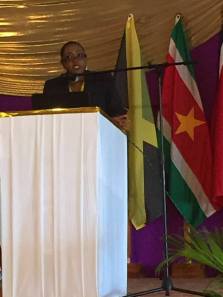
    A few weeks ago I had the honour and pleasure of presenting on the Foreign Trade Impact of De-Risking at the Institute of Chartered Accountants’ (ICAC) 34th Annual Conference in beautiful Belize as part of a panel discussion along with Dr. Trevor Brathwaite, Deputy Governor of the Eastern Caribbean Central Bank (ECCB) and Mr. Filippo Alario, Chief Risk Officer of Belize Bank.

    Alicia Nicholls ICAC 2016 Belize
    Alicia Nicholls  at ICAC 2016 Photo compliments of R Mohammed

    I wish to again express my gratitude to ICAC for the invitation and to all stakeholders and everyone who kindly provided me with information and assisted me in my research.

    Some of the key points from the presentation were as follows:

    • De-risking is a business decision but with serious implications for Caribbean foreign trade.
    • As small open economies, Caribbean countries are highly dependent on foreign trade as evidenced by their high trade to GDP ratios which range between 70-130% of GDP, according to World Bank data.
    • Several Caribbean countries are among the most dependent in the world on remittance-inflows.
    • Bank de-risking threatens the region’s integration into the global trade and financial systems and has implications for economic growth, stability, employment.
    • Disruptions to remittance and FDI flows by de-risking also have poverty alleviation and sustainable development implications.
    • Cross-border payment for goods via wire transfer and remittance sending appear to be the most affected from a trade perspective.

    Several persons  have written me requesting a copy of the full presentation. It is available below:

    ICAC_Presentation_2016_ANicholls(1)

    Alicia Nicholls, B.Sc., M.Sc., LL.B. is a trade and development consultant with a keen interest in sustainable development, international law and trade. You can also read more of her commentaries and follow her on Twitter @LicyLaw.

  • CARICOM countries continue fight against bank de-risking

    CARICOM countries continue fight against bank de-risking

    Alicia Nicholls

    The countries of the Caribbean Community (CARICOM) are continuing their fight against bank de-risking practices which are resulting in the restriction, threat of, or outright termination of correspondent banking relations with banks and wire transfer providers in the Caribbean region.

    Onerous global and national regulatory requirements (such as anti-money laundering and combating the financing of terrorism standards), burdensome compliance costs and the stringent sanctions for breach of these regulations are increasingly leading banks in metropolitan countries, particularly in the United States, to de-risk, that is, avoid risk by discontinuing business with whole classes of customers without taking into account their levels of risk, as opposed to managing and mitigating risk. While other countries are also experiencing this disquieting phenomenon, the Caribbean appears to be the most affected region according to a World Bank survey conducted last year.

    There are a number of other factors influencing de-risking decisions. Besides risk and reward considerations, added to the mix is the growing perception of the Caribbean as a “risky” place for financial transactions. The unwarranted attacks against legitimate offshore financial centres in the Caribbean in the wake of the Panama Papers scandal will no doubt unfortunately add fuel to the fire. The net result is an increasing unwillingness of international banks to continue correspondent banking relationships with banks and wire transfer providers in the region.

    Belize has been the hardest hit so far by bank de-risking, but other Caribbean countries are also being affected. In the International Monetary Fund (IMF)’s Caribbean Corner publication of September 2015, it was reported that “[a]lready at least 10 banks in the region in five countries have (as of June 2015) lost all or some of their CBRs, including two central banks.” This number has grown.

    At the meeting of the Financial Stability Board in Tokyo in March this year, Barbados’ Central Bank Governor, Dr. Delisle Worrell, reporting in his capacity as co-Chair of the Financial Stability Board’s Regional Consultative Group for the Americas, highlighted that eight correspondent banking relationships in Barbados’ international business sector have already been severed. He further warned that the lack of correspondent banking services could lead individuals to utilise unregulated channels, thereby limiting transparency and adding further risk to international transactions.

    The loss of correspondent banking relationships disrupts the processing of financial instruments, such as credit card transactions and cheques,  needed for trade, investment, tourism and remittance flows, and would effectively de-link regional economies from the international financial system. It also has humanitarian and poverty eradication consequences as well. Remittances are the “bread and butter” for many poor families who depend on earnings made by breadwinners abroad. In light of the serious threat posed to the region’s economic, financial and social stability by de-risking, CARICOM heads of government took the decision to raise the issue not just bilaterally but in multilateral fora.In March Caribbean countries sought the Organisation of American States’ support.

    Last week, Prime Minister of St. Kitts & Nevis, Dr. Timothy Harris took the lead during an important consultation with officials from the US State and Treasury Departments in Washington DC raised the serious impact de-risking was having on regional economies. The issue was also raised at the recently concluded Ninth UK-Caribbean Forum. The Ministers noted at paragraph 9 of the Communique:

    The Caribbean therefore called on the UK to continue to work with international
    partners to address this global phenomenon, and to encourage banks which
    provide correspondent banking services, and regulatory authorities, to take
    into account the efforts being made by Caribbean countries and financial
    institutions to implement international regulations and to mitigate risks.

    The full communique from that meeting may be viewed here.

    The Caribbean Association of Banks has also been playing a critical role in lobbying efforts. At the Association’s recently held CEO Forum on May 3rd, parties came together “to explore potential solutions and develop a set of actions in response to this threat”. According to the press release, the Forum “discussed and agreed” on the following possible solutions:  the establishment of a clearing institution in the US, alternative Payment Methods and alternative Correspondent Banking Relationships. The forum also established a six member committee to advance these recommendations. The full press release from the CAB’s CEO Forum may be viewed here.

    Alicia Nicholls, B.Sc., M.Sc., LL.B. is a trade and development consultant with a keen interest in sustainable development, international law and trade. You can also read more of her commentaries and follow her on Twitter @LicyLaw.