Tag: covid19

  • An uphill climb?  International Trade for Boosting Post-COVID-19 Growth in Least Developed Countries

    Lucius S.J. Doxerie – Guest contributor

    Lucius S.J. Doxerie

    The Covid-19 pandemic severely impacted/devasted the economies of countries that have been classified as ‘least developed’ by the international arena. It has prompted me to take a closer look at the ideation of resilience amid global shocks and market failures.

    The aim of this brief article is to examine the role of trade in boosting economic growth of least developed countries (LDCs) such as Haiti, Liberia and Timor-Leste. Special attention will be diverted to the type of preferential treatment received and the trade policies needed to increase the growth prospects in a post-Covid period. We first need to highlight the current situation with regard to trade amongst LDC countries as underscored by the World Trade Organisation (WTO) and will posit possible solutions to facilitate an amelioration of trade.

    According to (WTO 2022:5) “The top ten LDC exporters represented more than 80 per cent of LDC merchandise exports in 2011; this declined to 73 per cent in 2020. LDC exports continue to be concentrated in five major destination markets: China, the European Union, the United States, India and Thailand.”.

    As early as the 1930’s, discussion around the benefits of lessening restrictions to international trade and investment was actively happening among countries. In 1948, an international agreement was established among countries to reduce barriers to trade. After eight rounds of meetings, a General Agreement on Tariffs and Trade (GATT) was formed, and in 1995, the World Trade Ogranisation (WTO) was established. The WTO is an international trade governing body that is tasked with monitoring, enforcing and liberalizing trade amongst countries (Suranovic 2010).

    The key reasons why countries trade is summed up below.

    1. Differences in technology (Ricardian theory of comparative advantage)
    2. Differences in resource endowments (Pure exchange model of trade and Heckscher-Ohlin factor proportions model)
    3. Differences in demand (Monopolistic model)
    4. Existence of economies of scale in production (Increasing returns to scale)
    5. Existence of government policies among countries

    In the reality, trade takes place for many reasons. There is no single model or theory that captures all the reasons. For example, the Ricardian model, which focuses on the differences in technology among countries posits that everyone benefits from trade whereas on the other hand the Heckscher-Ohlin model suggests differences in endowments are the reason for trade and that there will be losers and winners. These traditional trade theories illustrate a myopic justification for trading as countries trade for a myriad of reasons. According to experts like Suranovic, most of these theories of trade are very simplistic in nature and generate unrealistic assumptions.  

    So let’s now discuss, especially in consideration of the quote below:

     “Least developed countries (LDCs) have been recognized by the United Nations since 1971 as the category of the states, which are deemed highly disadvantaged in their development process, for structural, historical and also geographical reasons”(Białowąs and Budzyńska 2022:1).

    As early as 1979, least developed countries have been receiving preferential treatment from advanced economies as part of the Tokyo round of the GATT. These preferences fall under what is coined the generalised system of preferences (GSP). As such, they have enjoyed exclusive schemes geared at entry into the markets of advanced economies by removing barriers such as tariffs and quotas from the early 2000s (Klasen et al. 2016).

    According to the WTO, “the Istanbul Programme of Action for LDCs (IPoA) for the decade 2011 to 2020 identified trade as one of the eight priority areas of actions for the economic growth and sustainable development of least-developed countries”(WTO 2022:3).

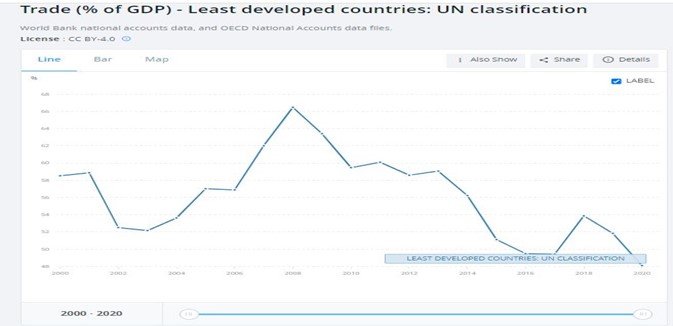
    Trade as a percentage of the Gross domestic Product (GDP) for LDC’s since the year 2000 is reflected below in figure 0.1.
    Source: http://data.worldbank.org

    The graph above illustrates that trade as a percentage of GDP for LDCs rose steadily from as early as 2003 up until the financial crisis in 2008. A downward pattern continued for another eight years until 2016, then there was improvement. However due to the Cocid-19 pandemic a downward movement has been evidenced since.

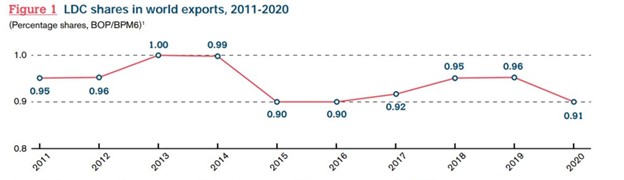
    The graph below illustrates the latest statistics of the LDCs share of world exports.
    Source (WTO 2022)

    We can clearly see that there was steady expansion of exports between 2017-2019. After the pandemic, there was a sharp decline of .04%, falling way below the expected target set by IPoA. (WTO 2022) shows that LDCs have seen declines over the last ten years in merchandise exports in all areas except clothing.  Although LDCs received preferential treatment, not all goods and services exported are covered (Antimiani and Cernat 2021).

    So what does this all mean, and what’s the bottom line?

    There is clear evidence supporting the WTO’s preferential treatment towards increasing  the revenues and economic prosperity of LDCs (Antimiani and Cernat 2021). Notably, there is still room for further easing of  trade barriers especially due to the shocks created by the pandemic. This is further underpinned by larger regional trade blocks emerging amongst developed countries undermining the efforts of the WTO (Palit 2015).  A 2016 paper carried out by (Klasen et al. 2016:5) using econometric techniques highlighted that “only Canada’s, Australia’s and EU’s trade preference systems have a positive and significant impact on LDCs’ exports”. Therefore, the following recommendations are proffered in the interest of economic uptake and growth through trade for LDCs.

    1. Establish regional trade agreements among LDCs to help increase their market share.
    2. Provide concessions for value added goods from LDCs within the global value chain for finished products exported by WTO members
    3. Increase the unilateral agreements enjoyed by LDCs  especially duty and quota free access to world markets on a wider range of products
    4. Increase the production and institutional capacity of LDCs by providing technical support to their industries
    5. Improve the LDC service waiver allowing it to cover more areas within the service industries

    These recommendations will allow LDCs to improve their trade practices, have more standardized procedures, facilate growth of local sectors which, in turn will increase the overall welfare of the economy and the people post covid.

    Note: Multiple WTO reports, textbooks and journals from industry experts were utilized in the writing of this article.

    Lucius S.J. Doxerie is an aspiring economist and co-founder and CEO of Stratagem Paradigms Inc.  He is a Chevening Scholar currently enrolled at the University of Bradford completing a Master of Science in Economics and Finance for Development. 

    REFERENCES

    Antimiani, A. and Cernat, L. (2021) Untapping the full development potential of trade along global supply chains: ‘gvcs for ldcs’ proposal. Journal of world trade 55 (5), 697-714.

    Białowąs, T. and Budzyńska, A. (2022) The Importance of Global Value Chains in Developing Countries’ Agricultural Trade Development. Sustainability 14 (3), 1389.

    Klasen, S., Martínez-Zarzoso, I., Nowak-Lehmann, F. and Bruckner, N. (2016) Trade preferences for least developed countries. Are they effective? Preliminary Econometric Evidence. Policy Review 4.

    Palit, A. (2015) Mega-RTAs and LDCs: Trade is not for the poor. Geoforum 58, 23-26.

    Suranovic, S. (2010) International trade: Theory and policy. The Saylor Foundation.

    WTO (2022) Boosting Trade Opportunities for Least Developed Countries. WTO. https://www.wto.org/english/res_e/publications_e/boottradeopp22_e.htm Accessed 22/03/22.
  • Closer Africa-Caribbean Relations: A COVID ‘legacy good’?

    Closer Africa-Caribbean Relations: A COVID ‘legacy good’?

    Alicia Nicholls

    Without doubt, if one considers the significant loss of life, human suffering and economic hardship inflicted by the novel coronavirus disease (COVID-19) since December 2019, the negatives far outweigh the positives. But as the saying goes, when ‘life gives you lemons, make lemonade’. For those unfamiliar with this phrase, it is an entreaty to make some good out of a less than ideal situation, no matter how bad it is. In this article, I argue that deeper south-south cooperation, and in particular closer Africa-Caribbean cooperation, appears to be one potential COVID-19 ‘legacy good’.

    First, let me state from the outset that bilateral and regional initiatives towards deepening Africa-Caribbean ties predate COVID-19. For instance, the African Union (AU) has for some time now recognized the African diaspora (including that in the Caribbean) as its sixth region. In 2019, the leaders of two African countries, Ghana and Kenya, respectively, made separate high-level visits to the region. Jamaica has its Africa-Caribbean Institute of Jamaica. An AU-CARICOM forum was planned for July 2020 but had to be unfortunately postponed due to the COVID-19 pandemic. CARICOM also announced the creation of a joint embassy to be housed in Nairobi, Kenya. Moreover, African and Caribbean countries participate and cooperate in various multilateral and other fora, such as the World Trade Organization (WTO), the United Nations (UN), Organisation of Africa, Caribbean and Pacific States (OACPS), the Commonwealth of Nations, as examples.

    However, it could be argued that the exigencies of the COVID-19 crisis have intensified the need for deeper Africa-Caribbean collaboration on areas of mutual interest in multilateral fora and at the regional and bilateral levels. As many western countries turned inward to focus on bringing the crisis under control in their countries, Caribbean countries were forced to turn to newer non-traditional partners for assistance in accessing vaccines. For instance, to use another South-South example, India’s generous donation of vaccines to Barbados and Dominica were critical to the start of Barbados’ vaccine programme which to date has vaccinated over 70,000 Barbadians, or nearly a third of the population. As such, it is heartbreaking to watch what is happening in India at the moment as it undergoes a deadly second-wave. I continue to keep our Indian brothers and sisters in my prayers.

    Turning back to Africa, CARICOM was also granted access to the Africa Medical Supplies Platform, a procurement system for medical supplies. Jamaica became the first CARICOM Member State to receive vaccine supplies under that mechanism. In a COVID-19 environment, improved vaccine access for developing countries has been a unifying theme for Africa and Caribbean countries’ multilateral cooperation, including at the sub-regional level. Both regions have condemned vaccine nationalism, particularly the hoarding of vaccines and imposition of export controls on needed medical supplies by some developed countries.

    Another laudable recent development in Africa-Caribbean cooperation is the formation of the Africa-CARICOM Group (AfCAR), a geopolitical grouping of sixty-eight African and Caribbean countries in the UN in March this year. Their first act was to issue a joint statement in the UN General Assembly in commemoration of  the ‘International Day of Remembrance of Victims of Slavery and Transatlantic Slave Trade’.

    There are many other areas in which Africa-Caribbean cooperation already exist, such as climate change, debt relief, financing for development and repatriations for the Trans-Atlantic Slave Trade, for example. There has been some  high-level cooperation involving Caribbean, African and Pacific countries on raising awareness on the de-risking issue, manifested most acutely by the withdrawal or restriction by large Western banks of correspondent banking services to banks in developing countries. African and Caribbean countries are among the most affected by this practice which has implications for trade, investment attraction and financial inclusion. The upcoming UNCTAD XV Quadriennial Conference due to be hosted virtually and chaired by Barbados in October this year presents another opportunity for our regions to collaborate on placing these and other issues on the global trade and development agenda.

    Additionally, as tourism-dependent Caribbean economies hard-hit by the COVID-19 pandemic seek to step up diversification efforts, African countries are among those targeted for greater economic engagement. Barbados has announced the creation of embassies in Ghana and Kenya (part of the CARICOM joint effort), while Jamaica will establish diplomatic relations with Liberia and Togo. Both Barbados and Jamaica have indicated the deployment of enhanced economic diplomacy as part of their Post-COVID-19 recovery strategies. There are also promising areas for further regional and bilateral collaboration, such as agri-business and sustainable agriculture, renewable energy, the cultural industries, education and digital payments systems.

    Naturally, for this momentum of closer Africa-Caribbean ties to be sustained, it must transcend the political level and trickle down to greater business-to-business and people-to-people engagement. Banking relationships would also need to improve to faciliate greater trade between the two regions. Current political discussions on improving air and sea connectivity would help to bolster the still meagre tourism, trade and investment ties between the two regions. Africa-Caribbean goods trade volumes remain small, with CARICOM countries enjoying a trade surplus with the continent on a whole.

    At the bilateral level, December 2020 saw an inaugural direct flight between Montego Bay (Jamaica) and Lagos (Nigeria), in hopes of commencing a regularly scheduled and most overdue direct link between the African continent and the English-speaking Caribbean. The potential for strong Africa-Caribbean tourism exists as an increasing number of Afro-Caribbean persons are interested in tracing their genealogy, discovering their African roots and learning about the ‘Motherland’. Encouragingly, the region’s top tertiary institution, The University of the West Indies (UWI) has signed a memorandum of understanding (MOU) with the University of Ghana. This raises the possibility of enhanced student and faculty exchanges, other educational collaboration and meaningful academic research between our two regions.

    As I conclude, I concur with the sage words of Dr. Len Ishmael who noted in her 2019 study ‘Under-invested: The Caribbean-African Relationship‘:

    “The future of Caribbean-African relations is one ripe with potential and promise, but it requires
    the investments of time, attention and political will to transform the relationship into one fit for
    purpose and suitable for these modern times.”

    It would also be remiss of me if in concluding I fail to lament the dearth of scholarship on Africa-Caribbean relations. As such, Afronomics Law will be hosting a scholarly Blog Symposium examining the “Prospects for deepening Africa-Caribbean Economic Relations”. The deadline for submission of blog contributions is May 14. Learn more about the symposium and how to submit a blog piece here.

    Alicia Nicholls, B.Sc., M.Sc., LL.B. is a trade and development consultant with a keen interest in sustainable development, international law and trade. All views herein expressed are her personal views and should not be attributed to any institution with which she may from time to time be affiliated. You can read more of her commentaries and follow her on Twitter @LicyLaw.

  • COVID-19: Side Effects on the World

    COVID-19: Side Effects on the World

    Image by Alexandra_Koch from Pixabay

    Renaldo Weekes, Guest Contributor

    Renaldo Weekes, Guest Contributor

    COVID-19 has been characterised by the disruption of many systems and procedures that the world uses to conduct business and everyday life. It follows, then, that the global economy took a severe hit when the virus spread across the world and forced many countries to close their borders and businesses to halt or slow their operations. Many began to ponder how countries, especially Small Open Economies (SOEs), would survive. Now that a year has passed since the start of the pandemic, many are eager to return to the life we once had.  Though this is possible with the availability of vaccines, there is no doubt that COVID-19 has left a scar on the world that may never be healed. In assessing this, we must consider the ways in which trade is impacted. Namely, through scams and Anti-Money Laundering (AML), tourism and immigration, and the acceleration of technological trends.

    Scams and Anti-Money Laundering

    Scams are schemes used to swindle money out of unsuspecting persons. The money gained from scams are laundered through the bank system in order to legitimize it. AML seeks to prevent the act of laundering money. In the context of the current COVID-19 pandemic, government agencies such as the Federal Trade Commission (FTC) have warned that fraudsters are sending phishing emails, posing as government agencies promising to provide aid in exchange for access to bank accounts.

    As many countries and businesses are slow to recover from the pandemic, many persons remain desperate and vulnerable to scammers who continue to exploit the situation. In light of the increase in scam activity at a time when Governments are hyper focused on providing relief, it is imperative that AML procedures are enforced to ensure that fraudsters do not slip by. National Public Radio (NPR) in the United States (US) reported that so many business requested assistance that the government could not properly vet who actually needed assistance and thus, many fraudsters slipped by. How does this relate to trade?

    Trade is driven by businesses and individuals located in different countries buying from or selling to each other. AML procedures can persuade persons seeking to do business in other countries. They indicate a jurisdiction’s commitment to stopping money laundering which can be used for things such as acts such as terrorism. Persons must be sure that their assets are safe. Scammers’ abilities to continually slip through the cracks during this crisis unscathed may serve as an indication of weak enforcement of AML procedures. Reviews of internal procedures must be prioritized. This issue is more likely to affect countries with an already undesirable AML rating, especially those that may have had the unfortunate privilege of being included on lists such as the European Union’s (EU) list of non-cooperative jurisdictions. Such lists can restrict foreign investment which is especially important to SOEs.

    Tourism and Immigration

    Tourism and immigration are two aspects of trade that are sometimes overlooked. Tourism is only associated with vacationing families and immigration associated with persons moving from one country to another permanently. However, there is more to these two areas. Tourism and immigration are predicated on the movement of people across borders and the pandemic has hindered this significantly, but how does this affect trade? We will consider tourism first. Tourism is defined by the UNWTO as “a social, cultural and economic phenomenon which entails the movement of people to countries or places outside their usual environment for personal or business/professional purposes.” It “has to do with their activities” which involves “tourism expenditure.” This definition notes that tourists travel for business, and contribute to expenditure. A paper entitled ‘Tourism and Trade: A Global Agenda for Sustainable Development’ notes that tourism counts as an export for the destination country and import for the tourists country of origin.

    Tourism expenditure directly involves several companies such as hotels, travel agencies and tour companies, and self-employed persons who focus on tourists. Indirectly, tourism involves companies that provide services to the aforementioned companies. Part of their success depends on the success of those directly impacted by tourism. It is no secret that tourism is major source of revenue for SOEs, especially those in the Caribbean. A decline in a major revenue earner for SOEs counts toward a decrease in their exports and leads to the disruption of the value chains that exist between companies that are involved in tourism.

    In addition to this, tourists aid building the brand of a country. Not only the for the sake of leisure but for the sake of investments. Each product they return home with, review of services and other infrastructure gives insight into the country. Tourists themselves can turn into possible investors. Being physically in a country provides experiences that online-only services cannot provide.

    With this coming to a sudden halt during 2020 and some countries struggling to fully reopen, it remains a struggle to regain ground for those that rely on tourism. Though the distribution of vaccines seems promising, there are reports of a third wave of the pandemic in some parts of the world. This third wave will likely result in the reinstatement of lockdowns which will further hinder the regrowth of tourism. The institution of a vaccine passport is another hindrance as those unable to receive the vaccine will not be able to travel. This is especially for those who live in relatively poor countries that must rely on the COVAX facility and the generosity of wealthier nations for vaccine doses.   

    Immigration

    Immigration, being similar to tourism in terms of the movement of people, is affected in many of the same ways as tourism. Closed borders and the institution of a vaccine passport limit rates of tourism and immigration alike. This notwithstanding, immigration affects trade and concomitant supply links in other in its own ways. Firstly, immigrants add to the number of workers within a country and this increases the capacity of businesses and investment since there would be, in theory, more productivity. Added to this is the fact that immigrants are willing to do jobs that natural born citizens of a country may not be willing to do. For example, immigrants in America perform jobs that native born Americans opt out of. This being the case, immigrants contribute greatly to the export of commodities such as agriculture as this sector is likely to be filled with immigrant workers.

    Secondly, immigrants forge links to their home country in their destination country. Immigrants have family and friends in their home country that they send remittances and other products to. In turn, they import products from their home country that may not be otherwise available in their new home. This diasporic link contributes to businesses that specially target immigrants. Recognizing the contributions that immigrants make to both their home country and their resident country, any downturn in immigration can hinder the growth of these trade links.  

    Acceleration of technological trends

    Before the pandemic began, certain practices within the global economy were trending either upward or downward. One such practice that was trending upward was the reliance on technology. The worldwide spread of COVID has pushed a work from home initiative that has made technology more of a necessity in our lives. Many businesses and governments were forced to have more online presence and reshape their operations to have more technological focus. The benefits of this include more fluidity in logistics and operations as there would be less administrative overhead. This translates to better trade fluidity since efficiency would be increased. This is especially important for SOEs that heavily rely on trade. They must have a state of the art customs system that facilitates fluid importation and exportation that serve as the lifeline of the country.

    Conclusion

    While most persons are concerned with the side effects of the coronavirus on the body, the pandemic itself will prove to have variety of side effects on the global economy at large. It may have been obvious to the majority of persons that the world would have been forced to change as result of a pandemic that has pushed the boundaries of our systems and made reconsider things once considered impossible. However, some persons may not have considered the specific ways in which the world would be changed, especially international trade. In light of increasing scams related directly the pandemic, the current limits placed on tourism and immigration, and the acceleration of trends that were already in place, it is imperative that persons be ready for the stresses and permanent changes that are in place or will be put in place as we prepare to leave COVID behind once and for all and rebuild our society and economy.

    Renaldo Weekes is a holder of a BSc. (Sociology and Law) who observes international affairs from his humble, small island home. He has keen interest in how countries try to maneuver across the international political and legal stage.

    The views and opinions expressed herein are solely those of the guest author and are not necessarily representative of those of the Caribbean Trade Law & Development Blog.

    SOURCES

    FEDERAL TRADE COMMISSION WARNING – https://www.ftc.gov/news-events/blogs/business-blog/2021/01/business-owners-latest-covid-scam-directed-you

    NPR – https://www.npr.org/2020/10/28/928792199/billions-in-covid-19-relief-loans-may-have-been-handed-out-to-scammers-report-sa

    TOURISM DEFINITION – https://www.unwto.org/glossary-tourism-terms

    TOURISM AS TRADE – https://www.intracen.org/uploadedFiles/intracenorg/Content/Publications/Tourism_and_Trade__low%20res_2014-2015-335.pdf

    DO IMMIGRANTS STEAL JOBS? – https://www.brookings.edu/blog/brookings-now/2017/08/24/do-immigrants-steal-jobs-from-american-workers/