
Tag: CSME

  • CSME working though ‘uneven and imperfect’

    CSME working though ‘uneven and imperfect’

    Alicia Nicholls

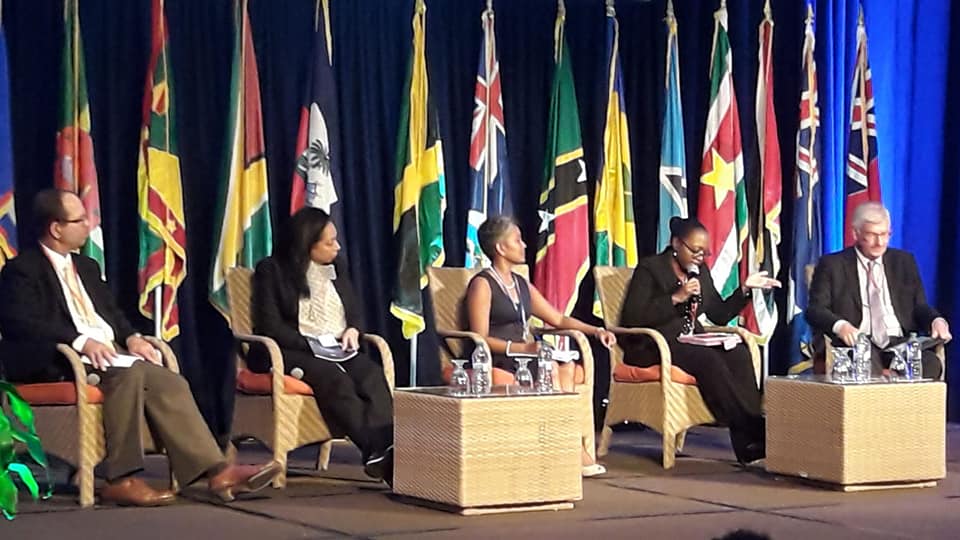
    Though “uneven and imperfect”, the five regimes of the CARICOM Single Market and Economy (CSME) (free movement of skilled nationals, capital, goods, services and the right of establishment) are working. This was the assurance given to audience members by His Excellency Ambassador Irwin Larocque, Secretary General of the Caribbean Community (CARICOM), in his welcome remarks at a public regional stakeholder consultation on the CSME. The event was held at the Errol Barrow Centre for Creative Imagination (EBCCI) of The University of the West Indies Cave Hill in Barbados on Monday, November 4th.

    The stakeholder discussion, which was also streamed online and broadcast via television, attracted a packed audience which included a wide cross-section of the general public, as well as online viewers from across the region. The moderator for the evening was Mr. Salas Hamilton, Communication Specialist at the Barbados-based CSME Unit.

    In his welcome remarks, Ambassador Larocque outlined some of the progress made on the regional agenda, including the recent St. Ann’s Declaration on Contingent Rights, work on government procurement and discussions around creating a single CARICOM Information and Communication Technologies (ICT) space. Noting that the public was an important constituency of the regional integration process, the Secretary General invited audience members to provide feedback on what needs to be done, whether the region was on the right track and whether what was being done impactful.

    President of the Caribbean Development Bank (CDB), Dr. Warren Smith, applauded Barbados’ Prime Minister, the Hon. Mia Amor Mottley, for “injecting a new energy into the CSME”. Under the quasi-Cabinet of CARICOM, Barbados has lead responsibility for the CSME. In making the case for an acceleration of the CSME, Dr. Smith reiterated the original vision of the CSME’s architects of increasing the competitiveness and viability of Caribbean economies on a global stage. Our region’s focus, he noted, must be on becoming an internationally competitive trading bloc, particularly given the shift towards inward looking policies and retreat from multilateralism by some of our main trading partners.

    Prime Minister Mottley reiterated that economic statistics show that the Caribbean is under-performing the world. She also noted that within the next 15 months there will be 8 general elections across the region which could put the pace of integration under strain. The Prime Minister noted that functional cooperation has been working for the region, and called for everyone to get on board to avoid the Caribbean becoming a source of climate refugees and having one of the poorest levels of economic performance in the world by 2050.

    Prime Mottley and Ambassador Lacroque fielded questions for over two hours during a lively question and answers session. The questions ranged on a variety of topics including consumer protection, the Labour Market Information System, the diaspora, youth engagement, indigenous persons, derisking, the high costs of intra-regional travel, to name a few.

    In response to a question on better integrating Haiti into the CSME, Ambassador Larocque indicated that there are ongoing discussions on providing a ‘special development dispensation’ for Haiti. He indicated CARICOM’s concern with the current political situation in Haiti and called for dialogue.

    Prime Minister Mottley suggested that CARICOM Member States commit to a minimum level of social development, what she termed a ‘social floor’, for things such as health, education and the like. She further highlighted the need for the end to roaming charges across the region through the creation of a single CARICOM ICT space. She also reiterated the need for CARICOM Heads of Government to meet more frequently than the current two meetings per year, and that technology now makes more frequent meetings possible.

    There were also several useful audience interventions, including one by Dr. Olivia Smith who called for a Labour Market Impact study, as well as the need for clarification of what “indefinite stay” means given the trouble some persons encountered with financial institutions when seeking to access financing.

    My take-aways

    There was much to take away from the discussion. However, while much ink has been spilled about the implementation deficit plaguing CARICOM, equally crippling is the information deficit. This prompted me to ask my question, which thankfully was one of the questions addressed, on the paucity of data and information.

    First let me applaud the CARICOM Secretariat for its increasing use of social media, its CARICOM One on One discussions and weekly news broadcasts. These are welcomed developments. However, the CARICOM website remains challenging to navigate in terms of finding information. Secondly, the communiques released at the end of meetings (when they are released) remain vague with little substance. Thirdly, decisions of Heads of Government should be made public. These decisions, after all, are binding on Member States and also have implications for we the average CARICOM citizen. Fourthly, there are many studies and documents which have been commissioned by CARICOM which are not online. Fifthly, live streaming of certain CARICOM meetings (and not just the opening ceremonies) should be public once they are not of a national security nature.

    Finding information and data remains a tedious task for persons conducting research in the Caribbean, far less, the average citizen who simply wishes to keep up to date with regional developments. Lack of information also feeds the impression that “CARICOM is doing nothing”, when indeed we know that there is some progress happening. Our regional process still remains opaque and there is need for much more transparency and information flows.

    On another note, I think there is cause for optimism. We often hear of apathy of the average Caribbean citizen towards CARICOM. The packed audience and the high level of engagement at the just concluded forum show that there is at least some level of engagement on the part of the regional public in wanting to know what is happening with the regional process. The questions posed, for the most part, were substantive and related to real issues faced by CARICOM nationals each day. There were also several suggestions raised which shows that people are thinking about ways the regional process could be improved.

    It shows that there is the need for more frequent engagement and contact between the average citizens and their leaders on regional issues. It is therefore heartening to hear that future public stakeholder sessions will be conducted.

    Another nugget of hope was the high level of youth engagement and attendance at the form. The future of our regional integration project lies with our youth. They are the ones who will be most utilizing the five CSME regimes now and in years to come. They will be the ones charged with taking the regional project forward. The youth involvement displayed at the forum, therefore, is a good sign.

    In conclusion, the CARICOM Secretariat (including the CSME Unit), the Office of the Prime Minister of Barbados and The UWI must be commended for hosting a very stimulating and rich discussion. It is hoped that similar public events will be hosted in other CARICOM countries and will be held with some frequency. You can view my live tweets from the event at #csmetownhall.

    The video recording from the event may be accessed below:

    Alicia Nicholls, B.Sc., M.Sc., LL.B., is an international trade and development consultant with a keen interest in sustainable development, international law and trade. You can also read more of her commentaries and follow her on Twitter @LicyLaw.

    DISCLAIMER: All views expressed herein are her personal views and do not necessarily reflect the views of any institution or entity with which she may be affiliated from time to time.

  • Caribbean Trade & Development Digest – October 20-26, 2019

    Caribbean Trade & Development Digest – October 20-26, 2019

    Welcome to the Caribbean Trade & Development News Digest for the week of October 20-26, 2019! We are happy to bring you the major trade and development headlines and analysis from across the Caribbean Region and the world from the past week.

    THE WEEK’S HIGHLIGHTS

    South Korea has agreed to give up its ‘developing country’ status in future negotiations at the WTO. This move is in light of increased US pressure for a change in the current system of self-designation as a developing country at the WTO. Read here.

    The Caribbean Court of Justice (CCJ) held a two-day hearing in its first ever application for an Advisory Opinion. At the end of the second day, the judges indicated that they would deliver their decision in a “reasonable time”. Read more here.

    The World Bank has released its latest Doing Business Report (2020). Find out how the Caribbean fared here.

    REGIONAL NEWS

    Bermuda Launches Two Key Fintech Initiatives, Becomes First Nation to Accept Stable Coins for Government Payments

    National Law Review: On Oct. 16, 2019, Bermuda Premier the Hon. E. David Burt JP, MP announced that Bermuda has committed to accept, for payment of government taxes, fees, and services, 1:1 U.S.-dollar-backed digital currencies of entities licensed by the Bermuda Monetary Authority (BMA) under the 2018 Digital Asset Business Act (DABA), becoming the first nation to do so. Read more

    Antigua To Sell Shares In State-Owned Oil Company

    Jamaica Gleaner: The Antigua and Barbuda government says it is to sell 10 per cent of its shares in the state-owned West Indies Oil Company (WIOC). Read more

    Belize Senate ratifies UK-CARIFORUM trade treaty

    Breaking Belize News: Тhе Ѕеnаtе mеt іn ѕресіаl ѕеѕѕіоn thіѕ mоrnіng іn rесоrd tіmе tо rаtіfу а trеаtу ѕаfеguаrdіng trаdе bеtwееn Веlіzе аnd fеllоw Саrіbbеаn ѕtаtеѕ аnd thе Unіtеd Кіngdоm. Read more

    CARICOM to await CCJ decision on waiver for free movement

    Jamaica Observer: The five (5) Justices of the Caribbean Court of Justice (CCJ) have promised, at a “reasonable time,” to deliver their decision on whether countries within the Caribbean Community (CARICOM) can lawfully, under the legal framework of the organisation, choose to opt-out of obligations set out in the Caribbean Single Market and Economy (CSME) agreement. Read more

    The Caribbean exhibits record of reforms in business sector in 2018

    Prensa Latina: The economies in the Caribbean carried out a record of 19 reforms during 2018 to help private national companies do business, a report released today by the World Bank (WB) says. Read more

    Jamaica Opposition welcomes reversal in Ease of Doing Business ranking

    Jamaica Observer: People’s National Party (PNP) shadow minister of Industry, Competitiveness & Global Logistics Anthony Hylton has welcomed the reversal in Jamaica’s ranking in the World Bank’s Ease of Doing Business Report 2020. Read more

    Agricultural woes: building a domestically and internationally competitive sector

    Dominica News Online: Finding agricultural products that can compete both on the domestic and international markets has been singled out as one of the major challenges facing the sector in the region. Read more

    INTERNATIONAL NEWS

    Nigeria’s border closure has implications for Africa’s economic integration

    The Conversation: Nigeria recently partially closed its border with Benin in an effort to stem the smuggling of rice. It then went on to close its land borders to the movement of all goods from Benin, Niger and Cameroon, effectively banning trade flows with its neighbours. Read more

    China Signs its First African Free Trade Agreement with Mauritius

    China Daily Briefing: China and Mauritius signed a free trade agreement (FTA) on October 17. This is China’s first FTA with an African nation. The agreement will reportedly give Mauritius duty-free access to about 8,547 products, representing 96 percent of Chinese tariff lines. Read more

    RCEP deal hangs in balance even as India, other members resolve some issues

    Livemint: India and other member countries of Regional Comprehensive Economic Partnership (RCEP) may have resolved differences related to investor to state dispute settlement (ISDS) mechanism and data localization, but issues such as India’s demands to shift the base year for tariff cuts to 2019 and an auto-trigger mechanism to check import surge from China may make or break a deal. Read more

    China submits 7th offer to join government procurement agreement at WTO

    Xinhua: China has submitted the 7th offer to join the World Trade Organization’s (WTO) Agreement on Government Procurement (GPA), which added the military sector for the first time, according to the Ministry of Finance. Read more

    China’s New Investment Law a Positive Step, Foreign Firms Say

    Bloomberg: China’s new law governing foreign investment will take effect next year. Read more

    US-China Trade Truce: Cautious Optimism or Reasonable Pessimism?

    Modern Diplomacy: China and the United States have achieved tangible progress in their recent round of trade talks. This has given rise to cautious optimism about the possibility of striking a deal, writes the Chinese edition of Global Times. Read more

    Brexit: European leaders agree extension to 31 January

    BBC: EU leaders have agreed in principle to extend Brexit until 31 January 2020 – meaning the UK will not leave as planned on Thursday. Read more

    Breaking down the path forward for the USMCA

    Politico: With fewer than two dozen legislative days left in the year, the pressing question for the USMCA is not just whether U.S. Trade Representative Robert Lighthizer and House Democrats will be able to reach a deal, but whether they still have enough time to get it done by 2020. Read more

    The EU should be leading this new era of FTAs, shaping new standards and spurring on growth

    Euronews: The next EU Trade Commissioner faces a daunting in-tray. Certainty is in short supply and difficult decisions abound. Many of them are marked urgent. Read more

    China asks WTO for $2.4 billion sanctions against U.S. in latest clash

    Reuters: China is seeking $2.4 billion in retaliatory sanctions against the United States for failing to comply with a World Trade Organization ruling in a case that highlights White House complaints about the global trade body. Read more

    STRAIGHT FROM THE WTO

    NEW ON THE CTLD BLOG

    The Caribbean Trade & Development Digest is a weekly trade news digest produced and published by the Caribbean Trade Law & Development Blog. Liked this issue? To read past issues, please visit here. To receive these mailings directly to your inbox, please subscribe to our Blog below:

  • Caribbean Trade & Development Digest – September 8-14, 2019

    Caribbean Trade & Development Digest – September 8-14, 2019

    Welcome to the Caribbean Trade & Development News Digest for the weeks of September 8-14, 2019! We are happy to bring you the major trade and development headlines and analysis from across the Caribbean Region and the world from the past week.

    HIGHLIGHTS

    Prime Minister of Barbados, the Hon. Mia Amor Mottley, delivered the prestigious 16th Raul Prebisch Lecture. Prime Minister Mottley’s theme was ‘Invisible yet Indispensable’. The full lecture may be watched here.

    UNCTAD held its first UN Trade Forum, with climate change as the major focal point. This week also marked the twenty-fifth anniversary of the conclusion of the Uruguay Round which culminated in the formation of the World Trade Organization (WTO).

    On a personal note, I had the pleasure and honour of being a panelist at the 3rd annual BITT Conference ‘Central Bank meets Blockchain. I spoke on the potential benefits of BITT’s proposed blockchain-enabled Caribbean Settlement Network (CSN) for facilitating intra-regional payments and trade, regional integration and development. Kudos to my fellow panelists, to the moderator and to the BITT team on an informative and well-executed conference!

    L-R – John Williams (CEO, Cave Shepherd Group of Companies), Racquel Moses (CEO, Caribbean Climate Smart Accelerator), Marla Dukharan (Chief Economist of BITT and moderator of the panel), Alicia Nicholls (Trade Specialist, UWI) and Geoffrey Scott (Executive Director, ICBL).

    REGIONAL NEWS

    Barbados leader urges moral leadership to tackle climate crisis

    UNCTAD: Prime Minister of Barbados, Mia Amor Mottley, challenged the world to reinvent the international order and do better by small island states that are on the frontlines of the climate crisis, fighting for their survival in a war they did not start. Read more

    Hefty bill for pork imports

    Barbados Advocate: A Government official is gravely concerned with the fact that millions of dollars are being spent on importing pork into Barbados. Read more

    JAMPRO targeting Latin America for Jamaican exporters

    Loop Jamaica: To increase Jamaican exporters’ access to Latin American and Caribbean (LAC) markets, Jamaica’s trade and investment promotions agency, JAMPRO, will be leading a delegation of 6 companies to the LAC Flavors trade exhibition in Cali, Colombia. Read more

    Digitally transforming the Eastern Caribbean

    World Bank: The Caribbean has been at the forefront of the resilience-building agenda. For countries in the region, most of them Small Island States located in the path of strong and recurrent hurricanes, climate change adaptation is a matter of survival. The passage of Hurricane Dorian in 2019 is a stark reminder of this vulnerability. Read more

    Region good for trade

    Newsday: Trade and Industry Minister Paula Gopee-Scoon believes the region has evolved to transform its economies to some extent away from traditional sectors into the production of high value-added goods. Read more

    Bahamas suspends immigration crackdown

    Jamaica Observer: The Bahamas Government says it has suspended the crackdown on illegal migrants in the Abacos and Grand Bahama, as the death toll from the passage of Hurricane Dorian a week ago climbed to 45. Read more

    Dr. Rowley goes to Washington

    Trinidad Express: Within 24 hours of his arriving in Washington DC, Prime Minister Dr Keith Rowley met with a number of high-ranking members of the United States Congress on Thursday. Read more

    Caricom Silent While Refined Sugar Quarrel Rages

    Jamaica Gleaner: It might be working feverishly behind the scenes to cool tempers and iron out differences as it normally does in these matters, but the secretariat for regional trade bloc Caricom is not saying anything publicly about the running battle between regional sugar producers on the one hand, and manufacturers and national governments. Read more

    Greater ties with CARICOM-Africa Trading Partners

    Barbados Advocate: The changing nature of the world economy is demanding that there be greater co-operation between Barbados and its Caribbean Community trading partners as well as with African countries. Read more

    Trump admin won’t give temporary protected status to Bahamian victims of Hurricane Dorian

    CNBC: The status would have let Bahamians work and live in the U.S. until it is deemed safe to return home. Read more

    Trade issues too distant from climate issues, says Vaz

    Jamaica Observer: Jamaica has called on member countries of the World Trade Organization (WTO) to include the cost associated with climate change in any discussion on international trade. Read more

    The Rum Market In The UK Could Grow By 8.8% In Coming Years

    The Voice: Caribbean Rum is one of the preferred drinks of the British, a fact reflected in the market, which is expected to grow in the UK by 8.8% in coming years. Revenue in the rum segment for 2019 amounts to nearly £1 million. Read more

    INTERNATIONAL NEWS

    All 16 nations set for final RCEP deal: Australian negotiator

    The Hindu: Amidst conflicting signals from the government over whether India will join the Regional Comprehensive Economic Partnership (RCEP) this year, Australia’s lead negotiator for the 16-nation free trade agreement (FTA) says all countries have “committed” to completing talks in time for the RCEP summit on November 1. Read more

    Mexico may be an unexpected winner of the US-China trade war

    CNBC: China and the United States are disrupting trade in much of the world with their trade war — but Mexico may be a winner. Read more

    Wary of China in RCEP, India looks for bilateral deals amid mounting trade deficit

    Business Today: In 2018-19, India had trade deficit with 11 out of 20 RCEP countries. In 2017-18, it had a trade deficit of $104 billion with all RCEP countries; more than half of this ($57.86 trillion) was with China. Read more

    A Latin American Brexit? Analysing Brazil’s threat on Mercosur

    Buenos Aires Times: Jair Bolsonaro has said Brazil could leave Mercosur if Argentina, the second-largest economy in the customs union, pivots to the left after presidential elections in October. But how feasible is such a break? Read more

    South Korean Duties on Japanese Valves Violate Rules, WTO Finds

    Bloomberg: The World Trade Organization on Tuesday ruled for a second time that South Korea’s anti-dumping duties on Japanese valves violate international trade rules, according to a decision published on the WTO website. Read more

    Trump Advisers Consider Interim China Deal to Delay Tariffs

    Bloomberg: Trump administration officials have discussed offering a limited trade agreement to China that would delay and even roll back some U.S. tariffs for the first time in exchange for Chinese commitments on intellectual property and agricultural purchases, according to five people familiar with the matter. Read more

    WTO on brink of crisis due to inaction over dispute-settlement reforms, Birmingham warns

    Sydney Morning Herald: Trade Minister Simon Birmingham has warned inaction over reform of the World Trade Organisation’s dispute-settlement system has taken the body to the brink of crisis. Read more

    A New Phase in Japanese-South Korean Relations as Trade Becomes Weapon in Political Row

    Nippon: Japanese and South Korean relations entered a new phase when the Japanese government announced on July 1 that it was going to “normalize” its export control measures, in effect curbing its trade with South Korea. The move linked a political conflict between the two countries with the economy in a way that has not been seen before. Read more

    Trade rep sends responses on revised NAFTA deal to Democrats

    Politico: U.S. Trade Representative Robert Lighthizer on Wednesday formally responded to House Democrats’ concerns about the new North American trade agreement, marking a step forward in negotiations between the Trump administration and Capitol Hill. Read more

    Britain agrees post-Brexit trade deal with southern Africa

    Reuters: Britain has agreed a deal with six southern African countries including South Africa, the continent’s most developed economy, that will ensure continuity of trade conditions after Brexit, the British High Commission in South Africa said on Wednesday. Read more

    New EU trade commissioner is Phil Hogan

    BBC: Irishman Phil Hogan has been named as the EU’s new trade commissioner. His appointment was announced at a press conference by the incoming head of the European Commission, Ursula von der Leyen. Read more

    Trump poised to hit EU with billions in tariffs after victory in Airbus case

    Politico: The United States has gotten the green light to impose billions of euros in punitive tariffs on EU products in retaliation for illegal subsidies granted to European aerospace giant Airbus. Read more

    Countries dependent on commodities should diversify economies to survive climate crisis, says UN report

    UNCTAD: Economic and export diversification is the best response to the challenges posed by climate change in developing countries that depend on commodities, according to UNCTAD’s Commodities and Development Report 2019. Read more

    WTO NEWS

    NEW ON CTLD BLOG

  • CARICOM Protocol on Contingent Rights: An important Step to CSME Consolidation

    CARICOM Protocol on Contingent Rights: An important Step to CSME Consolidation

    Alicia Nicholls

    The Government of Barbados has recently announced a Bill entitled the Caribbean Community (Amendment) Bill 2019, which, when passed, would amend the principal Act to give effect to the CARICOM Protocol on Contingent Rights, making it part of Barbadian law.

    Barbados, along with six other CARICOM Member States, had signed the Protocol during the 39th Regular Meeting of the Conference of CARICOM Heads of Government in Montego Bay Jamaica in July 2018.

    Following the recently held 30th Inter-sessional Meeting of the Conference of CARICOM Heads of Government in St. Kitts & Nevis, it has been reported that all CSME participating Member States have now signed the Protocol. But what is the Protocol about and why is it necessary for the consolidation of the CSME?

    What is the Protocol on Contingent Rights and Why is it Necessary?

    The Revised Treaty of Chaguaramas confers a number of rights to Community Nationals, including the right of establishment, the right to provide services, the free movement of capital and of skilled Community Nationals to seek employment in other CSME participating Member States. However, it was recognised by Member States that despite these rights (called ‘primary rights’) being conferred, additional enforceable rights (or ‘contingent rights’) were needed to ensure that Community Nationals could enjoy them effectively and without frustration.

    For example, there was concern by CARICOM nationals who were working in other jurisdictions about their inability to access social services on the same basis as nationals of the host country, the inability of their spouses to also legally seek employment, and for their children to access primary education on the same basis as the children of nationals of the host country. These barriers frustrate the exercise of the rights conferred in the Revised Treaty.

    The Protocol, which was a long time in the making, confers certain enforceable social and economic rights to Community Nationals and their immediate families who make use of the right of establishment, the right to provide services, the right to move capital and the free movement of skilled labour under the Revised Treaty of Chaguaramas. As such, the Protocol is not only a starting point for addressing some of the issues currently faced by Community Nationals seeking to exercise these rights effectively, but is, therefore, an important step towards the consolidation of the CSME.

    Rights guaranteed under the Protocol

    The framers of the Protocol define ‘contingent rights’ as “rights to which a national and his or her spouse and immediate dependents are entitled, contingent on the exercise by the principal beneficiary of the right of establishment, provision of services, movement of capital or free movement of skills”.

    Subject to certain exceptions, the contingent rights currently guaranteed under the Protocol are:

    • the right of a principal beneficiary resident in a host country, his or her spouse or their dependants to transfer capital into and from a host country subject to Article 43 of the Treaty, which speaks to restrictions to safeguard balance of payments;
    • the right of a spouse or dependants of a principal beneficiary resident in a host country to leave and re-enter a host country;
    • the right of the spouse of a principal beneficiary resident in a host country to work in a host country without a work permit;
    • the right of a principal beneficiary resident in a host country and his or her spouse to access on a non-discriminatory basis lands, buildings and other property for residential or business purposes reasonably connected with the exercise of the rights of the principal beneficiary;
    • the right of dependent children of a principal beneficiary resident in a host country to access primary education on a nondiscriminatory basis, where and to the extent provided by the Government of the host country;
    • the right of a principal beneficiary resident in a host country to import into the host country free of duties within six months of being granted a stay, subject to the principal beneficiary having already satisfied the duty regime in another Member State, tools of trade that are (i) reasonably connected with the exercise of any of the
      primary rights of the principal beneficiary; (ii) in the possession of the principal beneficiary in the exercise of any of those primary rights; and (iii) located in a Member State.

    These are a minimum standard and as such, Article IV of the Protocol specifically notes that Member States are not precluded from granting greater rights once not done in a discriminatory manner in contravention of the non-discrimination principle (Article 7) and more specifically, the Most Favoured Nation principle (Article 8) of the Revised Treaty respectively. It should be noted that consistent with a phased approach, the Barbados Bill adopts the Protocol as is and does not grant any greater rights.

    Who may qualify for these rights?

    Principal Beneficiary

    The Protocol defines a ‘principal beneficiary’ as a national of a Member State exercising one or more primary rights, that is, rights pursuant to the Treaty in relation to the operation of the CSME and described in Articles 32, 34, 36, 40 and 46 of the Treaty, which deal with right of establishment, right to provide services, the movement of capital and free movement of skilled community nationals respectively.

    For example, under the free movement of skilled nationals regime, ten categories of wage earners may move and work freely within CSME participating Member States without having to seek a work permit in the jurisdiction in which they seek to work and once they hold a CARICOM Skills Certificate (formally known as the CARICOM Certificate of Recognition of Skills Qualification).

    The five original categories under the Revised Treaty of Chaguaramas were: University graduates, artistes, musicians, sportspersons, media workers. These were later expanded to include five additional categories: nurses, teachers, artisans with a Caribbean Vocational Qualification (CVQ), holders of Associates Degrees or comparable qualification and Household Domestics with a Caribbean Vocational Qualification (CVQ) or equivalent qualification. These eligible categories will soon include others, namely, agricultural workers, barbers, security guards and beauticians.

    All other Community nationals need to apply for work permits in order to seek employment in another CSME jurisdiction.

    Spouses and Dependents

    With a nod to inclusiveness, the framers of the Protocol adopted a broad definition of ‘dependent’ to include any unmarried child of a principal beneficiary or of his or her spouse provided that such child is under the age of 18 years, under the age of 25 years attending school or university full time or over the age of 18 years who is disabled and dependent on the principal beneficiary. However, the definition of ‘spouse’ is still restricted to heterosexual relationships either via marriage, or via common-law unions to the extent that such unions are recognized by the laws of the host country.

    Built-in agenda and monitoring

    The issue of contingent rights has been a sensitive one as not all CARICOM Member States offer their own nationals the same level of social benefits. There are legitimate fears that there may be undue burdens placed on those States with more generous social welfare programmes, such as free education and free health care, as well as concerns about the potential for abuse of these programs.

    One way the framers of the Protocol appear to seek to address this concern is by allowing for a phased approach through a built-in agenda (Article III). It enumerates a list of potential more extensive rights to be adopted by Member States on a phased approach subject to agreement. It also provides for monitoring and review. Additionally, temporary service providers are not entitled to contingent rights and safeguard measures in Article 47 apply to the Protocol mutatis mutandis.

    Moving from paper to practice

    CARICOM Member States are dualist States, that is, even after a treaty is signed by a Member State, it needs to be translated into domestic law in order for the treaty obligations to be binding on the State domestically. Therefore, the rights under the Protocol can only be enjoyed, and the State bound to provide these rights, once they have been translated into domestic law through an Act of Parliament.

    1. Domestic Ratification Needed by all signatories – For the Protocol to enter into force, it must be signed and then ratified by all parties to the Revised Treaty, which will not be an easy task. The Protocol, however, may be provisionally applied once seven or more of the Parties to the Protocol declare their intention to apply the Protocol provisionally before the Protocol enters into force.The next step is to ensure the Protocol is brought into force as soon as possible, thereby ensuring it is parlayed from mere ink on paper. On this front, it is commendable that Barbados, which has lead responsibility for the CSME in CARICOM’s quasi cabinet, is leading by example through its commencement of the ratification process.
    2. Procedures for implementation and monitoring – Procedures and systems must be put in place domestically and regionally to allow for implementation and monitoring of the Protocol’s operation to ensure Member States are honouring their commitments and to ascertain any problems. Data collection will be key.
    3. Training – Guidance, as well as further training of staff members of agencies which are tasked with implementation and monitoring, may be necessary.
    4. Public Awareness Campaign – As evidenced by the misinformation which was circulated on social media after the Bill was announced in Barbados, it is evident that a public awareness campaign is needed not only to educate CARICOM citizens about the rights contained in the Protocol and how they as nationals may benefit, but to help assuage concerns and fears about the Protocol’s intentions and implications.

    The very timely Golding Commission Report, which had examined Jamaica’s relations within CARICOM and CARIFORUM, had spoken of the CSME implementation deficit and challenged regional leaders to chart a way forward. Having this Protocol enter into force would not only facilitate greater movement, but also be a much-needed injection of confidence to show the region’s populace that the CSME is not moribund. On this note, Barbados’ initiative to begin the ratification process is certainly a commendable one, and it is hoped that other CARICOM countries will swiftly follow suit.

    Alicia Nicholls, B.Sc., M.Sc., LL.B., is an international trade and development consultant with a keen interest in sustainable development, international law and trade. You can also read more of her commentaries and follow her on Twitter @LicyLaw.