
Tag: economy

  • Caribbean Trade & Development News Digest – Feb 8-14, 2026

    Caribbean Trade & Development News Digest – Feb 8-14, 2026

    Dear Reader,

    Welcome to our Caribbean Trade & Development News Digest for the week February 8-14, 2026!

    📌THIS WEEK’S HIGHLIGHTS

    WTO reform discussions ahead of the WTO Fourteenth Ministerial Conference (MC 14) in Cameroon next month (March 26-29) reflect pressure on the organisation to adapt to rising protectionism and geopolitics-fuelled trade tensions.

    China announced its intention to remove tariffs on most imports from African countries starting 1 May to expand trade and cooperation across the continent.

    The U.S. House of Representatives voted narrowly to repeal tariffs imposed on Canadian imports under a controversial national emergency declaration.

    At a summit in Belgium, EU leaders backed moving forward with a Buy European approach.

    Let’s get you caught up on these and some of the major trade policy news from across the Caribbean and the world for the past week!

    🌴CARIBBEAN AND HEMISPHERIC TRADE STORIES

    Cuba-bound humanitarian aid flotilla organized as US economic sanctions tighten

    Latin America Reports: An alliance of progressive advocacy groups announced on Thursday their intention to organize a humanitarian aid flotilla – named the Nuestra América Flotilla – to Cuba next month amidst increased economic pressure on the island by the United States. Read more

    Mexico sends aid to Cuba as Sheinbaum walks diplomatic tightrope with US

    The Guardian: Much-needed supplies but no oil arrive on navy ships as Trump stokes island nation’s economic crisis. Read more

    Trinidad receives US licences for cross-border energy work with Venezuela

    CNW: Prime Minister Kamla Persad-Bissessar, in a statement posted Friday on X, said the licences represent an opportunity to deepen hemispheric energy cooperation and strengthen regional stability. Read more

    T&T seeks energy gains…Moonilal optimistic over new US OFAC licences…

    Trinidad Express: The Ministry of Energy will continue proactive engagement with all relevant partners to ensure Trinidad and Tobago responsibly capitalises on opportunities arising from two new licences issued under the US Office of Foreign Assets Control (OFAC) General Licence, Energy Minister Dr Roodal Moonilal has said. Read more

    Caribbean takes centre stage at CAF’s International Economic Forum 2026 in Panama

    Caribbean News Global: Caribbean priorities featured prominently at CAF’s International Economic Forum – Latin America and the Caribbean 2026, as regional leaders, policymakers, experts and business stakeholders advanced discussions on issues at the forefront of the region’s development agenda, including resilience and financing solutions tailored to small island economies. Read more

    CTO head sees potential for continued upward movement

    Nationnews: Tourism in Barbados and the Caribbean is poised for continued growth this year. Caribbean Tourism Organisation (CTO) secretary general Dona Regis-Prosper is confident that will be the outcome, following what she called “another remarkable year” in 2025 for land and cruise tourism. Read more

    Dominican Republic Joins Jamaica, the Bahamas, Guatemala, Mexico, Barbados, and Other Caribbean Countries in Facing Severe Visa Cuts and Travel Changes in the US Under the EXILE Act in 2026: Everything You Need to Know

    TTW: In 2026, the Dominican Republic, along with Jamaica, the Bahamas, Guatemala, Mexico, Barbados, and other Caribbean countries, will face severe visa cuts and significant travel changes due to the implementation of the EXILE Act. Read more

    Dr Reddy’s pharmaceutical brand exporting to oil-rich territories in region

    Jamaica Gleaner: Indian pharmaceutical brand Dr Reddy’s Laboratories shipped its first batch of exports from Jamaica to Trinidad & Tobago and Guyana valued at some US$300,000 – about J$50 million. The shipment marks a step towards positioning Jamaica as a regional pharmaceutical hub. Read more

    U.S. House votes against Trump’s tariffs on Canada

    CBC: 6 Republicans join Democrats in resolution to terminate president’s ‘fentanyl emergency’ tariffs. Read more

    U.S. agriculture groups launch campaign backing trade deal with Canada, Mexico

    CBC: Coalition touts benefits of CUSMA to rural America, key voting block for Trump and Republicans. Read more

    Trump privately weighs quitting USMCA trade pact he negotiated, Bloomberg News reports

    Reuters: U.S. President Donald Trump is privately musing about exiting the North American trade pact, injecting further uncertainty about the deal’s future into pivotal renegotiations involving the U.S., Canada and Mexico, Bloomberg News reported on Wednesday, citing people familiar with the matter. Read more

    U.S. signs trade deal with Taiwan, lowering tariffs to 15%, while Taipei to boost American goods purchases

    CNBC: Washington and Taipei have signed a trade deal lowering tariffs on Taiwanese exports to 15%, on par with those on Asian allies Japan and South Korea, while the island will open its market for U.S. goods. Read more

    Report on Canada’s 2025 CUSMA Consultations released

    MeanwhileUpNorth: From September 20 to November 3, 2025, Global Affairs Canada conducted a second set of public consultations regarding the Canada-United States-Mexico Agreement (CUSMA) through a Canada Gazette notice. Read more

    📢 STRAIGHT FROM THE WTO!

    Philippines launches safeguard investigation on ceramic tiles

    WTO: On 10 February 2026, the Philippines notified the WTO’s Committee on Safeguards that it had initiated on 5 February 2026 a safeguard investigation on imports of ceramic tiles. Read more

    Korea contributes to WTO Global Trust Fund and WTO Chairs Programme

    WTO: The Republic of Korea made a 2025 contribution of CHF 271,000 to the WTO to help build capacity in developing economies and least-developed countries (LDCs), encompassing CHF 145,000 to the Global Trust Fund and CHF 126,000 to help finance the WTO Chairs Programme. Read more

    Applications from LDCs open for WTO annual workshop on transfer of technology

    WTO: Government officials from WTO least-developed country (LDC) members and eligible observers are invited to apply for the 2026 WTO workshop on Article 66.2 (Incentives for Technology Transfer) of the Agreement on Trade-Related Aspects of Intellectual Property Rights (TRIPS), to be held in Geneva from 21 to 23 April 2026. Applications close on 16 February 2026. Read more

    🌎 GLOBAL TRADE STORIES

    WTO chief in Geneva warns of ‘chaos’ if global trade system collapses

    Swiss Info: The head of the World Trade Organization (WTO) has warned of “chaos” if the global trading system were to fall apart. But keeping things as they are is not an option, WTO Director General Ngozi Okonjo‑Iweala said on Wednesday in Geneva. Read more

    After U.S. extends AGOA, China finally agrees zero-tariff access for 53 African nations

    Business Insider (Africa): China will implement zero-tariff treatment for imports from 53 African countries with which it maintains diplomatic relations from May 1, 2026, state media reported on Saturday, in a move that broadens Beijing’s preferential trade regime across the continent. Read more

    China-South Africa trade deal signals new era of economic cooperation

    CGTN: China and South Africa have taken a major step toward deepening economic ties with the signing of a framework trade and investment agreement, the China-Africa Economic Partnership Agreement for Shared Development. Read more

    US, European Union deals open door to nearly $55-60 trillion market, says Piyush Goyal

    The Economic Times: India has fully protected the interests of farmers and more than 95% of farm produce in its trade deal with the US, commerce and industry minister Piyush Goyal said on Friday, adding that the US and European Union together open up a market of nearly $55-60 trillion for exporters. Read more

    EU leaders agree to move ahead with ‘Buy European’ policy

    The Guardian: Ursula von der Leyen promises action plan to boost and protect sectors including defence, AI and clean tech. Read more

    European Parliament’s political groups agree EU-US trade deal

    Euronews: Representatives of the Parliament’s groups have agreed on the conditions for applying the controversial agreement. After the formal vote, negotiations with EU member states will move towards a final text. Read more

    Australia, EU zero in on free trade deal after breakthrough talks

    AFR: Two days of intense negotiations have all but ended deadlocks over a free trade agreement with the European Union, with a deal now virtually settled and requiring just the signatures of leaders to finalise. Read more

    Thank you for reading the Caribbean Trade & Development News Digest, a product of the Caribbean Trade and Development blog. If you found this edition useful, subscribe to our Blog to ensure you never miss a weekly update.

    Image by Gerd Altmann from Pixabay
  • Caribbean Trade & Development News Digest – Feb 1-7, 2026

    Caribbean Trade & Development News Digest – Feb 1-7, 2026

    Dear Readers,

    You have been asking for it and it is back – our Caribbean Trade & Development News Digest! It has been a while and there is much in the trade news to catch up on. Let’s get you caught up on some of the major trade stories from the past days.

    The Inter-American Development Bank (IDB)’s Trade Trends and Estimates for Latin America report shows that the value of goods exports from Latin America and the Caribbean is estimated to have grown by 6.4% in 2025, following an increase of 4.7% in 2024 aided by higher export volumes. But they warn of “continuing uncertainty surrounding the global economic outlook and the direction of trade policies, which could potentially temper global demand”. Have a read of the report here.

    According to UNCTAD’s latest Global Investment Trends Monitor report, global foreign investment rose 14% in 2025, but underlying activity remains weak. The report notes that “a significant share of the increase came from higher flows through major global financial centres. Excluding these, underlying FDI growth would have been closer to 5%”. Have a read here.

    REGIONAL AND HEMISPHERIC TRADE STORIES

    From blackouts to food shortages: How US blockade is crippling life in Cuba

    Al Jazeera: US pressure pushes island nation’s 11 million people to the brink as Cuba imposes emergency measures amid fuel crisis. Read more

    CARICOM strengthens relations with three EU nations

    St Vincent Times: The Caribbean Community (CARICOM) strengthened its growing relationship with Sweden, Norway and Austria this week as new ambassadors from those countries were accredited to CARICOM. Read more

    Africa-CARICOM Trade Poised to Exceed $1 Billion

    St Vincent Times: Exports from the Africa Union to CARICOM could cross the US$1 billion mark, according to a CARICOM Private Sector Organization (CPSO) Study unveiled this week, signalling a major opportunity to rewire CARICOM import supply chains. Read more

    BPO sector highlighted as key driver of jobs and digital exports at business mixer in Belize

    BreakingBelizeNews: CEO Narda Garcia noted that to date, there is a total of 17 BPOs that benefit under Belize’s Designated Process Area Program (the DPA) and that provide over nine thousand jobs to Belizeans. Read more

    Caribbean cannabis growers eye budding domestic sales and exports

    BBC: Last year marked a decade since Jamaica decriminalised the recreational use of cannabis and legalised its production and sale for medical reasons. Several other Caribbean nations, including the twin island country Antigua and Barbuda in 2018, have since followed suit. Read more

    STRAIGHT FROM THE WTO!

    Members discuss next steps on WTO reform ahead of MC14

    WTO members on 3 February considered next steps in advancing work on WTO reform in the lead-up to the 14th Ministerial Conference (MC14) scheduled to take place in Yaoundé, Cameroon, in March 2026. The facilitator on WTO reform, Ambassador Petter Ølberg of Norway, announced that he will launch a reform month on 5 February aimed at discussing a post-MC14 workplan. He underscored that reform must mean change and that WTO reform will be a central element of MC14. Read more

    WTO revamps data portal with new catalogue of WTO datasets

    The WTO has revamped the WTO Data Portal, the principal gateway to all trade data published by the organization. A key feature of the portal is a new catalogue of WTO datasets allowing WTO members and other users to explore WTO data in one self-contained area instead of navigating various platforms. Read more

    GLOBAL TRADE STORIES

    Trump extends AGOA by a year – but wants more US benefits

    African Business: President Trump has extended the flagship US-Africa trade act by a year – but his administration wants to rework it to benefit US firms. Read more

    Here’s why the India-EU trade pact is the ‘mother of all deals’

    WEF: India and the European Union reached a landmark free trade deal last week, concluding negotiations in one of the world’s most ambitious trade pacts. Read more

    U.S. and India unveil framework of interim trade deal, move closer to broad pact

    CNBC: The United States and India moved closer to a trade pact on Friday, releasing an interim framework that would lower tariffs, reshape energy ties and deepen economic cooperation as both countries seek to realign global supply chains. Read more

    EU and Australia revive stalled trade talks over agriculture, raw materials

    RFI: The European Union is hoping to conclude a long-sought trade agreement with Australia which will include agricultural products and raw materials. Read more

    Trade momentum slows in Asia and the Pacific

    UNESCAP: Asia and the Pacific remained a central driver of global trade and investment in 2025, despite slowing momentum amid rising geopolitical and policy uncertainties. Read more

    China hits growth goal after exports defy US tariffs

    BBC: China said its economy expanded by 5% last year, meeting Beijing’s official target as a record trade surplus boosted growth. Read more

    The Caribbean Trade & Development News Digest is a product of the Caribbean Trade and Development blog.

    Image by Gerd Altmann from Pixabay

  • Deeper CARICOM integration key to navigating fractured global trade order – CARICOM ASG

    Deeper CARICOM integration key to navigating fractured global trade order – CARICOM ASG

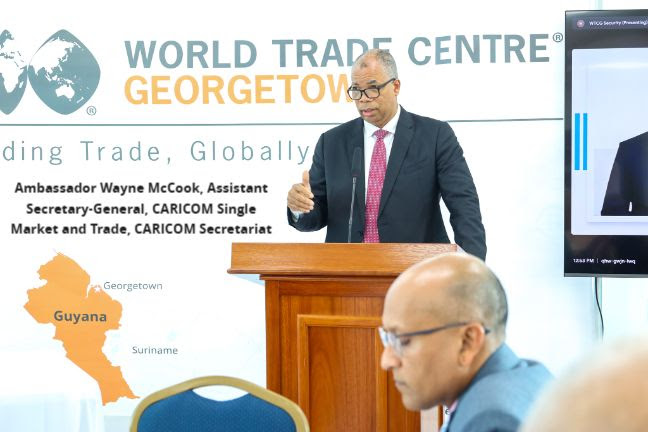
    CARICOM Secretariat | Turkeyen, Greater Georgetown, Guyana | Thursday, 29 January 2026:     A senior Caribbean Community (CARICOM) official has positioned deeper regional integration as a strategic response to an increasingly fragmented and uncertain global trade environment, as global rules-based systems weaken and economic nationalism intensifies.

    Ambassador Wayne McCook, Assistant Secretary-General, CARICOM Single Market and Trade, was a panelist discussing Prospects for International Trade in 2026 in the Context of the Changing Global Geopolitical and Economic Landscape – Impact on Trade and the Challenges and Opportunities for the Caribbean and Latin America. The discussion was held on Wednesday, 28 January, at the World Trade Centre in Georgetown, Guyana.

    Contextualising the Region’s position, Amb. McCook said: “For our Region, the scars of the immediate past are visible. The devastating passage of Hurricane Melissa encapsulated the dual challenge we face: the existential threat of climate change and the inherent economic vulnerabilities of our CARICOM Member States. Simultaneously, we have navigated dramatic shifts in global trade, driven largely by an intensified “America First” trade policy that has significantly impacted our exports, value chains and supply chains through a suite of unprecedented tariff measures.”

    Against the background of what he described as “a truly tumultuous 2025” for international and regional trade, Amb. McCook highlighted CARICOM’s “oneness” and its resilience to navigate the “choppy waters” of the 21st century.

    Amb. McCook warned that the erosion of multilateral trade norms is no longer theoretical, but already affecting investment, supply chains, and growth prospects worldwide.

    According to UN Trade and Development (UNCTAD), global foreign direct investment fell by 11 per cent in 2024, marking a second consecutive year of decline, with further weakness expected in 2026. Global trade growth has slowed dramatically, falling below one per cent in 2025, even as uncertainty and geopolitical rivalry reshape supply chains.

    Despite these headwinds, CARICOM’s trade performance has shown resilience. Between 2023 and 2024, CARICOM exports grew by 32 per cent to US$34.7B, with exports to the United States increasing by 86 per cent. However, recent data reveals uneven impacts across Member States.

    The Assistant Secretary-General pointed to the recent steps toward full free movement of people by Barbados, Belize, Dominica, and St. Vincent and the Grenadines as tangible progress toward a more integrated Community.

    “Fundamentally, CARICOM integration should be seen as a strategic response to a shifting global order,” he emphasised.

    Addressing prospects for international trade in 2026, he advanced a multi-pronged strategy focused on strengthening intra-regional trade, strengthening existing relationships while diversifying global partnerships beyond traditional allies, and deepening economic integration. Central to this approach is the CARICOM Industrial Policy and Strategy (CIPS), and the 25×25+5 food security agenda aimed at reducing food import dependence and boosting regional production.
    Read his presentation here: https://caricom.org/deeper-caricom-integration-key-to-navigating-fractured-global-trade-order-amb-wayne-mccook/

  • Re-invigorating CARICOM–Canada Trade in a Shifting Global Order

    Re-invigorating CARICOM–Canada Trade in a Shifting Global Order

    Alicia Nicholls

    On May 5, 2025 I had the opportunity and pleasure of being a panelist on the Canada Caribbean Institute (CCI)’s webinar entitled “Canada-CARICOM Relations in the Trump Era”.  In this blog post, I share and expand on some of the reflections I made at this session around the theme of reinvigorating CARICOM-Canada trade in this current global dispensation.

    While the US remains an important partner for Caribbean Community (CARICOM) countries, it is well understood in international trade and development circles that overreliance on any single market or partner increases exposure to geopolitical, economic and other shocks emanating in that partner. For the small island developing states (SIDS) of CARICOM whose economies are already highly open and vulnerable, diversifying trade and economic relationships is not a luxury, but a necessity. Diversification entails not only expanding south-south ties with Africa, China, and Latin America, as CARICOM countries have increasingly been doing, but also strengthening partnerships with long-standing allies like Canada. In this storm of uncertainty, Canada stands out as a stable and values-aligned safe harbour—a reality reinforced by the presence of a sizable Caribbean diaspora in Canada and a not insignificant Canadian diaspora presence here in the Caribbean, serving as bridges between us.

    The foundations of the Canada-CARICOM trading relationship stretch back to the colonial era when trade between the British West Indies and British North America (now Canada) involved an exchange of sugar, molasses, and rum for Canadian fish, lumber, and flour. That historical trade has evolved in structure and content, but the essence of mutual respect and cooperation remains. Today, our trade is anchored by the Canada Caribbean Trade Agreement (CARIBCAN)—a non-reciprocal preferential trade arrangement established in 1986 under which Canada grants unilateral duty-free access to eligible goods from Commonwealth Caribbean countries and territories. This covers most CARICOM countries’ exports to Canada, excluding goods in Harmonised System (HS) chapters 50-65 (mainly textile products) and goods subject to most favoured nation (MFN) tariffs of over 35%.

    CARIBCAN beneficiary countries or territories are Anguilla, Antigua & Barbuda, Bahamas, Barbados, Belize, Bermuda, The BVI, the Cayman Islands, Dominica, Grenada, Guyana, Jamaica, Montserrat, St. Kitts & Nevis, St Lucia, St. Vincent & the Grenadines, Trinidad & Tobago and the Turks and Caicos Islands. Notably, CARICOM member States Suriname and Haiti are not CARIBCAN beneficiaries.

    The arrangement is unilateral which means that beneficiary countries and territories are not required to reciprocate by lowering duties on Canadian imports, reflecting the agreement’s original development-oriented rationale: to enhance the region’s export capacity, promote economic development, and stimulate regional integration. The arrangement is subject to a World Trade Organisation (WTO) waiver, which was most recently extended in 2023 for another ten year period (until 2033).

    Despite this favourable arrangement, CARICOM’s trade performance with Canada has seen signs of stagnation. According to data gleaned from ITC’s Market Access Map, bilateral trade between CARICOM and Canada was valued at just US $1.2 billion in 2024. This is relatively modest when compared to CARICOM’s trade volumes with other partners. Notably, CARICOM enjoyed a trade surplus with Canada until 2019, but that dynamic has since reversed and Canada now enjoys a surplus with the region. CARICOM countries’ margin of preference in the Canadian market has declined as Canada has concluded agreements with other partners and its tariffs have lowered. Moreover, utilization rates of CARIBCAN preferences vary significantly across countries, with some utilising the preferences for significant shares of their exports and others failing to capitalize on the access afforded. CARICOM’s share of Canadian imports has declined, from 0.17% in 2014 to just 0.09% in 2024. Conversely, Canada’s share of CARICOM’s imports also dropped from 2.5% in 2014 to 1.5% in 2024.

    Digging deeper into the data reveals more about what is being traded and where opportunities lie. CARICOM’s leading exports to Canada include gold, aluminum, methanol, rum and spirits, root crops and seafood. On the flip side, Canada exports oil, wheat, iron ores, medicines, and meats to the Caribbean. According to ITC’s Export Potential Map, there remains significant unrealized export potential—estimated at around $1.4 billion. Gold alone, in its unwrought, non-monetary form, represents a good portion of this untapped potential. There may also be scope to expand exports of products like Caribbean rum, especially as Canadian consumers seek alternatives to U.S. products, including spirits and other alcoholic beverages.

    On the services side, tourism, commercial services and transportation services form the bedrock of the Canada–CARICOM relationship. Canadian banks have a long history in the region and for Barbados, Canadian firms are the major players in its global business sector. Travel remains one of the most vital service links, with Canada emerging as the region’s second-largest source market in 2024, sending 3.3 million visitors—a 4% increase from 2023, although still below pre-pandemic figures. With Canadians traveling less frequently to the US due to geopolitical tensions between these two countries, there is real potential for the Caribbean to capture more of this outbound market through targeted marketing, improved airlift, and creative offerings such as multi-destination packages. The education link is also noteworthy. Many CARICOM nationals study at Canadian institutions, bolstering ties through Mode 2 (consumption abroad) services trade.

    In addition to bilateral trade and services, Canada and CARICOM share values that manifest in their joint positions on the multilateral stage on issues like climate action, support for the Sustainable Development Goals (SDGs), and championing on-going and badly needed reform of the rules-based multilateral trading system. As global multilateralism comes under increasing strain, these alignments become even more critical.

    Some concrete recommendations

    The 2023 Canada–CARICOM Strategic Partnership, launched at the Ottawa Summit, marked an important milestone. This framework creates a permanent mechanism for structured dialogue and coordination—a platform we must now leverage more ambitiously. There are several immediate and medium-term actions worth considering.

    First, we need to better understand and address the reasons behind the low utilization of CARIBCAN by firms in beneficiary countries and territories and ensure evidence-based interventions to remedy this. This might involve empirical research in partnership with institutions like the University of the West Indies. Technical assistance to help exporters meet rules of origin, the simplification of customs procedures, and the creation of digital trade platforms or business missions could strengthen small and medium-sized enterprise (SME) readiness. As most CARICOM countries’ exports (except those exempted from the baseline tariff) now face additional 10% tariffs in the US market where they might have entered either duty-free or reduced rates of duty under the Caribbean Basin Initative (CBI) programmes, some CARICOM exporters will be seeking alternative markets for their products and Canada’s market of 40 million people and where most CARICOM goods can enter duty-free under CARIBCAN, beckons.

    Second, the question of whether CARIBCAN should be modernized or replaced with a reciprocal but development-sensitive agreement must be considered seriously before it is up for renewal of the waiver in 2033. While negotiations for a reciprocal trade agreement began in 2007, they eventually stalled due to divergent priorities. Today’s changed global landscape may offer a window to revisit the idea, possibly with a WTO-compatible trade and development agreement better tailored to CARICOM and Canada’s current needs.

    Third, Canada and CARICOM could benefit from updating their bilateral investment treaties (BITs) to reflect contemporary standards. Most are older generation BITs which prioritise investor protection over promoting and facilitating investment for sustainable development. In the absence of the negotiation of an FTA with a comprehensive investment chapter, Canada and CARICOM countries with which it has BITs should consider renegotiating their BITs and integrating development-friendly provisions, environmental safeguards, and mechanisms that encourage responsible investment.

    Fourth, greater attention should be paid to emerging sectors like digital trade, creative industries, fintech, scientific research and development, and digital health. These are areas where Canadian and Caribbean firms can collaborate meaningfully, and where mutual capacity-building could lead to innovation and job creation. I am always reminded of and inspired by the story of Barbadian-born scientist, Dr. Juliet Daniel, who is doing significant cancer research in Canada. This shows that the possibilities do indeed exist, especially given the strong ties between many Canadian universities and The UWI here in the Caribbean.

    Fifth, Canadian tourism is on a growth trend towards its pre-pandemic levels but could be boosted not just through more aggressive marketing in Canada, but through product innovation and better coordination across the region. Multi-destination tourism packages, for instance, could offer Canadians a richer Caribbean experience while distributing tourism benefits more evenly within CARICOM.

    Finally, the new Canada–CARICOM Strategic Partnership should also be used as a platform for closer multilateral coordination, including on WTO reform to strengthen the rules-based multilateral trading system. Although the Liberal Party in Canada won the elections in the just concluded election, there is a new Prime Minister and it remains to be seen to what extent he will continue some of the work of his predecessor.

    In all of this, the Caribbean diaspora in Canada and the Canadian community in the Caribbean serve as vital bridges that can drive trade, investment, cultural exchange, and policy dialogue, and are important players and allies as we seek to strengthen this relationship.

    In a world increasingly shaped by geopolitical unpredictability and economic volatility, deepening our economic relationship with Canada is not simply a reactive response. It is a logical and strategic one. Canada is already a valued partner with shared values, historical ties and a demonstrated commitment to inclusive and sustainable development. But the current level of trade and investment does not yet reflect the true potential of this relationship. There is considerable scope for deeper growth.

    Let me thank the Canada Caribbean Institute for the great work it is doing on fomenting this relationship, including its advancement of thinking on forging deeper Canada-Caribbean ties in the backdrop of Trump 2.0, as well as some of the concrete policy recommendations it has highlighted in a recent blog post. In these headwinds of global uncertainty, we should view Canada as not just a buffer in times of crisis, but as a cornerstone in our efforts to build a more resilient, prosperous, and sustainable CARICOM. Strengthening this partnership is more than a policy option—it is a strategic imperative.

    Alicia Nicholls, B.Sc., M.Sc., LL.B. is an international trade and development specialist with over 15 years experience and is the founder of the Caribbean Trade Law and Development Blog.