
Tag: global trade

  • Caribbean Trade & Development News Digest – March 1-7, 2026

    Caribbean Trade & Development News Digest – March 1-7, 2026

    Dear Reader,

    Welcome to our Caribbean Trade & Development News Digest for the week March 1 – 7, 2026!

    📌THIS WEEK’S HIGHLIGHTS

    Below are this week’s headlines!

    US Treasury Secretary Scott Bessent has stated that the 15% global tariff under section 122 of the Trade Act, 1974, will be implemented some time in the coming days.

    A coalition of 24 U.S. states filed a lawsuit arguing the tariff exceeds presidential authority and infringes on Congress’s control over trade policy.

    A U.S. trade court ordered the government to start refunding more than $130 billion in tariffs previously ruled unlawful. Thousands of companies have filed for refunds.

    🌴CARIBBEAN AND HEMISPHERIC TRADE STORIES

    Minister: Becoming part of Mercosur would benefit T&T

    Daily Express: Trinidad and Tobago’s potential membership in the South American trade bloc Mercosur (short for Spanish Mercado Común del Sur, or Southern Common Market) could bring significant benefits, according to Foreign and Caricom Affairs Minister Sean Sobers. Read more

    Trump threatens Cuba again, says island nation may face ‘friendly takeover’

    Al Jazeera: United States President Donald Trump has signalled that his administration is still pursuing a government overthrow in Cuba even as the US-Israeli war on Iran enters its second week. Read more

    Can Belize Grow Its Cacao Industry Into a Major Export Sector?

    Greater Belize Media: The government of Belize has launched the National Cacao Committee, a new body tasked with driving growth in the country’s cacao industry. Read more

    Belize Records Modest Growth in Niche Agricultural Exports to Asia
    Business, Companies & Organizations

    LoveFM: Belize is gaining encouraging signals on two economic fronts tonight, modest but steady growth in niche agricultural exports to Asia and renewed international attention as a competitive retirement destination in the Caribbean. Read more

    Afreximbank raises CARICOM financing cap to $5 billion to accelerate regional transformation

    Afreximbank: Pan African Multilateral Bank, African Export-Import Bank (Afreximbank), has announced a major expansion of its engagement with the Caribbean Community (CARICOM), increasing its regional financing limit from US$3 billion over the next four years. Read more

    Worrell: Barbados can’t get cheaper oil deals in CARICOM as regional trade still in US dollars

    Barbados Today: Former Central Bank Governor Dr Delisle Worrell has warned that Barbados should abandon any expectation of getting cheaper oil deals from its Caribbean partners, since oil and fuel trade within CARICOM is priced and paid for in US dollars — just like imports from the United States or India. Read more

    Bessent says global 15% tariff starts this week, predicts Trump duties will return to old levels later this year

    CNBC: President Donald Trump’s recently announced 15% global tariff will likely be implemented sometime this week, rising from its current rate of 10%, Treasury Secretary Scott Bessent said Wednesday. Read more

    US trade court orders tariff refunds in setback for Trump administration

    BBC: A federal judge has cleared the way for thousands of businesses to receive refunds for tariffs that the US Supreme Court struck down last month. Read more

    Small business owners doubt they’ll see refunds after supreme court invalidates Trump’s tariffs

    Guardian: Ruling could free $175bn, but legal hurdles and higher costs have left businesses questioning if claims are even worth it. Read more

    Judge rules companies are entitled to refunds for Trump tariffs overturned by the Supreme Court

    NBC: In a defeat for the Trump administration, the U.S. Court of International Trade said all “importers of record” were “entitled to benefit” from the ruling against the sweeping tariffs. Read more

    Mexican companies eager to keep USMCA treaty, report shows

    Reuters: Mexican businesses are eager to maintain ​a trilateral trade agreement with the United States and Canada that is up for review this year, according ‌to a report summarizing Mexico’s public consultation, released on Monday. Read more

    📢 STRAIGHT FROM THE WTO!

    Coordinators of Plastics Dialogue ready ministerial statement and other outcomes for MC14

    The coordinators of the Dialogue on Plastics Pollution and Environmentally Sustainable Plastics Trade (DPP) on 6 March finalized the ministerial statement for the 14th Ministerial Conference (MC14), scheduled to take place on 26-29 March in Cameroon. The statement was first introduced by the co coordinators in November 2025 and has been continuously updated to reflect members’ perspectives following intensive consultations. Read more

    Chair of agriculture talks circulates revised draft text, as MC14 outline emerges

    The Chair of the negotiations on agriculture, Ambassador Ali Sarfraz Hussain (Pakistan), has circulated a revised draft text ahead of the WTO’s 14th Ministerial Conference (MC14) in Yaoundé, Cameroon, from 26 to 29 March. Most WTO members welcomed the draft as a basis for consensus at a meeting of the negotiating body on 6 March, although a couple of members said they do not find it acceptable in its current form. Read more

    DG Okonjo-Iweala urges members to explore new ways to revitalize WTO at South-South event

    Speaking at the 8th South-South Dialogue on Least-Developed Countries (LDCs) and Development on 6 March in Geneva, Director-General Ngozi Okonjo-Iweala highlighted the importance of members’ work to reform the WTO in the run-up to the 14th Ministerial Conference (MC14) to be held on 26-29 March. She acknowledged the progress they have made in addressing LDCs’ trade priorities and encouraged LDCs to continue pursuing their trade interests. Read more

    Ahead of Women’s Day, WEIDE Fund announces US$ 1.76-million grants to women-led businesses

    To mark the upcoming International Women’s Day on 8 March, the Women Exporters in the Digital Economy (WEIDE) Fund on 6 March announced its plans to disburse US$ 1.76 million in grants in the first quarter of 2026 to benefit 219 women-led enterprises in the Dominican Republic, Mongolia and Nigeria. The first disbursement sets in motion the innovative design of the WEIDE Fund, which introduces a new model of grant financing supported by technical assistance and exposure to a multistakeholder ecosystem for enterprises. Read more

    EU contributes EUR 75,000 to support LDC participation at MC14

    The European Union has contributed EUR 75,000 (approximately CHF 69,500) to support the participation of government officials from least developed countries (LDCs) at the WTO’s 14th Ministerial Conference (MC14), to be held from 26 to 29 March 2026 in Yaoundé, Cameroon. The contribution aims to ensure broad and inclusive participation in the WTO’s highest decision making body. Read more

    WTO members conclude month-long reform discussions in Geneva

    WTO members on 5 March completed a series of meetings dedicated to advancing work on WTO reform. Over the past month, members have exchanged views on a draft ministerial statement and a work plan intended to frame the scope of reform efforts following the 14th Ministerial Conference (MC14) on 26-29 March. They also finalized preparations for the ministerial level political discussion on reform to be held at MC14 in Yaoundé, Cameroon. The reform facilitator, Ambassador Petter Ølberg of Norway, described the exchanges as substantive, thoughtful and conducted throughout in a positive spirit. Read more

    EU contributes EUR 1 million to strengthen trade capacity in developing economies, LDCs

    The European Union is contributing EUR 1 million (approximately CHF 928,000) to support developing economies including least developed countries (LDCs) in strengthening their participation in the multilateral trading system for 2026–2027. Read more

    Government Procurement Committee discusses GPA implementation, progress in accessions

    At a meeting of the Committee on Government Procurement on 4 March, parties to the Government Procurement Agreement (GPA) discussed issues concerning GPA implementation and progress in accession negotiations. Parties also elected a new Committee chair, Mr William Westerveld Jensen of Norway. Read more

    Heads of WTO, EIB sign landmark agreement to boost trade and investment

    The WTO Secretariat and the European Investment Bank (EIB) Group signed a Memorandum of Understanding (MoU) on 4 March to enhance sustainable trade and investment worldwide. The agreement marks the beginning of a partnership that will leverage the EIB’s financial resources and investment facilitation tools developed under the Investment Facilitation for Development Agreement concluded by a large number of WTO members to improve the regulatory environment, unlock investment and expand opportunities for developing countries. Read more

    WTO members consider new e-commerce proposal and previous submissions ahead of MC14

    At a meeting on the Work Programme on E-Commerce on 3 March, WTO members considered a proposal to establish a Committee on Digital Trade as part of a draft decision on e-commerce for the 14th Ministerial Conference (MC14), which will take place from 26 to 29 March in Yaoundé, Cameroon. Members also continued discussions on the reinvigoration of the Work Programme and on the moratorium on the imposition of customs duties on electronic transmissions on the basis of two other proposals. Read more

    WTO members review five regional trade agreements, discuss transparency issues

    At a meeting of the Committee on Regional Trade Agreements (CRTA) on 3 March, WTO members reviewed five regional trade agreements (RTAs) involving Comoros, the European Union, Mozambique, Indonesia, China, Serbia, Kazakhstan, Azerbaijan, Türkiye and the Faroe Islands. They also reviewed other topics relevant to the Committee’s work under the Transparency Mechanism for RTAs. Read more

    🌎 GLOBAL TRADE STORIES

    Voice of Nigeria: Nigeria has intensified efforts to consolidate its leadership under the African Continental Free Trade Area (AfCFTA) while strategically positioning itself ahead of the 14th World Trade Organization Ministerial Conference. Read more

    EU keeps U.S. trade deal frozen over tariff uncertainty

    Financial Post: Top EU lawmakers on the parliament’s trade committee made the choice on Wednesday, saying they wanted more information from Washington about how it will preserve a 15 per cent ceiling on most EU products — a level both sides agreed to in last summer’s trade pact. Parliament initially halted ratification several days after the ruling. Read more

    Business mobilisation grows to 189 chambers and associations backing WTO reform and Moratorium renewal

    ICC: A growing number of chambers of commerce and business associations from around the world are urging governments to deliver concrete outcomes at the 14th Ministerial Conference of the WTO, as concerns mount over fragmentation in the global trading system. Read more

    China exports surge despite Trump tariffs

    BBC: Official figures show exports jumped by more than 20% in January and February, which is almost three times the rate predicted by economists. It puts the country on track to top the record-breaking annual trade surplus it saw in 2025. Read more

    Indonesia to file suspension of concessions against EU on palm oil dispute in WTO

    Reuters: Indonesia’s trade ministry said on Saturday that the government will file a suspension-of-concessions request ​against the European Union at the World Trade ‌Organization’s (WTO’s) dispute settlement body, citing the block’s failure to meet a WTO ruling in a palm oil case. Read more

    Thank you for reading the Caribbean Trade & Development News Digest, a product of the Caribbean Trade and Development blog. If you found this edition useful, subscribe to our Blog to ensure you never miss a weekly update.

    Image by Gerd Altmann from Pixabay
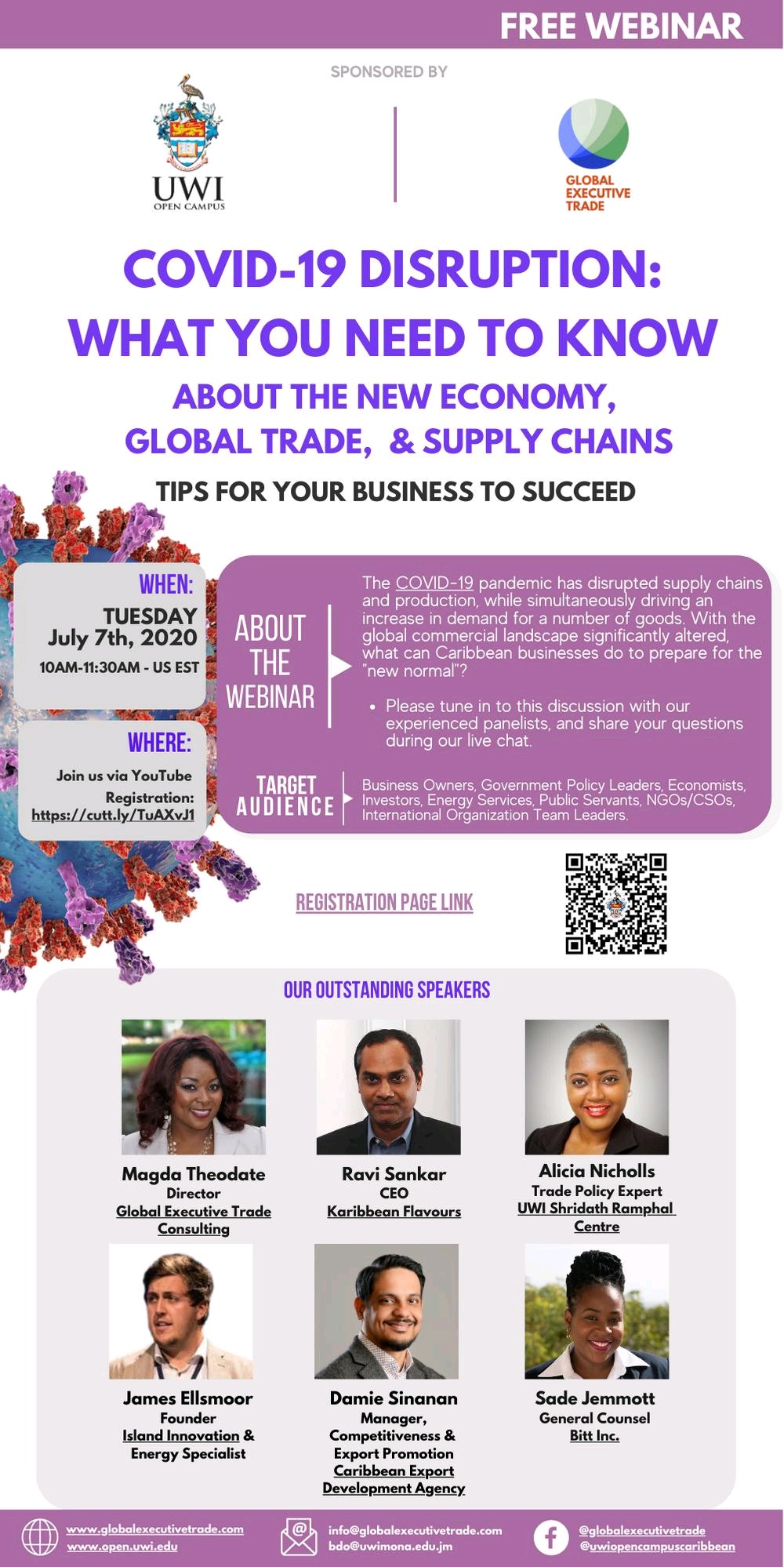
  • Webinar – Global Trade & Supply Chains: Tips for your business to succeed

    Webinar – Global Trade & Supply Chains: Tips for your business to succeed

    On Tuesday, July 7th, I am happy to be participating as a panelist in this free Webinar hosted by The University of the West Indies Open Campus’ Business Development Unit and Global Executive Trade! See flyer and below for further details.

    “The panel will examine the role of global trade, supply chains and the “new economy” to support Caribbean private sector success in the post Covid19 environment. This will be done by exploring legal policy, technological infrastructure, energy uses, and supply chain management as levers to success and greater opportunity for firms involved in commercial trade, or wanting to do business in and with the Region. It will consider the risks associated with global trade and the role the private sector holds in pooling all resources to boost the Region’s competitiveness during these tumultuous times and in the future.”

    To register please click here.

  • Seven Major Trade Developments of 2016: Trade Year in Review & Look Ahead

    Seven Major Trade Developments of 2016: Trade Year in Review & Look Ahead

    Alicia Nicholls

    Popular support for global trade took its greatest hammering in 2016 than it has in recent times.  Below are seven of the major international trade developments in 2016 and some thoughts on what 2017 may bring.

    1.Continued slowdown in Global Trade Growth

    Global merchandise trade growth continued to be lacklustre in 2016, according to the World Trade Organisation (WTO). The WTO in its September update downgraded its forecast for global trade growth for 2016 to 1.7%  from the April forecast of 2.8%, and for 2017, to between 1.8% and 3.1% from the April forecast of 3.6%.

    According to the Director General Roberto Azevedo in his Annual Report, if realised, this would be the slowest pace of global trade growth and output since the global financial and economic crisis in 2008. The reasons proffered were a fall in import demand and a slowdown in global GDP (particularly among emerging economies such as China and Brazil but also some deceleration in North America).

    Trade restrictive measures remain high. According to the DG’s Annual Report, 182 new trade restrictive measures (outside of trade remedy measures) were put in place by member states since the last report. The monthly average represented a reduction from 2015 but the Director General cautioned that “this does not mean that we are on a downward trend. Rather, it seems to be a return to the somewhat steady levels we have witnessed since 2009.”

    2. UK votes to leave the European Union 

    The first political bombshell of 2016 came on June 23rd when voters in the United Kingdom voted for the UK to withdraw from the 28-member European Union, its largest trading partner. Then UK Prime Minister, David Cameron, who backed the “Remain” camp, voluntarily resigned after the result.

    The value of Sterling has fallen significantly since the Brexit vote, improving the price competitiveness of UK exports. A BBC report noted that in the three months following the vote, the UK economy grew 0.5% on average, which while slower than the previous quarter, was higher than the rate predicted by many economists. However, the vote has created a climate of uncertainty not just with regard to the City of London’s future as the financial hub of Europe,  but also what level of access UK exporters would have to the EU single market once a withdrawal agreement is concluded pursuant to Article 50 of the Lisbon Treaty. In other words, will there be a “hard” or “soft” Brexit ?

    The new Prime Minister, Theresa May’s slated timeline of making the Article 50 notification by the end of March 2017 is now in doubt. The UK High Court held in R (Miller) v Secretary of State for Exiting the European Union that a parliamentary vote was needed which may extend the timeline (and that is if Parliament votes in favour of making the notification). The May-led government appealed and the UK Supreme Court is expected to render its judgment in R (on the application of Miller and Dos Santos) v Secretary of State for Exiting the European Union and associated references early this year.

    3. Donald Trump is elected US President

    In another unexpected political twist, billionaire businessman, Donald Trump, defeated establishment favourite, democratic nominee Hillary Clinton, in the November 8th US Presidential election poll. President-elect Trump will take office on January 20, 2016 but already many have questioned what will be the US’ new trade orientation in light of Mr. Trump’s trade policy proposals during and since the campaign.

    Both Canada and Mexico have indicated their willingness to come to the negotiating table in regards to renegotiating the North American Free Trade Agreement (NAFTA). It is not clear what will be the fate of the Trans-Atlantic Trade and Investment Partnership (TTIP) which was being negotiated between the US and the EU or any of the fourteen other free trade agreements under negotiation by the US. Additionally, the nature of the US’ continued involvement in the plurilateral negotiations of the Trade in Services Agreement (TISA), the Environmental Goods Agreement (EGA) and the Fisheries Subsidies Agreement, is uncertain.

    There are also concerns about a possible trade war between the US and China. Mr. Trump has promised to name China a currency manipulator and has also stated he would impose a tariff on Chinese imports.

    4. EU & Canada sign CETA 

    One agreement does appear to have bucked the trend. After nearly being derailed by the Belgian region of Wallonia, the Comprehensive Economic and Trade Agreement (CETA) was finally signed by the European Union and Canada in October, 2016. The Agreement will need the approval of the EU and Canadian parliaments into order to take full effect.

    One major question is what impact will the UK’s possible impending departure from the EU have on CETA especially given that the UK is Canada’s largest EU trading partner. A Bloomberg report quotes Canada’s Trade Minister, Chrystia Freeland, as stating that once the European Parliament passes CETA, Canada will have a trade deal with Britain which can be built on. There would be no need for a separate trade agreement with the UK.

    5. Maersk acquires Hamburg Süd

    The world’s largest shipping company Maersk acquired the German container shipping line, Hamburg Süd, the world’s seventh largest operator. It was noted in the press release announcing the acquisition agreement that Hamburg Süd would continue as a separate brand. The Wall Street Journal reports that the deal, which is estimated to be worth $4 billion dollars, would boost Maersk’s presence on North-South shipping routes and would make the shipping company the leading player in and out of Latin America.

    Overcapacity due to larger vessel capacity but weaker demand has plagued the global container shipping industry and has seen declines in global shipping rates. According to a report by American Shipper, credit rating agency Moody’s “holds a negative outlook for the shipping industry in 2017”. With declining profitability, it is likely that more mergers and acquisitions may follow in order to create scale in an industry which remains quite fragmented.

    6. Paris Climate Agreement comes into effect

    The Paris Climate Agreement, agreed by 195 countries at the UNFCCC’s COP21 in December 2015, came into effect, which is great news for the planet and especially for small island developing states and coastal states which are the most vulnerable to the ravages of climate change.

    While there is concern about whether the incoming US administration will adhere to the Agreement, the Agreement’s entry into force will have several possible impacts on global trade trends. Firstly, there may be increased trade in climate-friendly and renewable energy products as businesses and countries seek to reduce their carbon footprint in line with commitments made by countries under Nationally Determined Contributions and in line with businesses’ corporate social responsibility goals. Concomitantly, there might be reduction in trade in fossil fuel and other environmentally dangerous products.

    More trade disputes are likely as a result of climate change policies implemented by member states which may be deemed to be protectionist or discriminatory to other member states’ exports. The challenge for states will be in crafting environmental policies to promote a low carbon economy which also conform with their trade obligations.

    7. Oil producing nations reach deal to cut oil output 

    On November 30, 2016 oil producing nations, including member countries of the Organisation of Petroleum Exporting Countries (OPEC), reached a deal for the first time since 2008  to cut back oil production in order to stem a two-year glut. According to Wall Street Journal reporting, the deal would lead to 558,000 barrels less of crude oil per day and represents almost 2% of global oil supply. Saudi Arabia, the largest producer, has committed to cutting  back its output by 4%, according to The Economist’s reporting.

    Oversupply has led to two years of oil prices dropping to unprecedented lows, to the detriment of some oil-producing economies, most notably Venezuela but a much needed reprieve for oil importing nations. In the wake of the announcement, the price of Brent crude surged to over $50 a barrel, the highest in over a year. However, both oil prices and WTI futures fell shortly thereafter amidst skepticism about whether output would actually be reduced in light of higher output by oil-producing countries that same month.

    The “success” of this deal depends on several factors, including to what extent can an increase in US shale production compensate. Recall also that President-elect Trump has also promised to increase US production in order to ensure energy dependence. It will also depend on whether Russia will follow through with cutting output, and whether OPEC members themselves actually adhere to their own proposed production cuts.

    So what does this deal mean for trade? For starters, expect higher fuel costs to lead to higher freight  and production costs.

    What does this mean for 2017?

    In light of the above, what does 2017 portend? At the time of this article’s writing, we are just hours into 2017. The good news is that we are ever closer to the Trade Facilitation Agreement coming into force.

    However, the biggest buzzword for 2017 is uncertainty. A growing rise in populist anti-trade, anti-immigrant fervour has led to the election of Donald Trump, while anti-EU sentiment was one of the contributing factors underlying the UK Brexit vote. Will the election of anti-EU, anti-trade governments continue and what does this mean for the future of that trade bloc? Several European elections scheduled for 2017, including the French presidential elections (with the leader of the right wing Front National, Marine LePen, a strong candidate), the German presidential and parliamentary elections and the Netherland elections.

    Besides this, will the UK actually make its Article 50 notification? Will Donald Trump follow through with his promise to jettison the TPP and renegotiate NAFTA and will there be a trade war between the US and China? What about global trade? Will we see a pickup this year? Turning to the multilateral trade negotiations, what progress (if any) will be made at the WTO’s Buenos Aires ministerial this December? Will OPEC members follow through with the proposed cuts? No one knows.

    Alicia Nicholls, B.Sc., M.Sc., LL.B., is a trade and development consultant with a keen interest in sustainable development, international law and trade. You can also read more of her commentaries and follow her on Twitter @LicyLaw.

  • OECD describes global trade growth as “exceptionally weak”

    Alicia Nicholls

    In its Interim Economic Outlook released yesterday September 21, 2016, the Organisation for Economic Cooperation and Development (OECD) has again expressed concern about the slowdown in global trade growth, echoing similar sentiments made by the International Monetary Fund (IMF) and the World Trade Organisation (WTO). Describing global trade growth as “exceptionally weak”, the report notes that the volume of global trade fell in Q1 2016 and remains subdued despite some recovery in Q2.

    The OECD noted that weak trade growth was as a result of not only cyclical and structural factors but also “some backtracking” on the opening of global markets to trade in goods and services. Noting that trade is an important driver of productivity growth, the organisation warned that this deceleration could undermine productivity growth and living standards in future years. These issues are further explored in an OECD Economic Policy Paper entitled “Cardiac Arrest or Dizzy Spell: Why is World Trade so weak and what can Policy do about it?” which was also released that same day.

    The OECD report has reiterated the need for policy action to boost trade, including avoiding trade protectionist measures, reducing unnecessary trade costs and removing impediments and distortions for cross border investment. Recognising that support for globalisation in advanced economies has weakened, the report also suggests that policies be implemented to ensure that the benefits of trade and investment are widely shared.

    This low trade growth is also affecting global GDP growth. The OECD warned that the world economy remains in a “low-growth” trap and projects global GDP growth to remain flat at only  3% in 2016, with only a modest improvement in 2017.

    The full press release may be obtained here.

    Alicia Nicholls, B.Sc., M.Sc., LL.B. is a trade and development consultant with a keen interest in sustainable development, international law and trade. You can also read more of her commentaries and follow her on Twitter @LicyLaw.