Tag: Haiti

  • An uphill climb?  International Trade for Boosting Post-COVID-19 Growth in Least Developed Countries

    Lucius S.J. Doxerie – Guest contributor

    Lucius S.J. Doxerie

    The Covid-19 pandemic severely impacted/devasted the economies of countries that have been classified as ‘least developed’ by the international arena. It has prompted me to take a closer look at the ideation of resilience amid global shocks and market failures.

    The aim of this brief article is to examine the role of trade in boosting economic growth of least developed countries (LDCs) such as Haiti, Liberia and Timor-Leste. Special attention will be diverted to the type of preferential treatment received and the trade policies needed to increase the growth prospects in a post-Covid period. We first need to highlight the current situation with regard to trade amongst LDC countries as underscored by the World Trade Organisation (WTO) and will posit possible solutions to facilitate an amelioration of trade.

    According to (WTO 2022:5) “The top ten LDC exporters represented more than 80 per cent of LDC merchandise exports in 2011; this declined to 73 per cent in 2020. LDC exports continue to be concentrated in five major destination markets: China, the European Union, the United States, India and Thailand.”.

    As early as the 1930’s, discussion around the benefits of lessening restrictions to international trade and investment was actively happening among countries. In 1948, an international agreement was established among countries to reduce barriers to trade. After eight rounds of meetings, a General Agreement on Tariffs and Trade (GATT) was formed, and in 1995, the World Trade Ogranisation (WTO) was established. The WTO is an international trade governing body that is tasked with monitoring, enforcing and liberalizing trade amongst countries (Suranovic 2010).

    The key reasons why countries trade is summed up below.

    1. Differences in technology (Ricardian theory of comparative advantage)
    2. Differences in resource endowments (Pure exchange model of trade and Heckscher-Ohlin factor proportions model)
    3. Differences in demand (Monopolistic model)
    4. Existence of economies of scale in production (Increasing returns to scale)
    5. Existence of government policies among countries

    In the reality, trade takes place for many reasons. There is no single model or theory that captures all the reasons. For example, the Ricardian model, which focuses on the differences in technology among countries posits that everyone benefits from trade whereas on the other hand the Heckscher-Ohlin model suggests differences in endowments are the reason for trade and that there will be losers and winners. These traditional trade theories illustrate a myopic justification for trading as countries trade for a myriad of reasons. According to experts like Suranovic, most of these theories of trade are very simplistic in nature and generate unrealistic assumptions.  

    So let’s now discuss, especially in consideration of the quote below:

     “Least developed countries (LDCs) have been recognized by the United Nations since 1971 as the category of the states, which are deemed highly disadvantaged in their development process, for structural, historical and also geographical reasons”(Białowąs and Budzyńska 2022:1).

    As early as 1979, least developed countries have been receiving preferential treatment from advanced economies as part of the Tokyo round of the GATT. These preferences fall under what is coined the generalised system of preferences (GSP). As such, they have enjoyed exclusive schemes geared at entry into the markets of advanced economies by removing barriers such as tariffs and quotas from the early 2000s (Klasen et al. 2016).

    According to the WTO, “the Istanbul Programme of Action for LDCs (IPoA) for the decade 2011 to 2020 identified trade as one of the eight priority areas of actions for the economic growth and sustainable development of least-developed countries”(WTO 2022:3).

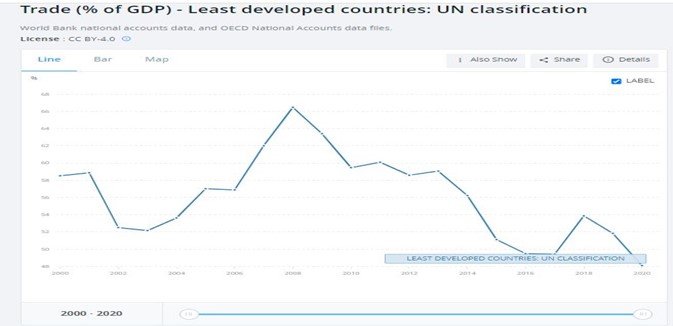
    Trade as a percentage of the Gross domestic Product (GDP) for LDC’s since the year 2000 is reflected below in figure 0.1.
    Source: http://data.worldbank.org

    The graph above illustrates that trade as a percentage of GDP for LDCs rose steadily from as early as 2003 up until the financial crisis in 2008. A downward pattern continued for another eight years until 2016, then there was improvement. However due to the Cocid-19 pandemic a downward movement has been evidenced since.

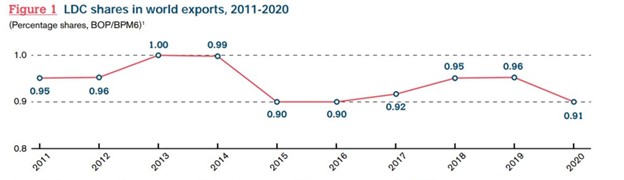
    The graph below illustrates the latest statistics of the LDCs share of world exports.
    Source (WTO 2022)

    We can clearly see that there was steady expansion of exports between 2017-2019. After the pandemic, there was a sharp decline of .04%, falling way below the expected target set by IPoA. (WTO 2022) shows that LDCs have seen declines over the last ten years in merchandise exports in all areas except clothing.  Although LDCs received preferential treatment, not all goods and services exported are covered (Antimiani and Cernat 2021).

    So what does this all mean, and what’s the bottom line?

    There is clear evidence supporting the WTO’s preferential treatment towards increasing  the revenues and economic prosperity of LDCs (Antimiani and Cernat 2021). Notably, there is still room for further easing of  trade barriers especially due to the shocks created by the pandemic. This is further underpinned by larger regional trade blocks emerging amongst developed countries undermining the efforts of the WTO (Palit 2015).  A 2016 paper carried out by (Klasen et al. 2016:5) using econometric techniques highlighted that “only Canada’s, Australia’s and EU’s trade preference systems have a positive and significant impact on LDCs’ exports”. Therefore, the following recommendations are proffered in the interest of economic uptake and growth through trade for LDCs.

    1. Establish regional trade agreements among LDCs to help increase their market share.
    2. Provide concessions for value added goods from LDCs within the global value chain for finished products exported by WTO members
    3. Increase the unilateral agreements enjoyed by LDCs  especially duty and quota free access to world markets on a wider range of products
    4. Increase the production and institutional capacity of LDCs by providing technical support to their industries
    5. Improve the LDC service waiver allowing it to cover more areas within the service industries

    These recommendations will allow LDCs to improve their trade practices, have more standardized procedures, facilate growth of local sectors which, in turn will increase the overall welfare of the economy and the people post covid.

    Note: Multiple WTO reports, textbooks and journals from industry experts were utilized in the writing of this article.

    Lucius S.J. Doxerie is an aspiring economist and co-founder and CEO of Stratagem Paradigms Inc.  He is a Chevening Scholar currently enrolled at the University of Bradford completing a Master of Science in Economics and Finance for Development. 

    REFERENCES

    Antimiani, A. and Cernat, L. (2021) Untapping the full development potential of trade along global supply chains: ‘gvcs for ldcs’ proposal. Journal of world trade 55 (5), 697-714.

    Białowąs, T. and Budzyńska, A. (2022) The Importance of Global Value Chains in Developing Countries’ Agricultural Trade Development. Sustainability 14 (3), 1389.

    Klasen, S., Martínez-Zarzoso, I., Nowak-Lehmann, F. and Bruckner, N. (2016) Trade preferences for least developed countries. Are they effective? Preliminary Econometric Evidence. Policy Review 4.

    Palit, A. (2015) Mega-RTAs and LDCs: Trade is not for the poor. Geoforum 58, 23-26.

    Suranovic, S. (2010) International trade: Theory and policy. The Saylor Foundation.

    WTO (2022) Boosting Trade Opportunities for Least Developed Countries. WTO. https://www.wto.org/english/res_e/publications_e/boottradeopp22_e.htm Accessed 22/03/22.

  • Report of Haiti’s 2nd WTO Trade Policy Review now online!

    Alicia Nicholls

    Following up to my previous article, Haiti has completed its second WTO Trade Policy Review which took place this week December 2nd-4th. The report of Haiti’s second review is now online.

    Haiti’s Economic and Trade Performance

    Some of the key summary points from the 2015 report in regards to Haiti’s economic and trade performance are as follows:

    • Haiti’s economy has been recovering slowly since the devastating earthquake in January 2010.
    • The fiscal deficit is largely financed by external grants and poses a considerable problem for medium-term expenditure sustainability.
    • The Haitian Government has implemented a set of measures to increase revenues and reduce the level of expenditure.
    • Haiti has maintained a large trade deficit for many years.
    • Remittances sent by Haitian workers living abroad are the main source of foreign exchange in the domestic economy.
    • Haiti’s main exports are textiles and clothing.
    • Services contribute around 56% of GDP.
    • Financial services still make only a modest contribution to GDP, although banking institutions have rapidly increased their holdings in recent years.

    Haiti’s Trade Policy Framework

    Some of the summary points in regards to its trade policy framework are as follows:

    • Generally speaking, Haiti’s trade and investment laws are relatively old.
    • Haiti has not signed any of the WTO plurilateral agreements.
    • Haiti receives non-reciprocal preferential treatment from a number of developed countries under the Generalised System of Preferences (GSP) and is also a member of the Caribbean Community (CARICOM).
    • Tariffs are still among Haiti’s principal trade policy tools, as well as being an important source of income, since customs revenue accounts for around one third of fiscal revenue each year.
    • There have been no major changes to the export regime since the previous Trade Policy Review.
    • Haiti has no legislation on competition, standardization or contingency trade measures.
    • Although a major step forward was made with the adoption of the legislation on copyright and related rights, the system of intellectual property protection remains weak, however, and trademarks are frequently infringed.
    • The agricultural sector continues to play a key role in food security and employment.The mining sector makes only a marginal contribution to GDP, despite its considerable potential.
    • Contributing to the majority of Haiti’s exports, the manufacturing sector’s contribution to GDP has remained relatively stable over recent years, at around 8%.

    The full WTO Secretariat report, the Government report and other documents from Haiti’s second trade policy review may be accessed here.

    Alicia Nicholls, B.Sc., M.Sc., LL.B. is a trade and development consultant with a keen interest in sustainable development, international law and trade. Please note that the views expressed in this article are solely hers. You can also read more of her commentaries and follow her on Twitter @LicyLaw.

  • A step towards progress between Haiti and the Dominican Republic?

    Alicia Nicholls

    The news this week of progress in the talks at Jimani between Haiti and the Dominican Republic to address, inter alia, the long-standing migration issue between the two countries is welcomed news. The fragile diplomatic relationship between the Dominican Republic and Haiti took a sharp turn for the worse in the latter part of last year following a controversial ruling by the DR’s Constitutional Court  on September 23.

    The DR’s Constitutional Court had been called on to consider an application made by Ms. Juliana Deguis Pierre that the Electoral Office be ordered to issue her with a national ID card which she had been denied on the basis that she was the child of Haitian parents and not Dominican. Ms. Pierre was born and raised in Los Jovillos, an area in Yamasa municipality (in Monte Plata province) where many persons of Haitian origin live. Denying her request, the Court ruled that Ms. Pierre was not a Dominican citizen but a child born of ‘foreigners in transit’. Using the case as an opportunity to elaborate on Dominican nationality law, the Court applied the restriction on the jus soli principle per Article 18 of the 2010 Constitution, holding that under Dominican law birth on Dominican soil did not automatically confer citizenship on an individual and that for a person born after 1929 to be deemed a citizen of the Dominican Republic, he or she must have been born to at least one parent with legal status in the country. All other persons who did not meet this criterion would be classified as being ‘extranjeros en transito” (foreigners in transit) and therefore as never having had Dominican citizenship.  A copy of the court’s judgment can be read here (in Spanish).

    The principle in Dominican immigration law of “foreigner in transit” is not new as it was included in the Constitution of 1929 and in subsequent constitutional reforms, including as recently as in Article 18.3 of the reformed constitution of January 26, 2010. However, prior to the 2010 Constitution, citizenship in the Dominican Republic was conferred on an absolute jus soli basis as evidenced by the language used in previous constitutions, which excluded any reference to the requirement of being born of Dominican parentage. The Court’s retroactive ruling which applies the jus sanguinis principle, established in Article 18 of the 2010 Constitution, to those born after 1929 (and not just to those born after 2010) leaves several generations of Dominicans of foreign descent in a legal limbo as to their status. The retroactive application by the Court of Article 18 to this case seems especially harsh given that the 2010 constitution itself does not indicate that it is meant  to apply retroactively, evidenced by Article 18.2. which states that “Dominicans [also] include those who enjoyed nationality before the entry into force of the Constitution”. A copy of the 2010 Constitution may be found here (in Spanish).

    While persons born to parents of other nationalities will be affected, it is persons of Haitian descent who make up the overwhelming majority of persons to whom this ruling would apply.  Some human rights groups estimate that as many as 200,000 persons of Haitian descent may be affected by the ruling. Haiti and the Dominican Republic, which share the Caribbean island of Hispaniola, have always had a tense and complicated relationship which has its roots in the colonial era and in subsequent historical events. These events include the 22-year Haitian occupation of the Dominican Republic in the immediate post-colonial period before the latter attained its independence, and the slaughter of thousands of Haitians by the Trujillo dictatorship in 1937. The socioeconomic disparities between the two states and their cultural, religious, linguistic and racial differences, a legacy of colonialism, have only helped to further deepen the gulf between these two sister nations. A constant source of tension between the two states has been undocumented Haitian migration to the Dominican Republic. Ever since the 1920s when Haitian workers were actively recruited to work in the Dominican Republic’s sugar industry, the Dominican Republic has been an attractive employment market for seasonal and long-term Haitian workers searching for a better life for themselves and their families. Many of those affected by the ruling include Haitians who had been brought in to work on Dominican farms during the 1920s and their descendants born and raised in the DR.

    Haitian emigration to the Dominican Republic has helped to foment anti-Haitian sentiment among some Dominicans, a sentiment which is also boosted because of the Dominican Republic’s own racially stratified society where darker skin is still synonymous with being poor and uneducated.

    The immigration policy of states is always a touchy subject because of the importance it has for national security. Indeed, it is no doubt that inherent in being a sovereign nation is the right of the state to protect its borders. Both customary international law and the Montevideo Convention of 1933 provide that no state has the right to intervene in the internal or external affairs of another. Further, international law gives states the right to dictate their own policies in regards to conferring nationality.

    However, these rights are not absolute as they are subject, inter alia, to the various international human rights treaties which States, like the DR, have acceded to, and by which they agree to respect human rights and to be held accountable for any violation thereof. The human rights implications of the constitutional court’s ruling cannot be overlooked on the basis that the ruling is solely in the province of the DR’s internal affairs. The ruling has been condemned by CARICOM states (of which Haiti is a member) and by various human rights groups as being ‘racist’ and ‘xenophobic’ in nature and with potentially devastating human rights consequences.

    Although Dominican authorities deny that the ruling leaves anyone stateless and argue that a plan for naturalisation of affected persons would be implemented, the Court’s retroactive application of Article 18 of the 2010 Constitution does have the effect of stripping those affected of citizenship, depriving them of the rights inherent with nationality, such as the right to vote, the ability to get married and the right of access to basic services such as education, employment and health care, and bringing with it the possibility of expulsion from the land of their birth. Like Juliana Deguis Pierre, many of those three generations of Haitians who are affected were born in, and have lived in the Dominican Republic all their lives, have little or no ties to Haiti and speak no Haitian creole.  In light of the ruling, CARICOM has agreed to indefinitely defer consideration of the Dominican Republic’s longstanding application to accede to CARICOM.

    Happily, it appears tentatively that some progress is being made to address this unfortunate state of affairs. Both countries have agreed to establish a Joint Commission to discuss not just issues relating to migration, but also matters of trade, the environment, security, among others. The Dominican Republic has stated that it will as shortly as February 27th bring legislation to address the situation of those born in the Dominican Republic but who currently have no documentation. It is hoped that such legislation will undo the human rights injustice which this ruling portends, affirming the right of those affected to Dominican nationality and being a needed step towards addressing and correcting  the discrimination which many native born Dominicans of Haitian  descent continue to face.

    Alicia Nicholls is a trade policy specialist and law graduate. She can be followed on Twitter at @Licylaw.