CARICOM Secretariat | Turkeyen, Greater Georgetown, Guyana | Thursday, 29 January 2026: A senior Caribbean Community (CARICOM) official has positioned deeper regional integration as a strategic response to an increasingly fragmented and uncertain global trade environment, as global rules-based systems weaken and economic nationalism intensifies.
Ambassador Wayne McCook, Assistant Secretary-General, CARICOM Single Market and Trade, was a panelist discussing Prospects for International Trade in 2026 in the Context of the Changing Global Geopolitical and Economic Landscape – Impact on Trade and the Challenges and Opportunities for the Caribbean and Latin America. The discussion was held on Wednesday, 28 January, at the World Trade Centre in Georgetown, Guyana.
Contextualising the Region’s position, Amb. McCook said: “For our Region, the scars of the immediate past are visible. The devastating passage of Hurricane Melissa encapsulated the dual challenge we face: the existential threat of climate change and the inherent economic vulnerabilities of our CARICOM Member States. Simultaneously, we have navigated dramatic shifts in global trade, driven largely by an intensified “America First” trade policy that has significantly impacted our exports, value chains and supply chains through a suite of unprecedented tariff measures.”
Against the background of what he described as “a truly tumultuous 2025” for international and regional trade, Amb. McCook highlighted CARICOM’s “oneness” and its resilience to navigate the “choppy waters” of the 21st century.
Amb. McCook warned that the erosion of multilateral trade norms is no longer theoretical, but already affecting investment, supply chains, and growth prospects worldwide.
According to UN Trade and Development (UNCTAD), global foreign direct investment fell by 11 per cent in 2024, marking a second consecutive year of decline, with further weakness expected in 2026. Global trade growth has slowed dramatically, falling below one per cent in 2025, even as uncertainty and geopolitical rivalry reshape supply chains.
Despite these headwinds, CARICOM’s trade performance has shown resilience. Between 2023 and 2024, CARICOM exports grew by 32 per cent to US$34.7B, with exports to the United States increasing by 86 per cent. However, recent data reveals uneven impacts across Member States.
The Assistant Secretary-General pointed to the recent steps toward full free movement of people by Barbados, Belize, Dominica, and St. Vincent and the Grenadines as tangible progress toward a more integrated Community.
“Fundamentally, CARICOM integration should be seen as a strategic response to a shifting global order,” he emphasised.
Addressing prospects for international trade in 2026, he advanced a multi-pronged strategy focused on strengthening intra-regional trade, strengthening existing relationships while diversifying global partnerships beyond traditional allies, and deepening economic integration. Central to this approach is the CARICOM Industrial Policy and Strategy (CIPS), and the 25×25+5 food security agenda aimed at reducing food import dependence and boosting regional production.
Read his presentation here: https://caricom.org/deeper-caricom-integration-key-to-navigating-fractured-global-trade-order-amb-wayne-mccook/
Tag: Integration
-
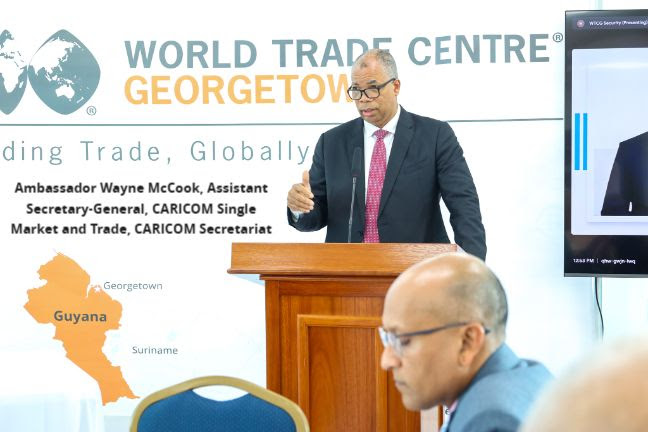
Deeper CARICOM integration key to navigating fractured global trade order – CARICOM ASG
-

CSME working though ‘uneven and imperfect’
Alicia Nicholls
Though “uneven and imperfect”, the five regimes of the CARICOM Single Market and Economy (CSME) (free movement of skilled nationals, capital, goods, services and the right of establishment) are working. This was the assurance given to audience members by His Excellency Ambassador Irwin Larocque, Secretary General of the Caribbean Community (CARICOM), in his welcome remarks at a public regional stakeholder consultation on the CSME. The event was held at the Errol Barrow Centre for Creative Imagination (EBCCI) of The University of the West Indies Cave Hill in Barbados on Monday, November 4th.
The stakeholder discussion, which was also streamed online and broadcast via television, attracted a packed audience which included a wide cross-section of the general public, as well as online viewers from across the region. The moderator for the evening was Mr. Salas Hamilton, Communication Specialist at the Barbados-based CSME Unit.
In his welcome remarks, Ambassador Larocque outlined some of the progress made on the regional agenda, including the recent St. Ann’s Declaration on Contingent Rights, work on government procurement and discussions around creating a single CARICOM Information and Communication Technologies (ICT) space. Noting that the public was an important constituency of the regional integration process, the Secretary General invited audience members to provide feedback on what needs to be done, whether the region was on the right track and whether what was being done impactful.
President of the Caribbean Development Bank (CDB), Dr. Warren Smith, applauded Barbados’ Prime Minister, the Hon. Mia Amor Mottley, for “injecting a new energy into the CSME”. Under the quasi-Cabinet of CARICOM, Barbados has lead responsibility for the CSME. In making the case for an acceleration of the CSME, Dr. Smith reiterated the original vision of the CSME’s architects of increasing the competitiveness and viability of Caribbean economies on a global stage. Our region’s focus, he noted, must be on becoming an internationally competitive trading bloc, particularly given the shift towards inward looking policies and retreat from multilateralism by some of our main trading partners.
Prime Minister Mottley reiterated that economic statistics show that the Caribbean is under-performing the world. She also noted that within the next 15 months there will be 8 general elections across the region which could put the pace of integration under strain. The Prime Minister noted that functional cooperation has been working for the region, and called for everyone to get on board to avoid the Caribbean becoming a source of climate refugees and having one of the poorest levels of economic performance in the world by 2050.
Prime Mottley and Ambassador Lacroque fielded questions for over two hours during a lively question and answers session. The questions ranged on a variety of topics including consumer protection, the Labour Market Information System, the diaspora, youth engagement, indigenous persons, derisking, the high costs of intra-regional travel, to name a few.
In response to a question on better integrating Haiti into the CSME, Ambassador Larocque indicated that there are ongoing discussions on providing a ‘special development dispensation’ for Haiti. He indicated CARICOM’s concern with the current political situation in Haiti and called for dialogue.
Prime Minister Mottley suggested that CARICOM Member States commit to a minimum level of social development, what she termed a ‘social floor’, for things such as health, education and the like. She further highlighted the need for the end to roaming charges across the region through the creation of a single CARICOM ICT space. She also reiterated the need for CARICOM Heads of Government to meet more frequently than the current two meetings per year, and that technology now makes more frequent meetings possible.
There were also several useful audience interventions, including one by Dr. Olivia Smith who called for a Labour Market Impact study, as well as the need for clarification of what “indefinite stay” means given the trouble some persons encountered with financial institutions when seeking to access financing.
My take-aways
There was much to take away from the discussion. However, while much ink has been spilled about the implementation deficit plaguing CARICOM, equally crippling is the information deficit. This prompted me to ask my question, which thankfully was one of the questions addressed, on the paucity of data and information.
First let me applaud the CARICOM Secretariat for its increasing use of social media, its CARICOM One on One discussions and weekly news broadcasts. These are welcomed developments. However, the CARICOM website remains challenging to navigate in terms of finding information. Secondly, the communiques released at the end of meetings (when they are released) remain vague with little substance. Thirdly, decisions of Heads of Government should be made public. These decisions, after all, are binding on Member States and also have implications for we the average CARICOM citizen. Fourthly, there are many studies and documents which have been commissioned by CARICOM which are not online. Fifthly, live streaming of certain CARICOM meetings (and not just the opening ceremonies) should be public once they are not of a national security nature.
Finding information and data remains a tedious task for persons conducting research in the Caribbean, far less, the average citizen who simply wishes to keep up to date with regional developments. Lack of information also feeds the impression that “CARICOM is doing nothing”, when indeed we know that there is some progress happening. Our regional process still remains opaque and there is need for much more transparency and information flows.
On another note, I think there is cause for optimism. We often hear of apathy of the average Caribbean citizen towards CARICOM. The packed audience and the high level of engagement at the just concluded forum show that there is at least some level of engagement on the part of the regional public in wanting to know what is happening with the regional process. The questions posed, for the most part, were substantive and related to real issues faced by CARICOM nationals each day. There were also several suggestions raised which shows that people are thinking about ways the regional process could be improved.
It shows that there is the need for more frequent engagement and contact between the average citizens and their leaders on regional issues. It is therefore heartening to hear that future public stakeholder sessions will be conducted.
Another nugget of hope was the high level of youth engagement and attendance at the form. The future of our regional integration project lies with our youth. They are the ones who will be most utilizing the five CSME regimes now and in years to come. They will be the ones charged with taking the regional project forward. The youth involvement displayed at the forum, therefore, is a good sign.
In conclusion, the CARICOM Secretariat (including the CSME Unit), the Office of the Prime Minister of Barbados and The UWI must be commended for hosting a very stimulating and rich discussion. It is hoped that similar public events will be hosted in other CARICOM countries and will be held with some frequency. You can view my live tweets from the event at #csmetownhall.
The video recording from the event may be accessed below:
Alicia Nicholls, B.Sc., M.Sc., LL.B., is an international trade and development consultant with a keen interest in sustainable development, international law and trade. You can also read more of her commentaries and follow her on Twitter @LicyLaw.
DISCLAIMER: All views expressed herein are her personal views and do not necessarily reflect the views of any institution or entity with which she may be affiliated from time to time.
 Caribbean Trade Law and Development