Tag: LDCs

  • An uphill climb?  International Trade for Boosting Post-COVID-19 Growth in Least Developed Countries

    Lucius S.J. Doxerie – Guest contributor

    Lucius S.J. Doxerie

    The Covid-19 pandemic severely impacted/devasted the economies of countries that have been classified as ‘least developed’ by the international arena. It has prompted me to take a closer look at the ideation of resilience amid global shocks and market failures.

    The aim of this brief article is to examine the role of trade in boosting economic growth of least developed countries (LDCs) such as Haiti, Liberia and Timor-Leste. Special attention will be diverted to the type of preferential treatment received and the trade policies needed to increase the growth prospects in a post-Covid period. We first need to highlight the current situation with regard to trade amongst LDC countries as underscored by the World Trade Organisation (WTO) and will posit possible solutions to facilitate an amelioration of trade.

    According to (WTO 2022:5) “The top ten LDC exporters represented more than 80 per cent of LDC merchandise exports in 2011; this declined to 73 per cent in 2020. LDC exports continue to be concentrated in five major destination markets: China, the European Union, the United States, India and Thailand.”.

    As early as the 1930’s, discussion around the benefits of lessening restrictions to international trade and investment was actively happening among countries. In 1948, an international agreement was established among countries to reduce barriers to trade. After eight rounds of meetings, a General Agreement on Tariffs and Trade (GATT) was formed, and in 1995, the World Trade Ogranisation (WTO) was established. The WTO is an international trade governing body that is tasked with monitoring, enforcing and liberalizing trade amongst countries (Suranovic 2010).

    The key reasons why countries trade is summed up below.

    1. Differences in technology (Ricardian theory of comparative advantage)
    2. Differences in resource endowments (Pure exchange model of trade and Heckscher-Ohlin factor proportions model)
    3. Differences in demand (Monopolistic model)
    4. Existence of economies of scale in production (Increasing returns to scale)
    5. Existence of government policies among countries

    In the reality, trade takes place for many reasons. There is no single model or theory that captures all the reasons. For example, the Ricardian model, which focuses on the differences in technology among countries posits that everyone benefits from trade whereas on the other hand the Heckscher-Ohlin model suggests differences in endowments are the reason for trade and that there will be losers and winners. These traditional trade theories illustrate a myopic justification for trading as countries trade for a myriad of reasons. According to experts like Suranovic, most of these theories of trade are very simplistic in nature and generate unrealistic assumptions.  

    So let’s now discuss, especially in consideration of the quote below:

     “Least developed countries (LDCs) have been recognized by the United Nations since 1971 as the category of the states, which are deemed highly disadvantaged in their development process, for structural, historical and also geographical reasons”(Białowąs and Budzyńska 2022:1).

    As early as 1979, least developed countries have been receiving preferential treatment from advanced economies as part of the Tokyo round of the GATT. These preferences fall under what is coined the generalised system of preferences (GSP). As such, they have enjoyed exclusive schemes geared at entry into the markets of advanced economies by removing barriers such as tariffs and quotas from the early 2000s (Klasen et al. 2016).

    According to the WTO, “the Istanbul Programme of Action for LDCs (IPoA) for the decade 2011 to 2020 identified trade as one of the eight priority areas of actions for the economic growth and sustainable development of least-developed countries”(WTO 2022:3).

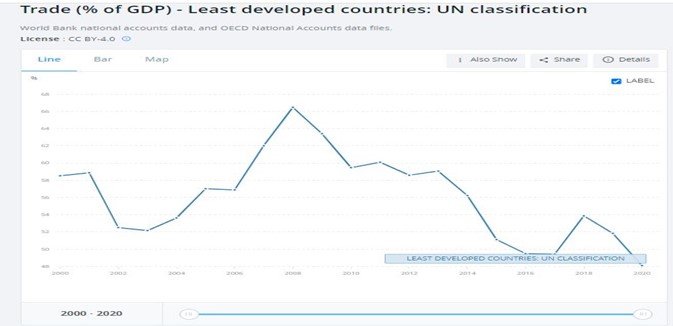
    Trade as a percentage of the Gross domestic Product (GDP) for LDC’s since the year 2000 is reflected below in figure 0.1.
    Source: http://data.worldbank.org

    The graph above illustrates that trade as a percentage of GDP for LDCs rose steadily from as early as 2003 up until the financial crisis in 2008. A downward pattern continued for another eight years until 2016, then there was improvement. However due to the Cocid-19 pandemic a downward movement has been evidenced since.

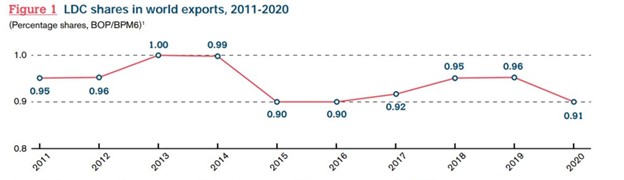
    The graph below illustrates the latest statistics of the LDCs share of world exports.
    Source (WTO 2022)

    We can clearly see that there was steady expansion of exports between 2017-2019. After the pandemic, there was a sharp decline of .04%, falling way below the expected target set by IPoA. (WTO 2022) shows that LDCs have seen declines over the last ten years in merchandise exports in all areas except clothing.  Although LDCs received preferential treatment, not all goods and services exported are covered (Antimiani and Cernat 2021).

    So what does this all mean, and what’s the bottom line?

    There is clear evidence supporting the WTO’s preferential treatment towards increasing  the revenues and economic prosperity of LDCs (Antimiani and Cernat 2021). Notably, there is still room for further easing of  trade barriers especially due to the shocks created by the pandemic. This is further underpinned by larger regional trade blocks emerging amongst developed countries undermining the efforts of the WTO (Palit 2015).  A 2016 paper carried out by (Klasen et al. 2016:5) using econometric techniques highlighted that “only Canada’s, Australia’s and EU’s trade preference systems have a positive and significant impact on LDCs’ exports”. Therefore, the following recommendations are proffered in the interest of economic uptake and growth through trade for LDCs.

    1. Establish regional trade agreements among LDCs to help increase their market share.
    2. Provide concessions for value added goods from LDCs within the global value chain for finished products exported by WTO members
    3. Increase the unilateral agreements enjoyed by LDCs  especially duty and quota free access to world markets on a wider range of products
    4. Increase the production and institutional capacity of LDCs by providing technical support to their industries
    5. Improve the LDC service waiver allowing it to cover more areas within the service industries

    These recommendations will allow LDCs to improve their trade practices, have more standardized procedures, facilate growth of local sectors which, in turn will increase the overall welfare of the economy and the people post covid.

    Note: Multiple WTO reports, textbooks and journals from industry experts were utilized in the writing of this article.

    Lucius S.J. Doxerie is an aspiring economist and co-founder and CEO of Stratagem Paradigms Inc.  He is a Chevening Scholar currently enrolled at the University of Bradford completing a Master of Science in Economics and Finance for Development. 

    REFERENCES

    Antimiani, A. and Cernat, L. (2021) Untapping the full development potential of trade along global supply chains: ‘gvcs for ldcs’ proposal. Journal of world trade 55 (5), 697-714.

    Białowąs, T. and Budzyńska, A. (2022) The Importance of Global Value Chains in Developing Countries’ Agricultural Trade Development. Sustainability 14 (3), 1389.

    Klasen, S., Martínez-Zarzoso, I., Nowak-Lehmann, F. and Bruckner, N. (2016) Trade preferences for least developed countries. Are they effective? Preliminary Econometric Evidence. Policy Review 4.

    Palit, A. (2015) Mega-RTAs and LDCs: Trade is not for the poor. Geoforum 58, 23-26.

    Suranovic, S. (2010) International trade: Theory and policy. The Saylor Foundation.

    WTO (2022) Boosting Trade Opportunities for Least Developed Countries. WTO. https://www.wto.org/english/res_e/publications_e/boottradeopp22_e.htm Accessed 22/03/22.

  • The WTO Trade Facilitation Agreement and Caribbean Small Island Developing States: Challenges and Opportunities

    Alicia Nicholls

    Getting raw sugar from a sugar factory in Guyana or Suriname to supermarkets and kitchens half-way across the world involves many different customs processes and paperwork. The World Trade Organisation’s Trade Facilitation Agreement seeks to cut the red tape and reduce the transaction costs and delays in the movement, release and clearance of goods across borders through the harmonisation, simplification and acceleration of customs procedures.

    Trade facilitation, along with investment, competition policy and government procurement, was one of the four “Singapore Issues” which developing countries were opposed to including in the multilateral negotiation agenda at the 5th WTO Ministerial in Cancun in 2003. However, negotiations on trade facilitation were eventually launched in 2004 (pursuant to Annex D of the July Package) with the “aim to clarify and improve” relevant aspects of trade facilitation articles under the GATT 1994″ in order to speed up the movement, release and clearance of goods, including goods in transit.

    After nearly ten years of negotiations, the TFA was concluded at the 9th WTO Ministerial Conference in Bali, Indonesia in 2013. It is the only multilateral trade agreement to be concluded so far out of the deadlocked Doha Development Round and the first since the WTO was established twenty years ago.  A separate Protocol of Amendment was adopted by WTO members on November 27, 2014 to insert the TFA into Annex 1A of the WTO Agreement.

    The TFA will enter into force once two-thirds of the WTO’s 161 states (as at April 2015) ratifies the agreement. So far of the only 52 countries which have already ratified the agreement, Trinidad & Tobago and Belize are the only countries of the Caribbean Community (CARICOM) to have done so, while Mauritius is the only other SIDS worldwide to have done so. A report published by UNCTAD in September 2014 on the status of implementation revealed that though a priority, trade facilitation is a major challenge for developing countries and least-developed countries (LDCs) and that some of the major barriers to implementation are lack of resources and of legal frameworks.

    Caribbean Economies are trade dependent

    Trade facilitation is important for Caribbean economies which have a high dependence on trade. Limited natural resources and lack of scale make most Caribbean SIDS (with the exception of Trinidad & Tobago) highly dependent on imported food, fuel and medicines, while their export profiles are characterised by a narrow range of exports and export markets. They have limited participation in global value chains and face declining terms of trade.

    Smaller Caribbean SIDS have largely diversified from economic dependence on mono-crop agriculture to services trade, mostly tourism and/or financial services. However, the major commodities exporters in the region (Trinidad & Tobago and the mainland countries of Guyana, Suriname and Belize) rely on exports ranging from oil and natural gas in Trinidad & Tobago and Belize, to aluminium, rice and raw sugar in Guyana and Suriname.

    Importance of Trade Facilitation

    Despite market access opportunities created by trade agreements, a major complaint for Caribbean SIDS exporters, especially small and medium sized enterprises (SMEs), have been the cumbersome hurdles they face when seeking to export to foreign markets. These hurdles include not just complex customs procedures but also stringent sanitary and phyto-sanitary standards (SPS) and technical barriers to trade (TBTs), these latter two are covered in other WTO agreements (i.e. the SPS and TBT Agreements).

    Customs procedures vary by country. By standardising and simplifying customs procedures, reforms pursuant to the TFA can enhance access and predictability for Caribbean SIDS exporters in foreign markets and promote export diversification.

    As the industrial action by customs officials in Barbados earlier this year showed, customs delays can negatively impact businesses and consumers. These delays can stem from the time taken to process applications for obtaining import or export licenses to the length of time for barrels and containers to clear ports.The quicker goods clear customs the quicker they can reach businesses and consumers for use as inputs or as final goods. Efficient customs release and clearance is particularly important for time-sensitive perishable products such as fruit and meats. Loss of perishable goods equals lost revenue to businesses.

    Transparent customs procedures and rules can also limit the opportunity for corruption by officials at checkpoints. Moreover, as import duties are still important revenue sources for Caribbean SIDS, modernisation of customs collection procedures can facilitate increased tariff revenue collection.

    The Agreement

    The TFA is divided into 3 sections: general provisions, special and differential treatment provisions for developing country members and least-developed country members (LDCs) and institutional arrangements and final provisions.

    It provides binding obligations in relation to procedures for pre-arrival processing, electronic payment, procedures allowing the release of goods prior to the final determination of customs duties, taxes, fees and charge, a risk management system for customs control, post-clearance audits, establishment and publication of average release times, procedures to allow expedited release of at least goods entered through air cargo facilities and procedures for releasing perishable goods within the shortest possible time.

    Provisions requiring publication and availability of information (such as applied rates and import/export restrictions) on the internet and for allowing traders and “other interested parties” the opportunity for comment and if necessary consultations before introducing or amending laws of general application to trade in goods, aim to promote transparency. While this latter provision may sound like an invasion of policy space, developing countries should take advantage of this provision to have their say on proposed policies by developed countries which might have an impact on their exporters.

    The Agreement also includes some ‘best endeavour” provisions, such as encouraging members to use relevant international standards in their formalities and procedures and to establish a single window for traders. The Agreement further provides for the establishment of a permanent WTO committee on trade facilitation and member states are required to designate a national committee to facilitate domestic coordination and implementation of the provisions of the Agreement.

    Special and Differential Treatment

    The TFA presents numerous benefits for Caribbean SIDS. However, Caribbean governments’ capacity to implement these trade facilitation reforms varies considerably as evidenced by the difference in their Category A notifications.

    The special and differential treatment provisions in Section II of the Agreement take this into account by linking countries’ commitments to their capacity to implement them. Moreover, LDCs will only be required to undertake commitments to the extent consistent with their individual development, financial and trade needs or their administrative and institutional capabilities.

    These flexibilities are based on the modalities that had been agreed in Annex D of the July 2004 Framework Agreement and paragraph 33 of and Annex E of the Hong Kong Ministerial Declaration. Developing countries and LDCs are to receive assistance and support for capacity building to implement the provisions of the Agreement in accordance with their nature and scope.

    Developing and LDC countries are required to categorise each provision of the Agreement  based on their individual implementation capacity, with Category A being those measures they can implement by the time the Agreement comes into force (or within one year after  for LDCs), Category B being those which they will implement after a transitional period following the Agreement’s entry into force and Category C meaning those which require capacity building support for implementation after a transitional period after the Agreement’s entry into force. Most Caribbean SIDS, including Barbados, have now submitted their Category A notifications.

    Trade Facilitation Facility

    A key developmental element of the TFA, the Trade Facilitation Facility (TFF) was established in July 2014 to provide assistance to developing countries and LDCs to ensure “no WTO member is left behind”. The TFF is to provide assistance in helping them assess their capacity to implement the TFA, by maintaining an information sharing platform to assist with the identification of possible donors , providing guidance on the implementation of the TFA through the development or collection of case studies and training materials,  undertaking donor and recipient match-making activities and providing project preparation and implementation grants related to the implementation of TFA provisions in cases where efforts to attract funding from other sources have failed.

    According to the World Trade Report 2015, once it enters into force, the TFA is expected to reduce total trade costs by up to 15 per cent in developing countries.

    Status of Implementation

    At the recently concluded COTED meeting in Georgetown, Guyana, CARICOM members reported on their status of TFA implementation. However, this status information has not been made public. Despite this, the Organisation for Economic Cooperation and Development (OECD) has a ‘compare your country on trade facilitation performance’ portal which allows for comparing countries on trade facilitation indicators.

    Looking at Barbados’ performance for instance, Barbados “matches or exceeds the average performance of high income countries in the areas of fees and charges and simplification and harmonisation of documents”, with performance improving in appeal procedures and automation. However, some ground was lost in information availability and internal border agency cooperation.

    Implementation Challenges

    Trade facilitation reforms can be beneficial to Caribbean SIDS.  This does not mean however that there will not be significant implementation challenges, particularly the infrastructure costs related to technology and equipment, and administrative, human resource and training costs. There will also be costs associated with raising private sector awareness. These costs are not just one-time costs but are recurring.  In light of competing resource demands and their limited access to concessionary loans these costs will not be easy for cash-trapped Caribbean SIDS which already have high debt to GDP ratios.

    The flexibilities in the Agreement allow states  to implement the provisions in accordance with their capabilities and there are aid for trade initiatives such as the European Development Fund of which Caribbean SIDS have been taking advantage in varying degrees.  Other challenges for implementation include limited human resource capacity and the need to reform existing laws and regulations to give effect to obligations.

    Surveys of developing countries and LDCs conducted by the WTO found that trade facilitation remains a high priority for developing countries. For Caribbean SIDS there certainly has been some interesting developments on this front. The governments of several Caribbean states have openly stated their countries’ firm commitment to trade facilitation and their recognition of its potential for economic growth.

    Trinidad & Tobago was recently approved for a $25 million loan from the Inter-American Development Bank (IDB) to help strengthen the country’s Single Electronic Window for Trade and Business Facilitation Project (TTBizLink). With the aim of becoming a logistics hub, Jamaica has recently established a Trade Facilitation Task Force. Technical assistance and aid for trade facilitation are also included in the EC-CARIFORUM Economic Partnership Agreement, which includes a protocol on mutual administrative assistance in customs matters.Moreover, in Barbados’ latest Trade Policy Review 2014 WTO members noted the considerable progress the country made with respect to the adoption of trade-facilitation measures. Recently, the island  also amended its Customs Act to allow for post-clearance audits.

    Taking full advantage of the technical assistance, aid and capacity building assistance under the TFF will be key for Caribbean SIDS in their implementation efforts.

    The Case of Mauritius 

    As the Indian Ocean island of Mauritius was the first SIDS to ratify the Agreement, it provides useful lessons for Caribbean SIDS. Seizing the opportunity to boost its competitiveness, Mauritius has received assistance from the International Trade Centre and UNCTAD, including for the establishment of the Mauritius National Trade Facilitation Committee. One can read about the Mauritius experience here.

    Conclusions

    Despite the high costs and challenges of implementation, trade facilitation reforms pursuant to the WTO TFA have the potential to bring many benefits to Caribbean SIDS. By streamlining the flow of cross-border trade, the ratification and speedy implementation of the TFA by Caribbean SIDS and their trade partners will allow Caribbean exporters to capitalise on the market access openings available in foreign export markets, thereby boosting Caribbean SIDS’ export competitiveness and GDP growth, with spillovers for income and job creation. However, regional exports will still need to meet SPS and technical standards which for many exporters still remain significant barriers to trade.

    Ratification and full implementation  of the TFA by all CARICOM states could also improve Caribbean regional integration by easing transaction costs of exporting across CARICOM states. Implementing these reforms also send a strong signal to the business community of these countries’ commitment to improving their business environment.

    Full realisation of the benefits of the TFA will not be automatic and the degree will largely be contingent on the pace and depth of implementation of the Agreement by  Caribbean governments and their trading partners and on stakeholder buy-in. Stakeholder holder consultation and strong coordination between public and private actors will be crucial for the formulation of implementation plans and the monitoring and assessment of the impact of the reforms. In this regard, lessons can be learnt from the Mauritius experience. Trinidad & Tobago and Belize have already made the step by ratifying  the Agreement. It is hoped that other Caribbean SIDS will soon follow suit.

    The full text of the Trade Facilitation Agreement is available here:

    Alicia Nicholls, B.Sc., M.Sc., LL.B. is a trade and development consultant with a keen interest in sustainable development, international law and trade. Please note that the views expressed in this article are solely hers. You can also read more of her commentaries and follow her on Twitter @LicyLaw.