Tag: mia mottley

  • Statement from Chair of CARICOM, Hon. Mia Amor Mottley on Impact of the Global Crises on the Caribbean

    Statement from Chair of CARICOM, Hon. Mia Amor Mottley on Impact of the Global Crises on the Caribbean

    (CARICOM Secretariat, Turkeyen, Greater Georgetown, Guyana – Friday, 4 April 2025)  –

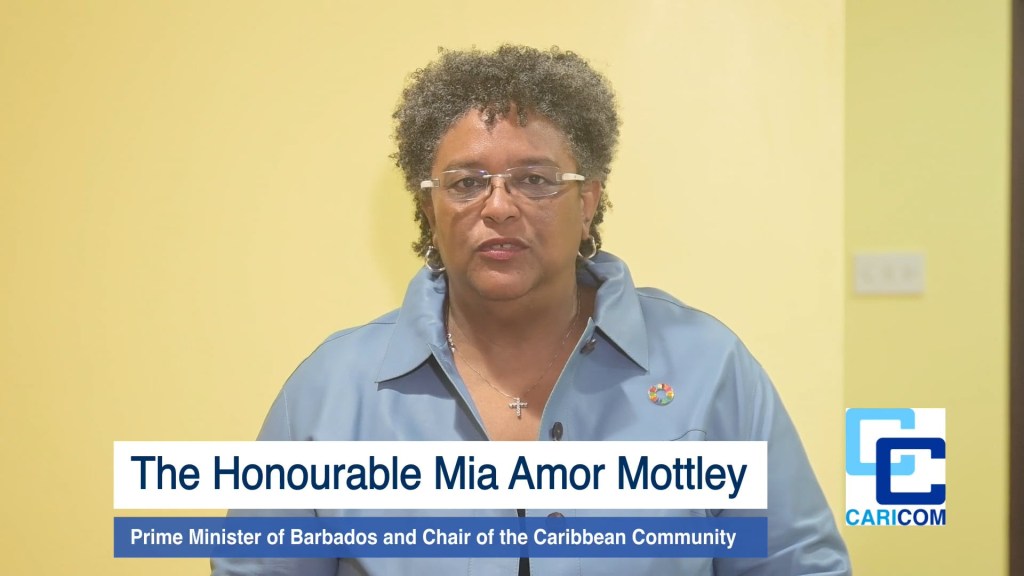
    The transcript of the Statement from the Honourable Mia Amor Mottley, Chair of the Caribbean Community (CARICOM) on the impact of the global crises on the Caribbean.

    I speak to all our Caribbean brothers and sisters today, not as the Prime Minister of Barbados, but in my capacity as Chair of the Caribbean Community.

    Our world is in crisis. I will not sugarcoat it. These are among the most challenging of times for our region since the majority of our members gained their independence. Indeed, it is the most difficult period our world has faced since the end of World War II, 80 years ago. Our planet faces a climate catastrophe that worsens every year. We have a cost-of-living crisis that has been bedevilling us since the disruption of supply chains, when the COVID-19 Pandemic triggered the shutdown of the majority of countries.

    Misinformation, disinformation and manipulation are relevant. The mental health crisis is causing hopelessness among many of our young people, and regrettably, crime and fear are on the rise. We’re fighting wars in the Holy Land, in Europe and in Africa. Countries are distrustful of countries and neighbours are distrustful of neighbours. The international order, the international system, my friends, is in great danger of collapse, and now we are on the precipice of a global trade war.

    Our Caribbean economies are largely reliant on imports. Just go to the supermarket or visit the mall or the hardware shop or the electronic store, and you will see that most of the things there are not produced in this Region. Many of those commodities are either purchased directly from the United States of America or passed through the United States of America on their way to the Caribbean region. That, my friends, is a legacy of our colonial dependence. Together with colleague Heads of State and Heads of Government, we have been working to diversify ourselves away from this dependence.

    We’ve already started to reap some successes, especially in the field of agriculture, for example, but we still have a long way to go. As we do this work, we have to be mindful that those recent announcements that have been made in the last few days will impact us very directly as a Region and as a Caribbean people.

    We are working and will continue to work to become more self-sufficient, but I want every Caribbean man and every Caribbean woman to hear me. This trade war and the possibility of a US $1 million to $1.5 million levy on all Chinese made ships entering US harbours will mean higher prices for all of us at the corner shop, higher prices at the supermarket, higher prices at the electronic store, higher prices for us at the shop, higher prices for us at the restaurant, higher prices for us at the current dealership and beyond.

    A lot of Caribbean people will think that these things that you are seeing on television news or reading about are far away and “They don’t impact on me.” A lot of people think “I’m just a farmer”, “I’m just a schoolteacher”, or “I’m just a mechanic.” They say, “I live in Saint Lucy in Barbados”, or “I live in Portmore in Jamaica”, or Kingstown in St Vincent, or Arima in Trinidad or Basseterre in St Kitts & Nevis, or San Ignacio in Belize.

    “These problems are far away from me, and they don’t impact me.” That is what you will hear them say. But the reality, my friends, is that if you buy food, if you buy electronics, if you buy clothes, it will impact you. It will impact each of us.

    My brothers and sisters, our Caribbean economies are not very large. So, we are, and have always been, at the whims of global prices. If Europe and China and the U.S. and Canada and Mexico are all putting tariffs on each other, that is going to disrupt supply chains, that is going to raise the cost of producing everything, from the food you eat, to the clothes on your back, to the phone in your pocket, to the car you drive down the road, to the spare parts that you need for critical infrastructure. That means higher prices for all of us to pay, and sadly, yes, this will impact all of us, regardless of what any of our Caribbean governments will do.

    We could lower our tariffs to zero in CARICOM, and it will not make a lick of difference, because our economies are small and vulnerable. This crisis, my friends, will impact not only goods, but it may also have a large spillover effect on tourism. We suggest that the region takes steps to sustain the tourism industry as likely worsening conditions and many of our source markets will have negative impacts on people’s ability to travel. We call on our regional private sector and the tourism sector to come together and to work with governments to collaborate for an immediate tourism strategy to ensure that we maintain market share numbers as a region.

    My friends, I pray that I’m wrong, and I’m praying that cooler heads prevail across the world, and leaders come together in a new sense of cooperation, to look after the poor and the vulnerable people of this world, and to leave space for the middle classes to chart their lives, to allow businesses to be able to get on with what they do and to trade.

    But truly, I do not have confidence that this will happen.

    So, what must we do?

    First, we must re-engage urgently, directly, and at the highest possible level with our friends in the United States of America. There is an obvious truth which has to be confronted by both sides. That truth is that these small and microstates of the Caribbean do not, in any way or in any sector, enjoy a greater degree of financial benefit in the balance of trade than does the United States. In fact, it is because of our small size, our great vulnerability, our limited manufacturing capacity, our inability to distort trade in any way, that successive United States administrations, included, and most recently, the Reagan administration in the early 1980s went to great lengths to assist us in promoting our abilities to sell in the United States under the Caribbean Basin Initiative. We will see how these tariffs will impact on that. That spirit of cooperation largely enabled security, social stability and economic growth on America’s third border in the Caribbean, or as we have agreed as recently in our meeting with Secretary of State Rubio, what is now our collective neighbourhood.

    Secondly, we must not fight among each other for political gain. Because my dear brothers and sisters, as the old adage  goes “United, we stand and divided, we fall.”

    Thirdly, we must redouble our efforts to invest in Caribbean agricultural production and light manufacturing. The 25 by 2025 initiative, ably led by President Ali, seems too modest a target now, given all that we are confronting. We must grow our own and produce our own as much as possible. We can all make the decision to buy healthy foods at the market instead of processed foods at the supermarket.

    Fourthly, we must build our ties with Africa, Central and Latin America, and renew those ties with some of our older partners around the world, in the United Kingdom and Europe, and in Canada. We must not rely solely on one or two markets. We need to be able to sell our Caribbean goods to a wider, more stable global market.

    My brothers and sisters, in every global political and economic crisis, there is always an opportunity. If we come together, put any divisions aside, support our small businesses and small producers, we will come out of this stronger.

    To our hoteliers, our supermarkets and our people, my message is the same. Buy local and buy regional. I repeat, buy local and buy regional. The products are better, fresher and more competitive in many instances. If we work together and strengthen our own, we can ride through this crisis. We may have to confront issues of logistics and movement of goods, but we can do that too.

    To the United States, I say this simply. We are not your enemy. We are your friends. So many people in the Caribbean region have brothers and sisters, aunties, uncles, grandmothers, grandfathers, sons and daughters, God children living up in Miami or Queens or Brooklyn or New Jersey, Connecticut, Virginia, wherever. We welcome your people to our shores and give them the holidays, and for many of them, the experiences of a lifetime.

    I say simply to President Trump; our economies are not doing your economy any harm in any way. They are too small to have any negative or distorted impact on your country. So, I ask you to consider your decades-long friendship between your country and ours. And look to the Caribbean, recognizing that the family ties, yes, are strong. Let us talk, I hope, and let us work together to keep prices down for all of our people.

    My brothers and sisters, there’s trouble in our Caribbean waters, but the responsibility each and every day for much of what we do and what much of what we grow must be ours, if we take care of each other, if we support each other, if we uplift each other, and if we tap into the strength and innovation of our common Caribbean spirit, we will see this through.

    Our forefathers faced tribulations far worse than we will ever do and yes, they came through it.

    My friends, my brothers and sisters, we can make it.

    We shall make it.

    God bless our Caribbean civilization.

    Thank you.

  • Africa-Caribbean cooperation, regional integration and climate change action among priorities of new CARICOM chairman

    Africa-Caribbean cooperation, regional integration and climate change action among priorities of new CARICOM chairman

    Alicia Nicholls

    Within the next six months, the Caribbean Community (CARICOM) will seek to jointly host the first ever African Union-CARICOM Summit. This announcement was made again by Barbados’ Prime Minister, the Hon. Mia Amor Mottley, QC, who assumed chairmanship of the 15-member grouping from January 1, 2020 under its six month rotating chairmanship system.

    In her New Year’s Message as incoming chairperson, Prime Minister Mottley intimated that the summit should lay the foundation for tangible progress in  “direct air and sea access across the Atlantic, greater trade in goods and services, and more cultural exchanges between our regions.”

    2019 saw renewed interest in deepening Africa-Caribbean relations, with two African leaders (President Nana Akufo-Addo of Ghana and President Uhuru Kenyatta of Kenya) making official state visits to the region. In late 2019, Prime Minister Mottley accepted on behalf of CARICOM an offer of shared office space in Nairobi from the Government of Kenya for the hosting of a joint CARICOM Mission. For many CARICOM countries, such a mission would be their first on the African continent.

    Regional Integration

    Barbados has lead responsibility for the CARICOM Single Market and Economy (CSME) under the CARICOM quasi-cabinet. Many regional observers hope that the invigorated leadership provided by Prime Minister Mottley will add much needed energy to the regional integration process, especially in the aftermath of the mirror image provided by the Jamaica-commissioned Golding Report.

    Indeed, there appears to be renewed commitment by Barbados to the CSME under current leadership. Barbados became the first country to ratify the Protocol on Contingent Rights and will also be the first to offer other CARICOM nationals free access to public schools once certain requirements are met.

    Likening the regional integration process to a relay race, Prime Minister Mottley stated that Caribbean leaders “are duty bound to continue this journey across the Community whether as a collective of the whole or in twos and threes”. However, she also sought to temper unrealistic expectations, noting that the much more resource-endowed and longer-established European Union (EU) was still working on perfecting its own regional process.

    The new CARICOM Chairman outlined several priorities with regard to the regional integration process. These are: removing the obstacles to passport-free movement and facilitating movement for work where there are opportunities; advancing the process of a single domestic space for transport and communications in the region by working to provide more affordable and reliable air and sea links between our countries; to establish a single domestic rate for telecommunications and phone calls within CARICOM; and to work with the private sector and the labour movement to provide further opportunities.

    Climate Change Action

    Since taking office as Prime Minister of Barbados, Miss Mottley has made climate change one of her signature issues on the international stage. She noted the need “to pool the funds of the region in order to be able to finance our own development trajectory for sustainable development so that we may adapt to the new realities of the climate crisis”.  

    Prime Minister Mottley took over the chairmanship from St. Lucia Prime Minister, the Hon. Allen Chastanet, whose term was July 1 – December 31, 2019. Barbados’ chairmanship will last until June 30, 2020. The last time Barbados held the chairmanship was in 2015 under then Prime Minister, the Hon. Freundel Stuart.

    The new CARICOM chairman’s speech may be watched here.

    Alicia Nicholls, B.Sc., M.Sc., LL.B., is an international trade and development consultant with a keen interest in sustainable development, international law and trade. You can also read more of her commentaries and follow her on Twitter @LicyLaw.

    DISCLAIMER: All views expressed herein are her personal views and do not necessarily reflect the views of any institution or entity with which she may be affiliated from time to time.

  • If you take away multilateralism, who will hear us?

    If you take away multilateralism, who will hear us?

    Alicia Nicholls

    The title of this week’s article is borrowed from the impromptu but impassioned appeal made by Prime Minister of Barbados, the Hon. Mia Amor Mottley, QC, MP, in her maiden address on September 28th during the General Debate of the 73rd Session of the United Nations General Assembly (UNGA). With only one notable exception, support for multilateralism was a common thread linking the speeches given by world leaders during the General Debate.

    Perhaps the most compelling case for multilateralism was that made by Foreign Minister of Singapore, Dr. Vivian Balakrishnan. While warning that multilateralism was at a crossroads and was facing a crisis of confidence, Foreign Minister Balakrishnan made an articulate case for the indispensability of multilateralism to the global community, especially to small states.

    Indeed, multilateralism affords small states a microphone that they would otherwise lack on the international stage. Despite the successes of the rules-based multilateral system, there are widening cracks in the system. These require immediate remedial action to enhance the system’s structural integrity to withstand the threat of creeping unilateralism, and to more effectively serve the needs of the global community in a changing geopolitical and economic world.

    What is multilateralism?

    Multilateralism, in the most rudimentary sense, refers to cooperation among three or more nation states to achieve a common goal. In contrast to the current isolationist US government stance, previous US governments were central to the establishment of the present-day multilateral system, which bears their footprint.

    The modern day multilateral system was fashioned in the wake of the Second World War (1939-1945) with the aim of promoting global peace and stability. It was based on the liberal theory of international relations which posited, inter alia, that states which cooperate would not resort to war. It was in that immediate post-war era that the United Nations, the progeny of the League of Nations (1920-1946), was formed in 1945. The Bretton Woods institutions (the International Monetary Fund and the World Bank), the watchdogs of the global economic order, were established at a conference held in Brettons Woods, New Hampshire, US in 1944.

    Multilateralism recognizes that no one Government alone can handle the growing plethora of challenges confronting the global community, and that by pooling resources, wisdom and ideas through shared institutions, optimum solutions could be found. In the years that followed, a spaghetti bowl of multilateral organisations has flourished in areas as diverse as health, telecommunications, the environment, migration, international transportation, labour, among others.

    With respect to trade governance, an attempt was made by a US-led group of countries to establish an International Trade Organisation (ITO) in the mid 1940s but failed after the US Congress repeatedly declined to approve the ITO Charter. As such, an informal organization known as the General Agreement on Tariffs and Trade (GATT) governed world trade from 1945 until January 1995 when the World Trade Organisation (WTO) came into being.

    Why Multilateralism Matters to Small States

    The majority of today’s developing countries were still colonies when many of these multilateral institutions were birthed. However, upon attaining independence, acceding to these institutions was viewed as a requisite rite of passage. This is particularly true for the world’s small states which have overwhelmingly been supporters of multilateralism.

    But why is that? Small states, with their diminutive economies and populations, weak political leverage and inherent vulnerabilities, would be the “bullied kids” in an anarchic global system where “might is right”. The rules-based multilateral system provides a buffer of stability and predictability for small states. Its norms-based system, undergirded by international law, helps to constrain and contain great power aggression. In a general sense, multilateral institutions provide some semblance of accountability for those States which contravene global norms. I say in a general sense as history has proven that this has not always been the case with big countries. In the area of trade, the WTO’s dispute settlement system gives small states the opportunity, at least in theory, to hold hegemons to account.

    Multilateral engagement gives small states, which would otherwise be Liliputians in the international system, a voice. Whereas by itself a small states’ voice is a little more than a squeak, by building coalitions small states have managed to achieve a roar on some issues. One of the most notable cases was the success of the Alliance of Small Island States (AOSIS) in the UNFCCC negotiations leading up to the signature of the Paris Climate Agreement during the COP21 in 2015. Though not perfect, that agreement is an important milestone in the fight against anthropogenic global warming.

    Small states have also been able to benefit from capacity building and technical assistance from multilateral institutions. An example is the research done by multilateral financial institutions on the issue of de-risking which has led to the loss of correspondent banking relations, with implications for these states’ financial sectors and commercial relations. In the wake of the financial crisis, several Caribbean countries, and most recently Barbados, have had to enter IMF structural adjustment programmes.

    Some small states have also played a key role in the establishment of multilateral institutions. Trinidad & Tobago was instrumental in pushing for the establishment of the International Criminal Court (ICC), and small states helped to push for the United Nations Convention on the Law of the Sea (UNCLOS). Moreover, small states have had some success in attaining high positions in international organisations.

    Why is Multilateralism Under Threat?

    Why is a system which has given the world relative peace and prosperity for some seventy years now facing what Singapore Foreign Minister Balakrishnan called a “crisis of confidence”? Questions about the efficacy and legitimacy of multilateral institutions have long been raised, but rising populism and anti-globalisation sentiment, in the wake of uneven recovery from the financial crisis has led to rising nationalism, xenophobia and unilateralism. Indeed, the recently published UNCTAD Trade and Development Report 2018 noted that trade tensions were a “symptom of a greater problem”, that is, failure to address rising global inequality and imbalances caused by “hyper-globalisation”.

    But many of the problems are not the fault of multilateralism but due to inappropriate policy responses by Governments and by disruptive technologies which have replaced labour with machines. As such, as noted by Foreign Minister Balakrishnan in his UNGA speech, it is up to governments to address this through retooling workers and reformulating their education systems to equip the next generation with the tools to exploit these technologies.

    Small states in their successive UNGA addresses have often expressed frustration at the slow pace of action on some fronts of concern to them, including financing for climate change. Antigua & Barbuda’s Prime Minister, Gaston Browne, voiced disappointment with his country’s inability to receive compensation from the US after the WTO dispute settlement body ruled in Antigua & Barbuda’s favour in the US Gambling dispute. Moreover, Caribbean leaders have frequently bemoaned the lack of support for discontinuing the use of GDP per capita as a basis against which to measure development status. This criterion has excluded middle and high income Caribbean countries from most concessional loans and official development assistance.

    Making Multilateralism Work Better

    The question is not whether multilateralism works, but how can it work better. There are legitimate concerns about whether today’s multilateral institutions, many of which were forged during different economic and geopolitical times, remain “fit for purpose” for today’s global realities and challenges. Former UN Secretary General, Kofi Annan recognised this when he asserted in 2002 that “the United Nations exists not as a static memorial to the aspirations of an earlier age but as a work in progress – imperfect as all human endeavours must be capable of adaptation and improvement.”

    On the trade front, for example, there have been increased calls for reform of the WTO. Several members, including the US, Canada and the EU, have made proposals for reform. As it stands, the WTO’s negotiation function remains in a state of paralysis, while the US blocking of the appointment of judges to its Appellate Body over the US government’s dissatisfaction with the dispute settlement system risks creating a crisis in that body’s ability to be an arbiter of trade disputes between WTO members. The renewed appetite for WTO reform provides a window of opportunity for small states to redouble their advocacy efforts for their own reform proposals, while making sure they are not excluded from having a seat at the table.

    There is the need to address democratic and transparency deficits within multilateral institutions. The configuration and operation of the UN Security Council, for example, stills reflects a geopolitical reality that no longer exists. Decisions made by the Paris-based Organisation for Economic Cooperation and Development (OECD), where developing states do not have a seat at the table, have had devastating consequences for the offshore financial services sectors of Caribbean states.

    Institutional reform would require, where feasible, strengthening the secretariats of these organisations to better serve the needs of member states, especially the most vulnerable. In addition to fostering a greater space for civil society to be heard in multilateral organizations, there should also be greater emphasis on building the capacity of small states to effectively participate in meetings and the day-to-day operations of these organisations.

    The challenges which face the world call for more multilateralism, not less. Multilateralism is important for achieving Agenda 2030, including the seventeen UN Sustainable Development Goals (SDGs). Multilateral institutions also have a pertinent role to play in developing rules to address emerging global issues. Singapore Foreign Minister Balakrishnan, for example, called for the UN to develop norms and rules for cybersecurity.

    In the past week alone, several events have further reiterated why multilateralism is needed now more than ever. One of which is the IPCC Special Report on Global Warming of 1.5ºC which showed that the world was already experiencing the effects of warming of 1.0 degrees Celsius above pre-industrial levels. The devastation caused by Hurricane Michael to the Florida Panhandle in the US this week reiterates the urgency of the need for redoubled climate action. Rising global trade tensions, protectionism and unilateralism have made trade top of mind for global economic leaders. In their communique released following the Annual Meetings of the Boards of the IMF and World Bank, it was specifically noted that the IMF would facilitate multilateral solutions for global challenges.

    Carrying on the multilateralism baton

    Prime Minister Mottley concluded her UNGA speech by asking “Will we carry and hand over to future generations, the baton left us by those who dreamed of a world of united nations or will we drop it?” For small states, it is important that we do not allow this baton to be dropped.

    Alicia Nicholls, B.Sc., M.Sc., LL.B., is an international trade and development consultant with a keen interest in sustainable development, international law and trade. You can also read more of her commentaries and follow her on Twitter @LicyLaw.