Tag: Politics

  • Caribbean Trade & Development News Digest – Feb 1-7, 2026

    Caribbean Trade & Development News Digest – Feb 1-7, 2026

    Dear Readers,

    You have been asking for it and it is back – our Caribbean Trade & Development News Digest! It has been a while and there is much in the trade news to catch up on. Let’s get you caught up on some of the major trade stories from the past days.

    The Inter-American Development Bank (IDB)’s Trade Trends and Estimates for Latin America report shows that the value of goods exports from Latin America and the Caribbean is estimated to have grown by 6.4% in 2025, following an increase of 4.7% in 2024 aided by higher export volumes. But they warn of “continuing uncertainty surrounding the global economic outlook and the direction of trade policies, which could potentially temper global demand”. Have a read of the report here.

    According to UNCTAD’s latest Global Investment Trends Monitor report, global foreign investment rose 14% in 2025, but underlying activity remains weak. The report notes that “a significant share of the increase came from higher flows through major global financial centres. Excluding these, underlying FDI growth would have been closer to 5%”. Have a read here.

    REGIONAL AND HEMISPHERIC TRADE STORIES

    From blackouts to food shortages: How US blockade is crippling life in Cuba

    Al Jazeera: US pressure pushes island nation’s 11 million people to the brink as Cuba imposes emergency measures amid fuel crisis. Read more

    CARICOM strengthens relations with three EU nations

    St Vincent Times: The Caribbean Community (CARICOM) strengthened its growing relationship with Sweden, Norway and Austria this week as new ambassadors from those countries were accredited to CARICOM. Read more

    Africa-CARICOM Trade Poised to Exceed $1 Billion

    St Vincent Times: Exports from the Africa Union to CARICOM could cross the US$1 billion mark, according to a CARICOM Private Sector Organization (CPSO) Study unveiled this week, signalling a major opportunity to rewire CARICOM import supply chains. Read more

    BPO sector highlighted as key driver of jobs and digital exports at business mixer in Belize

    BreakingBelizeNews: CEO Narda Garcia noted that to date, there is a total of 17 BPOs that benefit under Belize’s Designated Process Area Program (the DPA) and that provide over nine thousand jobs to Belizeans. Read more

    Caribbean cannabis growers eye budding domestic sales and exports

    BBC: Last year marked a decade since Jamaica decriminalised the recreational use of cannabis and legalised its production and sale for medical reasons. Several other Caribbean nations, including the twin island country Antigua and Barbuda in 2018, have since followed suit. Read more

    STRAIGHT FROM THE WTO!

    Members discuss next steps on WTO reform ahead of MC14

    WTO members on 3 February considered next steps in advancing work on WTO reform in the lead-up to the 14th Ministerial Conference (MC14) scheduled to take place in Yaoundé, Cameroon, in March 2026. The facilitator on WTO reform, Ambassador Petter Ølberg of Norway, announced that he will launch a reform month on 5 February aimed at discussing a post-MC14 workplan. He underscored that reform must mean change and that WTO reform will be a central element of MC14. Read more

    WTO revamps data portal with new catalogue of WTO datasets

    The WTO has revamped the WTO Data Portal, the principal gateway to all trade data published by the organization. A key feature of the portal is a new catalogue of WTO datasets allowing WTO members and other users to explore WTO data in one self-contained area instead of navigating various platforms. Read more

    GLOBAL TRADE STORIES

    Trump extends AGOA by a year – but wants more US benefits

    African Business: President Trump has extended the flagship US-Africa trade act by a year – but his administration wants to rework it to benefit US firms. Read more

    Here’s why the India-EU trade pact is the ‘mother of all deals’

    WEF: India and the European Union reached a landmark free trade deal last week, concluding negotiations in one of the world’s most ambitious trade pacts. Read more

    U.S. and India unveil framework of interim trade deal, move closer to broad pact

    CNBC: The United States and India moved closer to a trade pact on Friday, releasing an interim framework that would lower tariffs, reshape energy ties and deepen economic cooperation as both countries seek to realign global supply chains. Read more

    EU and Australia revive stalled trade talks over agriculture, raw materials

    RFI: The European Union is hoping to conclude a long-sought trade agreement with Australia which will include agricultural products and raw materials. Read more

    Trade momentum slows in Asia and the Pacific

    UNESCAP: Asia and the Pacific remained a central driver of global trade and investment in 2025, despite slowing momentum amid rising geopolitical and policy uncertainties. Read more

    China hits growth goal after exports defy US tariffs

    BBC: China said its economy expanded by 5% last year, meeting Beijing’s official target as a record trade surplus boosted growth. Read more

    The Caribbean Trade & Development News Digest is a product of the Caribbean Trade and Development blog.

    Image by Gerd Altmann from Pixabay
  • Cuba and the Moral Cost of Silence

    Cuba and the Moral Cost of Silence

    Alicia Nicholls

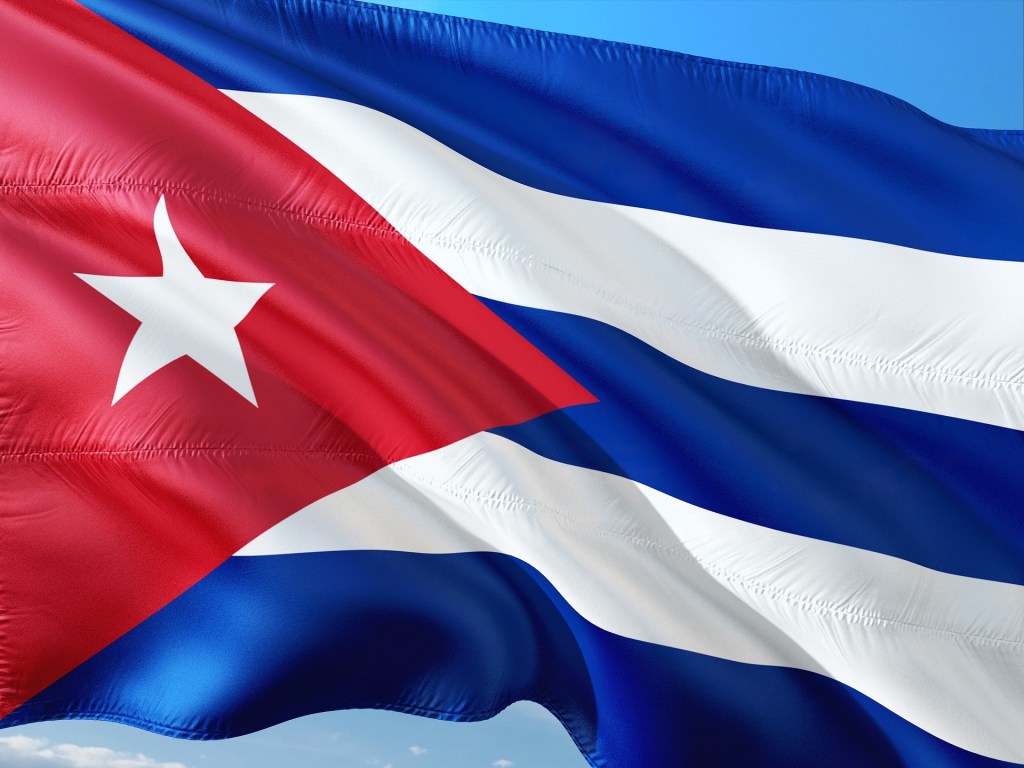
    We are barely into the second month of 2026, and already it feels as though the world has shifted beneath our feet. The pace of global change, or even upheaval, has driven many to tune out the news altogether. Yet here in the Caribbean we should not look away from what is unfolding in one of our neighbouring island states, Cuba. For decades, Cuba has been more than a steadfast neighbour to the anglophone Caribbean. It has provided scholarships to our students to study medicine and other disciplines at its universities. It has provided health care to our citizens, sent doctors and nurses to assist us during the COVID-19 pandemic, sent soldiers to fight in anti-colonial struggles, and stood with countless countries globally in moments of crisis.

    Following the Cuban Revolution of 1959 and since 1962, Cuba has been under a comprehensive US trade and economic embargo. Over time, these sanctions have been tightened, loosened and tightened again. They extend beyond US-Cuba bilateral trade, with the US seeking to apply it extra jurisdictionally to third countries and companies that do business with the island by leveraging its control of the global financial system as the world’s reserve currency. For a small island nation of roughly 11 million people and some 110,000 squared kilometers, this has meant decades of restricted access to many goods, services and investment.

    While no government is without fault and there have been some governance challenges and restrictions on political freedoms, it is impossible to ignore the structural pressure exerted by more than a half a century of economic isolation imposed by the world’s most powerful country. Despite its economic and political challenges, Cuba has achieved social outcomes that rival far wealthier nations. Its life expectancy is on par with that of the US, while its child mortality rate is lower than the US’ and many countries with significantly higher GDP per capita. These achievements reflect sustained investment in universal health care and education, policy choices in keeping with its socialist ideology which prioritises social development of its people.

    Today, however, Cuba faces an acute humanitarian crisis. On January 29, 2026, the US branded Cuba an “unusual and extraordinary threat” to its national security and foreign policy and has taken measures to further restrict the island’s access to essential supplies. Regular oil shipments from Venezuela have ceased following the US’ invasion and removal of President Nicolas Naduro from that country. Other countries, such as Mexico, which had been supplying oil have been met with US threats of economic retaliation, including tariffs.

    This escalation in US aggression is particularly concerning because in a world which still depends on fossil fuels, oil is not a luxury. It powers ventilators in intensive care units serving sick patients and premature babies. It runs water systems and electric grids. It keeps lights on in homes. When fuel stops flowing, daily life begins to unravel. The result is widespread blackouts, queuing at gas stations, rationing of basic necessities, rising prices, and mounting strain on hospitals and households, prompting Cuban President Miguel Diaz Canel to repeatedly condemn this latest escalation in US aggression, while maintaining Cuba’s openness to constructive dialogue. United Nations Secretary-General, Antonio Guterres, has warned of the humanitarian implications of this escalated US action. Starving Cuba of oil is to literally starve the Cuban people.

    What is perhaps most troubling is the global silence, despite some perfunctory statements of solidarity made. Powerful nations have, thus far, stood by as Cubans endure growing shortages and hardship for daring to choose a governance model that does not accord with capitalist interests and for seeking to navigate an asymmetric international system on its own terms. It is, therefore, both unsurprising, but also deeply disappointing, that Caribbean countries, which were among the first to establish diplomatic ties with Cuba and each year call for the end of the unjust US embargo, have been largely silent on these latest aggressions. It could very well be that regional leaders are quietly behind the scenes using diplomatic channels to engage the US government and legislators on this. But we also know that Caribbean governments have reportedly faced threats, such as tariffs, visa restrictions and economic retaliation, and some being allegedly forced to stop sending their students to Cuba.

    For small states, the calculation is stark, either speak out and face victimisation or be silent and shield your own citizens on whom you depend for electoral support from immediate harm. After all, if the more powerful countries lack the moral courage to stand up to the world’s most powerful country, who are we to do otherwise, right? But since when do we in the Caribbean determine our own morality by the actions of the most powerful? If the larger nations lack the courage to act, does that absolve us of our responsibility to come together and advocate for Cuba like we have done in the past?

    Solidarity with the Cuban people is not optional, it is a moral imperative. Just like the ongoing genocide in Gaza, history will record and judge how the world responded in this moment. We as citizens are not powerless. We can push our governments to act. We can write and we can organise to urge our leaders to engage bilaterally, and to advocate in regional and international fora. As individual governments we are limited, but by acting as a collective, we can advocate on behalf of Cuba, and for an end to this escalation and for the end of an embargo which has not only failed in its purpose but has only served to make the Cuban people stronger and more resilient.

    Cuba has been a friend to us and to many around the world. It is our time, as a region and as a global community, to step up and be a friend to Cuba when it matters the most. Moral courage is neither easy, nor convenient, but necessary. The question before us is whether when this juncture in history is remembered, will we be able to say we raised our voices in solidarity with our hermanos y hermanas cubanos (Cuban brothers and sisters), or do we choose the ‘safety’ of silence. Whatever happens, I hope and pray that Cuba vencerá (Cuba will overcome).

    Alicia Nicholls, B.Sc., M.Sc., LL.B. is an international trade specialist and the founder of Caribbean Trade & Law Development Blog: www.caribbeantradelaw.com.

    Image by jorono from Pixabay

  • Deeper CARICOM integration key to navigating fractured global trade order – CARICOM ASG

    Deeper CARICOM integration key to navigating fractured global trade order – CARICOM ASG

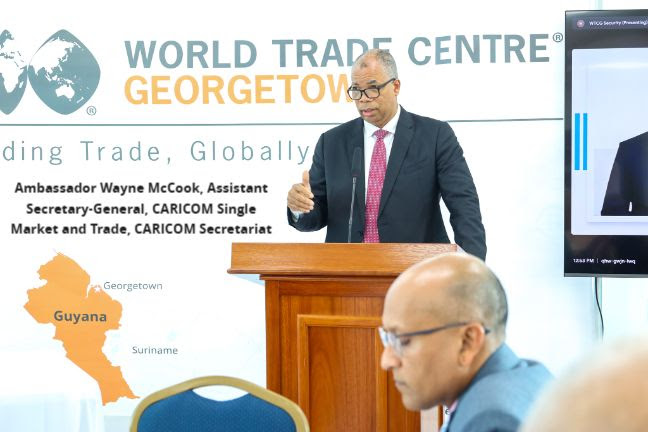
    CARICOM Secretariat | Turkeyen, Greater Georgetown, Guyana | Thursday, 29 January 2026:     A senior Caribbean Community (CARICOM) official has positioned deeper regional integration as a strategic response to an increasingly fragmented and uncertain global trade environment, as global rules-based systems weaken and economic nationalism intensifies.

    Ambassador Wayne McCook, Assistant Secretary-General, CARICOM Single Market and Trade, was a panelist discussing Prospects for International Trade in 2026 in the Context of the Changing Global Geopolitical and Economic Landscape – Impact on Trade and the Challenges and Opportunities for the Caribbean and Latin America. The discussion was held on Wednesday, 28 January, at the World Trade Centre in Georgetown, Guyana.

    Contextualising the Region’s position, Amb. McCook said: “For our Region, the scars of the immediate past are visible. The devastating passage of Hurricane Melissa encapsulated the dual challenge we face: the existential threat of climate change and the inherent economic vulnerabilities of our CARICOM Member States. Simultaneously, we have navigated dramatic shifts in global trade, driven largely by an intensified “America First” trade policy that has significantly impacted our exports, value chains and supply chains through a suite of unprecedented tariff measures.”

    Against the background of what he described as “a truly tumultuous 2025” for international and regional trade, Amb. McCook highlighted CARICOM’s “oneness” and its resilience to navigate the “choppy waters” of the 21st century.

    Amb. McCook warned that the erosion of multilateral trade norms is no longer theoretical, but already affecting investment, supply chains, and growth prospects worldwide.

    According to UN Trade and Development (UNCTAD), global foreign direct investment fell by 11 per cent in 2024, marking a second consecutive year of decline, with further weakness expected in 2026. Global trade growth has slowed dramatically, falling below one per cent in 2025, even as uncertainty and geopolitical rivalry reshape supply chains.

    Despite these headwinds, CARICOM’s trade performance has shown resilience. Between 2023 and 2024, CARICOM exports grew by 32 per cent to US$34.7B, with exports to the United States increasing by 86 per cent. However, recent data reveals uneven impacts across Member States.

    The Assistant Secretary-General pointed to the recent steps toward full free movement of people by Barbados, Belize, Dominica, and St. Vincent and the Grenadines as tangible progress toward a more integrated Community.

    “Fundamentally, CARICOM integration should be seen as a strategic response to a shifting global order,” he emphasised.

    Addressing prospects for international trade in 2026, he advanced a multi-pronged strategy focused on strengthening intra-regional trade, strengthening existing relationships while diversifying global partnerships beyond traditional allies, and deepening economic integration. Central to this approach is the CARICOM Industrial Policy and Strategy (CIPS), and the 25×25+5 food security agenda aimed at reducing food import dependence and boosting regional production.
    Read his presentation here: https://caricom.org/deeper-caricom-integration-key-to-navigating-fractured-global-trade-order-amb-wayne-mccook/

  • US ‘Liberation Day’ Tariffs: What impact for the Caribbean?

    US ‘Liberation Day’ Tariffs: What impact for the Caribbean?

    Alicia Nicholls

    On April 2, 2025, United States (US) President, Donald J. Trump, announced additional ad valorem tariffs of 10% on goods imports from all countries, including Caribbean Community (CARICOM) countries, under his new ‘Reciprocal Tariff Policy’. In addition, some countries like Guyana, which have a merchandise trade surplus with the US, will face even steeper additional tariffs. This article discusses these ‘Liberation Day’ developments and what they might mean for CARICOM countries.

    The Reciprocal Tariff Policy

    Earlier this year, on January 20, 2025, President Trump signed a presidential memorandum outlining the broad contours of his America First Trade Policy 2.0, initiating an investigation into the root causes of the country’s “large and persistent” merchandise trade deficit. This was followed by a second executive order, the Presidential Memorandum on Reciprocal Trade and Tariffs issued on February 13, 2025, which ordered a review of non-reciprocal trade practices and their contribution to the U.S. trade imbalance. On April 1, 2025, the President received the results of these investigations.

    The executive order of April 2, 2025 entitled “Regulating Imports with a Reciprocal Tariff to Rectify Trade Practices that contribute to large and persistent annual US goods trade deficits” introduces the so-called Reciprocal Tariff Policy as a response to the national emergency supposedly caused by foreign trade and economic practices.

    Using presidential authority pursuant to the International Emergency Economic Powers Act of 1977 (IEEPA), this policy applies an additional ad valorem duty starting at 10% on imports from all of the US’ trading partners, effective April 5, 2025 at 12:01 am (EDT). For countries in Annex I, these tariffs will increase to the country-specific rates outlined in that annex effective April 9, 2025 (EDT). For Guyana, the only Caribbean Community (CARICOM) country on Annex I, its goods exports to the US will be hit with additional ad valorem tariffs of 38%.

    These tariffs are to remain in place indefinitely, until the President determines that the conditions warranting them have been “satisfied, resolved, or mitigated”. Additionally, the President has the authority to increase the tariffs if the countries retaliate. A narrow range of goods listed in Annex II of the Memorandum is exempt from the ad valorem tariffs.

    These new ‘reciprocal’ tariffs aim to address what the Trump Administration perceives as chronic non-reciprocity in the US’ trade relationships, hampering U.S. manufacturers’ ability to compete in foreign markets and thereby threatening American jobs, manufacturing capacity, and competitiveness. However, the methodology used to determine these tariffs has faced criticism. If it is to be a so-called ‘reciprocal’ tariff, the initial thinking by many of us in the trade policy community was that the US would match the tariffs charged by these countries on US imports. Rather, according to financial journalist James Surowiecki in a post on X and later confirmed by economists and the administration, the formula for calculating the additional tariffs appears to involve simply dividing a country’s trade balance with the U.S. by the value of its exports to the US multiplied by ½ to arrive at the tariff rate. This has led to some of the poorest countries in the world being hit with disproportionately high tariffs based on this dubious formula. Moreover, tariffs have even been imposed on small uninhabited territories like the Heard and McDonald Islands, reiterating doubts about the logic behind the policy and on the more humorous side, giving rise to a raft of penguin memes on social media.

    Possible implications for Caribbean economies and firms

    However, this is no laughing matter as all goods exported from CARICOM countries to the U.S. will now face the additional 10% tariff, except for Guyana which faces a country-specific 38% tariff. This makes the costs of Caribbean products more expensive in the US, although there is the argument that they will also be competing with goods from other countries which might be subjected to even higher country-specific rates.

    The US has a large trade surplus with the region on a whole, and with most Caribbean countries, with the exceptions of the commodity-exporting countries of Guyana and Trinidad & Tobago. Indeed, the US remains a key market for several important Caribbean exports, including energy products like oil, ammonia and methanol, as well as rum, textiles and other manufactured and agricultural products. Since the 1980s most CARICOM countries’ goods exports to the US are eligible to enter duty-free due to the Caribbean Basin Initiative and its constituent Acts. This is not a negotiated trade agreement, but a unilateral preferences programme which has enjoyed bipartisan US support because it benefits US manufacturing as the biennial US International Trade Commission (USITC) reports on the operation of the CBERA have consistently shown.

    In her latest article, noted Caribbean economist Dr. Kari Grenade outlined a variety of ways in which these developments could impact Caribbean economies, including inflation as since the Caribbean imports a significant volume of US goods, including essential foodstuffs, this could lead to rising prices on our supermarket shelves. Analysis by Tax Foundation shows that the Trump tariffs amount to an average tax increase of more than $2,100 US per US household in 2025. What does this mean for the Caribbean diaspora in the US? What does this mean for Americans’ travel to the region if US consumers will be paying more for everyday goods and will have less disposable income ? What does this mean for those countries in the Caribbean which depend on the US as a major tourism source market?

    What next? Firm and regional responses

    The tariffs have not yet come into effect, and it is likely that they could be halted at the last minute given the backlash and stock market volatility the announcement has caused. Nonetheless, it is imperative for firms and Caribbean countries to plan for them. For Caribbean exporters which rely on the CBI concessions, this may necessitate rethinking export strategies, possibly by shifting to non-trade market entry strategies to maintain access to the U.S. market, or by diversifying into new export destinations. For those Caribbean companies which rely on inputs imported from the US, they could face higher costs as US manufacturers pass on their increased costs to intermediate and end consumers. This means they will have to continue to diversify their sourcing. Some firms are already doing this.

    Retaliation is not a feasible option for CARICOM countries as we import much of what we consume from the US and already have high tariffs on imported goods. Where feasible, Caribbean countries could lower their applied rates on imported goods to help offset some of the pain consumers would feel.  Our other main options are diplomatic, preferably as a grouping. Caribbean governments have been engaging in diplomatic outreach to urge the US to reconsider the policy or at least provide carve-outs for small countries. In a recent article, Antigua & Barbuda’s highly respected Ambassador to the US, Sir Ronald Sanders, has called on the US to revisit these tariffs as they are against the spirit of the CBI and US-Caribbean relations, have human and economic costs and also imperil US strategic interests. Indeed, this policy will make the price of US goods more expensive and further incentivise importers in the region to source more regionally or internationally. Moreover, many Caribbean nationals have customarily gone to the US, especially cities like Miami and New York, to vacation and shop, contributing to the economies of those cities. Caribbean nationals will increasingly go to cheaper destinations like Panama.

    The ‘America First Trade Policy 2.0’ reinforces the need for us in CARICOM to accelerate efforts to expand our intra-regional trade and continue our trade diversification efforts. This is nothing novel and it is something we have long recognised. I listened to the speech of EU Commission President, Ursula von der Leyen earlier this week and found it noteworthy that the EU, a market of some 450 million people and with the economic heft to implement meaningful retaliatory measures also saw the salience of deeper integration and economic diversification to helping build its resilience and navigate this period of uncertainty. If deeper integration and diversification are important for the EU, they are doubly vital for us in CARICOM. After all, it is not just these tariffs we must contend with, but also the mooted fees to be placed on vessels which are Chinese made or are part of fleets which have a large number of Chinese-made vessels, which could impact many Caribbean countries.

    A broader concern is the pall this beggar thy neighbour trade policy by US as the world’s largest economy casts over the rules-based multilateral trading system and the World Trade Organisation (WTO) which it was critical in establishing. While the multilateral trading rules are far from perfect, they have provided a predictable and rules-based framework where, inter alia, countries agreed to bind their tariffs for tariff lines at specific levels, which ensures some predictability for exporters. However, what the Trump administration is doing is contrary to the spirit of the multilateral trading system and will set off a global trade war as major economic powers react with their own retaliatory measures. As history shows, this will possibly have deleterious implications for the global economy, and just a mere five years after the world was hit by the worst pandemic in 100 years.  This latest move heralds a more unpredictable, uncertain, unstable and unilateral era in global trade relations, one in which strategic diplomacy, regional cooperation and diversification will be key for CARICOM countries to navigate.

    Alicia Nicholls, B.Sc., M.Sc., LL.B. is an international trade specialist and the founder of the Caribbean Trade Law and Development Blog: www.caribbeantradelaw.com.