Tag: trade

  • An uphill climb?  International Trade for Boosting Post-COVID-19 Growth in Least Developed Countries

    Lucius S.J. Doxerie – Guest contributor

    Lucius S.J. Doxerie

    The Covid-19 pandemic severely impacted/devasted the economies of countries that have been classified as ‘least developed’ by the international arena. It has prompted me to take a closer look at the ideation of resilience amid global shocks and market failures.

    The aim of this brief article is to examine the role of trade in boosting economic growth of least developed countries (LDCs) such as Haiti, Liberia and Timor-Leste. Special attention will be diverted to the type of preferential treatment received and the trade policies needed to increase the growth prospects in a post-Covid period. We first need to highlight the current situation with regard to trade amongst LDC countries as underscored by the World Trade Organisation (WTO) and will posit possible solutions to facilitate an amelioration of trade.

    According to (WTO 2022:5) “The top ten LDC exporters represented more than 80 per cent of LDC merchandise exports in 2011; this declined to 73 per cent in 2020. LDC exports continue to be concentrated in five major destination markets: China, the European Union, the United States, India and Thailand.”.

    As early as the 1930’s, discussion around the benefits of lessening restrictions to international trade and investment was actively happening among countries. In 1948, an international agreement was established among countries to reduce barriers to trade. After eight rounds of meetings, a General Agreement on Tariffs and Trade (GATT) was formed, and in 1995, the World Trade Ogranisation (WTO) was established. The WTO is an international trade governing body that is tasked with monitoring, enforcing and liberalizing trade amongst countries (Suranovic 2010).

    The key reasons why countries trade is summed up below.

    1. Differences in technology (Ricardian theory of comparative advantage)
    2. Differences in resource endowments (Pure exchange model of trade and Heckscher-Ohlin factor proportions model)
    3. Differences in demand (Monopolistic model)
    4. Existence of economies of scale in production (Increasing returns to scale)
    5. Existence of government policies among countries

    In the reality, trade takes place for many reasons. There is no single model or theory that captures all the reasons. For example, the Ricardian model, which focuses on the differences in technology among countries posits that everyone benefits from trade whereas on the other hand the Heckscher-Ohlin model suggests differences in endowments are the reason for trade and that there will be losers and winners. These traditional trade theories illustrate a myopic justification for trading as countries trade for a myriad of reasons. According to experts like Suranovic, most of these theories of trade are very simplistic in nature and generate unrealistic assumptions.  

    So let’s now discuss, especially in consideration of the quote below:

     “Least developed countries (LDCs) have been recognized by the United Nations since 1971 as the category of the states, which are deemed highly disadvantaged in their development process, for structural, historical and also geographical reasons”(Białowąs and Budzyńska 2022:1).

    As early as 1979, least developed countries have been receiving preferential treatment from advanced economies as part of the Tokyo round of the GATT. These preferences fall under what is coined the generalised system of preferences (GSP). As such, they have enjoyed exclusive schemes geared at entry into the markets of advanced economies by removing barriers such as tariffs and quotas from the early 2000s (Klasen et al. 2016).

    According to the WTO, “the Istanbul Programme of Action for LDCs (IPoA) for the decade 2011 to 2020 identified trade as one of the eight priority areas of actions for the economic growth and sustainable development of least-developed countries”(WTO 2022:3).

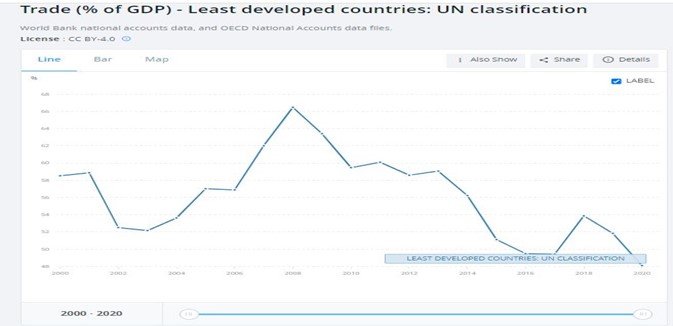
    Trade as a percentage of the Gross domestic Product (GDP) for LDC’s since the year 2000 is reflected below in figure 0.1.
    Source: http://data.worldbank.org

    The graph above illustrates that trade as a percentage of GDP for LDCs rose steadily from as early as 2003 up until the financial crisis in 2008. A downward pattern continued for another eight years until 2016, then there was improvement. However due to the Cocid-19 pandemic a downward movement has been evidenced since.

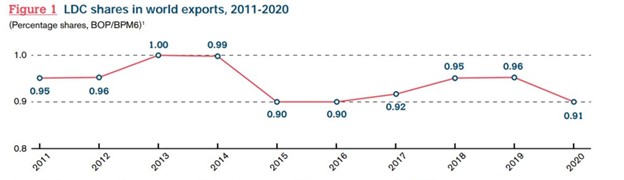
    The graph below illustrates the latest statistics of the LDCs share of world exports.
    Source (WTO 2022)

    We can clearly see that there was steady expansion of exports between 2017-2019. After the pandemic, there was a sharp decline of .04%, falling way below the expected target set by IPoA. (WTO 2022) shows that LDCs have seen declines over the last ten years in merchandise exports in all areas except clothing.  Although LDCs received preferential treatment, not all goods and services exported are covered (Antimiani and Cernat 2021).

    So what does this all mean, and what’s the bottom line?

    There is clear evidence supporting the WTO’s preferential treatment towards increasing  the revenues and economic prosperity of LDCs (Antimiani and Cernat 2021). Notably, there is still room for further easing of  trade barriers especially due to the shocks created by the pandemic. This is further underpinned by larger regional trade blocks emerging amongst developed countries undermining the efforts of the WTO (Palit 2015).  A 2016 paper carried out by (Klasen et al. 2016:5) using econometric techniques highlighted that “only Canada’s, Australia’s and EU’s trade preference systems have a positive and significant impact on LDCs’ exports”. Therefore, the following recommendations are proffered in the interest of economic uptake and growth through trade for LDCs.

    1. Establish regional trade agreements among LDCs to help increase their market share.
    2. Provide concessions for value added goods from LDCs within the global value chain for finished products exported by WTO members
    3. Increase the unilateral agreements enjoyed by LDCs  especially duty and quota free access to world markets on a wider range of products
    4. Increase the production and institutional capacity of LDCs by providing technical support to their industries
    5. Improve the LDC service waiver allowing it to cover more areas within the service industries

    These recommendations will allow LDCs to improve their trade practices, have more standardized procedures, facilate growth of local sectors which, in turn will increase the overall welfare of the economy and the people post covid.

    Note: Multiple WTO reports, textbooks and journals from industry experts were utilized in the writing of this article.

    Lucius S.J. Doxerie is an aspiring economist and co-founder and CEO of Stratagem Paradigms Inc.  He is a Chevening Scholar currently enrolled at the University of Bradford completing a Master of Science in Economics and Finance for Development. 

    REFERENCES

    Antimiani, A. and Cernat, L. (2021) Untapping the full development potential of trade along global supply chains: ‘gvcs for ldcs’ proposal. Journal of world trade 55 (5), 697-714.

    Białowąs, T. and Budzyńska, A. (2022) The Importance of Global Value Chains in Developing Countries’ Agricultural Trade Development. Sustainability 14 (3), 1389.

    Klasen, S., Martínez-Zarzoso, I., Nowak-Lehmann, F. and Bruckner, N. (2016) Trade preferences for least developed countries. Are they effective? Preliminary Econometric Evidence. Policy Review 4.

    Palit, A. (2015) Mega-RTAs and LDCs: Trade is not for the poor. Geoforum 58, 23-26.

    Suranovic, S. (2010) International trade: Theory and policy. The Saylor Foundation.

    WTO (2022) Boosting Trade Opportunities for Least Developed Countries. WTO. https://www.wto.org/english/res_e/publications_e/boottradeopp22_e.htm Accessed 22/03/22.

  • Youth and Trade Governance: Pulling up and Changing di Riddim

    Youth and Trade Governance: Pulling up and Changing di Riddim

    Alicia Nicholls

    This week I had the honour and pleasure of being a presenter on the “Redefining Trade Governance” panel at the United Nations Conference on Trade and Development (UNCTAD) Youth Forum, one of the pre-events of the UNCTAD XV Quadrennial being held virtually by Barbados. I wish first to congratulate and thank Ms. Roshanna Trim, UNCTAD Youth Forum Lead and her team, for a very thought-provoking and well-organised forum. Second, I am grateful for the opportunity kindly extended to me as a proud Barbadian to participate in this historic moment for our country – the first Small island Developing State to host an UNCTAD quadrennial starting officially from October 3-7, 2021. Third, as a young trade professional, I relished the opportunity to engage with my brilliant fellow panelists who hailed from Kenya, Indonesia and South Africa and who are all doing great things in their countries of origin. 

    In this article, I wish to share a few thoughts some of which, due to time constraints, I had been unable to flesh out fully during what was otherwise a very interesting session at the Youth Forum.

    Pull Up, Change Di Riddim

    In preparing for the session, the creative theme chosen by the UNCTAD Youth Forum organizers: ‘Pull up: Change di riddim’ gave me plenty of food for thought. Without doubt, the current soundtrack for the contemporary trade and development governance regime, both at national, regional and the multilateral levels, needs to be changed or remixed to create a more inclusive and equitable space that benefits marginalized groups, particularly the youth and in keeping with the overall UNCTAD XV theme of “from inequality and vulnerability to prosperity for all”.

    But what would this new or remixed ‘riddim’ sound like? It would be, for example, the rhythm of an updated World Trade Organization (WTO) trade rulebook with equitable trade rules on existing and emerging trade issues, allowing for sustainable job creation and facilitating youth-owned enterprises. It would be the rhythm of giving the youth opportunities to contribute meaningfully at national, regional and international levels solutions-oriented approaches to trade and development issues confronting our world.

    But whose responsibility is it to ‘pull up’ and change this rhythm? I will briefly outline my thoughts on some of the ‘DJs’ responsible for mixing and harmonizing this new riddim for trade governance. These include a wide range of actors, but in this article I am focusing on just a few.

    UNCTAD

    Nearly six decades ago, the Geneva-based UNCTAD was conceived and birthed out of the recognition that marginalized countries in the global trading system – developing countries – needed a voice in the trade and development conversation. UNCTAD already has commendably demonstrated that it values inclusion of youth and young women, including, for example, through its Youth Network and programmes like the Emtrepec Women in Business Award.

    Like other UN agencies, UNCTAD has an internship programme which allows those lucky youth chosen a front row seat on global trade and development issues and work alongside some of the world’s foremost experts on these issues. But these, like other UN system internships, are unremunerated positions, and interns have to pay for their own visas, travel and accommodation in Geneva which is a stunningly beautiful but very expensive city. Offering paid internships would extend this amazing opportunity to more youth, particularly those of poorer backgrounds and whose contributions are no less valuable.

    UNCTAD, as part of a Youth and Trade and Development work programme, can also serve as a forum for its 195 Member States to share best practices and providing technical assistance and capacity building on youth mainstreaming in trade and development policy making.

    National Governments

    Research from the Caribbean Development Bank in 2015 shows that youth unemployment in the Caribbean region is among the highest in the world at 25% and nearly three times the adult unemployment rate of 8%. An increasing number of youth are unable to find decent employment commensurate with their qualifications and skills and made worse by the COVID-19 pandemic. As a result, anecdotally, there has been an increase in youth in the region choosing to pursue entrepreneurial activities as opposed to working for someone else. These include from farming to soap-making to designing application software. But many of those businesses are in the informal sector and, therefore, often not eligible for assistance programmes, such as COVID relief.  

    Business facilitation, although there have been improvements, especially due to COVID-19 imperatives, remains a frustration, particularly for youth-owned SMEs. While Jamaica leads the region and is ranked sixth on the “starting a business” indicator, no Caribbean country currently ranks among the top 50 countries on the World Bank Doing Business Index overall. Improving access to information and reducing waiting times for simple things, such as registering a business or incorporating a company would help to incentivize business formalization.

    Governments can also expand the number of internship programmes in their ministries of trade, and other trade-related agencies so more young people can see international trade and international trade policy making and implementation in action at the national level.

    Another barrier facing youth-owned SMEs is lack of information, especially market intelligence information and having to deal with non-tariff barriers in markets they seek to access. Establishing and/or expanding bespoke youth-targeted export promotion programmes can help more youth make the transition from entrepreneurial exploits to exports to global markets and as part of global value chains.

    Youth concerns should be mainstreamed in national trade policies. As an example, Belize’s National Trade Policy includes a section on the youth. Moreover, we cannot create youth policies in a vacuum. Better data is needed for creating evidence-based youth policies and monitoring and evaluating the impact of trade and economic policies on the youth.  Additionally, we must move away from the notion that having a young face on a board or at a meeting is enough to qualify as involving a youth voice. The youth should be an important stakeholder in trade discussions, the way we would include the private sector and labour.

    Private Sector

    The private sector can play a role by mentoring and/or offering more internships to young people interested in trade. Mentorship of the youth, especially those interested in careers in the trade and development field is sorely lacking in the region. We must see investing in young people not as a threat or risk, but as an opportunity and investment that pays dividends.

    Access to finance is a major problem for SMEs, including youth SMEs which are often seen as risky. It is made harder by increased bank fees and stricter know your customer (KYC) requirements due to global anti-money laundering/countering the financing of terrorism (AML/CFT) rules. Not every young person has two forms of ID in order to open a bank account. Some also lack the financial records needed to borrow at non-prohibitive interest rates. Banks can do more to facilitate lending to young entrepreneurs.

    The ‘youth’ Diaspora

    Due to migration, there is a growing number of young professionals in our diasporas in the US, UK, Canada and even as far as China and Dubai. Caribbean governments need to have systematic ways of engaging our ‘youth diaspora’, many of whom have migrated to pursue better opportunities abroad but still want to give back to their home countries. The value of the youth diaspora is not limited to remittances. It is through the networks, know-how and knowledge they have which can be harnessed for our trade and development.

    Let’s take the area of sports which as I wrote a few years ago has tremendous potential for export diversification. I recently heard a Brasstacks discussion where our well-respected Olympic champion Obadele Thompson had indicated providing a comprehensive plan for high performance sport to our Olympic Association for their consideration. That is just one example of the eagerness displayed by some in the ‘youth’ diaspora in contributing to development ‘back home’. Additionally, members of the Caribbean diaspora, many of whom are professionals, can also be more fully engaged as potential mentors, particularly for other young entrepreneurs.

    Society

    While we may not wish to admit it, a big hindrance to greater youth involvement on trade and development matters is the anti-youth bias that pervades many of our societies and which rears its ugly head when youth try to insert their voices into debates on matters of public interest.  We need to get away from the belief that calls by the youth for inclusion are conceived in ‘millennial entitlement’ when really they are out of the desire for a voice and for opportunities to contribute meaningfully to the societies which invested in our education and where many of us which to retire some day.

    Youth ourselves as DJs

    We, as youth ourselves, are DJs and have a role in this riddim. The world is our oyster thanks to the internet. The COVID-19 pandemic has given greater imperative to create and expand spaces for ourselves to network, share information, ideas, opportunities, best practices, with other youth not just nationally, but regionally and across the world. We must also continue to advocate on trade and development issues.

    In conclusion, as a SIDS, Barbados’ virtual hosting of the UNCTAD 15 Quadrennial Conference and its concomitant chairmanship of UNCTAD for the next four years provides a unique opportunity for mainstreaming the voice of the youth, particularly from marginalized states like SIDS, in setting and advancing the trade and development governance agenda. This includes on trade issues such as special and differential treatment and solving the WTO Appellate Body crisis, but also non-trade issues like migration, climate change and the blue economy. A youth voice is also pertinent on issues of concessional financing and debt relief because it is the youth who are among today’s and tomorrow’s taxpayers. Every dollar spent in debt repayment is money that could be invested in education, in youth programmes and the like.

    Ultimately, the youth can be a valuable actor and change agent in helping to ‘pull up and change di riddim’ so we can have national, regional and international trading systems that move from inequality and vulnerability to prosperity for all.

    Alicia Nicholls, B.Sc., M.Sc., LL.B. is a trade and development consultant with a keen interest in sustainable development, international law and trade. All views herein expressed are her personal views and should not be attributed to any institution with which she may from time to time be affiliated. You can read more of her commentaries and follow her on Twitter @LicyLaw.

  • Introduction to Afronomics Blog Symposium – ‘Prospects for Deepening Africa-Caribbean Economic Relations’

    Introduction to Afronomics Blog Symposium – ‘Prospects for Deepening Africa-Caribbean Economic Relations’

    I am pleased to share that the Afronomics Law Blog Symposium entitled “Prospects for Deepening Africa-Caribbean Economic Relations”, which I am co-convening with the brilliant Dr. Ohio Omiunu, commences today Monday, September 6!

    To view the introduction to the Symposium authored by my co-convenor Dr. Ohio Omiunu and myself as well as the essays which will be posted daily, please click here.

  • Starting Monday! Afronomics Symposium on Africa-Caribbean Economic Relations

    Starting Monday! Afronomics Symposium on Africa-Caribbean Economic Relations

    I am pleased to share that the Afronomics Law Blog Symposium entitled “Prospects for Deepening Africa-Caribbean Economic Relations”, which I am co-convening with the brilliant Dr. Ohio Omiunu, will commence on Monday, September 6.

    The insightful essays in the Symposium authored by academics and practitioners focus on various aspects of the Africa-Caribbean economic relationship, including relations within the OACPS and WTO, prospects for deepening Africa-Caribbean trade, inter alia. The Symposium’s launch coincides with the historic first CARICOM-Africa Summit which will be held virtually on Tuesday, September 7.

    I wish to thank the Afronomics Law Blog for the opportunity to co-convene this Symposium. I also express deep gratitude to my excellent co-convenor Dr. Omiunu and our expert contributors for taking the time to share their insightful contributions and making what we hope you will also find to be an insightful Symposium!

    The essays will be available from Monday and will be added daily. They can be accessed from Monday here.

    Best,

    Alicia