Author: caribbeantradelaw

  • Human Rights in the context of the International Climate Change Agenda

    Stefan Newton, Guest Contributor

    snewton
    Stefan Newton

    In her address to the 73rd Session of the United Nations General Assembly (UNGA), Prime Minister of Barbados, the Hon. Mia Mottley, abandoned a scripted speech and made a passionate appeal to United Nations (UN) Member states to make good on their commitments to climate change under the United Nations Framework on Climate Change (UNFCCC). She urged States to accelerate mobilizing the necessary funding for climate adaptation and mitigation under The Green Climate Fund.

    In thinly veiled remarks, she criticized the current position of the United States of America (USA) by refusing to acknowledge the reality of climate change, noting “For us it is about saving lives. For others it is about saving profits”. It is well known by now that the USA has regrettably withdrawn from the Paris Climate Agreement: which builds upon the UNFCCC and for the first time brings all nations into a common cause to undertake ambitious efforts to combat climate change and adapt to its effects, with enhanced support to assist developing countries to do so.

    Moreover, the Prime Minister pointed to the need for UN Member States to recognize that “mighty or small we must protect each other in this world”. In closing her speech, she appealed to the international community to exercise empathy and care for those States and their citizens who are most vulnerable to the effects of climate change. I humbly submit that this is perhaps the most significant speech given by a Barbadian leader to the United Nations, as it impinges on Barbados’ very survival as a nation State. Indeed, if climate change ambitions are not met, Barbados and its citizens will face very certain demise due to the effects of climate change.

    Climate Change is a Human Rights Problem

    While climate change is most often viewed as an environmental problem, it is also very much a human rights problem. Mary Robinson, the former president of Ireland and former High Commissioner for Human Rights, has described climate change as “probably the greatest human rights challenge of the 21st century”.

    Explicit mention of human rights is now being made in international climate agreements. The Preamble to the Paris Agreement to the UNFCCC calls for all States, when acting to address climate change, to “respect, promote and consider their respective obligations on human rights”. The World Bank Report on Human Rights and Climate Change highlights the relevancy of international human rights law to climate change by linking particular social and human impacts of climate change to special human rights standards under international human rights treaties, thereby confirming human rights impacts. For example, the right to life is the most fundamental human right and well enshrined in the Universal Declaration on Human Rights and International Covenant on Civil and Political Rights.

    A number of observed and projected effects of climate change will pose direct and indirect threats to the human right to life. The Intergovernmental Panel on Climate Change (IPCC) projects with high confidence an increase in people suffering from death, disease and injury from heat waves, floods, storms etc. Equally, climate change will affect the right to life through an increase in malnutrition, cardio- respiratory morbidity and mortality related climate change effects.

    Despite the clear human rights implications of failure to act to combat climate change, the international community is not “grasping the baton firmly” enough through decisive policy actions to reach the ambitions of the climate change agenda. The USA- Trump led administration seems to be a lost cause with its view that climate change is a fiction. Heeding Prime Minister Mottley’s call to climate action will most likely be viewed by them as a mere courtesy, not an obligation. However, it can be soundly argued that Prime Minister Mottley’s urging of States to protect each other from the effects of climate change, are not merely aspirational or appeals to international consciousness, but are linked to and grounded in legally binding international human rights principles.

    Legal Link between Human Rights and Climate Change

    The Office of the High Commissioner for Human Rights (OHCHR) has set out the essentials of the legal dimensions link between Human Rights and Climate Change. International Human Rights principles to respect, protect and fulfill the human rights of all people without discrimination gives rise to a wide range of duties for State in acting on climate change. I will touch on three.

    First, under these principles is the duty to mitigate climate change and to prevent its negative human rights impacts. Failure to take affirmative action to prevent human rights harms caused by climate change, including foreseeable long-term harms, breaches this obligation. Second is the duty to ensure that all persons have the necessary capacity to adapt to climate change. Falling under this duty States must ensure that appropriate adaptation measures are taken to protect and fulfil the rights of all persons, particularly those most endangered by the negative impacts of climate change e.g. small islands, riparian and low-lying coastal zones. Third, under core human rights treaties, States acting individually or collectively are obliged to mobilize and allocate the maximum available resources for the progressive realization of economic, social and cultural rights, as well as the advancement of civil and political rights and the right to development. The failure to adopt reasonable measures to mobilize available resources to prevent foreseeable climate change harm breaches this obligation.

    Incorporating Human Rights into Climate Change Policy Discussions

    Besides recognizing the legal implications of international human rights law as it pertains to climate change, Caribbean policy makers should also recognize the value added of incorporating human rights into discussions around climate change policy.

    Among other things, a focus on human rights law may serve to locate policy within the framework of internationally agreed obligations and acceptance of certain goods, interests or goals as rights. This has the effect of establishing a hierarchy of importance among policy goals, helping to ensure that human rights are not traded off among interests lacking that status. Simply put, human rights place people before profits. This is critical as more firms and investors enter the Caribbean market whose activities may have climate and environmental impacts.

    Additionally, human rights offer a normative and institutional framework for strengthened accountability and international co-operation for those responsible for adverse impacts of climate change. It may be argued that states should be encouraged to take climate action on this basis and do more in their capacity to assist and contribute to the financing of climate adaptation programs. This might be a useful bargaining chip in the realm of international relations and negotiations. For small developing states, such accountability can be used as a tool of moral suasion against large carbon emitting States like the USA which have retreated from global actions on climate change, or to spur States who are already implementing climate action targets to redouble their efforts.

    Diagonal Environmental Rights

    Further to policy, human rights law has an incredible potential to fill in a missing legal gap present in the international legal framework addressing climate change. The carbon emissions from large industrial States have a disproportionate impact on small lesser emitting States. Citizens of small developing States are thus marginalized and face aggravated vulnerability to human rights impacts from climate change. Yet currently there exists no formal legal mechanism for citizens to claim climate justice against large states responsible for impacting on and violating their human rights. This is referred to a Diagonal Environmental Rights; a term coined by John Knox the United Nations Independent on Human Rights relating to a safe, healthy and sustainable environment. Without going into the theory of a State’s extra-territorial human rights obligations, and proving causation, I submit that the ability to claim climate justice is well founded in the principles of international law.

    As previously stated, no formal international diagonal environmental rights legal mechanism exists. Given the state of geo- political madness that has taken hold of multilateralism, I also do not see one being created and implemented by UN Member States. As the experience of the Paris Agreement has shown, it is a challenge just to get a critical mass of countries- let alone all countries- to participate in an international environmental agreement.

    Therefore, the greatest hope is that existing international human rights mechanisms, such as the Inter-American Court on Human Rights (IACHR), and domestic courts are flexible enough to accommodate climate change litigation. There has been jurisprudence emerging from domestic courts that successfully incorporates rights-based arguments to climate change e.g. Pakistan in the case of Leghari v Federation of Pakistan.

    Albeit these claims were made in the context of litigation by citizens against their own State for failing to respond to climate change. Nevertheless, such cases do much to add shape and contour to this emerging body of climate justice jurisprudence. They set precedents on which international, and broader litigation may find success.

    Stefan Newton is a graduate of the University of the West Indies Faculty of Law.  The views reflected here are entirely his own.

  • The Sino-American Challenge to Multilateralism

    Rasheed J. Griffith, Guest Contributor

    Nations don’t trade. Metaphors can both clarify and deceive. Trade is no exception. The current commentary on trade relationships between nations has elevated the commercial profit-loss mechanisms of international trade to an abstract state level apparatus. When we say states trade what we really mean is the firms in different states have commercial relationships. Firms have a singular motive: to make profit. Similarly to making the individual-firm distinction, we must always remember to make the state-firm distinction. This distinction is further amplified when we are discussing large economy states. They too have a singular motive: geopolitical dominance.

    The persistent US trade deficit with China implies that US consumers are able to buy cheaper goods from China. But it is also a signal of the erosion of the US global geopolitical dominance caused by economic decline. In the US economy financial goods are replacing physical goods. The chart below shows the increase in the financial component of US GDP relative to manufacturing.

    Americasfireeconomy

    (c) Rasheed Griffith

    Stock market capitalization of the US relative to GDP is 153%. For China it is 65% and Germany 54%. I am familiar with arguments that claim this is not problematic because countries trust the US markets most.

    The 2008 financial crisis gave a glimpse of what could happen to the US economy if the financial sector collapsed.

    The US government was barely able to patch up the financial markets by using excessive money creation and debt redistribution (i.e quantitative easing) in 2008. This was a necessary move but it means the Federal Reserve System balance sheet is now bloated. In another crisis, quantitative easing will likely not be effective. At that point, the money and capital markets of the US will no longer be as attractive in the long term, resulting in the dollar losing its global reserve currency status. At this point, the geopolitical dominance of US will weaken. And the main adversary (which is now China) will strive to make sure the US remains in a weakened position.

    Very few people seem to understand this. But the Communist Party of China (CCP) understands. In 1999, two colonels of the People’s Liberation Army published Unrestricted Warfare[1]. The book gave strategies for defeating the USA without direct conventional military engagement. One of the core strategies was the use economic policies to eat away at the US economy. Having China being the core manufacturing hub of the world was one such strategy. This was made explicit with the ‘Made in China 2025’ policy recently launched by the CCP[2].

    China did not achieve its spectacular growth through free trade. All of China’s trade is managed by the CCP. When discussing the USA-China trade relationship we must always acknowledge that China has an authoritarian government that will create and implement policies that they believe will benefit China irrespective of what the Chinese citizens think or what multilateral organizations demand. When China ascended to the WTO in 2001 it was naively expected that China would conform to the rules of that organization. Authoritarian governments, however, do not follow neoliberal rules.

    Starting around 1978 under Deng Xiaoping, the CCP began their reforms from Soviet style system wide planning to state capitalism directed by large and powerful state owned enterprises (SOEs)[3]. Although China ascended to the WTO in 2001, this model never changed. On the Fortune 500 list of largest global companies, China comes in a close second (120) behind the US (126). Japan (52) is quite far behind. But what is shocking is that 93% of the Chinese firms on the list are SOEs. The CCP heavily subsidies their SOEs, and creates rules specifically favorable to them; to the detriment of foreign entities.

    The USTR Section 301 report identified several instances where China has violated the WTO rules to which it signed in 2001. These concern trading rights, import regulations, export regulations, intellectual property rights, technology transfer, foreign investment, and so on[4]. The US has complained to the WTO about China on 22 occasions and China has still persisted in violating the rules. The White House Office of Trade and Manufacturing report goes on the dissect the persistent economic aggressions of China[5].

    What choice does the US have if it is not able to deal with China through WTO processes? Multilateral processes only work if everyone agrees to adhere to the same rules. Of course , though, these rules were largely set by the US. In dealing with China, the WTO is absolutely ineffective. There is no democratic fallout if China refuses to acknowledge multilateral rules (as seen explicitly in China’s absolute refusal to acknowledge the Philippine’s win in the Hague in matter of the West Philippines Sea/South China Sea). It is likely that any strong ruling in the WTO against China will similarly fall on deaf ears. (Similarly the US has substantially disregarded a WTO ruling after losing a case to Antigua).

    In any case, it has gotten to a point where countries cannot simply halt or significantly decrease trade with China in the form of sanctions. The US, then, is forced to use geoeconomics – the use of economic instruments to further geopolitical goals.

    As the President of the United States, Trump is right to engage China directly. His strategy is clever: robe a geostrategic containment engagement in bland terms of trade rhetoric. And this is by no means outside the modus operandi of the US. During the Cold War period the US actively practised a strategy of containment against the Soviet Union. In fact, China has accused the US of trying to economically contain China[6]. But of course, China has been engaging in geoeconomics as well recently.

    For example, in 2012 China allowed farmers from the Phillipines to export their bananas to China but when the bananas arrived they were left to rot on the dock. This left the Philippines banana planters with neither stock nor payment (30% of Philippines banana exports go to China). This was used as a tactic to weaken the Philippines position when the tensions over the South China Sea were rising[7]. Another example is when China blocked rare earth metals to Japan almost crippling Japanese tech manufacturing, until Japan finally conceded, over another maritime dispute[8]. In both cases, the WTO was impotent.

    What Trump gets wrong is that tariffs are not sufficient. And he failed to properly define a long term strategy to deal with China. Without such a strategy the US will continue ad hoc aggressions.

    China has been shown to disregard all multilateral rules if it wants to. But even so, it is difficult being upset with China. China has succeeded in the most comprehensive and rapid poverty alleviation program in all of human history. China was able to lift over 600 million people out of poverty in less than 30 years[9]. Following along this path, it should be expected that the CCP is mounting a restoration of China to compensate for its decline after the late 1850s: the “century of humiliation[10]”. Few commentators remember that for 18 of the last 20 centuries China commanded a greater share of world GDP that any other country. Henry Kissinger reminds us that as recent as 1820 China “produced over 30% of world GDP – an amount exceeding the GDP of Western Europe, Eastern Europe, and the United States combines.”[11]

    Wang Yi, however, recently attempted to assure the UN that China has no ambition of hegemonic dominance[12]. I believe that is an empty statement given Xi Jinping’s expansive Belt and Road Initiative (BRI) which has been added to the Party constitution of the CCP[13]. From the perspective of CCP, as Lee Kuan Yew frames it, China is not looking to become dominant; rather, it is looking to restore dominance. It is a different geopolitical mindset.

    This to me is the crux of the Sino-American challenge. The US is right that China is not properly following WTO rules because it has disregarded many of those rules to accelerate its economic growth. And it has been exceedingly effective. But if China were to conform to the WTO rules, it would not match the model that has been so successful.

    Multilateral trade rules were not designed by China to fit China’s model (authoritarian government, state capitalism). They were primarily designed by liberal democracies – the US in particular. Both of these nations have fundamentally different economic models and justifiable geopolitical reasons for disregarding WTO rules to protect (or increase) their geopolitical dominance.

    We are living in a time of multilateralism. But this time is anomalous. Dani Rodrik has explained in detail why “free trade agreements” have little to do with free trade[14]. Those agreements are primarily political documents. In fact, “76 percent of existing preferential trade agreements covered at least some aspect of investment (such as free capital mobility) by 2011; 61 percent covered intellectual property rights protection; and 46 percent covered environmental regulations”[15]. These are political documents that attempt to alter a nation’s domestic policies with the preferences of international actors.

    This is not possible with a powerful authoritarian government. It is a grave error to treat China as just another Western country; like how you would treat Japan. China is an ideological adversary to the US that has now become an economic adversary. When at odds with geopolitical motives multilateralism always fails. Geoeconomic escalation is not only justified but it is inevitable.

    Rasheed Griffith’s professional interests include Southeast Asian Monetary Policy and AML Compliance. He may be contacted at rasheed.j.griffith AT gmail.com. You can also follow him on Twitter at @RasheedGriffith

    The views and opinions expressed herein are solely those of the guest author and are not necessarily representative of those of the Caribbean Trade Law & Development Blog.

    [1] http://www.c4i.org/unrestricted.pdf

    [2] https://supchina.com/2018/06/28/made-in-china-2025/

    [3] https://orca.cf.ac.uk/99467/1/Publication_2016_IJEMSc.pdf

    [4] https://ustr.gov/sites/default/files/Section%20301%20FINAL.PDF

    [5] https://www.whitehouse.gov/wp-content/uploads/2018/06/FINAL-China-Technology-Report-6.18.18-PDF.pdf

    [6] http://www.atimes.com/article/us-tariffs-are-containment-beijings-message-fed-by-the-white-house/

    [7] https://www.asiasentinel.com/society/the-china-philippine-banana-war/

    [8] https://www.nytimes.com/2010/09/23/business/global/23rare.html

    [9] https://en.wikipedia.org/wiki/Poverty_in_China#Poverty_reduction

    [10] https://www.theatlantic.com/china/archive/2013/10/how-humiliation-drove-modern-chinese-history/280878/

    [11] https://www.amazon.com/China-Henry-Kissinger/dp/0143121316

    [12] http://usa.chinadaily.com.cn/a/201809/30/WS5bafb647a310eff303280520.html

    [13] https://idsa.in/idsacomments/what-the-inclusion-of-bri-in-the-chinese-constitution-implies_jpanda_071117

    [14]https://drodrik.scholar.harvard.edu/files/dani-rodrik/files/what_do_trade_agreements_really_do.pdf

    [15] Limão, Nuno. 2016. “Preferential Trade Agreements.” NBER Working Paper 22138, March

  • Caribbean Trade & Development Digest – September 23-29, 2018

    Caribbean Trade & Development Digest – September 23-29, 2018

    Welcome to the Caribbean Trade & Development Digest for the week of September 22-29, 2018! We are happy to bring you the trade and development headlines and analysis from across the Caribbean Region and the world from the past week.

    THIS WEEK’S HIGHLIGHTS

    World leaders gathered for the 73rd Session of the United Nations’ General Assembly this week where issues of trade and wider multilateralism featured prominently. Economic releases by the Organisation for Economic Cooperation and Development (OECD) and World Trade Organisation (WTO), respectively, have warned of the risks posed by escalating trade tensions to global economic and trade growth. In its flagship Trade and Development Report 2018 released this week, UNCTAD highlighted that the current trade tensions were a symptom of excessive financialisation and imbalances in trade and economic power. This week, the US also blocked the reappointment of a fourth WTO Appellate Body judge, which will reduce that body’s roster of judges to three, the bare minimum needed to hear a dispute.

    On the NAFTA front, the promised release of the renewal text agreed to by the US and Mexico has been delayed with hopes that the impasse between the US and Canada will be surmounted as the Sunday (today) deadline for agreement on the updated NAFTA looms.

    REGIONAL

    Tourism investments under the microscope

    The Gleaner: Jamaica Minister of Tourism Edmund Bartlett has put a cork on new approvals of tour businesses, while his Tourism Working Group (TWG) examines the degree to which large hotel groups may be crowding out local destination management companies and tour operators from the market. Read more 

    No significant return (on Carnival), says (Trinidad tourism minister)

    Trinidad Express: More than $500 million was spent on promoting Carnival over the last ten years and Trinidad and Tobago failed to get a significant return in terms of its investment, says Tourism Minister Randall Mitchell. Read more 

    Guyana to sign economic cooperation agreement with Barbados

    Caribbean360:  President David Granger has announced that Guyana will soon sign a framework agreement for economic cooperation with Barbados. The announcement came 24 hours after a memorandum of understanding (MOU) was signed between Guyana and Trinidad and Tobago for energy cooperation. Read more 

    Producers Seek CET Protection To Launch White Sugar Market

    The Gleaner: The sugar sector in the Caribbean is protected from outside competition by a 40 per cent tariff on brown sugar imports, and producers want that protection extended to refined sugar as a predicate to developing a market internally. Read more 

    Guyana should be pressing Trinidad & Tobago over artificial trade barriers -Ramkarran

    Stabroek: With opportunities now opening up due to Guyana’s advantageous position in the emerging oil and gas sector, it should begin pressing Trinidad and Tobago to remove its artificial barriers to trade, says commentator Ralph Ramkarran. Read more 

    T&T to continue restricting trade in honey produced in other CARICOM countries

    CNC3: The Government of Trinidad and Tobago has vowed to continue restricting the trade in honey being produced by CARICOM countries to prevent the spread of diseases. Read more 

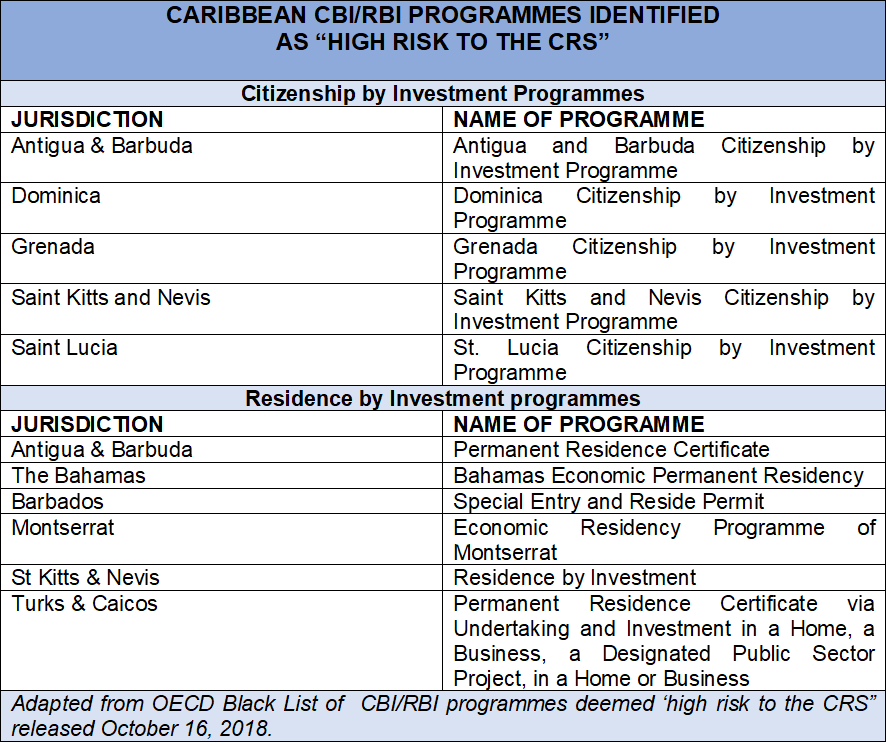
    Caribbean region is the top destination for investors looking for second citizenship

    Global Trade Magazine: The 2018 CBI Index—a special report published by the Financial Times’ Professional Wealth Management magazine—has revealed that Caribbean nations remain the top destinations in the world to apply for second citizenship. Read more 

    Study: Post-Maria Contracts Go To Mainland, Not Puerto Rico

    The Gleaner: A study published last Wednesday found that the bulk of federal funds slated for post-hurricane reconstruction efforts in Puerto Rico are going to mainland companies despite a federal provision that states that local companies should receive priority. Read more 

    INTERNATIONAL

    World trade’s top court close to breakdown as U.S. blocks another judge

    Reuters: The supreme court of world trade is close to breakdown after the United States turned down a last-ditch petition to reappoint one of the four remaining judges at the World Trade Organization. Read more

    WTO downgrades outlook for global trade as risks accumulate

    WTO: Escalating trade tensions and tighter credit market conditions in important markets will slow trade growth for the rest of this year and in 2019, WTO economists expect. Read more

    Trade Deals, Multilateralism in the Spotlight as UN General Assembly Gets Underway

    ICTSD: Trade has been a high-profile topic both at this week’s UN General Assembly (UNGA), featuring during leaders’ speeches and at meetings in the margins, as officials lay out their visions on trade and multilateralism while also working to advance different negotiating processes at the political level.  Read more

    Sustainable Financing, Climate Action Take Centre Stage During New York, Halifax Meetings

    ICTSD: Boosting the political momentum for climate action has taken centre stage in multiple high-level meetings across North America this month, including at this week’s UN General Assembly (UNGA) in New York. Read more 

    Members conclude first review of Nairobi Decision on export competition, seek details on US farm aid package

    WTO: WTO Members approved by consensus the first triennial review of the 2015 Nairobi Decision on export competition during a meeting of the WTO’s agriculture committee on 25-26 September. Read more 

    Panels established to rule on US safeguards, Canadian wine measures

    WTO: At a meeting of the WTO’s Dispute Settlement Body (DSB) on 26 September, WTO members agreed to requests from Korea for the establishment of two panels to determine whether safeguards imposed by the United States on imports of solar cells and washers are compatible with WTO rules. Read more 

    Canada unveils plan to strengthen WTO in face of U.S. protectionism

    Bloomberg: The proposal, called “Strengthening and Modernizing the WTO,” seeks to forge an alliance of like-minded countries to “restore confidence in the multilateral trading system and discourage protectionist measures and countermeasures,” according to a copy of the eight-page document obtained by Bloomberg. Read more 

    Commissioner Malmström visits Canada to take stock of progress with EU-Canada trade agreement

    EU: On Wednesday 26 September, the Commissioner met with the Canadian Minister of International Trade Diversification, James Gordon Carr. Together, they attended the first EU-Canada Joint Committee, which is the highest body for the two partners to discuss issues of interest related to the agreement. Read more

    Trade conflicts to dampen growth in Asia

    Deutsche Welle: Rising debt, US interest rate hikes, but above all simmering trade conflicts will take their toll on Asia’s growth prospects next year, the Asian Development Bank (ADB) has said in an update of its regional outlook. Read more 

    NYTimes: President Trump signed a revised free trade agreement with South Korea on Monday in New York, cementing the first bilateral trade deal of his administration and suggesting the United States could soon win similar agreements with other trading partners. Read more 

    EU, Japan and US met at Ministerial level

    EU: The three met as a continuation of the trilateral talks launched last year, to address issues such as trade-distortive practices. Read more 

    India-South Asia trade has potential to triple to $62 billion, says World Bank 

    Economic Times: Deeper regional trade and connectivity has the potential to more than triple India’s trade with its South Asian neighbors, World Bank said in a report on Monday. Read more 

    EU, China to meet on WTO reform in October

    Reuters: European Union trade officials will travel to Beijing next month for talks with Chinese counterparts on ideas for reform of the World Trade Organization, EU ambassador to the WTO Marc Vanheukelen said on Wednesday. Read more

    US, Japan agree to negotiate a free trade agreement

    Washington Post: The United States and Japan announced Wednesday they will open negotiations on a bilateral trade agreement between the world’s first- and third-largest economies. Read more 

    India sees opportunity in escalating US-China trade war

    Livemint: India has spotted an opportunity to boost its exports with the second round of tariff hikes by the Donald Trump administration on $200 billion of Chinese imports putting the US at a disadvantage. Read more 

    Courting Canada, U.S. and Mexico cancel plans to publish NAFTA texts: sources

    Reuters: The United States and Mexico abruptly canceled plans to publish NAFTA texts on Friday, sources said, as signs of renewed efforts by Canada and Washington to settle differences raised hopes a breakthrough could be made to keep the deal trilateral. Read more 

    Brexit costings 500M a week, study says

    Politico: The British economy is 2.5 percent smaller today than if the U.K. had voted to remain in the European Union, according to the Center for European Reform, a think tank. Read more 

    The closer we get to Brexit, the more polls show Britain wants to remain in Europe

    Business Insider: The closer we get to the Brexit deadline in March 2019, the more British people tell pollsters they think their decision to leave the European Union was wrong. Read more 

    Economists are severely underestimating the amount of trade between African countries

    Quartz Africa: The share of internal trade in Africa remains low, as reflected by official statistics. This is despite numerous regional trade agreements that have led to tariffs removal within the trading blocs. At least in principle. Read more 

    UNCTAD releases Trade and Development Report 2018

    UNCTAD: The world economy is again under stress. The immediate pressures are building around escalating tariffs and volatile financial flows but behind these threats to global stability is a wider failure, since 2008, to address the inequities and imbalances of our hyperglobalized world. Read more 

    African Development Bank Launches first Africa-to-Africa (A2A) Investment Report

    AfDB: The report unearths the realities African companies face when investing in the continent, the emerging trends in A2A investment and the steps African policymakers can take to accelerate intra-African investment. Read more 

    Africa: Kagame – CFTA Will Help the World Better Relate to Africa

    All Africa: The African Continental Free Trade Area (CFTA) Agreement is a bold framework that stands to define the future of relations between the continent and the rest of the world, President Paul Kagame has said. Read more 

    ECA emphasizes holistic approach to realize Africa’s ambitions in trade

    Xinhua: The UN Economic Commission for Africa (ECA) on Wednesday called for greater all-rounded involvement in Africa’s trade policy processes, with due emphasis given to the success of Africa’s flagship trade agreements and policies. Read more 

    Commonwealth countries back rules-based global trade

    Commonwealth Secretariat: Commonwealth members in the World Trade Organisation (WTO) agreed that despite their rich diversity, including in levels of development, they are united in recognising the importance of the rules-based multilateral system as a common good. Read more

    NEW ON CTLD BLOG

    US-China Trade Tensions: What may these mean for the Caribbean?

    Liked this issue? To read past issues of our weekly Caribbean Trade & Development Digest, please visit here. To receive these mailings directly to your inbox, please follow our blog.

  • US-China Trade Tensions: What may these mean for the Caribbean?

    US-China Trade Tensions: What may these mean for the Caribbean?

    Alicia Nicholls

    On-going trade tensions between the United States of America (US) and China reached a new low point last week. Beijing cancelled upcoming trade talks with Washington in the wake of US President Donald Trump’s announcement of tariffs on a further $200 billion dollars’ worth of Chinese imports, starting September 24th. The Chinese government announced that it will retaliate with tariffs on a further US$60 billion dollars’ worth of US imports.

    US-China relations have had turbulent periods throughout the years, but the Trump Presidency has taken a markedly more aggressive stance to Beijing’s purported unfair trade practices which the US President blames for China’s large merchandise trade surplus with the US, estimated to be US$375 billion in 2017.

    With the US as the Caribbean region’s main trading partner and China, a growing economic presence in the region, will the Caribbean be caught in the middle of this spat between the world’s two largest economic superpowers? And is there anyway in which the region could possibly benefit?

    China-Caribbean Relations

    It must first be noted that Caribbean countries’ policy towards the recognition of either the People’s Republic of China (PRC) or the Republic of China (ROC – Taiwan) is fragmented. Five (Belize, Haiti, St. Kitts & Nevis, St. Vincent & the Grenadines and St. Lucia) out of fifteen Caribbean Community (CARICOM) member States still recognise Taiwan as a sovereign State. Moreover, it was only this week that China opened an embassy in the Dominican Republic after that country severed ties with Taiwan earlier. As such, not all Caribbean countries have diplomatic or economic ties with the PRC, but the majority do.

    In the midst of declining US presence in the Caribbean, Beijing has sought to fill the void through mainly bilateral engagement with individual Caribbean governments. China has become an increasingly important source of foreign direct investment, government loans, and development aid and cooperation. A growing number of infrastructure projects throughout the region have been built with Chinese funding and labour. The Chinese Government has also long provided generous government scholarships to Caribbean nationals whose countries recognize the PRC.

    China-Caribbean trade flows have increased and China has widened its trade surplus with the region. According to Ambassador Dr. Richard L. Bernal in his insightful book “Dragon in the Caribbean”, while Caribbean countries’ imports from China have grown “substantially and rapidly”, Caribbean exports to China have increased, but not nearly in as robust a manner. The Chinese Ambassador to Barbados has been reported as stating last week that in “the first six months of this year trade volume between Bridgetown and Beijing reached US$79.8 million”, a rapid increase.

    US-Caribbean Relations

    While China’s deepened economic engagement with the Caribbean is relatively recent, US-Caribbean relations with the region it considers its “backyard” or “third border” are longstanding, dating back to colonial times. The US is not just the region’s largest trading partner, but since the late 1980s many Caribbean countries have benefited from duty-free, quota-free access for most goods to the US market under the Caribbean Basin Initiative, a non-reciprocal goods-only preferences programme.

    The US is the major source market for Caribbean tourist arrivals, with the Caribbean Tourism Organisation reporting an estimated 14.9 million US arrivals to the region in 2017. US-Caribbean ties also manifest through the relatively large Caribbean-American diaspora which numbers approximately four million. The US is also a major (though declining) provider of foreign assistance to the Caribbean, and the Trump Administration has sought to scale back its assistance even further.

    However, the Caribbean region’s geopolitical significance to Washington has diminished since the end of the Cold War, and so has the level of development assistance in recent years. The US-Caribbean Strategic Engagement Act, which had bi-partisan congressional support, was passed in 2016 and signed into law under the then Obama administration as Washington’s attempt to re-engage with the Region. A multi-year Strategy, as required under the Act, was published in 2017.

    So, what may US-China trade tensions mean for the Caribbean?

    It is still too early to tell whether there will or has been any economic fall-out from the US-China tariff war so far on Caribbean economies. Most Caribbean countries are services-dependent making them generally more insulated from direct fall-out from the tariff hikes on global goods supply chains. Commodities-based economies, however, might suffer from softening commodities prices due to reduced Chinese demand.

    President Trump’s calculation may be that a trade war would be more damaging to China’s economy than to the US since it exports more to the US than viceversa. This gives Beijing less American imports on which it could levy tariffs. An already slowing Chinese economy would be further weakened by reduced American demand for its products.

    One possible negative consequence of any severe downturn in the Chinese economy may be a reduction in Beijing’s economic largesse in the region. But, the US economy may not be immune either. Though the US economy grew 4.2% in the last quarter and unemployment is low, these fortunes could be reversed due to Washington’s erratic trade policy and recent tax cuts. American farmers in key states are already warning about the possible impact of the tariff hikes. A downturn in the US economy could have a ripple effect on Caribbean economies, especially those dependent on US tourist arrivals. It is also worth pointing out that China is the US’ largest creditor, with a stockpile of over US$1 trillion worth of US Treasury securities. Beijing may see this as a source of leverage in this economic war, but a mass sell-off by China of its US debt could also backfire.

    Another possible channel of impact for Caribbean countries could be in the financial markets. Spooked by these trade tensions, investors may revert to less risky investment options, which may make bonds issued by emerging economies, like those in the Caribbean, less attractive, and also affect currency markets. Additionally, any downturn in the global economy precipitated by softening global demand due to the rising trade tensions and reduced investor confidence could have a ripple effect on the small open economies of the Caribbean. In its recently released Interim Economic outlook, the OECD warned that new restrictive trade measures were already impacting global trade flows, resulting in a slowdown in global trade volume growth in the first half of 2018.

    An upside to the US-China trade tensions, and this may already be playing out, is that Chinese exporters, faced with these high tariffs in the US market, will be looking at alternative markets for their goods. In light of Washington’s anti-China stance, Chinese firms may also seek out more investment-friendly climates in which to invest. In this case, the Caribbean also hypothetically stands to benefit.

    It should be noted as well that China increasingly sees itself as having similar interests to the Caribbean, and also as an ally to the region in multilateral fora. This week the Chinese government noted that it plans to step up its multilateral cooperation with the Caribbean Community (CARICOM), to help protect the integrity of multilateral institutions which have been increasingly under attack from the current unilateral stance taken by the Trump administration. WTO reform is one area in which China and the Caribbean could potentially collaborate, although China’s status as a developing country is one of the sore points for some WTO members, including the US.

    There may also be greater opportunities for Caribbean countries to meaningfully increase exports to China. However, this is easier said than done. Caribbean firms looking to export to, or invest in China, will need to overcome barriers to market access and penetration, which are not just legal/regulatory in the form of non-tariff barriers, but also linguistic and cultural.

    One way in which these barriers may be mitigated is by tapping into those persons who have knowledge of the Chinese market and culture. A growing number of Caribbean nationals have benefited from Chinese government scholarships. These persons not only speak the language, but know the culture and may have built up lasting contacts there. They could be employed as trade and investment liaisons in their countries’ diplomatic missions in China and their expertise used during trade shows to China. Local chambers of commerce, trade and investment promotion agencies, and individual firms looking to scope out the Chinese market, should also view these persons as useful sources of insights on the Chinese market and sources of contacts for exploring possible joint ventures and partnerships as market entry strategies.

    Notwithstanding, it is still too early to state definitively what impact the current US-China trade tensions will have for the Caribbean region. As such, Caribbean leaders and the business community should continue to monitor the situation closely, looking for ways to mitigate any possible channels of impact, but also areas where opportunities may arise.

    Alicia Nicholls, B.Sc., M.Sc., LL.B., is an international trade and development consultant with a keen interest in sustainable development, international law and trade. You can also read more of her commentaries and follow her on Twitter @LicyLaw.