CARICOM Secretariat | Turkeyen, Greater Georgetown, Guyana | Thursday, 29 January 2026: A senior Caribbean Community (CARICOM) official has positioned deeper regional integration as a strategic response to an increasingly fragmented and uncertain global trade environment, as global rules-based systems weaken and economic nationalism intensifies.
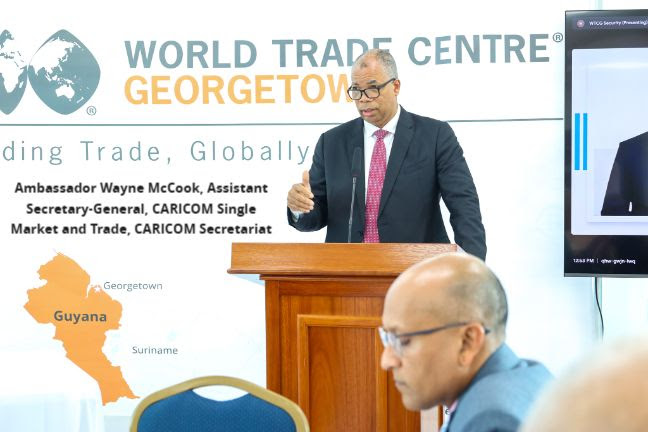
Ambassador Wayne McCook, Assistant Secretary-General, CARICOM Single Market and Trade, was a panelist discussing Prospects for International Trade in 2026 in the Context of the Changing Global Geopolitical and Economic Landscape – Impact on Trade and the Challenges and Opportunities for the Caribbean and Latin America. The discussion was held on Wednesday, 28 January, at the World Trade Centre in Georgetown, Guyana.
Contextualising the Region’s position, Amb. McCook said: “For our Region, the scars of the immediate past are visible. The devastating passage of Hurricane Melissa encapsulated the dual challenge we face: the existential threat of climate change and the inherent economic vulnerabilities of our CARICOM Member States. Simultaneously, we have navigated dramatic shifts in global trade, driven largely by an intensified “America First” trade policy that has significantly impacted our exports, value chains and supply chains through a suite of unprecedented tariff measures.”
Against the background of what he described as “a truly tumultuous 2025” for international and regional trade, Amb. McCook highlighted CARICOM’s “oneness” and its resilience to navigate the “choppy waters” of the 21st century.
Amb. McCook warned that the erosion of multilateral trade norms is no longer theoretical, but already affecting investment, supply chains, and growth prospects worldwide.
According to UN Trade and Development (UNCTAD), global foreign direct investment fell by 11 per cent in 2024, marking a second consecutive year of decline, with further weakness expected in 2026. Global trade growth has slowed dramatically, falling below one per cent in 2025, even as uncertainty and geopolitical rivalry reshape supply chains.
Despite these headwinds, CARICOM’s trade performance has shown resilience. Between 2023 and 2024, CARICOM exports grew by 32 per cent to US$34.7B, with exports to the United States increasing by 86 per cent. However, recent data reveals uneven impacts across Member States.
The Assistant Secretary-General pointed to the recent steps toward full free movement of people by Barbados, Belize, Dominica, and St. Vincent and the Grenadines as tangible progress toward a more integrated Community.
“Fundamentally, CARICOM integration should be seen as a strategic response to a shifting global order,” he emphasised.
Addressing prospects for international trade in 2026, he advanced a multi-pronged strategy focused on strengthening intra-regional trade, strengthening existing relationships while diversifying global partnerships beyond traditional allies, and deepening economic integration. Central to this approach is the CARICOM Industrial Policy and Strategy (CIPS), and the 25×25+5 food security agenda aimed at reducing food import dependence and boosting regional production.
Read his presentation here: https://caricom.org/deeper-caricom-integration-key-to-navigating-fractured-global-trade-order-amb-wayne-mccook/
Category: CARICOM
-
Deeper CARICOM integration key to navigating fractured global trade order – CARICOM ASG
-

Denial and Banning of Dancehall and Trinibad Artists across CARICOM : Compatible or Incompatible with Regional Integration Law
Rahym R. Augustin-Joseph (Mr.) (Guest contributor)

Overtime, there has been a discernible increase in the denial of entry or even banning of certain dancehall and Trinibad artists, who were scheduled to perform in Caribbean countries in 2024 such as K-Mann 6IXX in Antigua and Barbuda and DJ Punz in St. Kitts and Nevis.
Earlier, in 2022, Skeng was denied future permits for any show he was scheduled to have in Guyana, after the Baderation event he had, was disrupted by gunfire and bottles turned missiles. In response, the Guyanese Government therefore noted that they would no longer issue permits to skeng or other artists whose lyrics included violence and public disorder to perform in Guyana. In 2024 however, it appears that this position was reversed as Skeng performed in Guyana.
But these refusals and banning of artists from other Caribbean countries is not a new phenomenon, as in 2014 Jamaican artiste Tommy Lee Sparta, or Cabral Douglas was denied entry into Dominica, where he was supposed to perform, but it raised concerns for public safety. In 2010, Vybz Kartel was issued a performance ban in Saint Lucia and Barbados, citing his lewd lyrics and raunchy performances, and in 2009, Bounty Killer was also denied entry into Trinidad and Tobago, allegedly without reasons, while Vybz Kartel his reputed rival was allowed to enter and perform. There are many more examples of the denial of entry and banning of artists in the Caribbean.
On the one hand, a wide cross section of the Caribbean peoples listen and engage with the music of these artists, and see it is a citadel of modern Caribbean culture. However, political leaders and technocrats have noted that these artists and their music are in the main, vulgar, misogynistic, crude, and have a major influence in the increased crime and violence in our society. It is their view that this music is contributing towards the increase in gang recruitment and violence, as people continue to be influenced by the lyrical component and call to action elicited by this music. Young people are therefore not seeing this music for its ‘creative expression’ but instead seeing this music for its literal meaning.
One only has to listen to the words uttered by Dr. Mohamed Irfaan Ali of Guyana, when he noted during the 46th Regular Meeting of the Conference of the Heads of Government of CARICOM. He urged leaders to prevent the proliferation of violent music in their respective nations. “We do not need lyrics that promote violence in this region, We have the ability to promote positive lyrics that inspire people to think, act, and behave positively. As leaders, we must take this matter seriously and ensure that the region’s lyrics reflect the positivity embodied by Bob Marley and encourage positive living and change.”
This debate however is to be had at another time, and within our respective countries, wherein one can examine properly whether the music which portrays violence has been having an effect on the perpetrators of violence within the Caribbean, such that if it is reduced, curtailed or banned across various mediums, that it would reduce violence significantly. This is a task for researchers across the region, which political leaders must take their cues from if they are to sustain such an argument.
But, beyond just the consumption of the music by nationals in the respective Caribbean countries, it is also being packaged and sold through concerts and other mediums across the Caribbean. As such, the banning and denial of entry of the artists has effects on trade in services, and also possibly implicates regional integration law of which will be discussed briefly here.
So, how is the banning and denial of entry of artists to ply their trade within the Caribbean a regional integration law problem?
As you may be aware, every CARICOM national has an automatic right of entry and stay within another CARICOM country for a maximum of 6 months pursuant to the 2007 Conference Decision of the CARICOM Heads of Government, Article 45 of the Revised Treaty of Chaguaramas, and the seminal case of Shanique Myrie v. The State of Barbados. This automatic right must also be hassle free, or without harassment or the imposition of impediments. Beyond just the mere right of entry, cases such as Tamika Gilbert v. The State of Barbados also notes that the right extends to being able to move freely within the particular country without any harassment and impediments.
In restricting such right however, the offending state can only do so on two strict and narrowly applied grounds i.e., if the individual is an undesirable or a charge on public funds. Under the first prong, the offending state must show that the individual presents a genuine, present and sufficiently serious threat to national security and safety, public morals, and national health of the member state affecting one of the fundamental interests of the society. So, individuals who actually pose or can reasonably be expected to pose such a threat. It is interesting however, that the cases from the European Court of Justice also suggest that one cannot refuse an individual of another state to one’s territory by reason of or of the threat of conduct which when attributable to their own nationals, do not give rise to repressive measures or other genuine and effective measures intended to combat such conduct. One must show essentially that their own nationals who engage in the behaviour which is refused are prosecuted regularly or otherwise subjected to some legal action. This begs the question of whether the states which have denied entry and banned artists altogether, have similarly banned local artists which share similar lyrical content in their songs?
In the latter, one must show that the individual does not have sufficient funds, such that they will become a charge on public funds, wherein they do not have sufficient monies for the duration of their visit, lack possession of online cash and card among other considerations. Further, when refusing an individual, there are certain procedural elements that the offending country must satisfy, which include inter alia, that they must (I) inform the individual in writing why they are being refused entry, (II) state the reasons why they are refused entry (III) provide them with the right to challenge such decision, through an effective appeal or review procedure with adequate safeguards to protect the rights of the persons denied entry and (IV) allow them the opportunity to consult with an attorney or their consular official of their country.
The probing questions is therefore whether reasons have been given to these artists justifying their performance ban, how long are these measures in effect and is there is a review mechanism for these artists to allow them to appeal against the performance ban and what do these review mechanisms look like. These are according to Dr. Waite, “serious legal and policy questions that have implications for our regional integration movement, cultural exchange, vibrancy of socio-political commentary and our community rights. In order to answer them, a probing review is necessary, not a knee-jerk emotional and moral response.”
However, the right which the refused artists will be captured under is the Article 46 right, which is where community nationals who are skilled nationals are able to travel freely across the region to ply their skills upon attainment and presentation of their CARICOM Skills Certificate. As such, the artists or musicians should be able to travel to any CARICOM state, hassle- free, without any impediments or harassment for a period of 6 months.
Should the abovementioned artists have their CSME Certificate, which is attained by artists after they provide, (I) copies of their portfolio work which include pictures, videos, news, reports, examples of their work, (II) letters from their previous employers which state the period of employment and a job description- which is a bit problematic of a criteria, recognising the entrepreneurial nature of most of our artists and their engagement in the gig economy, (III) letters of reference from previous individuals attesting to work previously and (IV) five invoices dated within the last six months. However, the artists can only enjoy such right of freedom of movement with the acquisition of the CSME Certificate which would validate their status as a skilled national. As such, on a prima facie level, the banning of artists and the denial of entry into certain countries within the Caribbean already has affected and infringed on their community rights as a CARICOM citizen, wherein they can receive redress before the Caribbean Court of Justice in its original jurisdiction.
Of course, any state, which has banned the artists who had upcoming and scheduled performances and shows in their respective countries if challenged would argue that these artists can be classified as ‘undesirables.’ As such they would argue that these artists represent a genuine, present and sufficiently serious threat to their national security, safety, and public morals, and they affect one of the fundamental interests of society. Their argument would possibly be that these artists by virtue of their lyrical component of their music could or have elicited violence in their respective countries, especially with increasing crime and violence statistics and as such is a threat to the national security. Further, they may argue that the lyrics of the artists may also be against public morals, particularly violent music which encourage gun violence. Recognising that there has been no cases within the region which have touched and concerned the exceptions, with regards to the nexus of violence and national security and public morals, one has to look towards the European Court of Justice jurisprudence, which the CCJ would look to.
Within the ECJ, Catherine Barnard in her text, The Substantive Law of the European Union, Four Freedoms has noted that, the court grants member states a certain latitude and margin of discretion to determine what constitutes national security or public security in light of the national circumstances. It would therefore vary from one member state to another as noted in Van Duyn v. Home Office [1974]. Moreover, the courts provide the relevant national authorities an area of discretion within the limits imposed by the treaty, particularly as it does not provide a uniform set of values related to conduct which may be considered contrary to the national security interests of a country. However, the court still maintains its overarching view that there must be a genuine and sufficiently serious threat affecting the fundamental interests of the society.
However, the court has noted in Shanique Myrie, which is a slight departure from the abovementioned, when they noted that public policy cannot be used as a justification for derogation from the fundamental principle of freedom of movement and hassle-free travel of community nationals wholly or unilaterally be determined by each member state without being subject to control by the major community organs, in particular the conference and ultimately by the court as the guardian of the RTC.
The unfortunate or fortunate thing about the law and the decision by the court is that it forces a ‘culture of justification’ as coined by the South African public law scholar Etienne Mureinik, albeit post-law and decision making, wherein our officials must justify their decisions utilising evidence, logical reasoning as the court does not provide a carte blanche to the decision maker, which is critical for policy making and decision making. While members of the public may see it as being heavy handed, Article 211 of the RTC, provides the CCJ with this exclusive and compulsory jurisdiction to interpret and apply the RTC.
As such, questions which have been posed by Dr. Neto Waite, on this subject are instructive and worthy of repetition here, when he asked whether it is right to argue that salacious lyrics undermine public morality and national security, is it true that lyrics about violence and rebellion against government harm public order? Has it ever posed a serious and sufficient risk and if so what does such intelligence tell us? Is the performance ban the best mechanism to deal with it, is it not too draconian and shouldn’t adult concertgoers be left to decide for themselves what sort of lyrics they wish to enjoy? In addressing whether the concern is minors being exposed to such music, he also argues correctly, whether it would be more appropriate for the government In consultation with civil society, implement a parental rating system for concerts based on the lineup of artists which can protect minors and respect the agency of adults to determine what types of music they want to listen to.
However, from the reports in the media, it appears that save and except for Tommy Lee Sparta or Cabral Douglas, of which the CCJ has ruled on, the artists are not being denied entry after they have attempted to enter the respective countries. Instead, they are being banned from before. This does not mean they are not captured under the abovementioned. It just means that existing domestic Immigration legislation is being utilised to preclude entry which has been addressed in Maurice Tomlinson v. The State of Belize and Trinidad and Tobago. The court has therefore noted however that the mere existence of incompatible legislation, which suggests that there are categories of individuals who may not be eligible to enter the respective country, without it being harmonised with community law is not ipso facto, incompatible. Instead, the court will assess the state practice of the particular state to decide whether the legislation is incompatible with regional integration law.
Therefore, this denial and banning of dancehall and trinibad artists would be assessed on a country-by-country basis in order to assess whether the individual country has a history of banning of dancehall and trinibad artists, which would be determinative of the legislation and state practice being incompatible. As such, countries such as Guyana, St. Kitts and Nevis among others may be found inconsistent, and the artists can make a claim even prior to entering that they will be denied entry, because of the legislation and also the application of the legislation with the banning of the artists. The artists would therefore have a claim before the CCJ in its OJ.
However, CARICOM countries should take heed of the warning of the CCJ, who noted in Maurice Tomlinson, “that the court does not condone the indefinite retention on the statute book of a national law which in appearance seems to conflict with obligations under Community Law, and member states must ensure that national laws, subsidiary legislation and administrative practices are transparent in their support of the free movement of all CARICOM nationals and there should be harmonisation of the legislation with Community Law. If there is any permanent or indefinite discord between administrative practices and the literal reading of the legislation, then the rule of law requires clarity and certainty especially for nationals of other Member states who are to be guided by such legislation and practice.”
Another right of the Artists, which may be affected is the right to not be discriminated on the grounds of nationality, as per Article 7 of the RTC. Essentially, in refusing entry to the artist, the offending state cannot discriminate on the artist solely on the basis of their nationality. Essentially, the artists must therefore show that similar individuals i.e., individuals who sing music similar to them have not been denied entry and that these individuals have no separate distinction other than their nationality. The unfortunate hurdle that they will face however is the high and unreasonable evidentry burden, as noted in Shanique Myrie v. Barbados, where the court noted that to show discrimination one has to show that there is statistical data which shows discrimination against the particular nationality that the individual artist has come from. It does not allow discrimination to be seen on a case-by-case basis, with the evidence being solely attributed from the particular case.
The last right however which may affect the artist is the right to provision of services under Article 36 of the RTC, which is connected to the right to freedom of movement as noted in Shanique Myrie v. Barbados. Cabral Douglas v. The State of Dominica notes that an individual can be a service provider, if they satisfy condition precedent in Article 36 which is that (I) it must be within an approved activity in an approved sector, which music and performances are, (II) It must be supplied cross-border, which is satisfied as the artists are moving from one country to another. This would be different from Cabral Douglas, which has been critiqued, where the court held that he could not show that he was providing services because he was from Dominica attempting to provide services in Dominica and therefore the cross-border element was not satisfied. Thirdly, the element of temporary nature will be satisfied as they are travelling for a concert or some other performances which would be temporary. Finally, there must be renumeration as they are going to benefit from the payment by the patrons among other forms of income arising from the concert.
Recognising the above, it would be advisable that these artists troubleshoot their cases in the OJ of the CCJ in order for the court to provide a definitive ruling on this matter, to guide or instruct states as to how to treat with these artists as a collective, ensuring state decisions are compatible with community law, as individual states believe they may be affecting their public morals, national security among other fundamental interests of the society.
This is particularly opportune as there are further promises to increase freedom of movement in the region. The region cannot continue to address these matters in isolation and also ignore the trade and possible incompatibility implications of the individual countries with the RTC.
Rahym Augustin-Joseph is the 2025 Commonwealth Caribbean Rhodes Scholar. He is a recent political science graduate from the UWI Cave Hill Campus and an aspiring attorney-at-law. He can be reached via rahymrjoseph9@ gmail.com and you can read more from him here.
Photo credit: WordPress AI-generated image
-

CARICOM at 50: Some Reflections on Trade for Sustainable Regional Development
Alicia Nicholls
This week I had the opportunity to moderate two panels which on the surface dealt with different topics, but in fact, had a central underlying theme. That theme, I argue, is that of how Caribbean Community (CARICOM) member States could better use trade and their trading relationships to meet their sustainable development imperatives. Read any of the speeches of our Caribbean statesmen or the writings of Caribbean scholarly giants over the years and you will see that the trade and development problematique has occupied the regional development discourse for decades. The topic bears continued significance as CARICOM celebrates its fiftieth year in existence. In this short article, I offer some cursory reflections on trade as an engine for sustainable development as we celebrate this important CARICOM milestone amidst a panoply of trade and development challenges facing not only our region but the global community.
CARICOM Heads meet this week (July 3-5) in Trinidad & Tobago for the 45th CARICOM Heads of Government meeting. Formed in 1973 and now comprising 15 member States and 5 Associate Members, CARICOM is a regional inter-governmental organization and regional integration movement built on four pillars. One of those four pillars is economic integration. While trade fits under this pillar, in reality, trade also touches and concerns the three other pillars: human and social development, foreign policy coordination, and security which was added later. Trade is not an end in itself. It is really to be an engine for promoting human and social development through creating meaningful jobs and opportunities for entrepreneurship and knowledge transfer, for example. Under foreign policy coordination, commercial diplomacy is becoming an essential part of the foreign policy imperative of countries, including CARICOM Small Island Developing States (SIDS). Finally, trade in illicit goods such as narcotics, illegal firearms and endangered species are among the most pressing security issues facing the Caribbean region. In essence, trade impacts and is impacted by all four pillars underpinning CARICOM. Indeed, trade, even more so now, cannot be viewed in a silo given its increasing intersection with development issues, such as human rights, the environment, climate change and public health.
Two key issues with which CARICOM continues to grapple as it celebrates its 50th year in existence is first, how can CARICOM promote greater intra-regional trade for sustainable development. Second, how can it meaningfully expand its trade with both traditional and non-traditional external trading partners in a mutually beneficial and sustainable manner?
The CARICOM Single Market and Economy (CSME) envisions the creation of a single economic space. By removing barriers to the flow of each other’s goods, services, skilled nationals and allowing the right of CARICOM nationals to establish businesses in each other’s markets, it is expected that there would be greater intra-regional trade and investment, tourism and the like. However, despite the importance of the CARICOM market for some countries like Barbados, intra-regional trade as a percentage of CARICOM’s total trade with the world remains low and has declined over time due to many factors, including, but not limited to, remaining barriers which still impinge on the ability to export in a frictionless manner, as well as high costs of transport and other logistical challenges. Intra-regional transportation, including travel for business and leisure, remains a bug-bear due to high airfares and taxes, and let us face it, it is even more frustrating now in the post-COVID era due to the LIAT fiasco. The introduction of intra-regional flights by UK-carrier Virgin Atlantic is an encouraging development and I truly hope that at least in the short term this could be a partial solution to this vexing problem.
Turning to extra-regional trade, most CARICOM countries, with the notable exception of Trinidad & Tobago which enjoys a trade surplus, are net-importing countries, that is to say, their imports exceed their exports. The region’s exports have in general been underperforming and remain highly concentrated in only a narrow range of goods and services despite attempts at diversification. Guyana has discovered oil and is developing a booming oil/gas industry but has to ensure it does not fall victim to ‘Dutch Disease’. Much of this declining competitiveness is due to high costs of production in the region, lack of economies of scale, loss of preferences and preference erosion in its main export markets which has led to declining competitiveness of Caribbean countries’ exports vis-à-vis exports of other countries.
CARICOM presently has free trade agreements with the European Union, the United Kingdom, the Dominican Republic and Costa Rica. It has partial scope agreements with Colombia, Cuba and Venezuela. Not many publicly available studies exist analysing CARICOM’s trade performance under these agreements. However, a 2015 study by McClean and Khadan on the performance of CARICOM’s extra-regional agreements show the private sector’s limited utilization of the preferences under CARICOM’s trade agreements and arrangements. This is despite the many sensitization workshops, export promotion programmes and other great assistance offered by regional business support organisations (BSOs). Perhaps a more recent study is needed to see if this is still the case.
Usually where more contemporary reports exist in the public sphere, such as the latest Ex Post Evaluation of the CARIFORUM-EU EPA, these are usually reports done by our trading partners and not our region itself. For instance, the latest biennial CBERA Report published by the Office of the US Trade Representative (USTR) in 2022 showed a marked increase in the percentage of some CBI-beneficiary countries’ imports into the US under the various components of the CBI programme. By contrast, only some 4% of Caribbean imports into Canada are under CARIBCAN preferences according to StatCan data.
I do not purport to have a magic wand to solve either of these issues and neither am I implying that these issues are easy to address or that they are not being actively worked on by the hard-working staff of the CARICOM secretariat, the BSOs and the various trade ministries across the region. Indeed, having spent two weeks in Geneva in May-June this year as part of an annual study tour offered by the UWI Shridath Ramphal Centre for students of the Masters in International Trade Policy (MITP) programme, I was able to see firsthand the hard work of our missions there, often with limited staff and resources. Perhaps it is time for CARICOM to more seriously consider having joint missions, similar to the OECS in key capitals, and pool their scarce financial and human resources. Additionally, there are clear initiatives underfoot, supported by commercial diplomacy, at expanding trade with non-traditional partners in China, Africa, Latin America and the Middle East, for example and deepening ties with the Caribbean diaspora, especially in the US, UK/Europe and Canada. Barbados’ recent opening of embassies in Ghana, Kenya and a consulate in Rwanda are examples of this outreach to non-traditional markets. Promoting digital transformation of regional economies is also another issue actively being worked on at both the regional and national levels, including how digitalization could improve the ease of doing business across the region, the role of digital technologies in building competitiveness, inter alia.
What I am offering in this article are some of my personal reflections as a trade specialist who firmly believes, like most other regional figures, that expanding intra-regional trade and diversifying CARICOM’s trading relationships are necessary in helping the region meet not just the 17 sustainable development goals (SDGs) under the United Nations (UN) 2030 Agenda for Sustainable Development but its wider development imperatives. Chief among these imperatives are reducing poverty and creating meaningful jobs for our populations (especially the youth), building resilience in an increasingly polycrisis world to climate change and other natural disasters and other shocks, and combatting the challenges of non-communicable diseases (NCDs) which are severe threats to the region’s prosperity.
With regard to extra-regional trade performance, CARICOM desperately needs to review its current trade agreements and evaluate their sustainable development impact. This means improving the data available on trade under these agreements. Have these agreements really contributed to job creation or expanded investment? This evaluation process is likely on-going but there is very little information publicly shared about the status or findings from such analyses. The point about evaluation of our trade agreements was certainly underscored in one of the panels I moderated at the CIC/CCI “Optimising the Canada-Caribbean Trade Relationship” webinar on June 29 with a key takeaway being the need to consider whether the current trade cooperation framework between Canada and the Caribbean was fit for the purpose of twenty-first century trade and development realities, where sustainability issues are increasingly recognized as being intersected with trade.
This evaluation process must include CARICOM member States’ network of international investment agreements (IIAs), particularly the older bilateral investment treaties (BITs), which, due to their broad and vague investor protection provisions, are unfit for the purpose of attracting investment for sustainable development. As I argued in a recent policy brief published by the UWI’s Shridath Ramphal Centre, such outdated IIAs could open up the region to legal exposure from foreign investor claims as the region seeks to step up its climate action.
I also think that there is still too much disconnect between CARICOM and the ordinary citizen, despite the excellent CARICOM youth ambassadors programme, the increasing public awareness campaigns, greater social media presence by the CARICOM Secretariat and to some extent, greater mainstreaming of teaching about CARICOM in schools. I think in many ways CARICOM does not do enough to tout its successes and how its work is beneficial to the ordinary CARICOM citizen. This could be focused on a lot more in its public awareness campaigns. Additionally, one of the things I would love to see is a CARICOM Young Professionals Programme, similar to what exists in other organisations, as well as greater opportunities for secondary school and university students to intern within CARICOM institutions.
CARICOM has released a 50th Anniversary celebrations calendar of activities. As many countries in the region will be observing a one-off public holiday in celebration of CARICOM’s 50th anniversary, it would be good if regional airlines would consider the feasibility of offering specials on inter-island routes in celebration of this important milestone. Doing such would be a win-win as it would not only make it cheaper for persons wishing travel to other CARICOM islands for these celebrations or on vacation, but also help to foster intra-regional tourism and people-to-people connection, key ingredients for promoting a common Community spirit and connection.
As trade and public health law expert Nicole Foster sagely opined in her presentation at the Public Health Law forum held June 30, it is imperative for ministries of trade and ministries of health, as well as other ministries to talk to each other to ensure policy coherence. This includes greater data sharing among ministries to ensure trade policy is being made based on actual empirical evidence and that trade policies support and do not undermine public health objectives. This latter point about empirical evidence also came up in a Barbados Coalition of Services Industries (BCSI) Breakfast Forum I moderated earlier this week. Data is key to effective trade policy making for development. As such, it is important for the private sector to recognize the need to respond to surveys in a timely and accurate manner and share data not only so governments have an accurate picture of economic activity, but also what challenges and barriers businesses face both in doing business domestically and when exporting. Governments themselves also need to improve access to data, including sharing data with the academic community whose research could be beneficial to both governments and the private sector. There needs to be deeper cooperation among government, business and academia if CARICOM is truly to prosper.
I conclude by imploring that CARICOM’s celebration of its fiftieth year of existence is an achievement. We, as lifelong ‘students’ of international politics know that CARICOM is just one (albeit an important one) chapter in a much longer history of regional integration. There have been failures and disappointments, but there have also been many triumphs. Certainly, let us use this occasion of CARICOM’s fiftieth anniversary as an opportunity for deserved celebration. But it should also be a moment for considered reflection of the lessons to be learnt from the past half a century of CARICOM’s existence and the lengthier history of the regional integration process, including the Caribbean Free Trade Association (CARIFTA) and the West Indies Federation that preceded it. Let us reflect on how we can use our trade policy to operationalize the Bridgetown Declaration on NCDs and Mental Health, for example, or how we can work more cohesively as a region to push for the creation of a more equitable international financial architecture as envisioned by the Bridgetown Initiative which has been endorsed by the Community. Let us use the lessons learnt from the past 50 years and beyond to craft a CARICOM trade policy that is truly fit for our contemporary development realities and meaningfully promotes both intra-regional and extra-regional trade for sustainable development, especially for the youth who are to inherit and continue this regional integration movement. Happy 50th Anniversary, CARICOM!
Alicia Nicholls, B.Sc., M.Sc., LL.B. is an international trade and development consultant and founder of the Caribbean Trade Law & Development Blog www.caribbeantradelaw.com.
-

CARICOM to meet to review its CET and Rules of Origin
CARICOM TO MEET TO REVIEW ITS COMMON EXTERNAL TARIFF (CET) AND ITS RULES OF ORIGIN(CARICOM Secretariat, Turkeyen, Greater Georgetown, Guyana – Tuesday, 20 June 2023): The Caribbean Community (CARICOM) is reviewing its trade instruments to make them fit for purpose to facilitate increased trade, agricultural expansion and industrial development beyond 2023. The Community’s main trade instruments are the Common External Tariff (CET) and the Rules of Origin.
Member States and other Regional stakeholders will engage in deliberations in the Seventh Meeting of the Sectoral Working Group to Review the CET and in the Ninth Meeting to Review the Rules of Origin. The Working Groups will meet respectively on 22 and 23 June 2023.
The Working Group on the CET will give further in-depth consideration to the principles underlying the categories and levels of the CET as well as the rates to be applied. The Working Group on the Rules of Origin will seek to finalise several aspects of the working text of the Rules of Origin regime.
The following was a press release from the CARICOM Secretariat.

 Caribbean Trade Law and Development
You must be logged in to post a comment.