Tag: China

  • What’s Happened in Trade since December 2020?

    What’s Happened in Trade since December 2020?

    Alicia Nicholls

    Happy New Year to all of our readers! Since our last Caribbean Trade & Development News Digest was published near the end of December 2020, some major trade developments have occurred. If you missed any of these developments, we will bring you up to speed with the top ones in this article!

    UK-EU begin trading under new trade arrangements

    The United Kingdom (UK) and European Union (EU) received the Christmas present they both wanted. On Christmas Eve (December 24) 2020, political agreement was reached on their future trading terms before the Brexit transition period deadline of December 31, 2020. The deal averts the no-deal scenario, that is, trading on World Trade Organization (WTO) Most Favoured Nation (MFN) terms. Such a scenario would have caused, among other things, the reintroduction of tariffs. This would have been disastrous for both parties, and is a circumstance both sides sought to avoid at all costs, even as contingency plans were put in place in case of the worst case scenario.

    The new EU-UK Trade and Cooperation Agreement covers not just trade and investment, but also deals with issues such as competition policy, fisheries, State aid, tax transparency, among other areas of mutual interest. January 31, 2021 marked the start of the EU-UK’s new trading arrangement. Of course, implementation of the new arrangements have not been without their kinks, including border delays due to the reintroduction of customs checks.  

    The UK-CARIFORUM EPA, which rolls over the provisions of the EU-CARIFORUM, now governs trade between the UK and CARIFORUM countries. The EU-CARIFORUM EPA, of course, remains in effect as between CARIFORUM countries and the remaining EU-27. It remains to be seen what practical impact the new EU-UK trading arrangement may have on CARIFORUM’s trade with the EU and UK respectively, including on supply chains.

    Trading under AfCFTA begins

    Originally slated for July 1, 2020, but delayed due to the COVID-19 pandemic, trading under the Africa Continental Free Trade Agreement (AfCFTA) has officially started from January 1, 2021. A special ceremony marking the Start of Trading was held to mark this historic occasion and the recording may be viewed here.

    The AfCFTA is a landmark trade agreement comprising 54 African countries, with an integrated population of 1.3 billion people and a combined GDP of US 3.4 trillion. It is second only to the WTO as the world’s largest trade agreement. While full implementation of the AfCFTA is not expected for some time, it is expected to help boost economic development on the continent.

    A recent PWC report highlights the ways the AfCFTA could assist African countries in their COVID-19 economic recovery. These include providing the opportunity to reconfigure supply chains, allowing for greater intra-regional sourcing of goods, such as pharmaceuticals, thereby reducing dependence on third countries.

    CARICOM-Africa relations continue to develop and it was announced that the African Union (AU) has offered CARICOM access to approved COVID-19 vaccines from a shipment the AU recently secured.

    EU-China reach agreement in principle on Comprehensive Agreement on Investment (CAI)

    On December 30, 2020, it was announced that the EU and China had reached agreement in principle on the text of a Comprehensive Agreement on Investment (CAI). While the text does not appear to be public as yet, the agreement is said to cover market access for EU and Chinese investors respectively, sustainability commitments and provision for State-to-State resolution of disputes arising under the agreement. The EU and China also commit to try to complete negotiations on investment protection and investment dispute settlement within two years of the agreement’s signature.

    US Section 301 investigations on Vietnam currency valuation and on DSTs

    In December, the US Department of the Treasury designated Vietnam as a currency manipulator. According to the USTR, Vietnam currently enjoys a $55 billion dollar merchandise trade surplus with the US, but a $1.2 billion services trade deficit. In the report on its Section 301 investigation of Vietnam’s acts, policies, and practices related to currency valuation, the USTR concluded that in their totality, they were “unreasonable and burden or restrict US commerce”, but stopped sort of recommending punitive tariffs.

    On the digital services tax front, the USTR has suspended retaliatory duties on French luxury goods, until further notice, which were scheduled to have taken effect on January 6, 2021. On another note, the USTR’s section 301 investigations on digital services taxes adopted by several other countries, including Italy, India and Turkey, found that these countries had placed “unreasonable or discriminatory and burdens or restricts U.S. commerce” but did not recommend any retaliatory action as yet.

    A new direction for US trade policy?

    On January 20, Joseph R. Biden will be sworn in as the 46th president of the US, and it is widely anticipated that this will herald a change from the outgoing administration’s often chaotic trade policy.

    In a key note speech delivered last week, Katherine Tai, the nominee for United States Trade Representative (USTR), provided some idea of the incoming Biden administration’s trade policy priorities, of which China and the USMCA remain foremost. Notable was that there was no mention in Ms. Tai’s speech of the WTO, including the current impasse on the appointment of a Director-General or the Appellate Body crisis. However, further information on the Biden administration’s trade policy priorities and disposition will be gleaned when the USTR releases its report on the President’s trade agenda, expected sometime in February.

    Without doubt, domestic issues, such as COVID-19 vaccine roll-out and economic recovery, are expected to absorb much of the administration’s policy agenda within the first 100 days. Biden has proposed a $1.9 trillion-dollar stimulus package to combat the COVID-19 pandemic and its economic fall-out. Climate change is also one of the policy priorities and Biden has indicated that the US will rejoin the Paris Climate Agreement.

    Despite the outgoing Trump administration’s limited cooperation with the President-elect’s transition team, fate appears to have dealt Biden some fortune on the legislative front. With both Houses of Congress controlled by Democrats (albeit a slim majority in the case of the Senate), Biden should have some breathing space to get his policy agenda enacted, at least for the first two years of his administration.

    US redesignates Cuba as a State Sponsor of Terrorism

    The outgoing Trump administration’s State Department has redesignated Cuba as a state sponsor of terrorism (SST) for allegedly “repeatedly providing support for acts of international terrorism in granting safe harbor to terrorists”. Cuba had been delisted in 2015 under the Obama Administration as part of that administration’s attempts to normalize US-Cuba relations. However, the US’ illegal and unwarranted economic, commercial and financial embargo on Cuba, which requires Congressional action to remove, remains.

    The redesignation of Cuba as a SST is just the latest of several actions taken over the course of the Trump administration, which has seen a hardening of the US’ policies against the island nation. This included, for example, ending the suspension of Title III of the Helms-Burton Act. With regard to the trade implications of Cuba’s redesignation, which is extraterritorial in application, it penalises persons and countries engaging in certain trade with Cuba, bans defense exports and sales, and imposes certain controls on exports of dual use items.

    In a strong statement condemning this unilateral action taken by the administration, the Caribbean Community (CARICOM) argued that “Cuba’s international conduct does not in any way warrant that designation.” CARICOM also unequivocally condemned it as a “further attack on the country adversely affects its international standing and its social, human and economic development”.

    US President-elect Joe Biden, who had been the VP under the Obama administration and part of the efforts at rapprochement, has been critical of the Trump Administration’s handling of Cuba affairs. It remains to be seen what will be his administration’s approach to Cuba policy.

    Post-Cotonou Agreement Text faces opposition by some EU Member States

    Towards the end of last year, the EU and the Organisation of African, Caribbean and Pacific States (OACPS) announced political agreement on the text of a deal to succeed the Cotonou Agreement which was meant to have expired in December 2020. The post-Cotonou agreement is not a trade deal; trade between the EU and the OACPS is covered by the various Economic Partnership Agreements (EPAs). It is, however, the overarching framework for EU-OACPS relations and, therefore, covers EU-OACP cooperation on a variety of political and social issues.

    A Devex exclusive report released last week revealed that some EU states, particularly Poland and Hungary, expressed reservations with the proposed text, especially on the treatment of issues such as sexual education issues and migration and mobility.

    WTO Developments

    According to Bloomberg WTO reporting, in its final General Council meeting for the year held December 16-17, 2020, WTO members approved the WTO’s budget for 2021 and also decided that a Special General Council meeting will be held earlier this year to determine where and when the next Ministerial Council will be held. However, the US maintained its veto on the selection of Dr. Ngozi Okonjo-Iweala as the new Director-General. It remains to be seen whether the Biden administration will maintain the US’ current objection.

    The African Union, Cuba and African Union’s proposal on strengthening the WTO for promoting development and inclusivity was also one of the agenda items. At the meeting, WTO Members were unable to agree on the proposal advanced by several developing country members on amending the Trade-Related Aspects of Intellectual Property Rights (TRIPS) Agreement to facilitate developing countries’ access to COVID-19 vaccines. This week, the countries proposing the amendment released their responses to WTO Members’ questions on their proposal.

    In other developments, India was the first WTO Member to have its Trade Policy Review for 2021. Costa Rica has requested WTO dispute consultations with Panama regarding measures affecting strawberries, dairy products, meat products, pineapples and bananas.

    Caribbean Community (CARICOM) developments

    From January 1, 2021, Prime Minister of Trinidad & Tobago, the Hon Dr. Keith Rowley, has assumed chairmanship of CARICOM under its six-month rotating chairmanship. He took over from then outgoing chairman, the Hon. Dr. Ralph Gonsalves, Prime Minister of St. Vincent & the Grenadines. Dr. Rowley’s statement as incoming Chair may be viewed here.

    CARICOM has already had a busy start to the year. According to a press release from the Community, the Heads of Government last week held their 13th Special Emergency Meeting of the Conference and under Prime Minister Rowley’s chairmanship. Among other things, they received an update on the Caribbean Economic Recovery and Transformation (CERT) Plan.  

    CARICOM IMPACS and the Small Arms Survey signed a Memorandum of Understanding to Reduce Gun Violence in the Caribbean, including support efforts to improve CARICOM Member States’ to prevent the illicit circulation of small arms and light weapons.

    The CARICOM Committee of Ambassadors also met later last week and among other things, reviewed plans for the Thirty-Second Inter-Sessional Meeting of the Conference of Heads of Government slated for 23-24 February 2021. The Community Council of Ministers also convened to, inter alia, advance preparations for the Intersessional Meeting and to approve the CARICOM Secretariat’s Budget for the financial year 2021-22.

    The Secretariat has since the start of the year already released separate statements condemning the US’ designation of Cuba as a State Sponsor of Terrorism and repudiating any Venezuelan aggression in the escalating Guyana-Venezuela border dispute. The latter statement was in response to a statement released by the Maduro Government on January 7, announcing the creation of a so-called “Territory for the development of the Atlantic Façade” in the disputed Essequibo region of Guyana over which Venezuela has repeatedly claimed as part of its territory. An interesting development is that the Brazilian Government has expressed support for Guyana in the matter.

    In its statement demanding greater equality in COVID-19 vaccine dissemination, CARICOM has called for a global summit in the context of the World Health Organisation’s (WHO) ACT-A Facilitation Council to discuss equitable access and distribution of the COVID-19 vaccines.

    Now you are all caught up! We look forward to continuing to follow these developments and more throughout the course of what promises to be a critical year for trade.

    Alicia Nicholls, B.Sc., M.Sc., LL.B. is a trade and development consultant with a keen interest in sustainable development, international law and trade. All views herein expressed are her personal views and should not be attributed to any institution with which she may from time to time be affiliated. You can read more of her commentaries and follow her on Twitter @LicyLaw.

  • COVID-19: The Push to Conflict

    COVID-19: The Push to Conflict

    Renaldo Weekes, Guest Contributor

    Renaldo Weekes

    The novel Coronavirus disease (COVID-19): a common threat that has united the world in unprecedented ways. As the pandemic rages on, however, some are getting anxious and want answers. United States (US) officials have accused China of mismanaging the coronavirus response and allege that it originated in a Chinese lab. China responded with allegations that the US military planted the virus in Wuhan. 

    The possibility for escalation is nigh as US President Donald Trump reportedly suggested that China may be punished for its alleged impropriety through new tariffs, sanctions and the lifting of sovereign immunity. As the US seeks to punish China, one wonders what the effects may be on the wider world.

    The Global Economy

    The tariffs being floated by the Trump administration as possible punishments will stifle the global economy since, being the world’s two largest economies, the US and China are very much intertwined in the global economy. Consideration must also be given to how China will retaliate to the tariffs.

    Tariffs, essentially being a tax on imported goods, will make goods more expensive at a time when many businesses and consumers cannot absorb such a cost. What little spending power exists will diminish, further pushing the economy downward. The global economy’s recovery rate will be restricted as supply chains will slowly regain traction amidst low numbers of buyers and sellers. Shocks will hit small open economies especially hard as they greatly depend on foreign production that travels through the US. It is still left to be seen if the US will follow through with such plans however.

    Sanctions have more versatility in the sense that they can be applied to certain businesses or individuals within the US banking system. This is effective because the US has a long reach in the world’s financial system. However, depending on where those sanctions are applied, there could be some disruption in the global supply chain because, as mentioned earlier, China is intertwined in the global system. Again, small open economies that regularly do business with China will be in trouble.

    The lifting of state sovereign immunity allows American citizens and the American Government to sue China for COVID-related issues. Removal of sovereign immunity may have at least two effects. First, it allows the US wants to fight China with its own rules by allowing lawsuits. Secondly, if state-owned or state-related Chinese businesses in US jurisdictions are entangled in lawsuits, China will have to decide if staying in the US is worth the retaliatory lawsuits or risk relocation which may cause disruptions in supply chains.

    Political

    Considering the implications of this clash to the wider world, both parties have been working to push their narrative to their partners for support. This puts a number of countries with mutual relationships in an awkward position as they must now play chess with their words and actions which, as seen through Australia and the European Union (EU), is quite difficult. 

    Australia has, just like the US, called for an investigation into the virus’s origins but has stopped short of saying the virus came from a lab. To China, not overtly opposing those claims is implicit support of the US’ claims and in response, Chinese Ambassador to Australia Cheng Jingye suggested a possible shift in trade relations between the two countries. Acting on those words, China has suspended beef imports from Australia. This underscores China’s willingness to use its economic might against countries politically opposed to it. Such tactics may hurt Australia as China accounts for 36 percent of Australia’s total annual exports. Though both countries claim that the issue is separate from the pandemic, it is hard to defend that point considering the veiled threat laid by the Chinese ambassador. One must ask whether it is possible to separate the two incidents or if it would have happened but for the call for an investigation.

    The EU has been under the spotlight for editing a report related to disinformation campaigns by China to appease China and for allowing China to censor an opinion piece written by the EU’s ambassador to China. The EU’s move is seen as bending more toward China by editing its report and allowing China to censor its piece. Added to this is reporting that the European External Action Service (EEAS), responsible for the bloc’s foreign policy, has been rife with problems related to each EU member state wanting to follow its own agenda. This suggests no real coordinated effort toward handling the issue and a weakening of the EU’s position as this may, theoretically, give China an opening to further cement this divide.

    Despite what may appear to be the case, EU member states have stood up to China. It is reported that China attempted to encourage German Government officials to make positive spins on how it has been handling the virus but it was quickly shot down. France hastily summoned its Chinese ambassador when a Chinese diplomat wrote a piece criticising Western countries on their treatment of the elderly. President of France Emmanuel Macron and German chancellor Angela Merkel have both called for investigations into the origins of the virus but, similar to Australia, have not claimed that the virus came from a lab. Joined with that is the EU’s support of the US’ push for an investigation into the coronavirus’s origins at the WHO general assembly. These examples show that the EU is not necessarily bowing to China. Considering the historically friendly relationship between the two, the EU would not have the same motivation as the US to immediately dismiss China.

    Even the World Health Organisation (WHO)?

    The WHO itself has been dragged into the fray by the US as the Washington has suspended its WHO funding due to accusations that that UN agency facilitated China’s hiding of coronavirus statistics. Such an accusation suggests that the WHO abdicated its duty in order to appease China. The US’ actions also serve to weaken the WHO’s ability to help the world at large; more so those who cannot help themselves. Allowing a spat to spill over into the UN agency for health during a pandemic is seen by many critics as a way for the Trump administration to deflect any blame it is receiving for its handling of the virus domestically; especially since a Presidential election is due this November.

    Conclusion

    COVID-19 has led to a pandemic that took the world by surprise. Most people did not think that a virus in China would spread to the world. Nevertheless it has and people’s magnanimity has shown through like never before. However, it has devolved into a blame game between the world’s most powerful countries about how the pandemic started, capturing many other countries in the fray. But for the pandemic, would the US and China be in this situation? Probably not, but here we are. The only real way for this situation to stop is if the US recants or if China admits fault. At this point, neither seems likely. One can only hope that the war of words between the two countries does not escalate to a point of no return that drags the rest of the world down as a result.

    Renaldo Weekes is a holder of a BSc. (Sociology and Law) who observes international affairs from his humble, small island home. He has keen interest in how countries try to maneuver across the international political and legal stage.

  • Has Canada become Collateral Damage in the US-China Trade War?

    Has Canada become Collateral Damage in the US-China Trade War?

    Renaldo Weekes, Guest Contributor 

    The trade tensions between the United States (US) and China have subsided for a while as each side has promised not to introduce new tariffs during a 90 day period starting from December 1, 2018, when US President Donald Trump and Chinese President Xi Jinping had a dinner at the G-20 summit in Argentina. Negotiations resume on January 7, 2019 and, so far, it seems that not much has changed as both have committed to their previous stances on the matter. However, the overall context of the negotiations has changed. Canada has arrested Huawei Technologies Co., Ltd’s Chief Financial Officer Meng Wanzhou at the US’ request. Shortly thereafter, China arrested two Canadian citizens, Michael Kovrig and Michael Spavor. Many see China’s actions as a tit-for-tat response to Meng’s arrest and wonder if Canada will now become collateral damage in a trade war between the US and China.

    Why were Meng and the Canadian duo arrested?

    Meng has been accused by the US of allegedly violating its sanctions on Iran by defrauding multiple US banks. On a layover in Canada, she was arrested by Canadian authorities on request from the US. She has since posted bail and is required to wear an ankle monitor and stay in her residence from 11 p.m. until 6 a.m. Kovrig and Spavor were arrested on suspicion of engaging in activities that were considered as breaching national security. The pair reportedly is subjected to three interrogations a day, must sleep with the lights, does not have access to legal representation and can only have consular visits once a month. Both Canada and China have denied that the arrests of the Canadian pair are related in any way to the arrest of Meng Wanzhou but Canada has said that the arrests were unfounded.

    Did Meng’s arrest influence Kovrig and Spavor’s arrests?

    Some may see it as a coincidence that Kovrig and Spavor, both Canadians, were arrested in China shortly after Meng, a Chinese heavy-weight, was arrested in Canada. As mentioned earlier, both countries have denied that the arrests are related. However, some persons, including former diplomats, are quite sure that the opposite is true. Reportedly, Chinese officials are concerned about Meng’s arrest. A Canadian parliamentary delegation, currently in China, has engaged in talks with Chinese officials about the pair of Canadians they arrested.  The officials demanded to know why Canada arrested Meng. It is public knowledge that Canada has detained Meng for bank fraud on the US’ request but it seems as though the Chinese believe there is more to the arrest than meets the eye. Fearing the worst, they may have retaliated by detaining two Canadians in order to keep Canada in check. It seems probable that Meng’s arrest had an impact China’s decision to arrest the Canadians.

    Do the arrests have an effect on the trade war?

    The trade war between the US and China has been quite contentious as each side continually laid tariffs on the other party’s goods until recently. When dealing with any high stakes negotiation such as this one, persons may wonder if external issues would impact the talks. This is especially the case in the current situation as the US has pointed out many problems it wants China to fix such as alleged forced transfer of intellectual property from foreign companies and restricted market access. There is also the issue of the disputed South China Sea where, as recently as today (Monday, January 7, 2018), China claimed that the US violated its domestic and international law by performing acts interpreted as provocation near the sea.

    As it relates to the arrests, China’s actions may be ostensibly seen as its modus operandi whenever one of its citizens is arrested overseas, and not related to the trade war. In a previous tit-for-tat situation in 2014, Canadian aid workers Kevin and Julia Garratt were detained for the same national security reasons as the pair of Michaels shortly after Canada arrested Su Bin, a Chinese man wanted for industrial espionage in the US. Mrs. Garratt was released on bail while Mr. Garratt remained detained for more than two years until his eventual deportation, which occurred after Su Bin was extradited to the US and sentenced.

    However, as mentioned earlier, Chinese officials seem to believe that Meng’s arrest was political. One may infer that the Chinese may not want the US to receive Meng as this may give additional leverage to the US in the trade talks. China’s paranoia may have been bolstered by comments President Trump made which insinuated that Meng’s arrest may assist in securing the “the largest trade deal ever made.” China may, therefore, seek to create its own leverage by punishing Canada, a US ally, in whatever way it can. China may refrain from committing any additional acts that directly affect the US but still continue current acts with which the US is concerned.

    Canada’s situation

    Canada is in a sticky situation. China will continue to punish Canada until it secures Meng’s release. Though it is a US ally, Canada’s citizens are the ones being used as pawns in China’s game so it will have to navigate this situation mostly on its own merit. This situation can be, theoretically, immediately remedied by Canada releasing Meng, rejecting the US’ extradition request. China may likely release the Canadians in return and refocus its attention solely on the US. However, this decision cannot be made lightly. Should Canada disregard all credible evidence of Meng’s crimes in order to appease China or will it repeat its 2014 decision of extradition? When weighing this decision against the well-being of your own citizens, it is not an easy decision to make. Canada must keep in mind that this is not a simple tit-for-tat situation for China as is usually the case but a piece on the battlefield. China cannot allow the US to gain what it sees as additional leverage. This ostensibly personal spat is being fought against the backdrop of the US-China trade war.

    If Canada arrested Meng outside of the context of a trade war between the US and China, the situation probably would have been the same. The US would have still made the request to Canada as Meng’s arrest was predicated on her committing bank fraud with the intent of violating the US’ sanctions on Iran. China would have still arrested the two Canadians in retaliation since this is its established modus operandi. The weighing of Meng’s crimes versus its citizens’ well-being would still be an issue. As mentioned earlier, the US has a number of issues with China’s actions. Therefore, if not the trade war, Canada may have been collateral damage in some other dispute. It is safe to conclude that Canada is indeed collateral damage in the US-China trade war. However, the trade war is just the biggest of many disputes that have the potential to create more collateral damage.

    Renaldo Weekes is a holder of a BSc. (Sociology and Law) who observes international affairs from his humble, small island home. He has keen interest in how countries try to maneuver across the international political and legal stage.

  • The Sino-American Challenge to Multilateralism

    Rasheed J. Griffith, Guest Contributor

    Nations don’t trade. Metaphors can both clarify and deceive. Trade is no exception. The current commentary on trade relationships between nations has elevated the commercial profit-loss mechanisms of international trade to an abstract state level apparatus. When we say states trade what we really mean is the firms in different states have commercial relationships. Firms have a singular motive: to make profit. Similarly to making the individual-firm distinction, we must always remember to make the state-firm distinction. This distinction is further amplified when we are discussing large economy states. They too have a singular motive: geopolitical dominance.

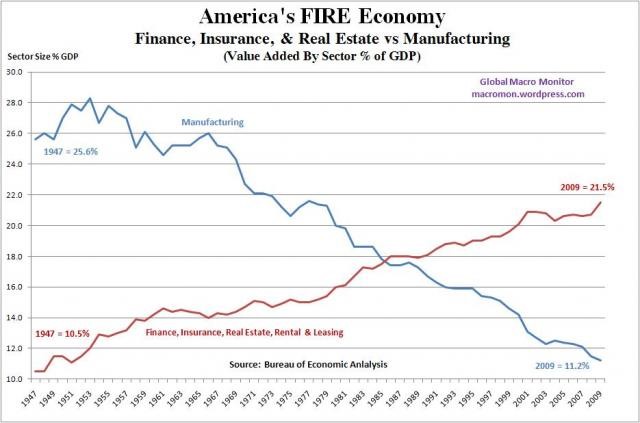
    The persistent US trade deficit with China implies that US consumers are able to buy cheaper goods from China. But it is also a signal of the erosion of the US global geopolitical dominance caused by economic decline. In the US economy financial goods are replacing physical goods. The chart below shows the increase in the financial component of US GDP relative to manufacturing.

    Americasfireeconomy

    (c) Rasheed Griffith

    Stock market capitalization of the US relative to GDP is 153%. For China it is 65% and Germany 54%. I am familiar with arguments that claim this is not problematic because countries trust the US markets most.

    The 2008 financial crisis gave a glimpse of what could happen to the US economy if the financial sector collapsed.

    The US government was barely able to patch up the financial markets by using excessive money creation and debt redistribution (i.e quantitative easing) in 2008. This was a necessary move but it means the Federal Reserve System balance sheet is now bloated. In another crisis, quantitative easing will likely not be effective. At that point, the money and capital markets of the US will no longer be as attractive in the long term, resulting in the dollar losing its global reserve currency status. At this point, the geopolitical dominance of US will weaken. And the main adversary (which is now China) will strive to make sure the US remains in a weakened position.

    Very few people seem to understand this. But the Communist Party of China (CCP) understands. In 1999, two colonels of the People’s Liberation Army published Unrestricted Warfare[1]. The book gave strategies for defeating the USA without direct conventional military engagement. One of the core strategies was the use economic policies to eat away at the US economy. Having China being the core manufacturing hub of the world was one such strategy. This was made explicit with the ‘Made in China 2025’ policy recently launched by the CCP[2].

    China did not achieve its spectacular growth through free trade. All of China’s trade is managed by the CCP. When discussing the USA-China trade relationship we must always acknowledge that China has an authoritarian government that will create and implement policies that they believe will benefit China irrespective of what the Chinese citizens think or what multilateral organizations demand. When China ascended to the WTO in 2001 it was naively expected that China would conform to the rules of that organization. Authoritarian governments, however, do not follow neoliberal rules.

    Starting around 1978 under Deng Xiaoping, the CCP began their reforms from Soviet style system wide planning to state capitalism directed by large and powerful state owned enterprises (SOEs)[3]. Although China ascended to the WTO in 2001, this model never changed. On the Fortune 500 list of largest global companies, China comes in a close second (120) behind the US (126). Japan (52) is quite far behind. But what is shocking is that 93% of the Chinese firms on the list are SOEs. The CCP heavily subsidies their SOEs, and creates rules specifically favorable to them; to the detriment of foreign entities.

    The USTR Section 301 report identified several instances where China has violated the WTO rules to which it signed in 2001. These concern trading rights, import regulations, export regulations, intellectual property rights, technology transfer, foreign investment, and so on[4]. The US has complained to the WTO about China on 22 occasions and China has still persisted in violating the rules. The White House Office of Trade and Manufacturing report goes on the dissect the persistent economic aggressions of China[5].

    What choice does the US have if it is not able to deal with China through WTO processes? Multilateral processes only work if everyone agrees to adhere to the same rules. Of course , though, these rules were largely set by the US. In dealing with China, the WTO is absolutely ineffective. There is no democratic fallout if China refuses to acknowledge multilateral rules (as seen explicitly in China’s absolute refusal to acknowledge the Philippine’s win in the Hague in matter of the West Philippines Sea/South China Sea). It is likely that any strong ruling in the WTO against China will similarly fall on deaf ears. (Similarly the US has substantially disregarded a WTO ruling after losing a case to Antigua).

    In any case, it has gotten to a point where countries cannot simply halt or significantly decrease trade with China in the form of sanctions. The US, then, is forced to use geoeconomics – the use of economic instruments to further geopolitical goals.

    As the President of the United States, Trump is right to engage China directly. His strategy is clever: robe a geostrategic containment engagement in bland terms of trade rhetoric. And this is by no means outside the modus operandi of the US. During the Cold War period the US actively practised a strategy of containment against the Soviet Union. In fact, China has accused the US of trying to economically contain China[6]. But of course, China has been engaging in geoeconomics as well recently.

    For example, in 2012 China allowed farmers from the Phillipines to export their bananas to China but when the bananas arrived they were left to rot on the dock. This left the Philippines banana planters with neither stock nor payment (30% of Philippines banana exports go to China). This was used as a tactic to weaken the Philippines position when the tensions over the South China Sea were rising[7]. Another example is when China blocked rare earth metals to Japan almost crippling Japanese tech manufacturing, until Japan finally conceded, over another maritime dispute[8]. In both cases, the WTO was impotent.

    What Trump gets wrong is that tariffs are not sufficient. And he failed to properly define a long term strategy to deal with China. Without such a strategy the US will continue ad hoc aggressions.

    China has been shown to disregard all multilateral rules if it wants to. But even so, it is difficult being upset with China. China has succeeded in the most comprehensive and rapid poverty alleviation program in all of human history. China was able to lift over 600 million people out of poverty in less than 30 years[9]. Following along this path, it should be expected that the CCP is mounting a restoration of China to compensate for its decline after the late 1850s: the “century of humiliation[10]”. Few commentators remember that for 18 of the last 20 centuries China commanded a greater share of world GDP that any other country. Henry Kissinger reminds us that as recent as 1820 China “produced over 30% of world GDP – an amount exceeding the GDP of Western Europe, Eastern Europe, and the United States combines.”[11]

    Wang Yi, however, recently attempted to assure the UN that China has no ambition of hegemonic dominance[12]. I believe that is an empty statement given Xi Jinping’s expansive Belt and Road Initiative (BRI) which has been added to the Party constitution of the CCP[13]. From the perspective of CCP, as Lee Kuan Yew frames it, China is not looking to become dominant; rather, it is looking to restore dominance. It is a different geopolitical mindset.

    This to me is the crux of the Sino-American challenge. The US is right that China is not properly following WTO rules because it has disregarded many of those rules to accelerate its economic growth. And it has been exceedingly effective. But if China were to conform to the WTO rules, it would not match the model that has been so successful.

    Multilateral trade rules were not designed by China to fit China’s model (authoritarian government, state capitalism). They were primarily designed by liberal democracies – the US in particular. Both of these nations have fundamentally different economic models and justifiable geopolitical reasons for disregarding WTO rules to protect (or increase) their geopolitical dominance.

    We are living in a time of multilateralism. But this time is anomalous. Dani Rodrik has explained in detail why “free trade agreements” have little to do with free trade[14]. Those agreements are primarily political documents. In fact, “76 percent of existing preferential trade agreements covered at least some aspect of investment (such as free capital mobility) by 2011; 61 percent covered intellectual property rights protection; and 46 percent covered environmental regulations”[15]. These are political documents that attempt to alter a nation’s domestic policies with the preferences of international actors.

    This is not possible with a powerful authoritarian government. It is a grave error to treat China as just another Western country; like how you would treat Japan. China is an ideological adversary to the US that has now become an economic adversary. When at odds with geopolitical motives multilateralism always fails. Geoeconomic escalation is not only justified but it is inevitable.

    Rasheed Griffith’s professional interests include Southeast Asian Monetary Policy and AML Compliance. He may be contacted at rasheed.j.griffith AT gmail.com. You can also follow him on Twitter at @RasheedGriffith

    The views and opinions expressed herein are solely those of the guest author and are not necessarily representative of those of the Caribbean Trade Law & Development Blog.

    [1] http://www.c4i.org/unrestricted.pdf

    [2] https://supchina.com/2018/06/28/made-in-china-2025/

    [3] https://orca.cf.ac.uk/99467/1/Publication_2016_IJEMSc.pdf

    [4] https://ustr.gov/sites/default/files/Section%20301%20FINAL.PDF

    [5] https://www.whitehouse.gov/wp-content/uploads/2018/06/FINAL-China-Technology-Report-6.18.18-PDF.pdf

    [6] http://www.atimes.com/article/us-tariffs-are-containment-beijings-message-fed-by-the-white-house/

    [7] https://www.asiasentinel.com/society/the-china-philippine-banana-war/

    [8] https://www.nytimes.com/2010/09/23/business/global/23rare.html

    [9] https://en.wikipedia.org/wiki/Poverty_in_China#Poverty_reduction

    [10] https://www.theatlantic.com/china/archive/2013/10/how-humiliation-drove-modern-chinese-history/280878/

    [11] https://www.amazon.com/China-Henry-Kissinger/dp/0143121316

    [12] http://usa.chinadaily.com.cn/a/201809/30/WS5bafb647a310eff303280520.html

    [13] https://idsa.in/idsacomments/what-the-inclusion-of-bri-in-the-chinese-constitution-implies_jpanda_071117

    [14]https://drodrik.scholar.harvard.edu/files/dani-rodrik/files/what_do_trade_agreements_really_do.pdf

    [15] Limão, Nuno. 2016. “Preferential Trade Agreements.” NBER Working Paper 22138, March