Tag: US

  • COVID-19: The Push to Conflict

    COVID-19: The Push to Conflict

    Renaldo Weekes, Guest Contributor

    Renaldo Weekes

    The novel Coronavirus disease (COVID-19): a common threat that has united the world in unprecedented ways. As the pandemic rages on, however, some are getting anxious and want answers. United States (US) officials have accused China of mismanaging the coronavirus response and allege that it originated in a Chinese lab. China responded with allegations that the US military planted the virus in Wuhan. 

    The possibility for escalation is nigh as US President Donald Trump reportedly suggested that China may be punished for its alleged impropriety through new tariffs, sanctions and the lifting of sovereign immunity. As the US seeks to punish China, one wonders what the effects may be on the wider world.

    The Global Economy

    The tariffs being floated by the Trump administration as possible punishments will stifle the global economy since, being the world’s two largest economies, the US and China are very much intertwined in the global economy. Consideration must also be given to how China will retaliate to the tariffs.

    Tariffs, essentially being a tax on imported goods, will make goods more expensive at a time when many businesses and consumers cannot absorb such a cost. What little spending power exists will diminish, further pushing the economy downward. The global economy’s recovery rate will be restricted as supply chains will slowly regain traction amidst low numbers of buyers and sellers. Shocks will hit small open economies especially hard as they greatly depend on foreign production that travels through the US. It is still left to be seen if the US will follow through with such plans however.

    Sanctions have more versatility in the sense that they can be applied to certain businesses or individuals within the US banking system. This is effective because the US has a long reach in the world’s financial system. However, depending on where those sanctions are applied, there could be some disruption in the global supply chain because, as mentioned earlier, China is intertwined in the global system. Again, small open economies that regularly do business with China will be in trouble.

    The lifting of state sovereign immunity allows American citizens and the American Government to sue China for COVID-related issues. Removal of sovereign immunity may have at least two effects. First, it allows the US wants to fight China with its own rules by allowing lawsuits. Secondly, if state-owned or state-related Chinese businesses in US jurisdictions are entangled in lawsuits, China will have to decide if staying in the US is worth the retaliatory lawsuits or risk relocation which may cause disruptions in supply chains.

    Political

    Considering the implications of this clash to the wider world, both parties have been working to push their narrative to their partners for support. This puts a number of countries with mutual relationships in an awkward position as they must now play chess with their words and actions which, as seen through Australia and the European Union (EU), is quite difficult. 

    Australia has, just like the US, called for an investigation into the virus’s origins but has stopped short of saying the virus came from a lab. To China, not overtly opposing those claims is implicit support of the US’ claims and in response, Chinese Ambassador to Australia Cheng Jingye suggested a possible shift in trade relations between the two countries. Acting on those words, China has suspended beef imports from Australia. This underscores China’s willingness to use its economic might against countries politically opposed to it. Such tactics may hurt Australia as China accounts for 36 percent of Australia’s total annual exports. Though both countries claim that the issue is separate from the pandemic, it is hard to defend that point considering the veiled threat laid by the Chinese ambassador. One must ask whether it is possible to separate the two incidents or if it would have happened but for the call for an investigation.

    The EU has been under the spotlight for editing a report related to disinformation campaigns by China to appease China and for allowing China to censor an opinion piece written by the EU’s ambassador to China. The EU’s move is seen as bending more toward China by editing its report and allowing China to censor its piece. Added to this is reporting that the European External Action Service (EEAS), responsible for the bloc’s foreign policy, has been rife with problems related to each EU member state wanting to follow its own agenda. This suggests no real coordinated effort toward handling the issue and a weakening of the EU’s position as this may, theoretically, give China an opening to further cement this divide.

    Despite what may appear to be the case, EU member states have stood up to China. It is reported that China attempted to encourage German Government officials to make positive spins on how it has been handling the virus but it was quickly shot down. France hastily summoned its Chinese ambassador when a Chinese diplomat wrote a piece criticising Western countries on their treatment of the elderly. President of France Emmanuel Macron and German chancellor Angela Merkel have both called for investigations into the origins of the virus but, similar to Australia, have not claimed that the virus came from a lab. Joined with that is the EU’s support of the US’ push for an investigation into the coronavirus’s origins at the WHO general assembly. These examples show that the EU is not necessarily bowing to China. Considering the historically friendly relationship between the two, the EU would not have the same motivation as the US to immediately dismiss China.

    Even the World Health Organisation (WHO)?

    The WHO itself has been dragged into the fray by the US as the Washington has suspended its WHO funding due to accusations that that UN agency facilitated China’s hiding of coronavirus statistics. Such an accusation suggests that the WHO abdicated its duty in order to appease China. The US’ actions also serve to weaken the WHO’s ability to help the world at large; more so those who cannot help themselves. Allowing a spat to spill over into the UN agency for health during a pandemic is seen by many critics as a way for the Trump administration to deflect any blame it is receiving for its handling of the virus domestically; especially since a Presidential election is due this November.

    Conclusion

    COVID-19 has led to a pandemic that took the world by surprise. Most people did not think that a virus in China would spread to the world. Nevertheless it has and people’s magnanimity has shown through like never before. However, it has devolved into a blame game between the world’s most powerful countries about how the pandemic started, capturing many other countries in the fray. But for the pandemic, would the US and China be in this situation? Probably not, but here we are. The only real way for this situation to stop is if the US recants or if China admits fault. At this point, neither seems likely. One can only hope that the war of words between the two countries does not escalate to a point of no return that drags the rest of the world down as a result.

    Renaldo Weekes is a holder of a BSc. (Sociology and Law) who observes international affairs from his humble, small island home. He has keen interest in how countries try to maneuver across the international political and legal stage.
  • US Request for CBERA Waiver Extension Approved by WTO General Council

    US Request for CBERA Waiver Extension Approved by WTO General Council

    Alicia Nicholls

    The World Trade Organization (WTO)’s General Council on October 16, 2019 approved the request by the United States (US) for a further extension of the waiver for the trade preferences it extends to certain Caribbean countries pursuant to the Caribbean Basin Economic Recovery Act (CBERA) of 1983 and its subsequent amendments.

    The CBERA is a major legislative component of the Caribbean Basin Initiative, a unilateral preferential programme operated by the US since the 1980s which extends duty-free treatment for most goods from beneficiary countries entering the US with the view to promoting economic development in the beneficiary countries. The programme is non-reciprocal as these countries are not required to extend similar treatment to US goods.

    Initially, the programme also included the Dominican Republic and several Central American countries as well, but these ceased being beneficiaries after entering into free trade agreements (FTAs) with the US.

    Seventeen Caribbean countries and territories currently benefit from the programme. These are: Antigua and Barbuda, Aruba, The Bahamas, Barbados, Belize, Curaçao, Dominica, Grenada, Guyana, Haiti, Jamaica, Montserrat, St. Kitts and Nevis, St. Lucia, St. Vincent and the Grenadines, Trinidad and Tobago, and the British Virgin Islands. Haiti also enjoys additional benefits under the Haitian Hemispheric Opportunity through Partnership Encouragement Act of 2006, the Haitian Hemispheric Opportunity through Partnership Encouragement Act of 2008, and the Haitian Economic Lift Program Act of 2010.

    Because the US only extends this preferential treatment to a select group of countries, the programme would be in violation of the non-discrimination principles undergirding the WTO, most specifically, paragraph 1 of Article I of the WTO’s General Agreement on Tariffs and Trade (GATT) which speaks to Most Favoured Nation treatment. The US has, therefore, had to request waivers of its obligations under paragraph 1 of Article I of the General Agreement on Tariffs and Trade 1994 (GATT 1994) and paragraphs 1 and 2 of Article XIII of the GATT 1994 in order to maintain the programme.

    The US first obtained a waiver under the GATT (precursor to the WTO) in 1985 and obtained subsequent waivers under the WTO. The previous waiver decision of May 5 2015 would have expired on December 31, 2019 . The current WTO waiver decision extends the waiver until September 2025.

    In the preamble to its decision, the General Council listed several factors it took into consideration. Among these were:

    • the exceptional situation of the CBERA and CBTPA beneficiary countries, and the stated objective of the CBERA as amended to assist the trade and economic development and recovery of Caribbean Basin countries by encouraging the expansion of productive capacity in those countries in response to more liberal access and to new trading opportunities;
    • the preferential treatment provided under the CBERA as amended will not alter benefits provided under the US Generalized System of Preferences to other developing countries; that the duty-free treatment provided under CBERA should not prejudice the interests of other Members not benefiting from such treatment, and that it is expected that the extension of such duty-free treatment will not cause a significant diversion of United States imports of products eligible under CBERA originating in Members who are not beneficiary countries;
    • assurances given by the United States that it will promptly enter into consultations, on request, with any interested Member with respect to any difficulty or matter that may arise as a result of the preferential treatment provided under the CBERA as amended.

    Under the waiver, the US is required to submit to the General Council an annual report on the implementation of the trade-related provisions of the CBERA with a view to facilitating the annual review provided for in paragraph 4 of Article IX of the WTO Agreement. It is also required to promptly notify the General Council of any trade-related measure taken under CBERA, in particular, any changes in the designation of beneficiary countries, as well as any modification being considered in the list of eligible products and the duty-free treatment provided. The US is also required to give the General Council all the information it may deem appropriate relating to such action. The United States is additionally required to consult with regard to any modification being considered in the list of eligible products

    In September, the US International Trade Commission recently released its biennial report on the programme’s operation. The report found that overall, the US’ total imports from CBERA countries grew from $5.8 billion in 2017 to $6.1 billion in 2018. This translates to an increase of 4.7 percent. Turning specifically to US imports under the CBERA programme, those grew from $1.5 billion in 2017 to $1.7 billion in 2018, an increase of 9.1 percent. US imports under CBERA accounted for 27.8 percent of all imports from CBERA beneficiaries.

    The waiver decision may be found on the WTO’s document’s portal.

    Alicia Nicholls, B.Sc., M.Sc., LL.B., is an international trade and development consultant with a keen interest in sustainable development, international law and trade. You can also read more of her commentaries and follow her on Twitter @LicyLaw.

    DISCLAIMER: All views expressed herein are her personal views and do not necessarily reflect the views of any institution or entity with which she may be affiliated from time to time.

  • US imports from Caribbean Basin Initiative beneficiaries grew in 2018

    US imports from Caribbean Basin Initiative beneficiaries grew in 2018

    The United States International Trade Commission (USITC) has released its twenty-fourth biennial report entitled “Caribbean Basin Economic Recovery Act: Impact on US Industries and Consumers and on Beneficiary Countries“.

    Seventeen Caribbean countries and territories currently benefit from duty-free access to the US market for many of their goods under the Caribbean Basin Economic Recovery Act (CBERA), one of the major pieces of legislation under the Caribbean Basin Initiative.

    The 150-page report dated September 2019 covers the period 2017-2018, but focuses mainly on data and developments from 2018.

    Below are some of the key findings from the report:

    The report found that overall, the US’ total imports from CBERA countries grew from $5.8 billion in 2017 to $6.1 billion in 2018. This translates to an increase of 4.7 percent. Turning specifically to US imports under the CBERA programme, those grew from $1.5 billion in 2017 to $1.7 billion in 2018, an increase of 9.1 percent. US imports under CBERA accounted for 27.8 percent of all imports from CBERA beneficiaries.

    It should be noted, however, that these increases were primarily due to higher U.S. imports of methanol (mainly from Trinidad & Tobago) and of textiles and apparel (mainly from Haiti).

    The report found that the CBERA’s impact on the U.S. economy “generally was negligible in 2017–18 and is likely to remain so”. According to the report, this is primarily because U.S. imports under CBERA comprise just 0.07 percent of total U.S. imports from the world.

    By contrast, the report noted that CBERA “continues to have a positive impact on a number of Caribbean Basin countries”. It singles out in particular Haiti as the “the greatest beneficiary of CBERA trade preferences in recent years” due primarily to more flexible rules of origin for apparel that country enjoys compared to other beneficiaries.

    It also found that CBERA has encouraged the development of niche product manufacturing in several other countries. The examples of polystyrene from The Bahamas and fruit juice from Belize were cited.

    The full USITC report may be read here.

    Alicia Nicholls, B.Sc., M.Sc., LL.B., is an international trade and development consultant with a keen interest in sustainable development, international law and trade. You can also read more of her commentaries and follow her on Twitter @LicyLaw.

    DISCLAIMER: All views expressed herein are her personal views and do not necessarily reflect the views of any institution or entity with which she may be affiliated from time to time.

  • The Sino-American Challenge to Multilateralism

    Rasheed J. Griffith, Guest Contributor

    Nations don’t trade. Metaphors can both clarify and deceive. Trade is no exception. The current commentary on trade relationships between nations has elevated the commercial profit-loss mechanisms of international trade to an abstract state level apparatus. When we say states trade what we really mean is the firms in different states have commercial relationships. Firms have a singular motive: to make profit. Similarly to making the individual-firm distinction, we must always remember to make the state-firm distinction. This distinction is further amplified when we are discussing large economy states. They too have a singular motive: geopolitical dominance.

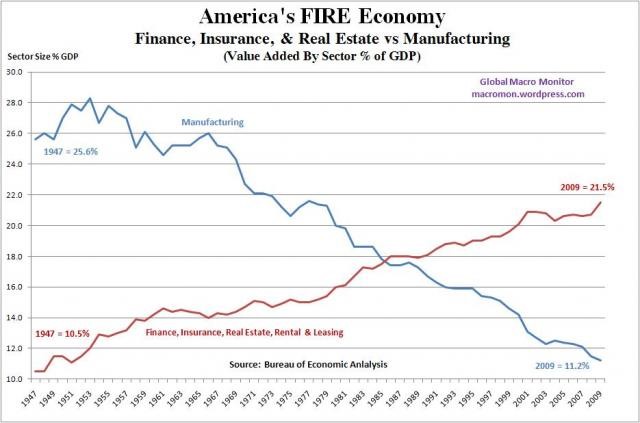
    The persistent US trade deficit with China implies that US consumers are able to buy cheaper goods from China. But it is also a signal of the erosion of the US global geopolitical dominance caused by economic decline. In the US economy financial goods are replacing physical goods. The chart below shows the increase in the financial component of US GDP relative to manufacturing.

    Americasfireeconomy

    (c) Rasheed Griffith

    Stock market capitalization of the US relative to GDP is 153%. For China it is 65% and Germany 54%. I am familiar with arguments that claim this is not problematic because countries trust the US markets most.

    The 2008 financial crisis gave a glimpse of what could happen to the US economy if the financial sector collapsed.

    The US government was barely able to patch up the financial markets by using excessive money creation and debt redistribution (i.e quantitative easing) in 2008. This was a necessary move but it means the Federal Reserve System balance sheet is now bloated. In another crisis, quantitative easing will likely not be effective. At that point, the money and capital markets of the US will no longer be as attractive in the long term, resulting in the dollar losing its global reserve currency status. At this point, the geopolitical dominance of US will weaken. And the main adversary (which is now China) will strive to make sure the US remains in a weakened position.

    Very few people seem to understand this. But the Communist Party of China (CCP) understands. In 1999, two colonels of the People’s Liberation Army published Unrestricted Warfare[1]. The book gave strategies for defeating the USA without direct conventional military engagement. One of the core strategies was the use economic policies to eat away at the US economy. Having China being the core manufacturing hub of the world was one such strategy. This was made explicit with the ‘Made in China 2025’ policy recently launched by the CCP[2].

    China did not achieve its spectacular growth through free trade. All of China’s trade is managed by the CCP. When discussing the USA-China trade relationship we must always acknowledge that China has an authoritarian government that will create and implement policies that they believe will benefit China irrespective of what the Chinese citizens think or what multilateral organizations demand. When China ascended to the WTO in 2001 it was naively expected that China would conform to the rules of that organization. Authoritarian governments, however, do not follow neoliberal rules.

    Starting around 1978 under Deng Xiaoping, the CCP began their reforms from Soviet style system wide planning to state capitalism directed by large and powerful state owned enterprises (SOEs)[3]. Although China ascended to the WTO in 2001, this model never changed. On the Fortune 500 list of largest global companies, China comes in a close second (120) behind the US (126). Japan (52) is quite far behind. But what is shocking is that 93% of the Chinese firms on the list are SOEs. The CCP heavily subsidies their SOEs, and creates rules specifically favorable to them; to the detriment of foreign entities.

    The USTR Section 301 report identified several instances where China has violated the WTO rules to which it signed in 2001. These concern trading rights, import regulations, export regulations, intellectual property rights, technology transfer, foreign investment, and so on[4]. The US has complained to the WTO about China on 22 occasions and China has still persisted in violating the rules. The White House Office of Trade and Manufacturing report goes on the dissect the persistent economic aggressions of China[5].

    What choice does the US have if it is not able to deal with China through WTO processes? Multilateral processes only work if everyone agrees to adhere to the same rules. Of course , though, these rules were largely set by the US. In dealing with China, the WTO is absolutely ineffective. There is no democratic fallout if China refuses to acknowledge multilateral rules (as seen explicitly in China’s absolute refusal to acknowledge the Philippine’s win in the Hague in matter of the West Philippines Sea/South China Sea). It is likely that any strong ruling in the WTO against China will similarly fall on deaf ears. (Similarly the US has substantially disregarded a WTO ruling after losing a case to Antigua).

    In any case, it has gotten to a point where countries cannot simply halt or significantly decrease trade with China in the form of sanctions. The US, then, is forced to use geoeconomics – the use of economic instruments to further geopolitical goals.

    As the President of the United States, Trump is right to engage China directly. His strategy is clever: robe a geostrategic containment engagement in bland terms of trade rhetoric. And this is by no means outside the modus operandi of the US. During the Cold War period the US actively practised a strategy of containment against the Soviet Union. In fact, China has accused the US of trying to economically contain China[6]. But of course, China has been engaging in geoeconomics as well recently.

    For example, in 2012 China allowed farmers from the Phillipines to export their bananas to China but when the bananas arrived they were left to rot on the dock. This left the Philippines banana planters with neither stock nor payment (30% of Philippines banana exports go to China). This was used as a tactic to weaken the Philippines position when the tensions over the South China Sea were rising[7]. Another example is when China blocked rare earth metals to Japan almost crippling Japanese tech manufacturing, until Japan finally conceded, over another maritime dispute[8]. In both cases, the WTO was impotent.

    What Trump gets wrong is that tariffs are not sufficient. And he failed to properly define a long term strategy to deal with China. Without such a strategy the US will continue ad hoc aggressions.

    China has been shown to disregard all multilateral rules if it wants to. But even so, it is difficult being upset with China. China has succeeded in the most comprehensive and rapid poverty alleviation program in all of human history. China was able to lift over 600 million people out of poverty in less than 30 years[9]. Following along this path, it should be expected that the CCP is mounting a restoration of China to compensate for its decline after the late 1850s: the “century of humiliation[10]”. Few commentators remember that for 18 of the last 20 centuries China commanded a greater share of world GDP that any other country. Henry Kissinger reminds us that as recent as 1820 China “produced over 30% of world GDP – an amount exceeding the GDP of Western Europe, Eastern Europe, and the United States combines.”[11]

    Wang Yi, however, recently attempted to assure the UN that China has no ambition of hegemonic dominance[12]. I believe that is an empty statement given Xi Jinping’s expansive Belt and Road Initiative (BRI) which has been added to the Party constitution of the CCP[13]. From the perspective of CCP, as Lee Kuan Yew frames it, China is not looking to become dominant; rather, it is looking to restore dominance. It is a different geopolitical mindset.

    This to me is the crux of the Sino-American challenge. The US is right that China is not properly following WTO rules because it has disregarded many of those rules to accelerate its economic growth. And it has been exceedingly effective. But if China were to conform to the WTO rules, it would not match the model that has been so successful.

    Multilateral trade rules were not designed by China to fit China’s model (authoritarian government, state capitalism). They were primarily designed by liberal democracies – the US in particular. Both of these nations have fundamentally different economic models and justifiable geopolitical reasons for disregarding WTO rules to protect (or increase) their geopolitical dominance.

    We are living in a time of multilateralism. But this time is anomalous. Dani Rodrik has explained in detail why “free trade agreements” have little to do with free trade[14]. Those agreements are primarily political documents. In fact, “76 percent of existing preferential trade agreements covered at least some aspect of investment (such as free capital mobility) by 2011; 61 percent covered intellectual property rights protection; and 46 percent covered environmental regulations”[15]. These are political documents that attempt to alter a nation’s domestic policies with the preferences of international actors.

    This is not possible with a powerful authoritarian government. It is a grave error to treat China as just another Western country; like how you would treat Japan. China is an ideological adversary to the US that has now become an economic adversary. When at odds with geopolitical motives multilateralism always fails. Geoeconomic escalation is not only justified but it is inevitable.

    Rasheed Griffith’s professional interests include Southeast Asian Monetary Policy and AML Compliance. He may be contacted at rasheed.j.griffith AT gmail.com. You can also follow him on Twitter at @RasheedGriffith

    The views and opinions expressed herein are solely those of the guest author and are not necessarily representative of those of the Caribbean Trade Law & Development Blog.

    [1] http://www.c4i.org/unrestricted.pdf

    [2] https://supchina.com/2018/06/28/made-in-china-2025/

    [3] https://orca.cf.ac.uk/99467/1/Publication_2016_IJEMSc.pdf

    [4] https://ustr.gov/sites/default/files/Section%20301%20FINAL.PDF

    [5] https://www.whitehouse.gov/wp-content/uploads/2018/06/FINAL-China-Technology-Report-6.18.18-PDF.pdf

    [6] http://www.atimes.com/article/us-tariffs-are-containment-beijings-message-fed-by-the-white-house/

    [7] https://www.asiasentinel.com/society/the-china-philippine-banana-war/

    [8] https://www.nytimes.com/2010/09/23/business/global/23rare.html

    [9] https://en.wikipedia.org/wiki/Poverty_in_China#Poverty_reduction

    [10] https://www.theatlantic.com/china/archive/2013/10/how-humiliation-drove-modern-chinese-history/280878/

    [11] https://www.amazon.com/China-Henry-Kissinger/dp/0143121316

    [12] http://usa.chinadaily.com.cn/a/201809/30/WS5bafb647a310eff303280520.html

    [13] https://idsa.in/idsacomments/what-the-inclusion-of-bri-in-the-chinese-constitution-implies_jpanda_071117

    [14]https://drodrik.scholar.harvard.edu/files/dani-rodrik/files/what_do_trade_agreements_really_do.pdf

    [15] Limão, Nuno. 2016. “Preferential Trade Agreements.” NBER Working Paper 22138, March