Tag: WTO

  • Why WTO Reform Matters for Caribbean Small States

    Why WTO Reform Matters for Caribbean Small States

    Alicia Nicholls

    At the conclusion of its 47th Meeting this week, the Caribbean Community (CARICOM) Council for Trade and Economic Development (COTED) released a statement in support of the multilateral trading system and its guardian, the World Trade Organisation (WTO), which are currently under threat. All independent CARICOM member States, with the exception of the Bahamas which is currently in the process of accession, are WTO members and have a rich history of engagement in the WTO. WTO reform is more than a moot point for the Caribbean, but a question of economic and sustainable development importance for the region.

    What is the Multilateral Trading System and the WTO?

    The multilateral trading system was formed at the end of the Second World War with the creation of the General Agreement on Tariffs and Trade (GATT), the progenitor to the WTO, in 1947. This rules-based system has provided for the predictable and peaceful conduct of global trade for more than a half century to the benefit of the global economy.

    Since its inception in 1995, the WTO has been the guardian of the multilateral trading system. Its 164 members account for over 97% of global trade, with 22 other countries currently in the accession process. Despite its flaws, some of which I will come to shortly, the WTO has been an important building block in the global economic governance structure. Among its functions, the organisation serves not just as a permanent forum for negotiation of global trading rules among its members, but its dispute settlement system provides to WTO members an exclusive and compulsory system for the timely and orderly settlement of trade disputes.

    Why the need for reform?

    The core functions of the WTO have become increasingly under strain. Calls for reform are not new, but have intensified in recent years. Without doubt, the United States’ threat of withdrawal unless its own demands are met, has invigorated political will for reform of the WTO.

    Firstly, the negotiation function of the WTO is in a paralytic state given the inability of member states to conclude the Doha Development Agenda – the latest round of trade negotiations which were launched at the Doha Ministerial in 2001 and whose only major agreement so far is the Trade Facilitation Agreement. The paralysis has been due largely to current decision-making procedures and the increased number of members which has made multilateral rule-making on ever more complex trade issues difficult. Secondly, the US has been blocking the appointment of judges to the WTO’s Appellate Body, which means there are currently only three judges, the minimum needed to hear a dispute. The once vaunted system will grind to a halt by December 2019 when two other judges’ terms are up for renewal. Thirdly, there are concerns with the lack of compliance by some States with notification and transparency requirements which impacts on the WTO’s monitoring function.

    In response, many countries have not just pivoted their attention away from the multilateral table towards the regional arena, but there is growing protectionism and resort to unilateral measures. In its latest economic outlook released November 21st , the Organisation for Economic Cooperation and Development (OECD) warned that global GDP growth has peaked on the back of a slowdown in global trade and investment flows owing to current trade tensions. The OECD has, therefore, called for renewed international cooperation and dialogue to tackle global trade issues and reform of the global trading system. Similar warnings have been made by other multilateral institutions and bring into sharp focus the importance of the stability of the multilateral trading system for the global economy in general, and for Caribbean small states, in particular, whose small open economies are susceptible to global economic shocks.

    These systemic risks suggest that the WTO requires more than superficial tinkering, but comprehensive, inclusive and transparent reform. The challenge is making the WTO, an institution born in a different era and different economic landscape, “fit for purpose” for twenty-first century global trading realities, and in a way that caters to the unique needs of its smallest and most vulnerable members.

    Why does WTO reform matter to Caribbean small States?

    Caribbean small states, and small States in general, comprise only a tiny fraction of world trade, but their equitable integration into the global economy is essential for their economic survival. These States comprise primarily small island States, but also some small continental States. Compromised by limited bargaining power and inherent economic and other vulnerabilities, they depend on the certainty and predictability of the rules-based multilateral trading system not just to ensure that their traders face fair trading conditions in external markets, but that they could hold (at least in theory) larger states to account through the WTO’s dispute settlement body when they do not play by the rules.

    It is of importance to Caribbean small States that updated trade rules for the twenty-first century not be made in negotiation theatres to which they are often not party (such as in Regional Trade Agreements and Mega-Regional Trade Agreements), but in the multilateral system where they have an equal seat at the table.

    What proposals are on the table?

    Thankfully, the silver lining to this story is that most WTO members have thus far expressed continued support for the multilateral trading system and have exhibited interest in WTO reform. The EU and Canada have both publicly shared their initial reform proposals and Canada held a meeting with thirteen other ‘like-minded’ governments in Ottawa to discuss WTO reform. The proposals have touched, for example, on decision and rule-making, improving the dispute settlement function and improving transparency and notification requirements.

    In November 2018, the US, EU, Japan, Argentina and Costa Rica laid a proposal for tightening transparency and notification requirements under the WTO agreements. Among the recommendations were changes to the current Trade Policy Review mechanism, special consideration for developing countries and penalties for non-compliance by members.

    Many of the proposals currently on the table have direct implications for Caribbean small States. For example, the EU and Canadian proposals evince growing appetite by the more advanced economies to change the current model of decision-making, that is, the consensus-based approach which requires absence of any formal objection to the decision. This approach has made the WTO one of the most democratic of the multilateral economic institutions. It allows small States to have bargaining power they otherwise would not have had and by mere numbers has led to a shift in the balance of bargaining power in favour of developing countries in the WTO. Though this approach has accounted for some of the stalemate, the wholesale move to a less democratic form of decision making would be disadvantageous to small States beset by limited negotiation might.

    There are also calls for reforming the application of special and differential treatment (SDT) since currently any WTO member can self-designate as a developing country, entitling it to the flexibilities under the Agreements. This concern is due to the inclusion of large emerging economies such as China, India and Brazil in particular as developing countries. While not specifically supporting the creation of special categories, the EU concept paper notes the lack of nuance in the concept of a ‘developing country’. This is a good reason why small States should redouble their advocacy efforts for the translation of the Small Vulnerable Economy (SVE) informal group into a formal sub-category of developing countries.

    What should we do?

    The current crisis in the multilateral trading system has implications for Caribbean small states which rely on the certainty of the multilateral trading system and on the health of the global economy. It, however, also opens the door for our States to advocate for reforms as well. CARICOM countries have always played an active role in WTO negotiations, including pushing for the SVE grouping. For this reason, the COTED statement supporting the multilateral trading system and the WTO, and demanding a space for small States in the negotiations, was a good initial step.

    The next step should entail formulating our own carefully considered responses to the proposals already on the table and advancing our own concrete proposals where we deem necessary. For instance, as noted before, given the dissatisfaction by advanced economies with the current carte blanche approach to SDT, this may be the opportune time to raise the reconsideration of making the SVE category a formal category. Additionally, as the on-going US-Antigua Gambling dispute shows, even though a small State may win a dispute, obtaining compliance is another matter. For this reason, dispute settlement reform is another area on which Caribbean small States should take particular interest.

    Indeed, CARICOM governments will not have to depend solely on the vast knowledge and experience of their technocrats, but there are an increasing number of regional scholars and academic institutions, such as the University of the West Indies’ Shridath Ramphal Centre for International Trade Law, Policy & Services, which are pro-actively considering these issues, and whose technical expertise and research capacity could be drawn upon. There is also no need to reinvent the wheel given the growing corpus of literature, developed by the Commonwealth Secretariat for example, which has analysed the drawbacks of the WTO for small States and making proposals for reform. This work can be drawn upon in the formulation of our own proposals.

    The Caribbean has a strong history of multilateral engagement within the WTO. The current situation gives us an appropriate moment to contribute to the comprehensive reform of the guardian of the multilateral trading system to ensure it remains fit for purpose for 21st century trading realities and for the global economy, and that it better serves its smallest and most vulnerable members. Caribbean small States can ill-afford to be perceived as backseat participants, but must be fully engaged and mobilized in this critical moment.

    Alicia Nicholls, B.Sc., M.Sc., LL.B., is an international trade and development consultant with a keen interest in sustainable development, international law and trade. You can also read more of her commentaries and follow her on Twitter @LicyLaw.
  • If you take away multilateralism, who will hear us?

    If you take away multilateralism, who will hear us?

    Alicia Nicholls

    The title of this week’s article is borrowed from the impromptu but impassioned appeal made by Prime Minister of Barbados, the Hon. Mia Amor Mottley, QC, MP, in her maiden address on September 28th during the General Debate of the 73rd Session of the United Nations General Assembly (UNGA). With only one notable exception, support for multilateralism was a common thread linking the speeches given by world leaders during the General Debate.

    Perhaps the most compelling case for multilateralism was that made by Foreign Minister of Singapore, Dr. Vivian Balakrishnan. While warning that multilateralism was at a crossroads and was facing a crisis of confidence, Foreign Minister Balakrishnan made an articulate case for the indispensability of multilateralism to the global community, especially to small states.

    Indeed, multilateralism affords small states a microphone that they would otherwise lack on the international stage. Despite the successes of the rules-based multilateral system, there are widening cracks in the system. These require immediate remedial action to enhance the system’s structural integrity to withstand the threat of creeping unilateralism, and to more effectively serve the needs of the global community in a changing geopolitical and economic world.

    What is multilateralism?

    Multilateralism, in the most rudimentary sense, refers to cooperation among three or more nation states to achieve a common goal. In contrast to the current isolationist US government stance, previous US governments were central to the establishment of the present-day multilateral system, which bears their footprint.

    The modern day multilateral system was fashioned in the wake of the Second World War (1939-1945) with the aim of promoting global peace and stability. It was based on the liberal theory of international relations which posited, inter alia, that states which cooperate would not resort to war. It was in that immediate post-war era that the United Nations, the progeny of the League of Nations (1920-1946), was formed in 1945. The Bretton Woods institutions (the International Monetary Fund and the World Bank), the watchdogs of the global economic order, were established at a conference held in Brettons Woods, New Hampshire, US in 1944.

    Multilateralism recognizes that no one Government alone can handle the growing plethora of challenges confronting the global community, and that by pooling resources, wisdom and ideas through shared institutions, optimum solutions could be found. In the years that followed, a spaghetti bowl of multilateral organisations has flourished in areas as diverse as health, telecommunications, the environment, migration, international transportation, labour, among others.

    With respect to trade governance, an attempt was made by a US-led group of countries to establish an International Trade Organisation (ITO) in the mid 1940s but failed after the US Congress repeatedly declined to approve the ITO Charter. As such, an informal organization known as the General Agreement on Tariffs and Trade (GATT) governed world trade from 1945 until January 1995 when the World Trade Organisation (WTO) came into being.

    Why Multilateralism Matters to Small States

    The majority of today’s developing countries were still colonies when many of these multilateral institutions were birthed. However, upon attaining independence, acceding to these institutions was viewed as a requisite rite of passage. This is particularly true for the world’s small states which have overwhelmingly been supporters of multilateralism.

    But why is that? Small states, with their diminutive economies and populations, weak political leverage and inherent vulnerabilities, would be the “bullied kids” in an anarchic global system where “might is right”. The rules-based multilateral system provides a buffer of stability and predictability for small states. Its norms-based system, undergirded by international law, helps to constrain and contain great power aggression. In a general sense, multilateral institutions provide some semblance of accountability for those States which contravene global norms. I say in a general sense as history has proven that this has not always been the case with big countries. In the area of trade, the WTO’s dispute settlement system gives small states the opportunity, at least in theory, to hold hegemons to account.

    Multilateral engagement gives small states, which would otherwise be Liliputians in the international system, a voice. Whereas by itself a small states’ voice is a little more than a squeak, by building coalitions small states have managed to achieve a roar on some issues. One of the most notable cases was the success of the Alliance of Small Island States (AOSIS) in the UNFCCC negotiations leading up to the signature of the Paris Climate Agreement during the COP21 in 2015. Though not perfect, that agreement is an important milestone in the fight against anthropogenic global warming.

    Small states have also been able to benefit from capacity building and technical assistance from multilateral institutions. An example is the research done by multilateral financial institutions on the issue of de-risking which has led to the loss of correspondent banking relations, with implications for these states’ financial sectors and commercial relations. In the wake of the financial crisis, several Caribbean countries, and most recently Barbados, have had to enter IMF structural adjustment programmes.

    Some small states have also played a key role in the establishment of multilateral institutions. Trinidad & Tobago was instrumental in pushing for the establishment of the International Criminal Court (ICC), and small states helped to push for the United Nations Convention on the Law of the Sea (UNCLOS). Moreover, small states have had some success in attaining high positions in international organisations.

    Why is Multilateralism Under Threat?

    Why is a system which has given the world relative peace and prosperity for some seventy years now facing what Singapore Foreign Minister Balakrishnan called a “crisis of confidence”? Questions about the efficacy and legitimacy of multilateral institutions have long been raised, but rising populism and anti-globalisation sentiment, in the wake of uneven recovery from the financial crisis has led to rising nationalism, xenophobia and unilateralism. Indeed, the recently published UNCTAD Trade and Development Report 2018 noted that trade tensions were a “symptom of a greater problem”, that is, failure to address rising global inequality and imbalances caused by “hyper-globalisation”.

    But many of the problems are not the fault of multilateralism but due to inappropriate policy responses by Governments and by disruptive technologies which have replaced labour with machines. As such, as noted by Foreign Minister Balakrishnan in his UNGA speech, it is up to governments to address this through retooling workers and reformulating their education systems to equip the next generation with the tools to exploit these technologies.

    Small states in their successive UNGA addresses have often expressed frustration at the slow pace of action on some fronts of concern to them, including financing for climate change. Antigua & Barbuda’s Prime Minister, Gaston Browne, voiced disappointment with his country’s inability to receive compensation from the US after the WTO dispute settlement body ruled in Antigua & Barbuda’s favour in the US Gambling dispute. Moreover, Caribbean leaders have frequently bemoaned the lack of support for discontinuing the use of GDP per capita as a basis against which to measure development status. This criterion has excluded middle and high income Caribbean countries from most concessional loans and official development assistance.

    Making Multilateralism Work Better

    The question is not whether multilateralism works, but how can it work better. There are legitimate concerns about whether today’s multilateral institutions, many of which were forged during different economic and geopolitical times, remain “fit for purpose” for today’s global realities and challenges. Former UN Secretary General, Kofi Annan recognised this when he asserted in 2002 that “the United Nations exists not as a static memorial to the aspirations of an earlier age but as a work in progress – imperfect as all human endeavours must be capable of adaptation and improvement.”

    On the trade front, for example, there have been increased calls for reform of the WTO. Several members, including the US, Canada and the EU, have made proposals for reform. As it stands, the WTO’s negotiation function remains in a state of paralysis, while the US blocking of the appointment of judges to its Appellate Body over the US government’s dissatisfaction with the dispute settlement system risks creating a crisis in that body’s ability to be an arbiter of trade disputes between WTO members. The renewed appetite for WTO reform provides a window of opportunity for small states to redouble their advocacy efforts for their own reform proposals, while making sure they are not excluded from having a seat at the table.

    There is the need to address democratic and transparency deficits within multilateral institutions. The configuration and operation of the UN Security Council, for example, stills reflects a geopolitical reality that no longer exists. Decisions made by the Paris-based Organisation for Economic Cooperation and Development (OECD), where developing states do not have a seat at the table, have had devastating consequences for the offshore financial services sectors of Caribbean states.

    Institutional reform would require, where feasible, strengthening the secretariats of these organisations to better serve the needs of member states, especially the most vulnerable. In addition to fostering a greater space for civil society to be heard in multilateral organizations, there should also be greater emphasis on building the capacity of small states to effectively participate in meetings and the day-to-day operations of these organisations.

    The challenges which face the world call for more multilateralism, not less. Multilateralism is important for achieving Agenda 2030, including the seventeen UN Sustainable Development Goals (SDGs). Multilateral institutions also have a pertinent role to play in developing rules to address emerging global issues. Singapore Foreign Minister Balakrishnan, for example, called for the UN to develop norms and rules for cybersecurity.

    In the past week alone, several events have further reiterated why multilateralism is needed now more than ever. One of which is the IPCC Special Report on Global Warming of 1.5ºC which showed that the world was already experiencing the effects of warming of 1.0 degrees Celsius above pre-industrial levels. The devastation caused by Hurricane Michael to the Florida Panhandle in the US this week reiterates the urgency of the need for redoubled climate action. Rising global trade tensions, protectionism and unilateralism have made trade top of mind for global economic leaders. In their communique released following the Annual Meetings of the Boards of the IMF and World Bank, it was specifically noted that the IMF would facilitate multilateral solutions for global challenges.

    Carrying on the multilateralism baton

    Prime Minister Mottley concluded her UNGA speech by asking “Will we carry and hand over to future generations, the baton left us by those who dreamed of a world of united nations or will we drop it?” For small states, it is important that we do not allow this baton to be dropped.

    Alicia Nicholls, B.Sc., M.Sc., LL.B., is an international trade and development consultant with a keen interest in sustainable development, international law and trade. You can also read more of her commentaries and follow her on Twitter @LicyLaw.

  • The Sino-American Challenge to Multilateralism

    Rasheed J. Griffith, Guest Contributor

    Nations don’t trade. Metaphors can both clarify and deceive. Trade is no exception. The current commentary on trade relationships between nations has elevated the commercial profit-loss mechanisms of international trade to an abstract state level apparatus. When we say states trade what we really mean is the firms in different states have commercial relationships. Firms have a singular motive: to make profit. Similarly to making the individual-firm distinction, we must always remember to make the state-firm distinction. This distinction is further amplified when we are discussing large economy states. They too have a singular motive: geopolitical dominance.

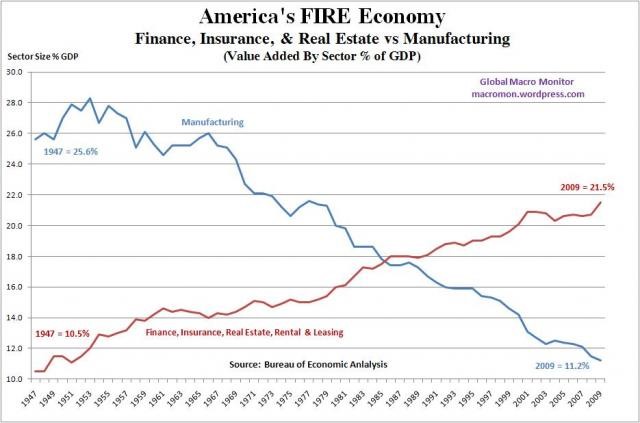
    The persistent US trade deficit with China implies that US consumers are able to buy cheaper goods from China. But it is also a signal of the erosion of the US global geopolitical dominance caused by economic decline. In the US economy financial goods are replacing physical goods. The chart below shows the increase in the financial component of US GDP relative to manufacturing.

    Americasfireeconomy

    (c) Rasheed Griffith

    Stock market capitalization of the US relative to GDP is 153%. For China it is 65% and Germany 54%. I am familiar with arguments that claim this is not problematic because countries trust the US markets most.

    The 2008 financial crisis gave a glimpse of what could happen to the US economy if the financial sector collapsed.

    The US government was barely able to patch up the financial markets by using excessive money creation and debt redistribution (i.e quantitative easing) in 2008. This was a necessary move but it means the Federal Reserve System balance sheet is now bloated. In another crisis, quantitative easing will likely not be effective. At that point, the money and capital markets of the US will no longer be as attractive in the long term, resulting in the dollar losing its global reserve currency status. At this point, the geopolitical dominance of US will weaken. And the main adversary (which is now China) will strive to make sure the US remains in a weakened position.

    Very few people seem to understand this. But the Communist Party of China (CCP) understands. In 1999, two colonels of the People’s Liberation Army published Unrestricted Warfare[1]. The book gave strategies for defeating the USA without direct conventional military engagement. One of the core strategies was the use economic policies to eat away at the US economy. Having China being the core manufacturing hub of the world was one such strategy. This was made explicit with the ‘Made in China 2025’ policy recently launched by the CCP[2].

    China did not achieve its spectacular growth through free trade. All of China’s trade is managed by the CCP. When discussing the USA-China trade relationship we must always acknowledge that China has an authoritarian government that will create and implement policies that they believe will benefit China irrespective of what the Chinese citizens think or what multilateral organizations demand. When China ascended to the WTO in 2001 it was naively expected that China would conform to the rules of that organization. Authoritarian governments, however, do not follow neoliberal rules.

    Starting around 1978 under Deng Xiaoping, the CCP began their reforms from Soviet style system wide planning to state capitalism directed by large and powerful state owned enterprises (SOEs)[3]. Although China ascended to the WTO in 2001, this model never changed. On the Fortune 500 list of largest global companies, China comes in a close second (120) behind the US (126). Japan (52) is quite far behind. But what is shocking is that 93% of the Chinese firms on the list are SOEs. The CCP heavily subsidies their SOEs, and creates rules specifically favorable to them; to the detriment of foreign entities.

    The USTR Section 301 report identified several instances where China has violated the WTO rules to which it signed in 2001. These concern trading rights, import regulations, export regulations, intellectual property rights, technology transfer, foreign investment, and so on[4]. The US has complained to the WTO about China on 22 occasions and China has still persisted in violating the rules. The White House Office of Trade and Manufacturing report goes on the dissect the persistent economic aggressions of China[5].

    What choice does the US have if it is not able to deal with China through WTO processes? Multilateral processes only work if everyone agrees to adhere to the same rules. Of course , though, these rules were largely set by the US. In dealing with China, the WTO is absolutely ineffective. There is no democratic fallout if China refuses to acknowledge multilateral rules (as seen explicitly in China’s absolute refusal to acknowledge the Philippine’s win in the Hague in matter of the West Philippines Sea/South China Sea). It is likely that any strong ruling in the WTO against China will similarly fall on deaf ears. (Similarly the US has substantially disregarded a WTO ruling after losing a case to Antigua).

    In any case, it has gotten to a point where countries cannot simply halt or significantly decrease trade with China in the form of sanctions. The US, then, is forced to use geoeconomics – the use of economic instruments to further geopolitical goals.

    As the President of the United States, Trump is right to engage China directly. His strategy is clever: robe a geostrategic containment engagement in bland terms of trade rhetoric. And this is by no means outside the modus operandi of the US. During the Cold War period the US actively practised a strategy of containment against the Soviet Union. In fact, China has accused the US of trying to economically contain China[6]. But of course, China has been engaging in geoeconomics as well recently.

    For example, in 2012 China allowed farmers from the Phillipines to export their bananas to China but when the bananas arrived they were left to rot on the dock. This left the Philippines banana planters with neither stock nor payment (30% of Philippines banana exports go to China). This was used as a tactic to weaken the Philippines position when the tensions over the South China Sea were rising[7]. Another example is when China blocked rare earth metals to Japan almost crippling Japanese tech manufacturing, until Japan finally conceded, over another maritime dispute[8]. In both cases, the WTO was impotent.

    What Trump gets wrong is that tariffs are not sufficient. And he failed to properly define a long term strategy to deal with China. Without such a strategy the US will continue ad hoc aggressions.

    China has been shown to disregard all multilateral rules if it wants to. But even so, it is difficult being upset with China. China has succeeded in the most comprehensive and rapid poverty alleviation program in all of human history. China was able to lift over 600 million people out of poverty in less than 30 years[9]. Following along this path, it should be expected that the CCP is mounting a restoration of China to compensate for its decline after the late 1850s: the “century of humiliation[10]”. Few commentators remember that for 18 of the last 20 centuries China commanded a greater share of world GDP that any other country. Henry Kissinger reminds us that as recent as 1820 China “produced over 30% of world GDP – an amount exceeding the GDP of Western Europe, Eastern Europe, and the United States combines.”[11]

    Wang Yi, however, recently attempted to assure the UN that China has no ambition of hegemonic dominance[12]. I believe that is an empty statement given Xi Jinping’s expansive Belt and Road Initiative (BRI) which has been added to the Party constitution of the CCP[13]. From the perspective of CCP, as Lee Kuan Yew frames it, China is not looking to become dominant; rather, it is looking to restore dominance. It is a different geopolitical mindset.

    This to me is the crux of the Sino-American challenge. The US is right that China is not properly following WTO rules because it has disregarded many of those rules to accelerate its economic growth. And it has been exceedingly effective. But if China were to conform to the WTO rules, it would not match the model that has been so successful.

    Multilateral trade rules were not designed by China to fit China’s model (authoritarian government, state capitalism). They were primarily designed by liberal democracies – the US in particular. Both of these nations have fundamentally different economic models and justifiable geopolitical reasons for disregarding WTO rules to protect (or increase) their geopolitical dominance.

    We are living in a time of multilateralism. But this time is anomalous. Dani Rodrik has explained in detail why “free trade agreements” have little to do with free trade[14]. Those agreements are primarily political documents. In fact, “76 percent of existing preferential trade agreements covered at least some aspect of investment (such as free capital mobility) by 2011; 61 percent covered intellectual property rights protection; and 46 percent covered environmental regulations”[15]. These are political documents that attempt to alter a nation’s domestic policies with the preferences of international actors.

    This is not possible with a powerful authoritarian government. It is a grave error to treat China as just another Western country; like how you would treat Japan. China is an ideological adversary to the US that has now become an economic adversary. When at odds with geopolitical motives multilateralism always fails. Geoeconomic escalation is not only justified but it is inevitable.

    Rasheed Griffith’s professional interests include Southeast Asian Monetary Policy and AML Compliance. He may be contacted at rasheed.j.griffith AT gmail.com. You can also follow him on Twitter at @RasheedGriffith

    The views and opinions expressed herein are solely those of the guest author and are not necessarily representative of those of the Caribbean Trade Law & Development Blog.

    [1] http://www.c4i.org/unrestricted.pdf

    [2] https://supchina.com/2018/06/28/made-in-china-2025/

    [3] https://orca.cf.ac.uk/99467/1/Publication_2016_IJEMSc.pdf

    [4] https://ustr.gov/sites/default/files/Section%20301%20FINAL.PDF

    [5] https://www.whitehouse.gov/wp-content/uploads/2018/06/FINAL-China-Technology-Report-6.18.18-PDF.pdf

    [6] http://www.atimes.com/article/us-tariffs-are-containment-beijings-message-fed-by-the-white-house/

    [7] https://www.asiasentinel.com/society/the-china-philippine-banana-war/

    [8] https://www.nytimes.com/2010/09/23/business/global/23rare.html

    [9] https://en.wikipedia.org/wiki/Poverty_in_China#Poverty_reduction

    [10] https://www.theatlantic.com/china/archive/2013/10/how-humiliation-drove-modern-chinese-history/280878/

    [11] https://www.amazon.com/China-Henry-Kissinger/dp/0143121316

    [12] http://usa.chinadaily.com.cn/a/201809/30/WS5bafb647a310eff303280520.html

    [13] https://idsa.in/idsacomments/what-the-inclusion-of-bri-in-the-chinese-constitution-implies_jpanda_071117

    [14]https://drodrik.scholar.harvard.edu/files/dani-rodrik/files/what_do_trade_agreements_really_do.pdf

    [15] Limão, Nuno. 2016. “Preferential Trade Agreements.” NBER Working Paper 22138, March

  • EU makes initial proposals for WTO modernization

    Alicia Nicholls

    The European Commission has released a concept paper outlining its initial proposals for making the WTO more relevant and adaptive to current global realities and for strengthening its effectiveness.

    The paper originates from a mandate given by the European Council to the European Commission. It was published days after G20 trade and investment ministers called for urgent WTO reform and a month after United States’ President Donald Trump renewed his desire to withdraw the US from the WTO. It also comes against the backdrop of an escalation in unilateralism as Washington readies to impose a further $200 billion in tariffs on Chinese goods imports.

    In the paper, the Commission reiterates the EU’s “staunch” support of the multilateral trading system, noting that the 164-member WTO was “indispensable in ensuring free and fair trade”. It warns, however, that the WTO is under threat. It notes that the organisation’s current marginalisation by some of its key members stem from its failure to “adapt sufficiently to the rapidly changing global economy”.

    The 17-page concept paper offers proposals under three key areas and is in effect three papers in one. These areas are: rulemaking and development, regular work and transparency and dispute settlement.

    The Commission recommends that the EU continue to the work on the issues under the existing Doha mandate, but also states there is urgent need to broaden the negotiating agenda, building on several initiatives launched at the Buenos Aires Ministerial held in December 2017. Lamenting the current inadequacy of the WTO’s Agreement on Subsidies and Countervailing Measures (SCM), the Commission calls for improved transparency and subsidy notifications, rules which better capture subsidies granted by state-owned enterprises and stricter rules for the most trade-distortive types of subsidies.

    The Commission recommends updating current trade rules on services and investment, and further reduce existing market access barriers and discriminatory treatment of foreign investors. One issue of which the Commission was particularly critical was the need to tighten rules on forced technology transfer – practices by some States which force foreign investors to directly or indirectly share their technological innovations with the State or domestic investors. Indeed, intellectual property rights issues are a major sore point between US and China trade relations.

    The Commission also sounds the alarm about the “grave danger” to the WTO’s dispute settlement system posed by the US’ blocking of Appellate Body judge appointments. By end of September, the Appellate Body would have only the minimum (just three judges on its roster) and by December 2019 will have less than the minimum required to hear an appeal as two more retire. As such, the Commission has made some initial proposals for amendments which would take into account many of the US’ concerns with the WTO dispute settlement system which had been outlined in the President’s Trade Policy Agenda for 2018. For example, the Commission has suggested amending the 90-days rule contained in Article 17.5 of the Dispute Settlement Understanding to provide for more transparency and consultation.

    The Commission has made clear that the proposals were meant to be a basis for discussion with the EU Parliament, the Council and other WTO members, and did not prejudice the EU’s final positions on the matters.

    The concept paper makes for an interesting read and may be viewed here.

    Alicia Nicholls, B.Sc., M.Sc., LL.B., is an international trade and development consultant with a keen interest in sustainable development, international law and trade. You can also read more of her commentaries and follow her on Twitter @LicyLaw.